New Semester
Started
Get
50% OFF
Study Help!
--h --m --s
Claim Now
Question Answers
Textbooks
Find textbooks, questions and answers
Oops, something went wrong!
Change your search query and then try again
S
Books
FREE
Study Help
Expert Questions
Accounting
General Management
Mathematics
Finance
Organizational Behaviour
Law
Physics
Operating System
Management Leadership
Sociology
Programming
Marketing
Database
Computer Network
Economics
Textbooks Solutions
Accounting
Managerial Accounting
Management Leadership
Cost Accounting
Statistics
Business Law
Corporate Finance
Finance
Economics
Auditing
Tutors
Online Tutors
Find a Tutor
Hire a Tutor
Become a Tutor
AI Tutor
AI Study Planner
NEW
Sell Books
Search
Search
Sign In
Register
study help
physics
college physics a strategic approach 2nd
College Physics Essentials Electricity And Magnetism Optics Modern Physics Volume Two 8th Edition Jerry D. Wilson, Anthony J. Buffa, Bo Lou - Solutions
10. What shape are the equipotential surfaces between two charged parallel plates?
9. Suppose a charge starts at rest on an equipotential surface, is moved off that surface, and is eventually returned to the same surface at rest after a round trip.How much work did it take to do this? Explain.
8. Explain physically why two equipotential surfaces cannot intersect.
7. Sketch the topographic map as you walk away from the ocean up a gently sloping uniform beach. Label the gravitational equipotentials showing how gravitational potential energy changes. Show how to predict, using your map, which way a ball accelerates if it is initially rolled up the beach (away
6. If two locations are at the same electrical potential, how much work does it take to move a charge from the first location to the second? Explain.
20. Explain clearly why the electric field between two parallel plates of a capacitor decreases when a dielectric is inserted if the capacitor is not connected to a power supply but remains the same when it is connected to a power supply.
8. IE •• According to the Bohr model of the hydrogen atom, the single electron can exist only in circular orbits of certain radii about a proton. (a) Will a larger orbit have (1) a higher, (2) an equal, or (3) a lower electric potential than a smaller orbit? Why? (b) Determine the potential
7. IE •• (a) At one-third the original distance from a positive point charge, by what factor is the electric potential changed: (1) 1/3, (2) 3, (3) 1/9, or (4) 9? Why?(b) How far from a +1.0-μC charge is a location that has an electric potential value of 10 kV? (c) How much of a change in
6. IE • Consider two points at different distances from a positive point charge. (a) The point closer to the charge is at a (1) higher, (2) equal, (3) lower potential than the point farther away. (b) How much different is the electric potential 20 cm from a charge of +5.5 μC compared to 40 cm
5. • (a) Repeat Exercise 4 using energy methods. Find the direction in which the electron is moving by considering electric potential energy changes. (b) Does the electron gain or lose electric potential energy?
4. • An electron is accelerated by a uniform electric field(E = 1000 V/m) vertically upward. Use Newton’s laws to find the electron’s velocity after it moves 0.10 cm from rest.
3. • It takes +1.6 × 10⁻⁵ J to move a positively charged particle between two oppositely charged parallel plates. (a) What is the charge on the particle if the plates are connected to a 6.0-V battery? (b) Was it moved from the negative to the positive plate or from the positive to the negative
24. You have N (an even number ≥ 2) identical capacitors, each with a capacitance of C. In terms of N and C, what is their total effective capacitance (a) if they are all in series? (b) If they are all in parallel? (c) If two halves(N/2 each) are connected in series and these two sets then
23. You are given two capacitors. How should you connect them to get (a) maximum equivalent capacitance and(b) minimum equivalent capacitance?
22. Under what conditions would two capacitors in parallel have the same charge on them? What if they were in series?
21. Under what conditions would two capacitors in series have the same voltage across them? What if they were in parallel?
5. An electron is released in a region where the electric potential is constant. Which way will the electron accelerate? Explain.
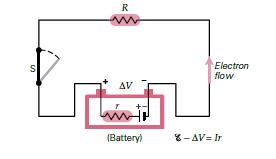
12. A real battery always has some internal resistance r that increases with the battery’s age (▼ Figure 17.16).Explain why, in a complete circuit connection, this results in a drop of the terminal voltage ΔV of the battery with time. R ww S AV Electron flow (Battery) %-AV-Ir
10. Filaments in lightbulbs usually fail just after the bulbs are turned on rather than when they have already been on for a while. Can you explain why?
9. Voltage is plotted on the vertical axis of a graph and current is plotted horizontally. For two ohmic resistors with different resistances, how could you tell from the graph which one is less resistive?
8. To move charges through a wire, a voltage must be placed between the ends of the wire. If the left side of the wire is at a higher potential than the right, the direction of the conventional current in the wire is (a) left to right, (b) right to left, or (c) it could be either (a) or (b)
7. In the battery design shown in Figure 17.1, how does the direction of current inside the battery compare to that in the wire connecting the electrodes?
6. The drift speed of electrons in a complete circuit is a few millimeters per second. Yet a bulb 3.0 m from a switch will turn on instantaneously when the switch is flipped. Explain this apparent paradox.
5. In Figure 17.4a, what is the direction of (a) the electron flow in the resistor, (b) the conventional current in the resistor, and (c) the conventional current in the battery?
4. Sketch the following complete circuits, using the symbols shown in Figure 17.5: (a) two ideal 6.0-V batteries in series wired to a capacitor followed by a resistor; (b) two ideal 12.0-V batteries in parallel, connected as a unit to two resistors in series with one another; (c) a nonideal battery
3. The manufacturer’s rating of a battery is 12 V. Does this mean that the battery will necessarily measure 12 V across its terminals when it is placed in a complete circuit? Explain.
2. Why does the battery design in Figure 17.1 require a chemical membrane?
1. Explain why electrode A (see battery in Figure 17.1) is labeled with a plus sign when it has an excess of electrons, which carry a negative charge.
23. Two wires are of the same length and thickness, but one is aluminum and the other copper. Both are connected, one at a time, to the terminals of the same battery. Which has a higher power output: (a) aluminum,(b) copper, (c) they have the same power output, or(d) you can’t tell?
14. Assuming the wire coils in your hair dryer obey Ohm’s law, what would happen to its power output if you plugged it into a 240-V outlet in Europe? Remember, it is designed to be used with the 120-V outlets of the United States.
15. Most lightbulb filaments are made of tungsten and are about the same length. What then must be different about the tungsten filament in a 60-W bulb compared with the one in a 40-W bulb?
7. • A net charge of 30 C passes through the crosssectional area of a wire in 2.0 min. What is the current in the wire?
6. • How long does it take for a charge of 3.50 C to pass through the cross-sectional area of a wire carrying a current of 0.57 A?
4. •• Given three batteries with voltages of 1.0, 3.0, and 12 V, what are the minimum and maximum voltages that could be achieved by connecting them in series?
18. Explain clearly why, in terms of electric energy generation from nonrenewable fuels, an electric appliance can be, at most, only about 33% efficient when calculated in terms of the energy content of the original fuel. [Hint: See Chapter 12 on thermal cycle efficiencies and modern power plants.
17. From the electric power relationship P = I2R, it would appear that increasing an appliance’s resistance, would cause its power output to also increase. Yet a 60-W lightbulb has less resistance than its 40-W counterpart.Explain.
16. Which gives off more joule heat when connected across a 12-V battery: a 5.0-Ω resistor or a 10-Ω resistor? Explain.
22. A cylindrical resistor dissipates thermal energy at a rate P when connected to a battery. It is disconnected and its length is cut in half. One of the halves is reconnected across the battery. The new power for the shortened resistor is (a) P, (b) 2P, (c) P/2, (d) P/4.
21. If the current through an ohmic resistor is halved, the power supplied the resistor (a) doubles, (b) quadruples,(c) is cut by half, or (d) decreases by a factor of 4.
5. In a circuit diagram, a battery is represented by(a) two parallel equal-length lines, (b) a straight line in the direction of the wires, (c) two unequal-length lines, (d) a wiggly jagged symbol.
4. To move 3.0 C of charge from one electrode to the other, a 12-V battery does much work: (a) 12 V, (b) 12 J,(c) 3.0 J, (d) 36 W, or (e) 36 J?
3. When several 1.5-V batteries are connected in series, the overall output voltage of the combination is measured to be 12 V. How many batteries are needed to achieve this voltage: (a) two, (b) ten, (c) eight, or(d) six?
2. When helping someone whose car has a “dead”battery, how should your car’s battery be connected in relation to the dead battery: (a) in series, (b) in parallel, or (c) either in series or in parallel would work fine?
1. When four 1.5-V batteries are connected, the output voltage of the combination is measured as 1.5 V.These batteries therefore are connected (a) in series,(b) in parallel, (c) as a pair in series connected in parallel to the other pair in series, (d) you can’t tell the connection from the data
49. ••• Four capacitors are connected in a circuit, as illustrated in ▼ Figure 16.32. Find the charge on, the voltage difference across, and the energy stored for each of the capacitors.
48. ••• If the capacitance of C1 is 0.10 μF, (a) what is the charge on each of the capacitors in the circuit in Figure 16.31? (b) How much energy is stored in each capacitor?
47. IE •• (a) Three capacitors of equal capacitance are connected in parallel to a battery, and together they acquire a certain total charge Q from that battery. Will the charge on each capacitor be (1) Q, (2) 3Q, or (3) Q/3?(b) Three capacitors of 0.25 μF each are connected in parallel to a
46. •• For the capacitors in ▼ Figure 16.31, what value of C1 would result in an equivalent capacitance of 1.7 μF?
45. IE •• (a) Two capacitors can be connected to a battery in either a series or parallel combination. The parallel combination will require (1) more, (2) equal,(3) less energy from a battery than the series combination.Why? (b) Two uncharged capacitors, one with a capacitance of 0.75 μF and
44. • Two identical capacitors are in series and their equivalent capacitance is 1.0 μF. What is each one’s capacitance? Repeat the calculation if, instead, they were in parallel.
43. • What is the equivalent capacitance of two capacitors with capacitances of 0.40 μF and 0.60 μF when connected (a) in series and (b) in parallel?
6. In the previous question, for which does the short line stand? (a) Anode, (b) a capacitor plate, (c) cathode,(d) the high voltage terminal of the battery.
7. In a circuit diagram if two wires cross it indicates(a) they are physically joined, making a junction,(b) they are not connected, they just pass over each other, or (c) either (a) or (b).
20. If the voltage across an ohmic resistor is doubled, the power supplied to the resistor (a) doubles,(b) quadruples, (c) is cut by half, or (d) none of the preceding.
19. The electric power unit, the watt, is equivalent to what combination of SI units: (a) A2·Ω, (b) J/s, (c) V2/Ω, or(d) all of the preceding?
18. Two wires are identical except that one is aluminum and the other copper. Which one’s resistance will increase more rapidly as they are heated: (a) the aluminum wire, (b) the copper wire, (c) both would increase at the same rate, or (d) you can’t tell?
17. Both the length and diameter of cylindrical resistor are doubled. What happens to the resistance:(a) it doubles, (b) it is halved, (c) it is cut to one-fourth its original value, or (d) none of these?
16. If you double the voltage across a resistor while cutting its resistance to one-third its original value, what happens to the current in the resistor: (a) it doubles, (b) it triples, (c) it increases by six times, or(d) you can’t tell from the data given?
15. An ohmic resistor is placed across the terminals of two different batteries, one at a time. When the resistor is connected to battery A, the resulting current is three times the current when it is attached to B. What can you say about the battery voltages: (a) ΔVA = 3·ΔVB, (b) ΔVA =
14. Two ohmic resistors are connected across a 12-V battery, one at a time. The current in resistor A is twice that in B. What can you say about their resistances:(a) RA = 2RB, (b) RA = RB, (c) RA = RB/2, or (d) none of the preceding?
13. The ohm is another name for the (a) volt/ampere,(b) ampere/volt, (c) watt, (d) volt.
12. When a light switch that controls a single lightbulb is thrown to the “on” position, the electric energy gets to the lightbulb at a speed on the order of (a) the speed of light, (b) the speed of sound, (c) a few millimeters per second, or (d) you can’t tell from the data given since it
11. In a current-carrying metal wire, the drift velocity of the electrons is on the order of (a) the speed of light, (b) the speed of sound, (c) millimeters per second.
10. In a dental X-ray machine, the accelerated electrons move to east. The conventional current is in what direction: (a) east, (b) west, or (c) you can’t tell from the data given?
9. Which of these situations represents the least current?(a) 1.5 C passing a point in 1.5 min, (b) 3.0 C passing a point in 1.0 min, or (c) 0.5 C passing a point in 0.10 min.
8. In which of these current situations does more charge flow past a point in a wire? (a) 2.0 A for 1.0 min,(b) 4.0 A for 0.5 min, (c) 1.0 A for 2.0 min, or (d) all are the same.
4. An electron is released in a region where the electric potential decreases to the left. Which way will the electron begin to move? Explain.
18. ••• Three charges are located at the corners of an equilateral triangle, as depicted in ▼ Figure 15.21.What are the magnitude and the direction of the force on q1?
24. Repeat the previous question, but this time insert a solid small metal sphere into the middle of the plate region.
23. Sketch the electric field line pattern that results when a metal slab is placed between a pair of closely spaced, equal (but oppositely charged) parallel plates. (Assume the slab has the same area as the plates and is oriented parallel to them but not touching.)
22. Tall buildings have lightning rods to protect them from lightning strikes. Explain why the rods are pointed in shape and taller than the buildings.
21. Under electrostatic conditions, it is found that the excess charge on a conductor is uniformly spread over its surface. What is the shape of the surface?
20. Is it safe to stay inside a car during a lightning storm?Explain.
19. At a distance extremely far from any positively charged object (regardless of its shape), what pattern would its electric field line map approximate? Explain.[Hint: When any object is viewed from a very large distance, it will appear geometrically as what type of object?]
16. At a certain location, the electric field near the Earth’s surface points downward. What is the sign of the charge on the Earth’s surface at that location? Explain.
15. A positive charge is placed inside at the center an isolated thick metal spherical shell. Describe the electric field in the following three regions: between the charge and the inside surface of the shell, inside the shell, and outside the outer shell surface. What is the sign of the charge on
14. Explain clearly why electric field lines can never cross.
3. •• An alpha particle is the nucleus of a helium atom. (a) What would be the charge on two alpha particles? (b) How many electrons would need to be added to make an alpha particle into a neutral helium atom?
17. •• An electron is placed on a line connecting two fixed point charges of equal charge but opposite sign.The distance between the charges is 30.0 cm and the charge of each is 4.50 pC. (a) Compute the force on the electron at 5.0-cm intervals starting 5.0 cm from the leftmost charge and
16. •• Two negative point charges are separated by 10.0 cm and feel a mutual repulsive force of 3.15 μN. The charge of one is three times that of the other. (a) How much charge does each have? (b) What would be the force if the total charge were instead distributed equally between the charges?
14. • The distance between neighboring singly charged sodium and chlorine ions in crystals of table salt(NaCl) is 2.82 × 10⁻¹⁰ m. What is the attractive electric force between the ions?
11. • An isolated system consists of just an electron and proton separated by 2.0 nm. (a) What is the magnitude of the force on the electron? (b) What is the net force on the system?
8. IE • An electron at a certain distance from a proton is acted on by the electrical force. (a) If the electron were moved to twice that distance from the proton, would the electrical force be (1) 2, (2) 1/2, (3) 4, or(4) 1/4 times the original force? Explain. (b) If the initial electric force
7. • An initially uncharged electroscope is charged by induction by bringing a positively charged object near.If 3.22×10⁸ electrons flow through the ground wire to Earth and the ground wire is then removed, what is the net charge on the electroscope?
6. • An initially uncharged electroscope is polarized by bringing a negatively charged rubber rod near the bulb. If the bulb end of the electroscope acquires a net charge of +2.50 pC, how many excess electrons are on the leaf end?
13. How can the relative magnitudes of an electric field at different locations be determined from an electric field line pattern?
12. How is the relative magnitude of an electric field at different locations determined from an electric field vector diagram?
14. Two electrons are placed on the (vertical) y-axis, one at y = +20 cm and the other at y = −20 cm. What is the direction of the electric field at the location y = 0 cm, x = +40 cm: (a) right, (b) left, (c) up, or (d) down?
13. At a point in space, an electric force acts vertically upward on an electron. The direction of the electric field at that point is (a) down, (b) up, (c) zero, (d) undetermined.
12. The SI units of electric field are (a) C, (b) N/C, (c) N, (d) J.
11. How is the magnitude of the electric field due to a point charge reduced when the distance from that charge is tripled? (a) It stays the same, (b) it is reduced to one-third of its original value, (c) it is reduced to one-ninth of its original value, or (d) it is reduced to one-twenty-seventh
10. In Question 9, if you wanted to change the amount of charge on each of the particles by the same amount so that the force between them went back to its original value, what would you do: (a) increase each charge by three times, (b) increase each charge by nine times, or(c) decrease each charge
9. If the distance between two charged particles is tripled, what happens to the magnitude of the electric force each exerts on the other: (a) it stays the same, (b) it is reduced to one-third its original value, or (c) it is reduced to one-ninth its original value?
8. Compared with the electric force, the gravitational force between two protons is (a) about the same, (b) somewhat larger, (c) very much larger, (d) very much smaller.
7. How does the magnitude of the electric force between two point charges change as the distance between them is increased? The force (a) decreases, (b) increases,(c) stays the same.
6. A balloon is charged and then clings to a wall. The sign of the charge on the balloon (a) is positive, (b) is negative,(c) is zero, (d) can’t be determined by the data given.
5. A stream of water is deflected toward a nearby electrically charged object that is brought close to it. The sign of the charge on the object (a) is positive, (b) is negative,(c) is zero, (d) can’t be determined by the data given.
4. A rubber rod is rubbed with fur. The fur is then quickly brought near the bulb of an uncharged electroscope.The sign of the charge on the leaves of the electroscope is (a) positive, (b) negative, (c) zero.
3. In Question 2, which one feels the greater magnitude force: (a) the electron, (b) the proton, or (c) both feel the same?
2. An electron is just above a fixed proton. The direction of the force on the proton is (a) up, (b) down, (c) zero.
Showing 1100 - 1200
of 3511
First
5
6
7
8
9
10
11
12
13
14
15
16
17
18
19
Last
Step by Step Answers

 Get 50% OFF
Claim Now
Get 50% OFF
Claim Now