New Semester
Started
Get
50% OFF
Study Help!
--h --m --s
Claim Now
Question Answers
Textbooks
Find textbooks, questions and answers
Oops, something went wrong!
Change your search query and then try again
S
Books
FREE
Study Help
Expert Questions
Accounting
General Management
Mathematics
Finance
Organizational Behaviour
Law
Physics
Operating System
Management Leadership
Sociology
Programming
Marketing
Database
Computer Network
Economics
Textbooks Solutions
Accounting
Managerial Accounting
Management Leadership
Cost Accounting
Statistics
Business Law
Corporate Finance
Finance
Economics
Auditing
Tutors
Online Tutors
Find a Tutor
Hire a Tutor
Become a Tutor
AI Tutor
AI Study Planner
NEW
Sell Books
Search
Search
Sign In
Register
study help
physics
physics everyday phenomena
Physics of Everyday Phenomena A conceptual Introduction to physics 6th edition W. Thomas Griffith, Juliet W. Brosing - Solutions
A positive lens has a focal length of 6 cm. An object is located 24 cm from the lens.a. How far from the lens is the image?b. Is the image real or virtual, erect or inverted?c. Trace three rays from the top of the object to confirm your results
An insect is embedded inside a glass block (n = 1.5) so that it is located 2.4 cm below a plane surface of the block. How far from this surface does this insect appear to a person looking at the block?
A rock appears to lie just 24 cm below the surface of a smooth stream when viewed from above the surface of the stream. Using the indices of refraction given in exercise 2, what is the actual distance of the rock below the surface?
A fish lies 80 cm below the surface of a clear pond. If the index of refraction of water is assumed to be 1.33 and that of air is approximately 1, how far below the surface does the fish appear to a person looking down from above?
A man with a height of 1.8 m stands 3.0 m in front of a plane mirror viewing his image. How tall is the image, and how far from the man is the image located
What advantages might there be to using binoculars rather than an astronomical telescope for viewing distant objects on land? Explain.
Is the objective lens of a microscope likely to have a longer focal length than that of the objective lens of a telescope? Explain.
Is it possible to produce an angular magnification of an object by simply bringing the object closer to your eye? Explain.
Does each of the two lenses used in a telescope produce a magnification of the object being viewed? Explain.
Does each of the two lenses used in a microscope produce a magnification of the object being viewed? Explain.
Would you use a positive lens or a negative lens to correct the vision of a farsighted person? Explain.
Does a nearsighted person have trouble seeing near objects? Explain.
When a convex mirror is used as a side-view mirror on an automobile, where is the image located? Why does printing on the mirror warn you that vehicles may be closer than they appear to be when viewed in the mirror? Explain.
Why would you use a convex mirror rather than a concave or plane mirror for viewing activities in a store aisle? Explain.
Is there any distance at which an object can be located in front of a convex mirror that will produce a real image? Explain.
An object is located inside the focal point of a concave mirror. Will the image of the object be nearer or farther from the observer than the object itself? Explain.
An object is located at the center of curvature of a concave mirror. Trace two rays from the top of the object to locate the image formed by the mirror. Is the image real or virtual, upright or inverted? Explain.
Do rays traveling parallel to the axis of a concave mirror pass through the center of curvature of the mirror after they are reflected? Explain.
Suppose that light rays approach a negative lens so that they are converging toward the focal point on the far side of the lens. Will these rays be diverging when they leave the lens? Explain.
Is there any position that an object could be placed in front of a negative (diverging) lens that will result in the formation of a real image? Explain.
An object is located at the left-side focal point of a negative lens. Trace three rays from the top of the object to locate the image. Is the image real or virtual, erect or inverted?
Is it possible to form a virtual image with a positive (converging) lens? Explain.
An object is located at a distance twice the focal length from a positive lens. Trace three rays from the top of the object to locate the image. Is the image real or virtual, erect or inverted?
Can we see a rainbow looking eastward if it is raining in the early morning? Explain.
Is reflection or refraction responsible for the separation of colors in a rainbow? Explain.
Do light waves of different colors all travel at the same speed in glass? Explain.
A light ray traveling in glass for which the critical angle is 42° strikes a surface between the glass and air at an angle of 45° to the surface normal. Is this ray refracted into the air at this surface? Explain.
A fish swimming in a pond looks up at an object lying a couple of feet above the surface of the water. Does this object appear to the fish to lie nearer to the surface or farther from the surface than its actual distance? Explain.
When we view an underwater object, is the image we see a real image or a virtual image? Explain.
Does either the speed or the velocity of light change when light passes from air into a glass block? Explain.
A light ray traveling in water (n = 1.33) passes from the water into a rectangular piece of glass (n = 1.5). Is the light ray bent toward the surface normal (the axis drawn perpendicular to the surface) of the glass or away from that axis? Explain
When two plane mirrors are joined at right angles to one another, three images of an object can be seen. The image of the object formed by each mirror can serve as object for the other mirror. Where is the third image located? Explain using a ray diagram.
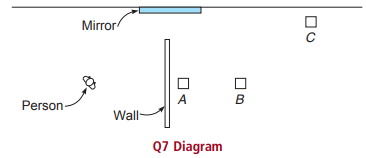
Objects A, B, and C lie in the next room hidden from direct view of the person shown in the diagram. A plane mirror is placed on the wall of the passageway between the two rooms as shown. Which of the objects will the person be able to see in the mirror? Explain using a ray diagram. Mirror A Person
Can a plane mirror focus light rays to a point like a positive lens does? Explain.
If you want to view your full height in a plane mirror, must the mirror be as tall as you are? Explain using a ray diagram.
When you view your image in a plane mirror, your right hand appears to be your left hand and vice versa. Explain how this reversal occurs.
How can an image lie behind a mirror hanging on a wall when no light can reach that point? Explain.
Does light actually pass through the position of the image formed by a plane mirror? Explain.
Does either the velocity or the speed of light change when a beam of light is reflected from a mirror? Explain.
A soap film has an index of refraction (see synthesis problem 1) of n = 1.333. This implies that the wavelength of light in the film is shorter than in air by a factor of 1/n. The index of refraction of air is approximately 1.0, so there is little difference between the wavelength in air and that
Standing waves (see section 15.3) can be formed by reflecting light from a mirror and allowing the reflected wave to interfere with the incoming wave. Suppose that we do so using light with a wavelength of 500 nm (5 x10⁻⁷ m). Assume that there is a node at the mirror surface.a. How far from the
Light with a wavelength of 600 nm (6 x 10⁻⁷ m) passes through two slits separated by just 0.03 mm (3 x10⁻⁵ m). A fringe pattern is observed on a screen placed 1.2 m from the double slit.a. How far from the center of the screen will the first bright fringe appear on either side of the central
The visible spectrum of colors ranges from approximately 380 nm in wavelength at the violet end to 750 nm at the far red end.a. What are the frequencies associated with these two wavelengths?b. When light passes into glass, the speed of light is reduced to v = c/n where n is called the index of
When passed through a diffraction grating with a slit spacing of 0.004 mm (4 x 10⁻⁶ m), the first-order fringe for light of a single wavelength lies a distance of 29 cm from the center of a screen located 2.0 m from the grating. What is the wavelength of the light?
Light of 546 nm (5.46 x 10⁻⁷ m) wavelength from a mercury lamp passes through a diffraction grating with a spacing between adjacent slits of 0.005 mm (5 x 10⁻⁶ m). A screen is located a distance of 2.5 m from the grating.a. How far from the center of the screen will the first order bright
A diffraction grating has 1000 slits or lines ruled in a space of 1.6 cm. What is the distance d between adjacent slits?
When illuminated with light of 500 nm (5 x 10⁻⁷ m), the first dark fringe produced by a single slit lies a distance of 1.2 cm from the center of the screen placed 4.0 m from the slit. How wide is the slit?
Light with a wavelength of 600 nm (6x10⁻⁷ m) strikes a single slit that is 0.5 mm (5 x 10⁻⁴ m) wide. The diffraction pattern produced by the slit is observed on a wall a distance of 2.0 m from the slit.a. What is the distance from the center of the pattern to the first dark fringe?b. How wide is
An anti reflection coating is designed with a thickness of a quarter of the wavelength of the light traveling in the film.a. How many wavelengths farther does the light reflected from the bottom surface of the coating travel than that reflected from the top surface?b. Does this produce constructive
Light of 600 nm is reflected from a thin film of air between two glass plates. The thickness of the film is 1.5μm (1500 nm).a. How much farther does the light reflected from the bottom surface of the film travel than that reflected from the top surface?b. How many wavelengths of light does this
A green fringe produced by double-slit interference lies 2.2 cm from the center of a screen placed 1.2 m from the double slit. If the screen is moved back so that it is now a distance of 3.6 m from the double slit, how far from the center of the screen will this green fringe lie?
For the same conditions described in exercise 5, at what distance from the center of the screen will the second dark fringe appear?
Light with a wavelength of 500 nm (5 x 10⁻⁷ m) is incident upon a double slit with a separation of 0.4 mm (4 x 10⁻⁴ m). A screen is located 2.0 m from the double slit. At what distance from the center of the screen will the first bright fringe beyond the center fringe appear?
X rays often have a wavelength of about 10-10 m. What is the frequency of such waves?
What is the frequency of green light waves with a wavelength of 520 nm?
What is the wavelength of the radio waves from a station broadcasting at 600 kilohertz?
Microwaves used in laboratory experiments often have a wavelength of about 1 cm. What is the frequency of these waves?
Birefringence is associated with anisotropic crystals but plastics are not usually crystalline. Is there any way in which a plastic material can exhibit birefringence? Explain.
A double image of a dot is seen when viewing the dot through a calcite crystal. Is there any difference in the polarization of the light associated with these two images? Explain.
If you use polarized sunglasses to eliminate glare from water surfaces, should the axis of transmission of the polarizer in the sunglasses be oriented in the vertical direction or in the horizontal direction? Explain.
Besides passing light through a polarizing filter, is there any other way that unpolarized light can become polarized? Explain.
If you pass an unpolarized light beam through a polarizing filter, will the light beam emerging from the filter be weaker or stronger than the incoming beam? Explain.
Can a wave on a guitar string be polarized? Explain.
How does polarized light differ from unpolarized light? Explain.
Suppose that light consisting of just two wavelengths, one blue and the other green, is passed through a diffraction grating. Which of these two colors will lie farther from the center of the screen in the first-order (m = 1) spectrum produced by the grating? Explain.
What is the usual function of a diffraction grating? Explain.
A light beam passes through a slit and forms a spot of light on a screen at some distance from the slit. Can we make this spot of light as small as we wish by making the slit very narrow? What happens in this process? Explain.
Is diffraction the same as interference? Explain.
An antireflection coating on eyeglasses employs a thinfilm coating on the lenses. If the coating is designed properly, does light reflected from the film undergo constructive or destructive interference? Explain.
Suppose that white light is reflected from a thin soap film. If the thickness is such that destructive interference is occurring for red light, what color will the film appear to be when viewed in reflected light? Explain.
Thin-film interference occurs when one clean glass plate is placed on top of another glass plate. What does the thin film consist of in this case? Explain.
When light is reflected from a thin film of oil on a water puddle, the colors we see are produced by interference. What two waves are interfering in this situation?
If two waves start out in phase with one another, but one wave travels two wavelengths farther than the other before they come together, will the waves be in phase or out of phase when they combine? Explain.
If two waves start out in phase with one another, but one wave travels half a wavelength farther than the other before they come together, will the waves be in phase or out of phase when they combine? Explain.
Two waves interfere to form fringes in Young’s doubleslit experiment. Do these two waves come from the same light source? Explain.
Skylight is produced by scattering of light from the direct beam coming from the sun. Why is the color of the sky different from the color of the light of the sun itself? Explain.
A color TV uses red, green, and blue phosphors to produce the colors that we see. In printing, however, we use magenta, yellow, and cyan as the primary colors. How do these two situations differ? Explain.
A certain pigment absorbs green light, while reflecting blue and red wavelengths. If a surface coated with this pigment is illuminated by white light, what is the color of the light reflected from this surface? Explain.
If we combine red light and green light in equal proportions, what color do we see? Explain.
Do the L cones in the retina of the eye respond to just a single wavelength? Explain.
What is the color of light with a wavelength of 470 nm? Explain.
A starter’s pistol is fired at the beginning of a race. If you are at the other end of the track, which will you perceive first, the sound of the pistol or the flash associated with its firing? Explain.
For which of the following characteristics speed, wavelength, and frequency is light similar to microwaves, and for which does it differ? Explain.
Is it possible for an electromagnetic wave to travel through a vacuum? Explain.
Is the electric field associated with an electromagnetic wave constant in time? Explain.
What characteristic of the electromagnetic waves predicted by Maxwell’s theory led him to suggest that light might be an electromagnetic wave? Explain.
Using the procedure outlined in section 15.5 where the ideal ratios for a justly-tuned scale are described, find the frequencies for all of the white keys between middle C (264 Hz) and the C above middle C (a C-major scale). If you have worked synthesis problem 4, compare the frequencies for just
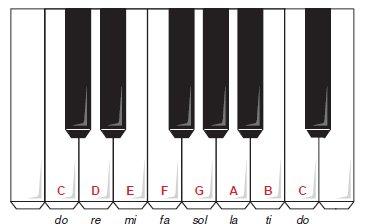
For standard tuning, concert A is defined to have a frequency of 440 Hz. On a piano, A is five white keys above C, but 9 half steps above C counting both the white and black keys. (See fig. 15.22.) A full octave consists of 12 half steps (semitones). In equally-tempered tuning, each half step has
A pipe that is open at both ends will form standing waves, if properly excited, with antinodes near both ends of the pipe. Suppose we have an open pipe 40 cm in length.a. Sketch the standing-wave pattern for the fundamental standing wave for this pipe. (There will be a node in the middle and
A guitar string has an overall length of 1.25 m and a total mass of 40 g (0.04 kg) before it is strung on the guitar. Once on the guitar, however, there is a distance of 64 cm between its fixed end points. It is tightened to a tension of 720 N.a. What is the mass per unit of length of this
A certain rope has a length of 8 m and a mass of 2.4 kg. It is fixed at one end and held taut at the other with a tension of 30 N. The end of the rope is moved up and down with a frequency of 2.5 Hz.a. What is the mass per unit of length of the rope?b. What is the speed of waves on this rope?c.
What is the beat frequency that results when an 880-Hz note is played with a 660-Hz note? If this beat frequency is heard as a musical tone, how is this tone related to the original two notes? What are the intervals?
If one guitar string is tuned to a frequency of 440 Hz and a string on another guitar produces 6 beats per second when played together with the first string, what are the possible frequencies of the second string?
If do has a frequency of 263 Hz and re a frequency of 323 Hz, what is the beat frequency produced when these two notes are played together?
In just tuning, the ratio for a major third is 5⁄4. In equal tempered tuning, the ratio is 1.260. If we start a scale on a frequency of 440 Hz for do, what is the difference in frequency for mi (a major third above do) on an equal tempered piano and a justly-tuned piano?
If sol on a given scale has a frequency of 396 Hz, what is the ideal-ratio frequency of do at the bottom of this scale?
Suppose that we start a major scale on concert A, which is defined to have a frequency of 440 Hz. If we call this frequency do, what is ideal-ratio frequency ofa. mi?b. sol?
An organ pipe closed at one end and open at the other has a length of 0.5 m.a. What is the longest possible wavelength for the interfering sound waves that can form a standing wave in this pipe?b. What is the frequency associated with this standing wave if the speed of sound is 340 m/s?
What is the frequency of a sound wave with a wavelength of 0.85 m traveling in room-temperature air (v = 340 m/s)?
Sound waves have a speed of 340 m/s in room-temperature air. What is the wavelength of the sound waves for the musical tone concert A, which has a frequency of 440 Hz?
Showing 300 - 400
of 1157
1
2
3
4
5
6
7
8
9
10
11
12
Step by Step Answers

 Get 50% OFF
Claim Now
Get 50% OFF
Claim Now