New Semester
Started
Get
50% OFF
Study Help!
--h --m --s
Claim Now
Question Answers
Textbooks
Find textbooks, questions and answers
Oops, something went wrong!
Change your search query and then try again
S
Books
FREE
Study Help
Expert Questions
Accounting
General Management
Mathematics
Finance
Organizational Behaviour
Law
Physics
Operating System
Management Leadership
Sociology
Programming
Marketing
Database
Computer Network
Economics
Textbooks Solutions
Accounting
Managerial Accounting
Management Leadership
Cost Accounting
Statistics
Business Law
Corporate Finance
Finance
Economics
Auditing
Tutors
Online Tutors
Find a Tutor
Hire a Tutor
Become a Tutor
AI Tutor
AI Study Planner
NEW
Sell Books
Search
Search
Sign In
Register
study help
physics
physics everyday phenomena
Physics of Everyday Phenomena A conceptual Introduction to physics 6th edition W. Thomas Griffith, Juliet W. Brosing - Solutions
An engineer designs a heat engine using flat-plate solar collectors. The collectors deliver heat at 70°C and the engine releases heat to the surroundings at 35°C. What is the maximum possible efficiency of this engine?
An ocean thermal-energy power plant takes in warm surface water at a temperature of 22°C and releases heat at 10°C to cooler water drawn from deeper in the ocean. Is it possible for this power plant to operate at an efficiency of 8%? Justify your answer.
A typical nuclear power plant delivers heat from the reactor to the turbines at a temperature of 540°C. If the turbines release heat at a temperature of 200°C, what is the maximum possible efficiency of these turbines?
A typical electric refrigerator has a power rating of 400 W, which is the rate (in J/s) at which electrical energy is supplied to do the work needed to remove heat from the refrigerator. If the refrigerator releases heat to the room at a rate of 900 W, at what rate (in watts) does it remove heat
In each cycle of its operation, a refrigerator removes 18 J of heat from the inside of the refrigerator and releases 30 J of heat into the room. How much work per cycle is required to operate this refrigerator?
A heat pump takes in 300 J of heat from a low-temperature reservoir in each cycle and uses 150 J of work per cycle to move the heat to a higher-temperature reservoir. How much heat is released to the higher-temperature reservoir in each cycle?
A Carnot engine operates between temperatures of 600 K and 400 K and does 150 J of work in each cycle.a. What is its efficiency?b. How much heat does it take in from the higher temperature reservoir in each cycle?
A Carnot engine takes in heat from a reservoir at 400°C and releases heat to a lower-temperature reservoir at 150°C. What is its efficiency?
A Carnot engine takes in heat at a temperature of 650 K and releases heat to a reservoir at a temperature of 350 K. What is its efficiency?
In one cycle, a heat engine does 400 J of work and releases 500 J of heat to a lower-temperature reservoir.a. How much heat does it take in from the higher temperature reservoir?b. What is the efficiency of the engine?
A heat engine with an efficiency of 40% takes in 600 J of heat from the high-temperature reservoir in each cycle.a. How much work does the engine do in each cycle?b. How much heat is released to the low-temperature reservoir?
In one cycle, a heat engine takes in 900 J of heat from a high-temperature reservoir and releases 600 J of heat to a lower-temperature reservoir.a. How much work is done by the engine in each cycle?b. What is its efficiency?
A heat engine with an efficiency of 25% does 400 J of work in each cycle. How much heat must be supplied from the high-temperature source in each cycle?
In one cycle, a heat engine takes in 1000 J of heat from a high-temperature reservoir, releases 600 J of heat to a lower-temperature reservoir, and does 400 J of work. What is its efficiency?
An engineer proposes a device that will extract heat from the atmosphere, convert some of it to work, and release the remaining heat back into the atmosphere at the same temperature as the input heat. Is this a perpetual-motion machine and, if so, what kind? Explain.
An engineer proposes a power plant that will extract heat from warm surface water in the ocean, convert some of it to work, and release the remaining heat into cooler water at greater depths. Is this a perpetual-motion machine and, if so, what kind? Explain.
Is an automobile engine a perpetual-motion machine? Explain.
Is heat obtained from a flat-plate solar collector best used for running a heat engine or for space heating? Explain.
Electric motors convert electric energy to mechanical work at a much higher efficiency than gasoline engines can convert heat to work. Why might it not make sense, then, to run all of our vehicles on electric power? Where does the electric power originate? Explain.
What is the distinction between high-grade heat and lowgrade heat? Explain.
In what ways is a nuclear power plant similar to a coalfired plant? Explain.
Which would normally have the greater thermal efficiency, a coal-fired power plant or a geothermal power plant? Explain.
When a substance freezes, the molecules become more organized and the entropy decreases. Does this involve a violation of the entropy statement of the second law of thermodynamics? Explain.
A hot cup of coffee is allowed to cool down, thus warming its surroundings. Does the entropy of the universe increase in this process? Explain.
Which has the higher entropy, a deck of cards in which the cards are organized by suit or a shuffled deck of cards? Explain.
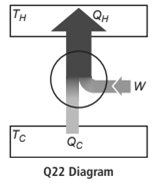
Is it possible for a heat pump to operate as shown in the diagram? Explain, using the laws of thermodynamics. TH Tc QH Qc Q22 Diagram W
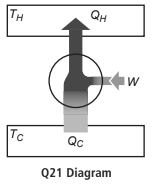
Is it possible for a heat pump to operate as shown in the diagram? Explain, using the laws of thermodynamics. TH Tc Qc QH Q21 Diagram W
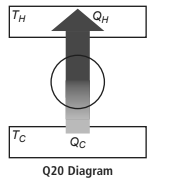
Is it possible for a heat pump to operate as shown in the diagram? Explain, using the laws of thermodynamics. TH Tc QH Qc Q20 Diagram
Is it ever possible to move heat from a cooler to a warmer temperature? Explain.
Is it possible to cool a closed room by leaving the door of a refrigerator open in the room? Explain.
When a heat pump is used to heat a building, where does the heat come from? Explain.
Is a heat pump essentially the same thing as a refrigerator? Explain.
Is a heat pump the same thing as a heat engine? Explain.
If we want to increase the efficiency of a Carnot engine, would it be more effective to raise the temperature of the high-temperature reservoir by 50°C or lower the temperature of the low-temperature reservoir by 50°C? Explain.
Which would have the greater efficiency a Carnot engine operating between the temperatures of 400°C and 300°C, or one operating between the temperatures of 400 K and 300 K? Explain.
Does a gasoline-burning automobile engine operate in a reversible manner? Explain.
Can a Carnot engine operate in an irreversible manner? Explain.
Is it possible for the efficiency of a heat engine to equal 1? Explain.
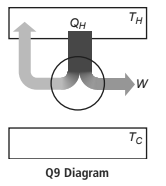
Is it possible for a heat engine to operate as shown in the following diagram? Explain, using the laws of thermodynamics. QH Q9 Diagram TH W Tc
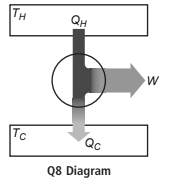
Is it possible for a heat engine to operate as shown in the following diagram? Explain, using the laws of thermodynamics. TH Tc QH Qc Q8 Diagram W
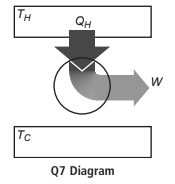
Is it possible for a heat engine to operate as shown in the following diagram? Explain, using the laws of thermodynamics. TH QH Tc Q7 Diagram
Which law of thermodynamics requires the work output of the engine to equal the difference in the quantities of heat taken in and released by the engine? Explain.
From the perspective of the first law of thermodynamics, is it possible for a heat engine to have an efficiency greater than 1? Explain.
Is the total amount of heat released by a heat engine to the low-temperature reservoir in one cycle ever greater than the amount of heat taken in from the high-temperature reservoir in one cycle? Explain.
In applying the first law of thermodynamics to a heat engine, why is the change in the internal energy of the engine assumed to be zero? Explain.
Could a simple machine such as a lever, a pulley system, or a hydraulic jack be considered a heat engine? Explain.
Which of these types of motors or engines are heat engines?a. An automobile engineb. An electric motorc. A steam turbine Explain your reasons for classifying or not classifying each of these as a heat engine.
Look around your home to see what kinds of thermometers you can find. Indoor, outdoor, clinical, or cooking thermometers can be found in most homes. For each thermometer, note:a. What temperature scales are used?b. What is the temperature range of the thermometer?c. What is the smallest temperature
Suppose that the pressure of an ideal gas mixture remains constant at 1800 Pa (1 Pa = 1N/m2) and the temperature is increased from 250K to 750K.a. If the original volume of the gas was 0.15 m2, what is the final volume?b. What is the change in volume ΔV for this process?c. How much work does the
A beaker containing 400 g of water has 1200 J of work done on it by stirring and 200 cal of heat added to it from a hot plate.a. What is the change in the internal energy of the water in joules?b. What is the change in the internal energy of the water in calories?c. What is the temperature change
A 150-g quantity of a certain metal, initially at 120°C, is dropped into an insulated beaker containing 100 g of water at 20°C. The final temperature of the metal and water in the beaker is measured as 35°C. Assume that the heat capacity of the beaker can be ignored.a. How much heat has been
The initial temperature of 150 g of ice is -20°C. The specific heat capacity of ice is 0.5 cal/g·C° and water’s is 1 cal/g·C°. The latent heat of fusion of water is 80 cal/g.a. How much heat is required to raise the ice to 0°C and completely melt the ice?b. How much additional heat is
A student constructs the thermometer and invents her own temperature scale with the ice point of water at 0°S (S for the student) and the boiling point of water at 50°S. She measures the temperature of a beaker of water with her thermometer and finds it to be 15°S.a. What is the temperature of
Heat is added to an object initially at 30°C, increasing its temperature to 80°C.a. What is the temperature change of the object in Fahrenheit degrees?b. What is the temperature change of the object in kelvins?c. Is there any difference in the numerical value of a heat capacity expressed in
Work of 600 J is done by stirring an insulated beaker containing 100 g of water.a. What is the change in the internal energy of the system?b. What is the change in the temperature of the water?
If 500 cal of heat are added to a gas, and the gas expands doing 500 J of work on its surroundings, what is the change in the internal energy of the gas?
Work of 1500 J is done on an ideal gas, but the internal energy increases by only 800 J. What is the amount and direction of heat flow into or out of the system?
If the initial temperature in exercise E14 is 700K, what is the final temperature?Data from Problem 14The volume of an ideal gas is increased from 0.8 m3 to 2.4 m3 while maintaining a constant pressure of 1000 Pa (1 Pa 1 N/m2).
The volume of an ideal gas is increased from 0.8 m3 to 2.4 m3 while maintaining a constant pressure of 1000 Pa (1 Pa 1 N/m2). How much work is done by the gas in this expansion?
While a gas does 300 J of work on its surroundings, 800 J of heat is added to the gas. What is the change in the internal energy of the gas?
If 600 J of heat are added to 50 g of water initially at 20°C,a. how much energy is this in calories?b. what is the final temperature of the water?
If 200 cal of heat are added to a system, how much energy has been added in joules?
How much heat must be added to 120 g of water at an initial temperature of 60°C to a. Heat it to the boiling point?b. Completely convert the 100°C water to steam?
If 600 cal of heat are added to 50 g of water initially at a temperature of 10°C, what is the final temperature of the water?
How much heat must be added to 60 g of ice at 0°C to melt the ice completely?
How much heat must be removed from a 200-g block of copper to lower its temperature from 150°C to 30°C? The specific heat capacity of copper is 0.093 cal/g·C°.
How much heat is required to raise the temperature of 70 g of water from 20°C to 80°C?
The temperature of a beaker of water is 318.2 K. What is this temperature a. In degrees Celsius?b. In degrees Fahrenheit?
The temperature on a warm summer day is 95°F. What is this temperaturea. In degrees Celsius?b. On the absolute (Kelvin) scale?
The temperature in a residence-hall room is 24°C. What is the temperature of the room on the absolute (Kelvin) temperature scale?
The temperature on a winter day is 14°F. What is the temperature in degrees Celsius?
An object has a temperature of 45°C. What is its temperature in degrees Fahrenheit?
Will a solar power plant (one that generates electricity from solar energy) have the same tendency to increase the greenhouse effect in the atmosphere as a coal-fired power plant? Explain.
What mechanism of heat flow (conduction, convection, or radiation) is involved in transporting useful thermal energy away from a flat-plate solar collector? Explain.
What property does glass share with carbon dioxide gas that makes them both effective in producing the greenhouse effect? Explain.
Is it possible for heat to flow across a vacuum? Explain
What heat transfer mechanisms (conduction, convection, or radiation) are involved when heat flows through a glass windowpane? Explain.
Is it possible for water on the surface of a road to freeze even though the temperature of the air just above the road is above 0°C? Explain.
Heat is sometimes lost from a house through cracks around windows and doors. What mechanism of heat transfer (conduction, convection, or radiation) is involved? Explain.
A block of wood and a block of metal have been sitting on a table for a long time. The block of metal feels colder to the touch than the block of wood. Does this mean that the metal is actually at a lower temperature than the wood? Explain.
Heat is added to ice causing the ice to melt but producing no change in temperature. Because water expands when it freezes into ice, the volume of the water obtained from melting the ice is less than the initial volume of ice. Does the internal energy of the ice-water system change in this process?
Heat is added to a hot-air balloon causing the air to expand. Will this increased volume of air cause the balloon to fall? Explain.
Heat is added to an ideal gas maintained at constant volume. Is it possible for the temperature of the gas to remain constant in this process? Explain.
Heat is added to an ideal gas, and the gas expands in the process. Is it possible for the temperature to remain constant in this situation? Explain.
Is it possible to decrease the temperature of a gas without removing any heat from the gas? Explain.
An ideal gas is compressed without allowing any heat to flow into or out of the gas. Will the temperature of the gas increase, decrease, or remain the same in this process? Explain.
Based upon his experiments, Joule proposed that the water in a pool at the bottom of a waterfall should have a higher temperature than that at the top. Why might this be so? Explain.
Is it possible for the internal energy of a system to be greater than the kinetic energy of the molecules and atoms making up the system? Explain.
Suppose that the internal energy of a system has been increased, resulting in an increase in the temperature of the system. Is it possible to tell from the final state of the system whether the change in internal energy was due to the addition of heat or of work to the system? Explain.
Which represents the greater amount of energy, 1 J or 1 cal? Explain.
A hammer is used to pound a piece of soft metal into a new shape. If the metal is thermally insulated from its surroundings, will its temperature change due to the pounding? Explain.
Is it possible to change the temperature of a glass of water by stirring the water, even though the glass is insulated from its surroundings? Explain.
What happens if we remove heat from water at 0°C? Does the temperature change? Explain.
What happens if we add heat to water that is at the temperature of 100°C? Does the temperature change? Explain.
Is it possible to add heat to a substance without changing its temperature? Explain.
Two cities, one near a large lake and the other in the desert, both reach the same high temperature during the day. Which city, if either, would you expect to cool down more rapidly once the sun has set? Explain.
Two objects of the same mass, but made of different materials, are initially at the same temperature. Equal amounts of heat are added to each object. Will the final temperature of the two objects necessarily be the same? Explain.
Is it possible for the final temperature of the objects discussed in question 8 to be greater than the initial temperatures of both objects? Explain.Data from question
Two objects at different temperatures are placed in contact with one another but are insulated from the surroundings. Will the temperature of either object change? Explain.
Is an object with a temperature of 273.2 K hotter than, colder than, or at the same temperature as an object with a temperature of 0°C? Explain.
Showing 600 - 700
of 1157
1
2
3
4
5
6
7
8
9
10
11
12
Step by Step Answers

 Get 50% OFF
Claim Now
Get 50% OFF
Claim Now