New Semester
Started
Get
50% OFF
Study Help!
--h --m --s
Claim Now
Question Answers
Textbooks
Find textbooks, questions and answers
Oops, something went wrong!
Change your search query and then try again
S
Books
FREE
Study Help
Expert Questions
Accounting
General Management
Mathematics
Finance
Organizational Behaviour
Law
Physics
Operating System
Management Leadership
Sociology
Programming
Marketing
Database
Computer Network
Economics
Textbooks Solutions
Accounting
Managerial Accounting
Management Leadership
Cost Accounting
Statistics
Business Law
Corporate Finance
Finance
Economics
Auditing
Tutors
Online Tutors
Find a Tutor
Hire a Tutor
Become a Tutor
AI Tutor
AI Study Planner
NEW
Sell Books
Search
Search
Sign In
Register
study help
physics
physics everyday phenomena
Physics of Everyday Phenomena A conceptual Introduction to physics 6th edition W. Thomas Griffith, Juliet W. Brosing - Solutions
For the pendulum in question 22 when the pendulum bob is halfway between the high point and the low point in its swing is the total energy kinetic energy, potential energy, on both? Explain.
A pendulum is pulled back from its equilibrium (center) position and then released.a. What form of energy is added to the system prior to its release? Explain.b. At what points in the motion of the pendulum after release is its kinetic energy the greatest? Explain.c. At what points is the potential
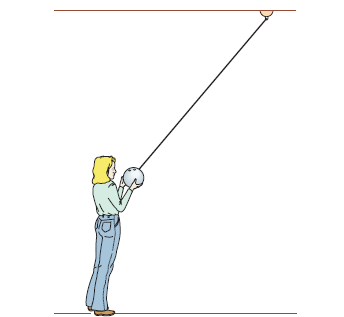
Suppose that the physics instructor pictured in figure 6.15 gives the bowling ball a push as she releases it. Will the ball return to the same point or will her chin be in danger? Explain.
When a bow and arrow are cocked, a force is applied to the string in order to pull it back. Is the energy of the system increased? Explain.
Which has the greater potential energy: a ball that is 10 feet above the ground, or one with the same mass that is 20 feet above the bottom of a nearby 50-foot-deep well? Explain.
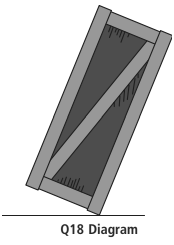
Suppose that work is done on a large crate to tilt the crate so that it is balanced on one edge, as shown in the diagram, rather than sitting squarely on the floor as it was at first. Has the potential energy of the crate increased in this process? Explain. Q18 Diagram
Is it possible for a system to have energy if nothing is moving in the system? Explain.
When work is done to increase the potential energy of an object without increasing its kinetic energy, is the net force acting on the object greater than zero? Explain.
A box is moved from the floor up to a tabletop but gains no speed in the process. Is there work done on the box, and if so, what has happened to the energy added to the system?
Two balls of the same mass are accelerated by different net forces such that one ball gains a velocity twice that of the other ball in the process. Is the work done by the net force acting on the faster-moving ball twice that done on the slower-moving ball? Explain.
If there is just one force acting on an object, does its work necessarily result in an increase in kinetic energy? Explain.
A child pulls a block across the floor with force applied by a horizontally held string. A smaller frictional force also acts upon the block, yielding a net force on the block that is smaller than the force applied by the string. Does the work done by the force applied by the string equal the
A boy pushes his friend across a skating rink. Since the frictional forces are very small, the force exerted by the boy on his friend’s back is the only significant force acting on the friend in the horizontal direction. Is the change in kinetic energy of the friend greater than, equal to, or
A crate on rollers is pushed up an inclined plane into a truck. The pushing force required is less than half the force that would be needed to lift the crate straight up into the truck. Does the inclined plane serve as a simple machine in this situation? Explain.
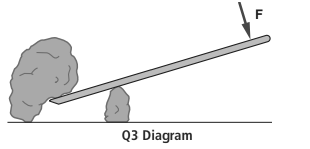
A lever is used to lift a rock as shown in the diagram. Will the work done by the person on the lever be greater than, equal to, or less than the work done by the lever on the rock? Explain. Q3 Diagram
A woman uses a pulley arrangement to lift a heavy crate. She applies a force that is one-fourth the weight of the crate, but moves the rope a distance four times the height that the crate is lifted. Is the work done by the woman greater than, equal to, or less than the work done by the rope on the
A man walks across the room. What forces act on the man during this process? Which, if any, of these forces do work on the man? Explain.
A ball is being twirled in a circle at the end of a string. The string provides the centripetal force needed to keep the ball moving in the circle at constant speed. Does the force exerted by the string on the ball do work on the ball in this situation? Explain.
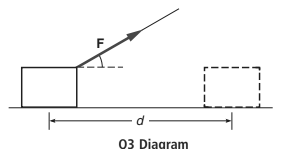
In the situation pictured in question 3, does the normal force of the floor pushing upward on the block do any work? Explain.
In the situation pictured in question 3, if there is a frictional force opposing the motion of the block, does this frictional force do work on the block? Explain.
A string is used to pull a wooden block across the floor without accelerating the block. The string makes an angle to the horizontal as shown in the diagram. a. Does the force applied via the string do work on the block? Explain. b. Is the total force involved in doing work or just a
Equal forces are used to move blocks A and B across the floor. Block A has twice the mass of block B, but block B moves twice the distance moved by block A. Which block, if either, has the greater amount of work done on it? Explain.
The period of the moon’s orbit about the Earth is 27.3 days, but the average time between full moons is approximately 29.3 days. The difference is due to the motion of the Earth about the sun.a. Through what fraction of its total orbital period does the Earth move in one period of the moon’s
The sun’s mass is 1.99 x 1030 kg, the Earth’s mass is 5.98 x 1024 kg, and the moon’s mass is 7.36 x 10²² kg. The average distance between the moon and the Earth is 3.82 x 10⁸ m, and the average distance between the Earth and the sun is 1.50 x 10¹¹ m.a. Using Newton’s law of gravitation,
Assume that a passenger in a rollover accident must turn through a radius of 3.0 m to remain in the seat of the vehicle. Assume also that the vehicle makes a complete turn in 1 second.a. Using the fact that the circumference of a circle is 2πr, what is the speed of the passenger?b. What is the
A car with a mass of 900 kg is traveling around a curve with a radius of 60 m at a constant speed of 25 m/s (56 MPH). The curve is banked at an angle of 15 degrees.a. What is the magnitude of the centripetal acceleration of the car?b. What is the magnitude of the centripetal force required to
A Ferris wheel with a radius of 12 m makes one complete rotation every 8 seconds.a. Using the fact that the distance traveled by a rider in one rotation is 2πr, the circumference of the wheel, find the speed with which the riders are moving.b. What is the magnitude of their centripetal
A 0.20-kg ball is twirled at the end of a string in a horizontal circle with a radius of 0.60 m. The ball travels with a constant speed of 4.0 m/s.a. What is the centripetal acceleration of the ball?b. What is the magnitude of the horizontal component of the tension in the string required to
The acceleration of gravity at the surface of the moon is approximately 1⁄ 6 that at the surface of the Earth (9.8 m/s2). What is the weight of an astronaut standing on the moon whose weight on Earth is 180 lb?
Two masses are attracted by a gravitational force of 0.14 N. What will the force of attraction be if the distance between these two masses is halved?
Two 200-kg masses (440 lb) are separated by a distance of 1 m. Using Newton’s law of gravitation, find the magnitude of the gravitational force exerted by one mass on the other.
Two masses are attracted by a gravitational force of 0.36 N. What will the force of attraction be if the distance between the two masses is tripled?
Joe has a weight of 720 N (about 162 lb) when he is standing on the surface of the Earth. What would his weight (the gravitational force due to the Earth) be if he doubled his distance from the center of the Earth by flying in a spacecraft?
What is the ratio of the Earth’s orbital period about the sun to the Earth’s period of rotation about its own axis?
The time separating high tides is 12 hours and 25 minutes. If high tide occurs at 2:10 P.M. one afternoon:a. At what time will high tide occur the next afternoon?b. When would you expect low tides to occur the next day?
The acceleration of gravity on the surface of Jupiter is 26.7 m/s2. What is the weight on Jupiter of a woman whose weight on Earth is 110 lb?
A Ferris wheel at a carnival has a radius of 12 m and turns so that the speed of the riders is 8 m/s.a. What is the magnitude of the centripetal acceleration of the riders?b. What is the magnitude of the net force required to produce this centripetal acceleration for a rider with a mass of 70 kg?
A car with a mass of 1000 kg travels around a banked curve with a constant speed of 27 m/s (about 60 MPH). The radius of curvature of the curve is 40 m.a. What is the centripetal acceleration of the car?b. What is the magnitude of the horizontal component of the normal force that would be required
A car with a mass of 1200 kg is moving around a curve with a radius of 40 m at a constant speed of 20 m/s (about 45 MPH).a. What is the centripetal acceleration of the car?b. What is the magnitude of the force required to produce this centripetal acceleration?
A 0.25-kg ball moving in a circle at the end of a string has a centripetal acceleration of 4 m/s2. What is the magnitude of the centripetal force exerted by the string on the ball to produce this acceleration?
How much larger is the required centripetal acceleration for a car rounding a curve at 60 MPH than for one rounding the same curve at 30 MPH?
A ball traveling in a circle with a constant speed of 3 m/s has a centripetal acceleration of 9 m/s2. What is the radius of the circle?
A car rounds a curve with a radius of 25 m at a speed of 20 m/s. What is the centripetal acceleration of the car?
A ball is traveling at a constant speed of 5 m/s in a circle with a radius of 0.8 m. What is the centripetal acceleration of the ball?
Would tides exist if the gravitational force did not depend upon the distance between objects? Explain.
Why is there a high tide rather than a low tide when the moon is on the opposite side of the Earth from the ocean and the gravitational pull of the moon on the water is the weakest? Explain.
Since the Earth rotates on its axis once every 24 hours, why don’t high tides occur exactly twice every 24 hours? Explain.
Is Kepler’s third law valid for artificial satellites orbiting about the Earth? Explain.
A synchronous satellite is one that does not move relative to the surface of the Earth; it is always above the same location. Why does such a satellite not just fall straight down to the Earth? Explain.
During what phase of the moon can a solar eclipse occur? Explain.
Are we normally able to see the new moon? Explain.
At what times of the day or night does the half-moon rise or set? Explain.
At what times during the day or night would you expect the new moon to rise and set? Explain.
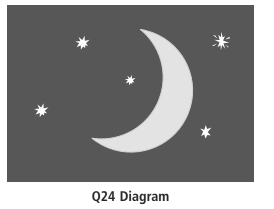
A painter depicts a portion of the night sky as shown in the diagram below, showing the stars and a crescent moon. Is this view possible? Explain. Q24 Diagram
Two masses are separated by a distance r. If this distance is doubled, is the force of interaction between the two masses doubled, halved, or changed by some other amount? Explain.
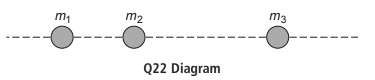
Three equal masses are located as shown in the diagram. What is the direction of the net force acting upon m2? Explain. mз m2 m, Q22 Diagram
Is there a net force acting on the planet Earth? Explain.
Does the sun exert a larger force on the Earth than that exerted on the sun by the Earth? Explain.
Does a planet moving in an elliptical orbit about the sun move fastest when it is farthest from the sun or when it is nearest to the sun? Explain by referring to one of Kepler’s laws.
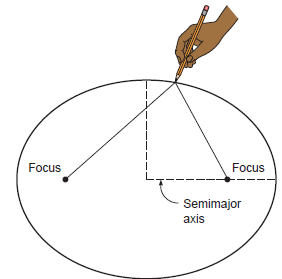
Consider the method of drawing an ellipse pictured in figure 5.15. How would we modify this process to make the ellipse into a circle, which is a special case of an ellipse? Explain. Focus Focus Semimajor axis
How did Kepler’s view of the solar system differ from that of Copernicus? Explain.
Heliocentric models of the solar system (Copernican or Keplerian) require that the Earth rotate on its axis producing surface speeds of roughly 1000 MPH. If this is the case, why do we not feel this tremendous speed? Explain.
Did Ptolemy’s view of the solar system require motion of the Earth, rotational or otherwise? Explain.
In what way did the heliocentric view of the solar system proposed by Copernicus provide a simpler explanation of planetary motion than the geocentric view of Ptolemy? Explain.
Sketch the forces acting upon a rider on a Ferris wheel when the rider is at the top of the cycle, labeling each force clearly. Which force is largest at this point, and what is the direction of the net force? Explain.
If a ball is whirled in a vertical circle with constant speed, at what point in the circle, if any, is the tension in the string the greatest? Explain.
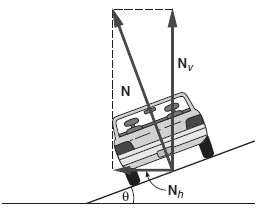
If a curve is banked, is it possible for a car to negotiate the curve even when the frictional force is zero due to very slick ice? Explain.
Is there a maximum speed at which the car in question 9 will be able to negotiate the curve? If so, what factors determine this maximum speed? Explain.
A car travels around a flat (nonbanked) curve with constant speed.a. Sketch a diagram showing all of the forces acting on the car.b. What is the direction of the net force acting on the car? Explain
For a ball being twirled in a horizontal circle at the end of a string, does the vertical component of the force exerted by the string produce the centripetal acceleration of the ball? Explain.
Before the string breaks in question 6, is there a net force acting upon the ball? If so, what is its direction? Explain.
The centripetal acceleration depends upon the square of the speed rather than just being proportional to the speed. Why does the speed enter twice? Explain.
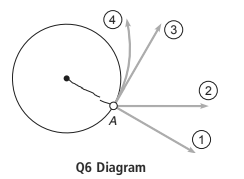
A ball on the end of a string is whirled with constant speed in a counterclockwise horizontal circle. At point A in the circle, the string breaks. Which of the curves sketched below most accurately represents the path that the ball will take after the string breaks (as seen from above)?
A car travels the same distance at constant speed around two curves, one with twice the radius of curvature of the other. For which of these curves is the change in velocity of the car greater? Explain.
Two cars travel around the same curve, one at twice the speed of the other. After traveling the same distance, which car, if either, has experienced a larger change in velocity? Explain.
A car travels around a curve with constant speed.a. Does the velocity of the car change in this process? Explain.b. Is the car accelerated? Explain.
Suppose that the speed of a ball moving in a horizontal circle is increasing at a steady rate. Is this increase in speed produced by the centripetal acceleration? Explain.
A sky diver has a weight of 750 N. Suppose that the air resistive force acting on the diver increases in direct proportion to his velocity such that for every 10 m/s that the diver’s velocity increases, the force of air resistance increases by 100 N.a. What is the net force acting on the sky
A 60-kg man is in an elevator that is accelerating downward at the rate of 1.4 m/s2.a. What is the true weight of the man in newtons?b. What is the net force acting on the man required to produce the acceleration?c. What is the force exerted on the man’s feet by the floor of the elevator?d. What
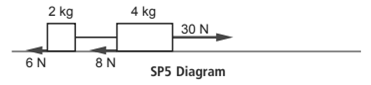
Two blocks tied together by a horizontal string are being pulled across the table by a horizontal force of 30 N as shown. The 2-kg block has a 6-N frictional force exerted on it by the table, and the 4-kg block has an 8-N frictional force acting on it.a. What is the net force acting on the entire
A 60-kg crate is lowered from a loading dock to the floor using a rope passing over a fixed support. The rope exerts a constant upward force on the crate of 500 N.a. Will the crate accelerate? Explain.b. What are the magnitude and direction of the acceleration of the crate?c. How long will it take
A dish with a mass 0.4 kg has a force of kinetic friction of 0.15 N exerted on it by a moving tablecloth for a time of 0.2 s.a. What is the acceleration of the dish?b. What velocity does it reach in this time, starting from rest?c. How far (in cm) does the dish move in this time?
A rope exerts a constant horizontal force of 250 N to pull a 60-kg crate across the floor. The velocity of the crate is observed to increase from 1 m/s to 3 m/s in a time of 2 seconds under the influence of this force and the frictional force exerted by the floor on the crate.a. What is the
A constant horizontal force of 30 N is exerted by a string attached to a 5-kg block being pulled across a tabletop. The block also experiences a frictional force of 5 N due to contact with the table.a. What is the horizontal acceleration of the block?b. If the block starts from rest, what will its
A 60-kg woman in an elevator is accelerating upward at a rate of 1.2 m/s2.a. What is the net force acting upon the woman?b. What is the gravitational force acting upon the woman?c. What is the normal force pushing upward on the woman’s feet?
An upward force of 18 N is applied via a string to lift a ball with a mass of 1.5 kg. a. What is the net force acting upon the ball? b. What is the acceleration of the ball?
A 0.5-kg book rests on a table. A downward force of 6 N is exerted on the top of the book by a hand pushing down on the book.a. What is the magnitude of the gravitational force acting upon the book?b. What is the magnitude of the upward (normal) force exerted by the table on the book? (Is the book
At a given instant in time, a 5-kg rock is observed to be falling with an acceleration of 7.0 m/s2. What is the magnitude of the force of air resistance acting upon the rock at this instant?
At a given instant in time, a 4-kg rock that has been dropped from a high cliff experiences a force of air resistance of 15 N. What are the magnitude and direction of the acceleration of the rock? (Do not forget the gravitational force!)
Who has the larger mass, a man weighing 145 lb or one weighing 735 N?
The author of this text has a weight of 600 N.a. What is his mass in kilograms?b. What is his weight in pounds? (1 lb = 4.45 N)
Jennifer has a weight of 110 lb.a. What is her weight in newtons? (1 lb = 4.45 N)b. What is her mass in kilograms?
What is the mass of a 196-N weight?
What is the weight of a 40-kg mass?
A 4-kg sled sliding freely on an icy surface experiences a 2-N frictional force exerted by the ice and an air-resistive force of 0.5 N.a. What is the net force acting on the sled?b. What is the acceleration of the sled?
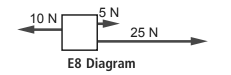
A 4-kg block is acted upon by three horizontal forces as shown in the diagram.a. What is the net horizontal force acting on the block?b. What is the horizontal acceleration of the block? 10 N 5 N 25 N E8 Diagram
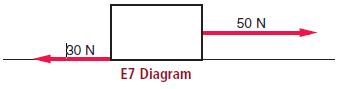
Two forces, one of 50 N and the other of 30 N, act in opposite directions on a box as shown in the diagram. What is the mass of the box if its acceleration is 4.0 m/s2? 50 N 30 N E7 Diagram
A 6-kg block being pushed across a table by a force P has an acceleration of 3.0 m/s2.a. What is the net force acting upon the block?b. If the magnitude of P is 20 N, what is the magnitude of the frictional force acting upon the block?
A pulled tablecloth exerts a frictional force of 0.6 N on a plate with a mass of 0.4 kg. What is the acceleration of the plate?
A 3.0-kg block being pulled across a table by a horizontal force of 80 N also experiences a frictional force of 5 N. What is the acceleration of the block?
Showing 900 - 1000
of 1157
1
2
3
4
5
6
7
8
9
10
11
12
Step by Step Answers

 Get 50% OFF
Claim Now
Get 50% OFF
Claim Now