New Semester
Started
Get
50% OFF
Study Help!
--h --m --s
Claim Now
Question Answers
Textbooks
Find textbooks, questions and answers
Oops, something went wrong!
Change your search query and then try again
S
Books
FREE
Study Help
Expert Questions
Accounting
General Management
Mathematics
Finance
Organizational Behaviour
Law
Physics
Operating System
Management Leadership
Sociology
Programming
Marketing
Database
Computer Network
Economics
Textbooks Solutions
Accounting
Managerial Accounting
Management Leadership
Cost Accounting
Statistics
Business Law
Corporate Finance
Finance
Economics
Auditing
Tutors
Online Tutors
Find a Tutor
Hire a Tutor
Become a Tutor
AI Tutor
AI Study Planner
NEW
Sell Books
Search
Search
Sign In
Register
study help
physics
physics everyday phenomena
Physics of Everyday Phenomena A conceptual Introduction to physics 6th edition W. Thomas Griffith, Juliet W. Brosing - Solutions
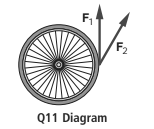
The two forces in the diagram have the same magnitude. Which orientation will produce the greater torque on the wheel? Explain. F, F2 Q11 Diagram
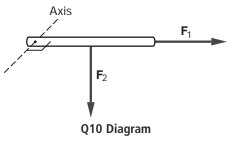
Which of the forces pictured as acting upon the rod in the diagram will produce a torque about an axis perpendicular to the plane of the diagram at the left end of the rod? Explain. Axis F2 Q10 Diagram
Which, if either, will produce the greater torque: a force applied at the end of a wrench handle (perpendicular to the handle) or an equal force applied in the same direction near the middle of the handle? Explain.
A ball rolls down an inclined plane gaining speed as it goes. Does the ball experience both linear and rotational acceleration? How far does the ball travel in one revolution? How is the linear velocity of the ball related to its rotational velocity? Explain.
If an object has a constant rotational acceleration, is its rotational velocity also constant? Explain.
Is the linear speed of a child sitting near the center of a rotating merry-go-round the same as that of another child sitting near the edge of the same merry-go-round? Explain.
Is the rotational velocity of a child sitting near the center of a rotating merry-go-round the same as that of another child sitting near the edge of the same merry-go-round? Explain.
The rate of rotation of an object is gradually slowing down. Does this object have a rotational acceleration? Explain.
A coin rolls down an inclined plane gaining speed as it rolls. Does the coin have a rotational acceleration? Explain.
Which units would not be appropriate for describing a rotational acceleration: rad/s, rev/s2, rev/m2 , degrees/s2 ? Explain.
Which units would not be appropriate for describing a rotational velocity: rad/min2, rev/s, rev/h, m/s? Explain.
A 1500-kg car traveling due north with a speed of 25 m/s collides head-on with a 4500-kg truck traveling due south with a speed of 15 m/s. The two vehicles stick together after the collision.a. What is the total momentum of the system prior to the collision?b. What is the velocity of the two
A car traveling at a speed of 18 m/s (approximately 40 MPH) crashes into a solid concrete wall. The driver has a mass of 90 kg.a. What is the change in momentum of the driver as he comes to a stop?b. What impulse is required in order to produce this change in momentum?c. How does the application
Consider two cases in which the same ball is thrown against a wall with the same initial velocity. In case A, the ball sticks to the wall and does not bounce. In case B, the ball bounces back with the same speed that it came in with.a. In which of these two cases is the change in momentum the
A bullet is fired into a block of wood sitting on a block of ice. The bullet has an initial velocity of 500 m/s and a mass of 0.005 kg. The wooden block has a mass of 1.2 kg and is initially at rest. The bullet remains embedded in the block of wood afterward.a. Assuming that momentum is conserved,
A fast ball thrown with a velocity of 40 m/s (approximately 90 MPH) is struck by a baseball bat, and a line drive comes back toward the pitcher with a velocity of 60 m/s. The ball is in contact with the bat for a time of just 0.04 s. The baseball has a mass of 120 g (0.120 kg).a. What is the change
A truck with a mass of 4000 kg traveling with a speed of 10 m/s collides at right angles with a car with a mass of 1500 kg traveling with a speed of 20 m/s.a. Sketch to proper scale and direction the momentum vectors of each vehicle prior to the collision.b. Using the graphical method of vector
For the two vehicles in exercise 16:a. Sketch to scale the momentum vectors of the two vehicles prior to the collision.b. Add the two vectors on your sketch graphically Data From exercise 16A 4000-kg truck traveling with a velocity of 10 m/s due north collides head-on with a 1200-kg car
A 4000-kg truck traveling with a velocity of 10 m/s due north collides head-on with a 1200-kg car traveling with a velocity of 20 m/s due south. The two vehicles stick together after the collision.a. What is the momentum of each vehicle prior to the collision?b. What are the size and direction of
For the railroad cars in example box 7.4:a. What is the kinetic energy of car 5 before the collision?b. What is the kinetic energy of all five cars just after the collision?c. Is energy conserved in this collision?
A railroad car with a mass of 12 000 kg collides and couples with a second car of mass 18 000 kg that is initially at rest. The first car is moving with a speed of 12 m/s prior to the collision.a. What is the initial momentum of the first car?b. If external forces can be ignored, what is the final
A rocket ship at rest in space gives a short blast of its engine, firing 50 kg of exhaust gas out the back end with an average velocity of 400 m/s. What is the change in momentum of the rocket during this blast?
A rifle with a mass of 1.2 kg fires a bullet with a mass of 6.0 g (0.006 kg). The bullet moves with a muzzle velocity of 600 m/s after the rifle is fired.a. What is the momentum of the bullet after the rifle is fired?b. If external forces acting on the rifle can be ignored, what is the recoil
An ice skater with a mass of 80 kg pushes off against a second skater with a mass of 32 kg. Both skaters are initially at rest.a. What is the total momentum of the system after they push off?b. If the larger skater moves off with a speed of 3 m/s, what is the corresponding speed of the smaller
A fullback with a mass of 100 kg and a velocity of 3.5 m/s due west collides head-on with a defensive back with a mass of 80 kg and a velocity of 6 m/s due east.a. What is the initial momentum of each player?b. What is the total momentum of the system before the collision?c. If they stick together
A ball traveling with an initial momentum of 4.0 kg·m/s bounces off a wall and comes back in the opposite direction with a momentum of - 3.5 kg·m/s.a. What is the change in momentum of the ball?b. What impulse is required to produce this change?
A ball traveling with an initial momentum of 2.5 kg·m/s bounces off a wall and comes back in the opposite direction with a momentum of - 2.5 kg·m/s.a. What is the change in momentum of the ball?b. What impulse would be required to produce this change?
A 60-kg front-seat passenger in a car moving initially with a speed of 18 m/s (40 MPH) is brought to rest by an airbag in a time of 0.4 s.a. What is the impulse acting on the passenger?b. What is the average force acting on the passenger in this process?
A ball experiences a change in momentum of 24 kg·m/s.a. What is the impulse acting on the ball?b. If the time of interaction is 0.15 s, what is the magnitude of the average force acting on the ball?
A 0.12-kg ball traveling with a speed of 40 m/s is brought to rest in a catcher’s mitt. What is the size of the impulse exerted by the mitt on the ball?
A force of 45 N acts on a ball for 0.2 s. If the ball is initially at rest:a. What is the impulse on the ball?b. What is the final momentum of the ball?
A bowling ball has a mass of 6 kg and a speed of 1.5 m/s. A baseball has a mass of 0.12 kg and a speed of 40 m/s. Which ball has the larger momentum?
What is the momentum of a 1200-kg car traveling with a speed of 27 m/s (60 MPH)?
An average force of 300 N acts for a time interval of 0.04 s on a golf ball.a. What is the magnitude of the impulse acting on the golf ball?b. What is the change in the golf ball’s momentum?
Suppose that the mass in question 26 is halfway between one of the extreme points of its motion and the center point. In this position, is the energy of the system kinetic energy, potential energy, or a combination of these forms? Explain.
List the following lengths in descending order: kilometer, feet, mile, centimeter, inch. The conversion factors given on the inside front cover may be useful
List the following volumes in descending order: gallon, quart, liter, milliliter. The conversion factors given on the inside front cover may be useful.
A pirate map indicates that a treasure is buried 50 paces due east and 120 paces due north of a big rock. Will you know where to dig? Explain.
The width of a man’s hand was used as a common unit of length several hundred years ago. What are the advantages and disadvantages of using such a unit? Explain.
Which system of units, the metric system or English system, is used more widely throughout the world? Explain.
What are the advantages, if any, of continuing to use the English system of units in industry and commerce rather than converting to the metric system? Explain.
What are the primary advantages of the metric system of units over the older English system of units? Explain.
The distance that an object travels when it starts from rest and undergoes constant acceleration is one-half the acceleration multiplied by the square of the time. Invent your own symbols and express this statement in symbolic form.
Impulse is defined as the average force acting on an object multiplied by the time the force acts. If we let I represent impulse, F the average force, and t the time, is I F/t a correct way of expressing this definition? Explain.
Suppose that you are told that speed is defined by the relationship s d/t, where s represents speed, d represents distance, and t represents time. State this relationship in words, using no mathematical symbols.
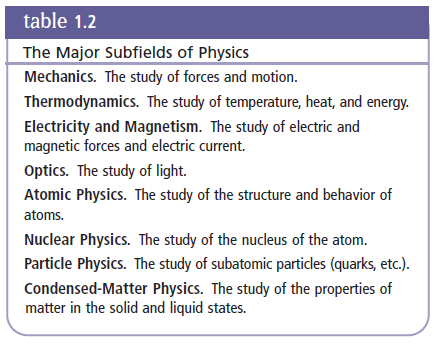
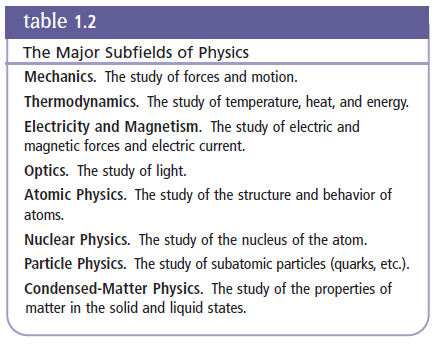
Based upon the descriptions provided in table 1.2, which subfields of physics are involved in explaining why an ice cube melts? Which subfields are involved in explaining how an airplane flies? Explain. table 1.2 The Major Subfields of Physics Mechanics. The study of forces and motion.
Based upon the brief descriptions provided in table 1.2, which subfield of physics would you say is involved in the explanation of rainbows? Which subfield is involved in describing how an acorn falls? Explain. table 1.2 The Major Subfields of Physics Mechanics. The study of forces and motion.
Which of the three science fields: biology, chemistry, or physics, would you say is the most fundamental? Explain by describing in what sense one of these fields may be more fundamental than the others.
Suppose that a friend states the hypothesis that the color of socks that he wears on a given day, brown or black, will determine whether the stock market will go up or down. He can cite several instances in which this hypothesis has been apparently verified. How would you go about evaluating this
Suppose that your phone has not rung in several days, but a friend tells you he has tried to call. Develop two hypotheses that could explain why the phone has not rung and state how you would test these hypotheses.
Suppose that your car will not start and you form the hypothesis that the battery is dead. How would you test this hypothesis? Explain.
Over the years, there have been several credible claims by experienced observers of sightings of Unidentified Flying Objects (UFOs). Despite this, scientists have shied away from taking up serious study of UFOs, although there are ongoing searches for signals from extraterrestrial intelligent
Historians sometimes develop theories to explain observed patterns in the history of different countries. Are these theories testable in the same sense as a theory in physics? Explain.
A person claiming to have paranormal powers states that she can predict which card will come up next in a shuffled deck of cards simply by exercising her mental powers. Is this a testable claim? Explain.
If an air bag inflates too rapidly and firmly during a collision, it can sometimes do more harm than good in low velocity collisions. Explain using impulse and momentum ideas.
What is the advantage of an air bag in reducing injuries during collisions? Explain using impulse and momentum ideas.
What is the advantage of a padded dashboard compared to a rigid dashboard in reducing injuries during collisions? Explain using momentum and impulse ideas.
Is there an advantage to following through when hitting a baseball with a bat, thereby maintaining a longer contact between the bat and the ball? Explain.
If a ball bounces off a wall so that its velocity coming back has the same magnitude that it had prior to bouncing:a. Is there a change in the momentum of the ball? Explain.b. Is there an impulse acting on the ball during its collision with the wall? Explain
Are impulse and momentum the same thing? Explain.
Are impulse and force the same thing? Explain.
Is it possible for a baseball to have as large a momentum as a much more massive bowling ball? Explain.
Two forces produce equal impulses, but the second force acts for a time twice that of the first force. Which force, if either, is larger? Explain.
Does the length of time that a force acts on an object have any effect on the strength of the impulse produced? Explain.
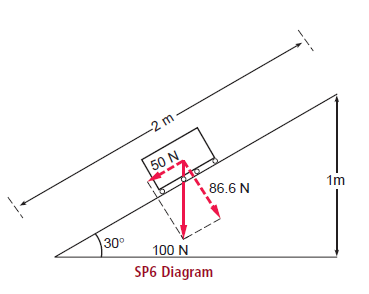
Suppose you wish to compare the work done by pushing a box on rollers up a ramp to the work done if you lift the box straight up to the same final height.a. What work is required to lift a 100N box (about 22 lbs) up to a table which is 1 m off the floor?b. Let’s assume you also have a ramp
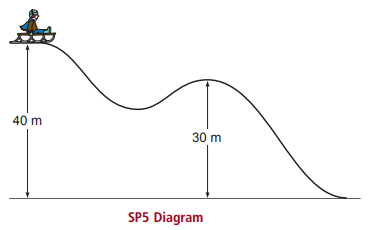
A sled and rider with a total mass of 40 kg are perched at the top of a hill as pictured in the diagram. The top of this hill is 40 m above the low point in the path of the sled. A second hump in the hill is 30 m above this low point. Suppose that we also know that approximately 2000 J of work is
Suppose that a 200-g mass (0.20 kg) is oscillating at the end of a spring upon a horizontal surface that is essentially friction-free. The spring can be both stretched and compressed and has a spring constant of 240 N/m. It was originally stretched a distance of 12 cm (0.12 m) from its equilibrium
A slingshot consists of a rubber strap attached to a Y-shaped frame, with a small pouch at the center of the strap to hold a small rock or other projectiles. The rubber strap behaves much like a spring. Suppose that for a particular slingshot a spring constant of 600 N/m is measured for the rubber
As described in example box 6.2, a 100-kg crate is accelerated by a net force of 50 N applied for 4 s.a. What is the acceleration of the crate from Newton’s second law?b. If it starts from rest, how far does it travel in the time of 4 s?c. How much work is done by the 50-N net force?d. What is
Suppose that two horizontal forces are acting upon a 0.25-kg wooden block as it moves across a laboratory table: a 5-N force pulling the block and a 2-N frictional force opposing the motion. The block moves a distance of 1.5 m across the table.a. What is the work done by the 5-N force?b. What is
The frequency of oscillation of a pendulum is 8 cycles/s. What is the period of oscillation?
The time required for one complete cycle of a mass oscillating at the end of a spring is 0.25 s. What is the frequency of oscillation?
A 200-g mass lying on a frictionless table is attached to a horizontal spring with a spring constant of 400 N/m. The spring is stretched a distance of 40 cm (0.40 m).a. What is the initial potential energy of the system?b. What is the kinetic energy of the system when the mass returns to the
A roller-coaster car has a potential energy of 450 000 J and a kinetic energy of 120 000 J at point A in its travel. At the low point of the ride, the potential energy is zero, and 50 000 J of work have been done against friction since it left point A. What is the kinetic energy of the roller
At the low point in its swing, a pendulum bob with a mass of 0.2 kg has a velocity of 4 m/s.a. What is its kinetic energy at the low point?b. Ignoring air resistance, how high will the bob swing above the low point before reversing direction?
Which requires more work: lifting a 2-kg rock to a height of 4 m without acceleration, or accelerating the same rock horizontally from rest to a speed of 10 m/s?
To stretch a spring a distance of 0.20 m, 40 J of work is done.a. What is the increase in potential energy of the spring?b. What is the value of the spring constant k of the spring?
A spring with a spring constant k of 40 N/m has stretched a distance of 20 cm (0.20 m) from its original unstretched position. What is the increase in potential energy of the spring?
A box with a mass of 5.0 kg is lifted (without acceleration) through a height of 2.0 m, in order to place it upon the shelf of a closet.a. What is the increase in potential energy of the box?b. How much work was required to lift the box to this position?
A 0.4-kg ball has a velocity of 20 m/s.a. What is the kinetic energy of the ball?b. How much work would be required to stop the ball?
A net force of 60 N accelerates a 4-kg mass over a distance of 10 m.a. What is the work done by this net force?b. What is the increase in kinetic energy of the mass?
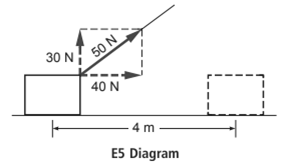
A force of 50 N is used to drag a crate 4 m across a floor. The force is directed at an angle upward from the crate so that the vertical component of the force is 30 N and the horizontal component is 40 N as shown in the diagram.a. What is the work done by the horizontal component of the force?b.
A rope applies a horizontal force of 180 N to pull a crate a distance of 2 m across the floor. A frictional force of 60 N opposes this motion.a. What is the work done by the force applied by the rope?b. What is the work done by the frictional force?c. What is the total work done on the crate?
A force of 60 N used to push a chair across a room does 300 J of work. How far does the chair move in this process?
A woman does 160 J of work to move a table 4 m across the floor. What is the magnitude of the force that the woman applied to the table if this force is applied in the horizontal direction?
A horizontally directed force of 40 N is used to pull a box a distance of 2.5 m across a tabletop. How much work is done by the 40-N force?
A man pushes very hard for several seconds upon a heavy rock, but the rock does not budge. Has the man done any work on the rock? Explain.
If one pole-vaulter can run faster than another, will the faster runner have an advantage in the pole vault? Explain.
Is the elastic potential energy stored in the pole the only type of potential energy involved in pole-vaulting? Explain.
Suppose that a pulley system is used to lift a heavy crate, but the pulleys have rusted and there are frictional forces acting on the pulleys. Will the useful work output of this system be greater than, equal to, or less than the work input? Explain.
Can work done by a frictional force ever increase the total mechanical energy of a system? (Consider the acceleration of an automobile.) Explain.
A sled is given a push at the top of a hill. Is it possible for the sled to cross a hump in the hill that is higher than its starting point under these circumstances? Explain.
Suppose that a mass is hanging vertically at the end of a spring. The mass is pulled downward and released to set it into oscillation. Is the potential energy of the system increased or decreased when the mass is lowered? Explain.
A spring gun is loaded with a rubber dart, the gun is cocked, and then fired at a target on the ceiling. Describe the energy transformations that take place in this process.
A mass attached to a spring, which in turn is attached to a wall, is free to move on a friction-free horizontal surface. The mass is pulled back and then released.a. What form of energy is added to the system prior to the release of the mass? Explain.b. At what points in the motion of the mass
A bird grabs a clam, carries it in its beak to a considerable height, and then drops it on a rock below, breaking the clam shell. Describe the energy conversions that take place in this process.
Suppose that we burn a barrel of oil just to warm our hands on a cold day.a. From the standpoint of physics, is energy conserved in this process? Explain.b. Why is this a bad idea from an economic or environmental standpoint? Explain.
A man commutes to work in a large sport utility vehicle (SUV).a. What energy transformations occur in this situation?b. Is mechanical energy conserved in this situation? Explain.c. Is energy of all forms conserved in this situation? Explain.
A sports car accelerates rapidly from a stop and “burns rubber.’’a. What energy transformations occur in this situation?b. Is energy conserved in this process? Explain.
Is the total mechanical energy conserved in the motion of a pendulum? Will it keep swinging forever? Explain.
Showing 800 - 900
of 1157
1
2
3
4
5
6
7
8
9
10
11
12
Step by Step Answers

 Get 50% OFF
Claim Now
Get 50% OFF
Claim Now