





Question: 19 2 Staffing with the M/M/s Queue McNeese is determining the staffing level for their credit union located within the university, and has recently hired
19 2 Staffing with the M/M/s Queue McNeese is
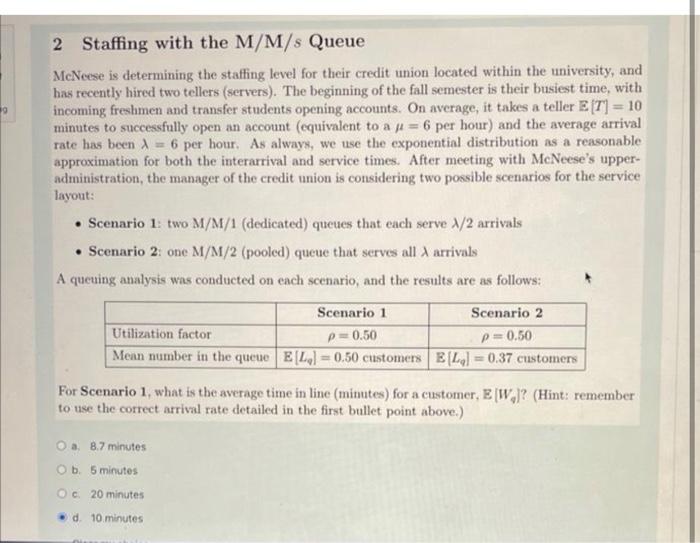
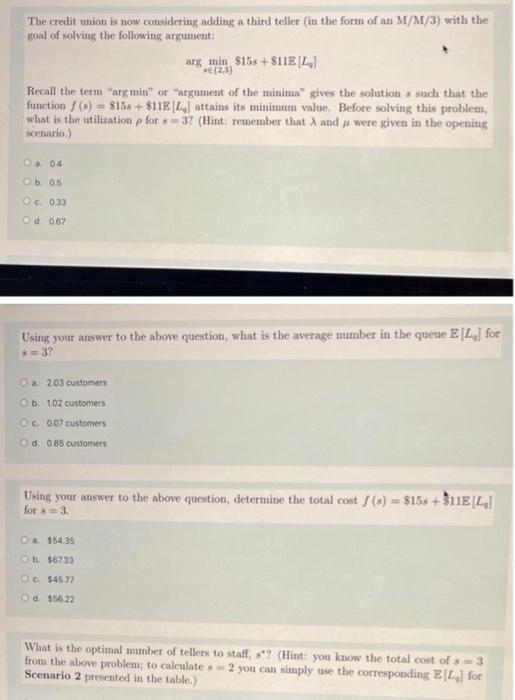
19 2 Staffing with the M/M/s Queue McNeese is determining the staffing level for their credit union located within the university, and has recently hired two tellers (servers). The beginning of the fall semester is their busiest time, with incoming freshmen and transfer students opening accounts. On average, it takes a teller E(T) = 10 minutes to successfully open an account (equivalent to a j = 6 per hour) and the average arrival rate has been = 6 per hour. As always, we use the exponential distribution as a reasonable approximation for both the interarrival and service times. After meeting with McNeese's upper- administration, the manager of the credit union is considering two possible scenarios for the service layout: Scenario 1: two M/M/1 (dedicated) queues that each serve X/2 arrivals . Scenario 2: one M/M/2 (pooled) queue that serves all X arrivals A queuing analysis was conducted on each scenario, and the results are as follows: Scenario 1 Scenario 2 Utilization factor P=0.50 P=0.50 Mean number in the queue EL=0.50 customers EL1 = 0.37 customers For Scenario 1, what is the average time in line (minutes) for a customer, EW.)? (Hint: remember to use the correct arrival rate detailed in the first bullet point above.) a 8.7 minutes Ob 5 minutes OC 20 minutes d. 10 minutes The credit union is now considering adding a third teller (in the form of an M/M/3) with the goal of solving the following argument: arg min $15s + S11E11 (23) Recall the term arg mit" or "argument of the minimn" gives the solution such that the function () = $165 + S11E|L) attains its minimum value. Before solving this problem, what is the utilization p for * = 3? (Hint: remember that and were given in the opening scenario.) O 04 Ob 05 c. 0.33 Od 0.67 Using your answer to the above question, what is the average number in the queue E(L) for =3? O. 203 customers Ob 102 customers Oc. 0.07 customers Od 0.85 customers Using your answer to the above question, determine the total cost ) = $158 + SUEL for 3 O$54.35 b. $67.33 $45.77 Od 556.22 What is the optimal number of tellers to staff, "? (Hint: you know the total cost of 8 = 3 from the above problem, to calculate s=2 you can simply case the corresponding EL for Scenario 2 presented in the table.)

Step by Step Solution

There are 3 Steps involved in it

1 Expert Approved Answer
Step: 1 Unlock blur-text-image

Question Has Been Solved by an Expert!

Get step-by-step solutions from verified subject matter experts

Step: 2 Unlock
Step: 3 Unlock

Students Have Also Explored These Related General Management Questions!