Question: 3. Consider the information about a project plan presented in the following table. Task Duration (days) Scheduled cost/day Immediate predecessor B D E F A
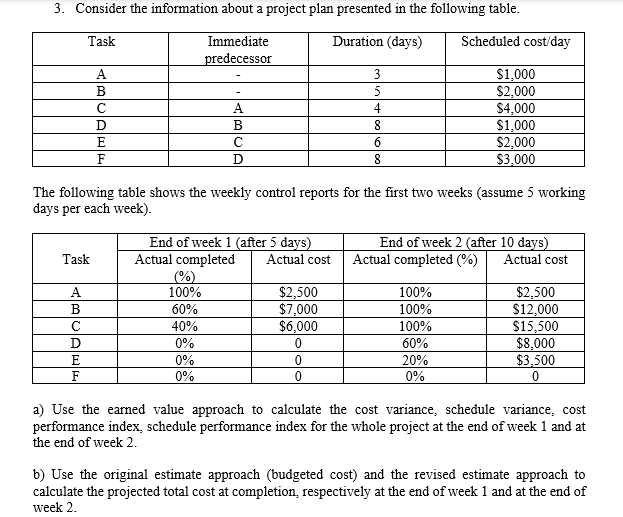
3. Consider the information about a project plan presented in the following table. Task Duration (days) Scheduled cost/day Immediate predecessor B D E F A B D 3 5 4 8 6 8 $1,000 $2,000 $4,000 $1,000 $2.000 $3,000 The following table shows the weekly control reports for the first two weeks (assume 5 working days per each week). End of week 1 (after 5 days) Actual completed Actual cost End of week 2 (after 10 days) Actual completed (%) Actual cost Task A B D E F 100% 60% 40% 0% 0% 0% $2,500 $7,000 $6,000 0 0 0 100% 100% 100% 60% 20% 0% $2,500 $12,000 $15,500 $8,000 $3,500 0 a) Use the earned value approach to calculate the cost variance, schedule variance, cost performance index, schedule performance index for the whole project at the end of week 1 and at the end of week 2. b) Use the original estimate approach (budgeted cost) and the revised estimate approach to calculate the projected total cost at completion, respectively at the end of week 1 and at the end of week 2 3. Consider the information about a project plan presented in the following table. Task Duration (days) Scheduled cost/day Immediate predecessor B D E F A B D 3 5 4 8 6 8 $1,000 $2,000 $4,000 $1,000 $2.000 $3,000 The following table shows the weekly control reports for the first two weeks (assume 5 working days per each week). End of week 1 (after 5 days) Actual completed Actual cost End of week 2 (after 10 days) Actual completed (%) Actual cost Task A B D E F 100% 60% 40% 0% 0% 0% $2,500 $7,000 $6,000 0 0 0 100% 100% 100% 60% 20% 0% $2,500 $12,000 $15,500 $8,000 $3,500 0 a) Use the earned value approach to calculate the cost variance, schedule variance, cost performance index, schedule performance index for the whole project at the end of week 1 and at the end of week 2. b) Use the original estimate approach (budgeted cost) and the revised estimate approach to calculate the projected total cost at completion, respectively at the end of week 1 and at the end of week 2









 Study Help