







Question: 3.If you were to make a 12 mL extraction buffer, what volume of PMSF would you need to add? Why is PMSF added? 4.Calculate the
3.If you were to make a 12 mL extraction buffer, what volume of PMSF would you need to add? Why is PMSF added?
4.Calculate the volume of L-DOPA to add to get each of the concentrations used in the lab0.4167 mM, 0.8334 mM, 1.667 mM, 3.334 mM, 5 mM, and 6.6667 mM.
5.When you graphed one of your reaction progress curves (where the volume of tyrosinase was 0.15 mL), with absorbance on the y
-axis and time (in seconds) on the x-axis, the equation of the
line was found to be y = 0.00134x + 0.0984. Convert t the slope to reaction rate in
i) AU/min
ii) M/min
iii) mol/min
iv) mol/min
v)mol/min/mL tyrosinase
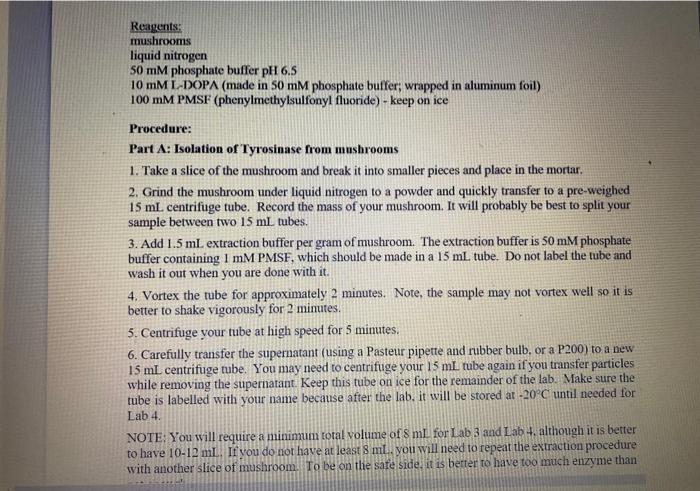
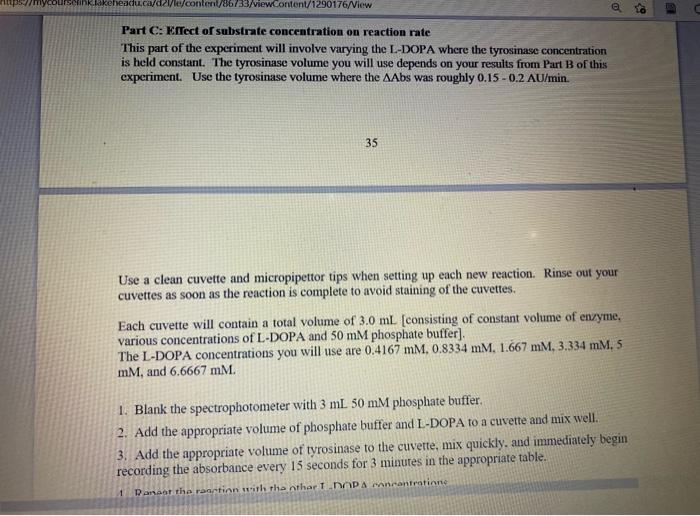
Reagents: mushrooms liquid nitrogen 50 mM phosphate buffer pH 6.5 10 mM L-DOPA (made in 50 mM phosphate buffer, wrapped in aluminum foil) 100 mM PMSF (phenylmethylsulfonyl fluoride) - keep on ice Procedure: Part A: Isolation of Tyrosinase from mushrooms 1. Take a slice of the mushroom and break it into smaller pieces and place in the mortar. 2. Grind the mushroom under liquid nitrogen to a powder and quickly transfer to a pre-weighed 15 mL centrifuge tube. Record the mass of your mushroom. It will probably be best to split your sample between two 15 ml tubes. 3. Add 1.5 mL extraction buffer per gram of mushroom. The extraction buffer is 50 mM phosphate buffer containing 1 mM PMSF, which should be made in a 15 ml tube. Do not label the tube and wash it out when you are done with it. 4. Vortex the tube for approximately 2 minutes. Note, the sample may not vortex well so it is better to shake vigorously for 2 minutes. 5. Centrifuge your tube at high speed for 5 minutes. 6. Carefully transfer the supernatant (using a Pasteur pipette and rubber bulb, or a P200) to a new 15 mL centrifuge tube. You may need to centrifuge your 15 mL tube again if you transfer particles while removing the supernatant. Keep this tube on ice for the remainder of the lab. Make sure the tube is labelled with your name because after the lab. it will be stored at -20C until needed for Lab 4. NOTE: You will require a minimum total volume of 8 ml for Lab 3 and Lab 4. although it is better to have 10-12 ml. If you do not have at least 8 ml. you will need to repeat the extraction procedure with another slice of mushroom To be on the safe side, it is better to have too much enzyme than a/ de/content/86733/viewcontent/1290176/View e 29 Part C: Effect of substrate concentration on reaction rate This part of the experiment will involve varying the L-DOPA where the tyrosinase concentration is held constant. The tyrosinase volume you will use depends on your results from Part B of this experiment. Use the tyrosinase volume where the AAbs was roughly 0.15-0.2 AU/min. 35 Use a clean cuvette and micropipettor tips when setting up each new reaction. Rinse out your cuvettes as soon as the reaction is complete to avoid staining of the cuvettes. Each cuvette will contain a total volume of 3.0 mL [consisting of constant volume of enzyme, various concentrations of L-DOPA and 50 mM phosphate buffer). The L-DOPA concentrations you will use are 0.4167 mm, 0.8334 mm, 1.667 mm, 3.334 mM. 5 mM, and 6.6667 mM. 1. Blank the spectrophotometer with 3 mL 50 mM phosphate buffer. 2. Add the appropriate volume of phosphate buffer and L-DOPA to a cuvette and mix well. 3. Add the appropriate volume of tyrosinase to the cuvette, mix quickly. and immediately begin recording the absorbance every 15 seconds for 3 minutes in the appropriate table. Danear the rantinn uith the nther TPA mncontratione 1
Step by Step Solution
There are 3 Steps involved in it

Get step-by-step solutions from verified subject matter experts
 Study Help