







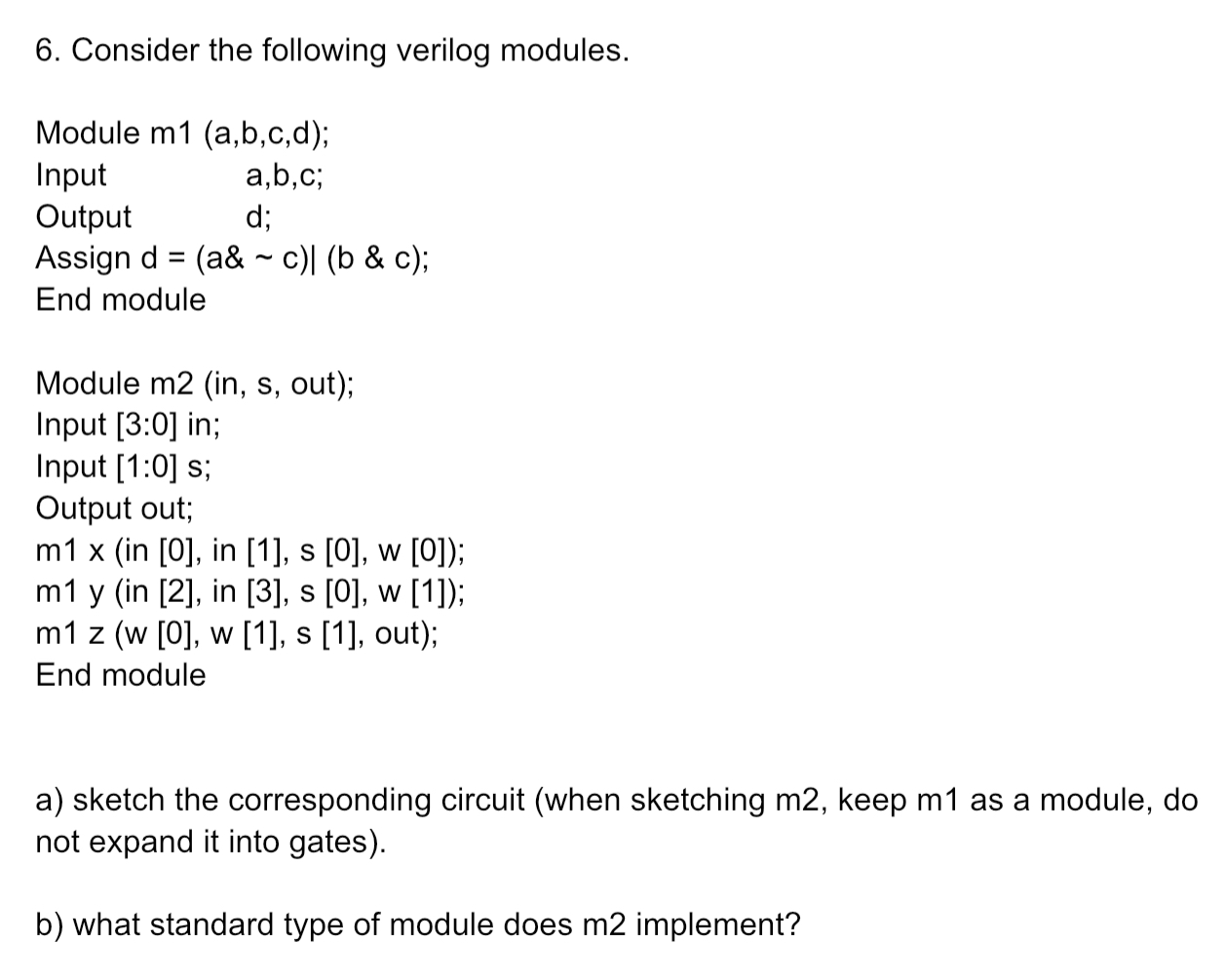
Question: 6 . Consider the following verilog modules. Module m 1 ( a , b , c , d ) ; Input a , b ,
Consider the following verilog modules.
Module mabcd;
Input abc;
Output d;
Assign d a& ~ cb & c;
End module
Module min s out;
Input : in;
Input : s;
Output out;
m x in in s w ;
m y in in s w ;
m z w w s out;
End module
a sketch the corresponding circuit when sketching m keep m as a module, do not expand it into gates
b what standard type of module does m implement? Consider the following verilog modules.
Module mabcd;
Input abc;
Output d;
Assign da & sim cmidb & c;
End module
Module min s out;
Input : in;
Input : s;
Output out;
m x in in s w ;
m y in in s w ;
m z w w s out;
End module
a sketch the corresponding circuit when sketching m keep m as a module, do not expand it into gates
b what standard type of module does m implement?
Step by Step Solution
There are 3 Steps involved in it
1 Expert Approved Answer
Step: 1 Unlock

Question Has Been Solved by an Expert!
Get step-by-step solutions from verified subject matter experts
Step: 2 Unlock
Step: 3 Unlock
 Study Help