







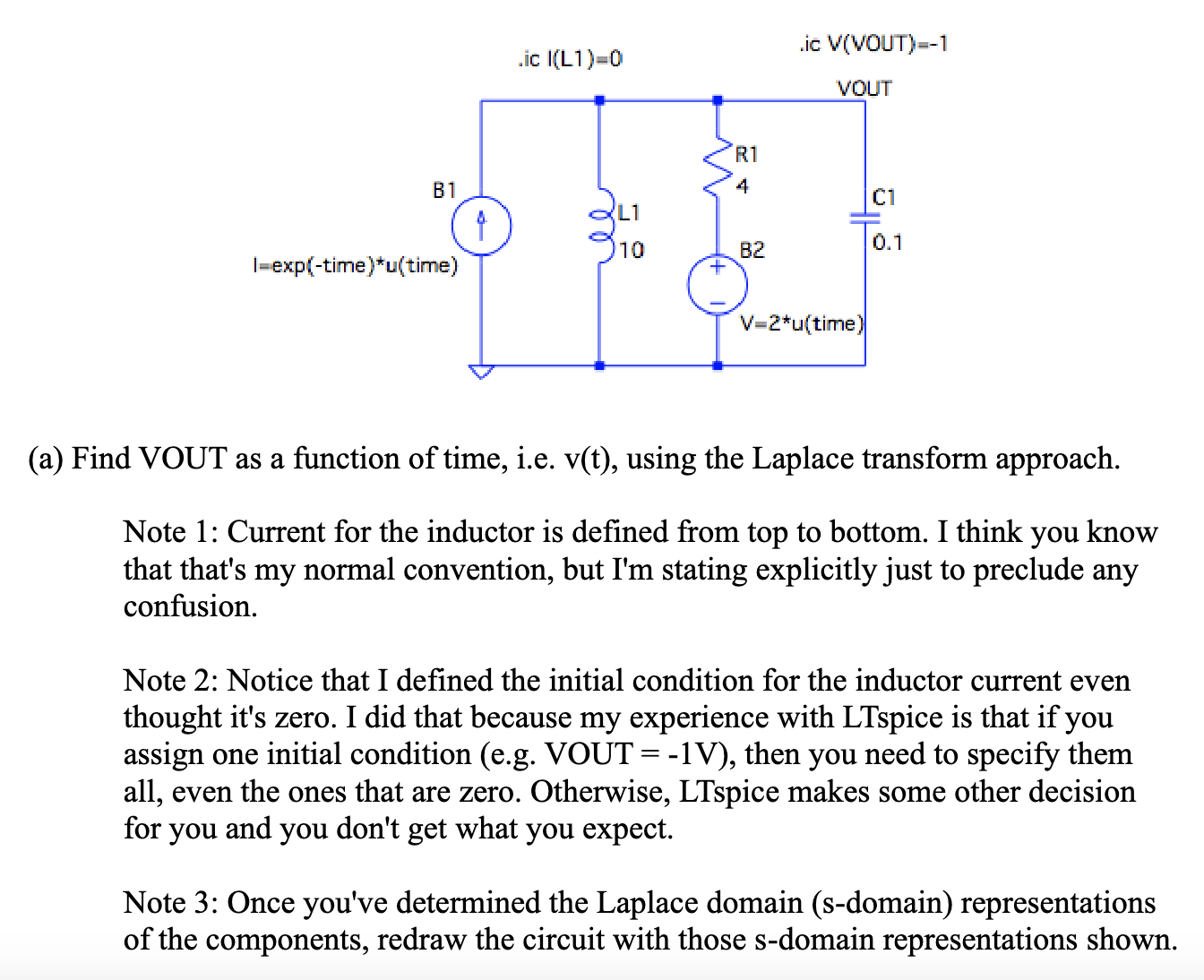
Question: ( a ) Find VOUT as a function of time, i . e . ( v ( mathrm { t } )
a Find VOUT as a function of time, ie vmathrmt using the Laplace transform approach.
Note : Current for the inductor is defined from top to bottom. I think you know that that's my normal convention, but Im stating explicitly just to preclude any confusion.
Note : Notice that I defined the initial condition for the inductor current even thought it's zero. I did that because my experience with LTspice is that if you assign one initial condition eg VOUT mathrm~V then you need to specify them all, even the ones that are zero. Otherwise, LTspice makes some other decision for you and you don't get what you expect.
Note : Once you've determined the Laplace domain sdomain representations of the components, redraw the circuit with those sdomain representations shown.
Step by Step Solution
There are 3 Steps involved in it
1 Expert Approved Answer
Step: 1 Unlock

Question Has Been Solved by an Expert!
Get step-by-step solutions from verified subject matter experts
Step: 2 Unlock
Step: 3 Unlock
 Study Help