







Question: A TiW layer is deposited on a substrate using a sputtering tool. Table below contains layer thickness measurements (in Angstroms) on 20 subgroups of four
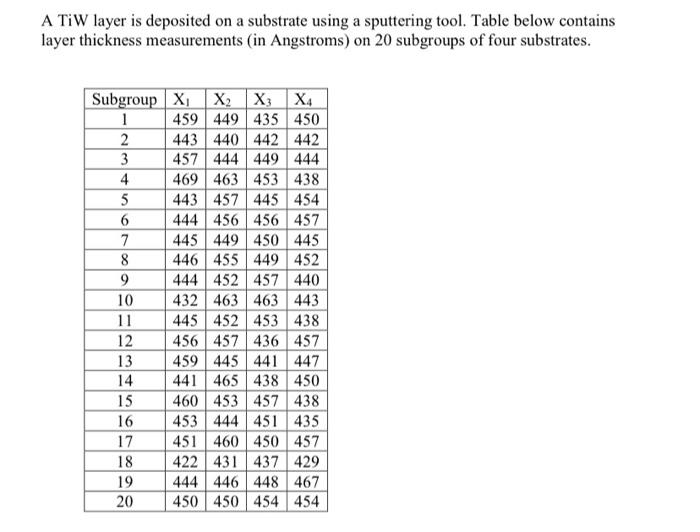
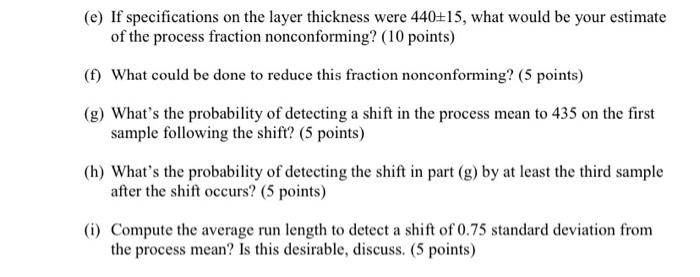
A TiW layer is deposited on a substrate using a sputtering tool. Table below contains layer thickness measurements (in Angstroms) on 20 subgroups of four substrates. (e) If specifications on the layer thickness were 44015, what would be your estimate of the process fraction nonconforming? (10 points) (f) What could be done to reduce this fraction nonconforming? (5 points) (g) What's the probability of detecting a shift in the process mean to 435 on the first sample following the shift? (5 points) (h) What's the probability of detecting the shift in part (g) by at least the third sample after the shift occurs? (5 points) (i) Compute the average run length to detect a shift of 0.75 standard deviation from the process mean? Is this desirable, discuss. (5 points) A TiW layer is deposited on a substrate using a sputtering tool. Table below contains layer thickness measurements (in Angstroms) on 20 subgroups of four substrates. (e) If specifications on the layer thickness were 44015, what would be your estimate of the process fraction nonconforming? (10 points) (f) What could be done to reduce this fraction nonconforming? (5 points) (g) What's the probability of detecting a shift in the process mean to 435 on the first sample following the shift? (5 points) (h) What's the probability of detecting the shift in part (g) by at least the third sample after the shift occurs? (5 points) (i) Compute the average run length to detect a shift of 0.75 standard deviation from the process mean? Is this desirable, discuss. (5 points)
Step by Step Solution
There are 3 Steps involved in it

Get step-by-step solutions from verified subject matter experts
 Study Help