Question: Answer these questions 1. How did Peapods strategy differ from Webvans? What made Peapod more successful? 2. How does Peapods strategy differ from Amazons? 3.
Answer these questions
1. How did Peapods strategy differ from Webvans? What made Peapod more successful?
2. How does Peapods strategy differ from Amazons?
3. Are Peapod and Amazon targeting the same customer base? Which customers
would you expect each company to attract and maintain?
4. What parallels can be drawn between the one-stop walk-in retail industry and
Amazons one-stop online strategy?
5. Do you expect Amazon to succeed in its one-stop strategy? Will Peapod survive?
What will each companys market share look like five years from now? Explain your answer.
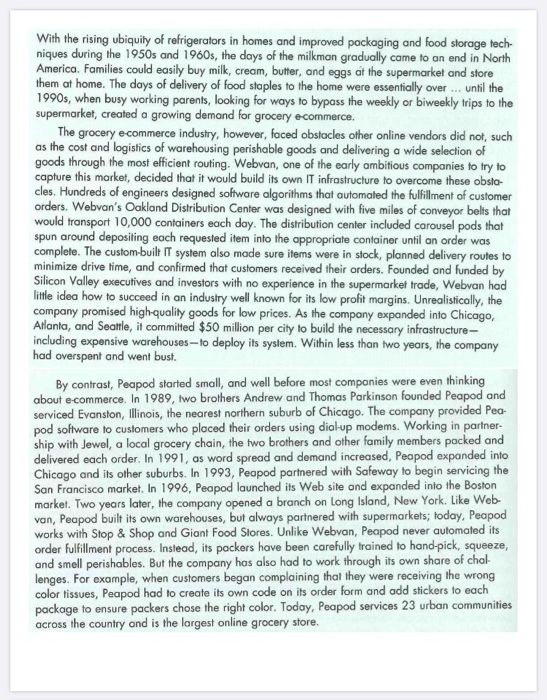
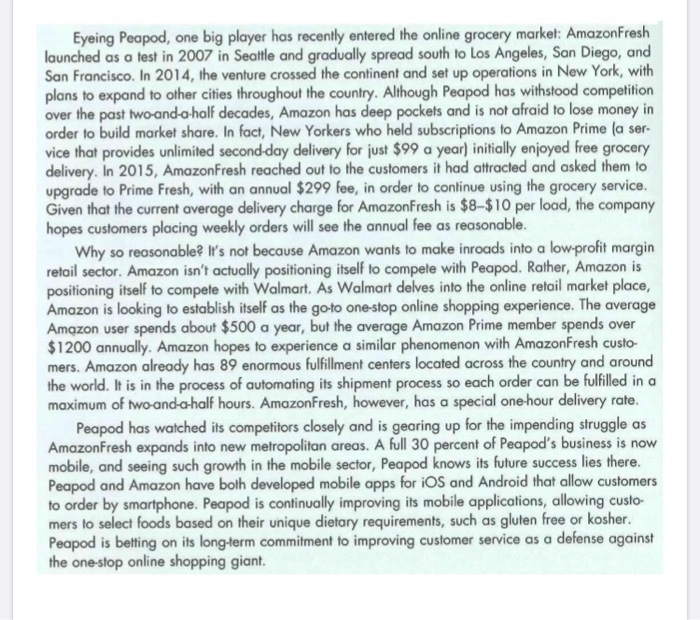
With the rising ubiquity of refrigerators in homes and improved packaging and food storage tech- niques during the 1950s and 1960s, the days of the milkman gradually came to an end in North America, Families could easily buy milk, cream, butter, and eggs at the supermarket and store them at home. The days of delivery of food staples to the home were essentially over ... until the 1990s, when busy working parents, looking for ways to bypass the weekly or biweekly trips to the supermarket, created a growing demand for grocery ocommerce. The grocery e-commerce industry, however, faced obstacles other online vendors did not, such as the cost and logistics of warehousing perishable goods and delivering a wide selection of goods through the most efficient routing. Webvan, one of the early ambitious companies to try to capture this market, decided that it would build its own IT infrastructure to overcome these obsto- cles. Hundreds of engineers designed software algorithms that automated the fulfillment of customer orders. Webvan's Oakland Distribution Center was designed with five miles of conveyor belts that would transport 10,000 containers each day. The distribution center included carousel pods that spun around depositing each requested item into the appropriate container until an order was complete. The custom-built IT system also made sure items were in stock, planned delivery routes to minimize drive time, and confirmed that customers received their orders. Founded and funded by Silicon Valley executives and investors with no experience in the supermarket trade, Webvan had little idea how to succeed in an industry well known for its low profit margins. Unrealistically, the company promised high-quality goods for low prices. As the company expanded into Chicago, Atlanta, and Seattle, it committed $50 million per city to build the necessary infrastructure- including expensive warehouses - to deploy its system. Within less than two years, the company had overspent and went bust. By contrast, Peapod started small, and well before most companies were even thinking about ecommerce. In 1989, two brothers Andrew and Thomas Parkinson founded Peapod and serviced Evanston, Illinois, the nearest northern suburb of Chicago. The company provided Pea- pod software to customers who placed their orders using dial-up modems. Working in partner ship with Jewel, a local grocery chain, the two brothers and other family members packed and delivered each order. In 1991, as word spread and demand increased, Peopod expanded into Chicago and its other suburbs. In 1993, Peapod partnered with Safeway to begin servicing the San Francisco market. In 1996, Peapod launched its Web site and expanded into the Boston market. Two years later, the company opened a branch on Long Island, New York. Like Web van, Peapod built its own warehouses, but always partnered with supermarkets, today, Peopod works with Stop & Shop and Giant Food Stores. Unlike Webvan, Peapod never automated its order Fulfillment process. Instead, its packers have been carefully trained to hand-pick, squeeze, and smell perishables. But the company has also had to work through its own share of chal lenges. For example, when customers began complaining that they were receiving the wrong color tissues, Peapod had to create its own code on its order form and add stickers to each package to ensure packers chose the right color. Today, Peapod services 23 urban communities across the country and is the largest online grocery store. Eyeing Peapod, one big player has recently entered the online grocery market: AmazonFresh launched as a test in 2007 in Seattle and gradually spread south to Los Angeles, San Diego, and San Francisco. In 2014, the venture crossed the continent and set up operations in New York, with plans to expand to other cities throughout the country. Although Peapod has withstood competition over the past two-and-a-half decades, Amazon has deep pockets and is not afraid to lose money in order to build market share. In fact, New Yorkers who held subscriptions to Amazon Prime la ser- vice that provides unlimited second day delivery for just $99 a year) initially enjoyed free grocery delivery. In 2015, AmazonFresh reached out to the customers it had attracted and asked them to upgrade to Prime Fresh, with an annual $299 fee, in order to continue using the grocery service, Given that the current average delivery charge for AmazonFresh is $8-$10 per load, the company hopes customers placing weekly orders will see the annual fee as reasonable. Why so reasonable? It's not because Amazon wants to make inroads into a low-profit margin retail sector. Amazon isn't actually positioning itself to compete with Peapod. Rather, Amazon is positioning itself to compete with Walmart. As Walmart delves into the online retail market place, Amazon is looking to establish itself as the go-to one-stop online shopping experience. The average Amazon user spends about $500 a year, but the average Amazon Prime member spends over $1200 annually. Amazon hopes to experience a similar phenomenon with AmazonFresh custo mers. Amazon already has 89 enormous fulfillment centers located across the country and around the world. It is in the process of automating its shipment process so each order can be fulfilled in a maximum of two-and-a-half hours. AmazonFresh, however, has a special one hour delivery rate. Peapod has watched its competitors closely and is gearing up for the impending struggle as AmazonFresh expands into new metropolitan areas. A full 30 percent of Peapod's business is now mobile, and seeing such growth in the mobile sector, Peapod knows its future success lies there. Peapod and Amazon have both developed mobile apps for iOS and Android that allow customers to order by smartphone. Peapod is continually improving its mobile applications, allowing custo- mers to select foods based on their unique dietary requirements, such as gluten free or kosher. Peapod is betting on its long-term commitment to improving customer service as a defense against the one-stop online shopping giant









 Study Help