







Question: Consider the following pipelined processor we studied in class ( registers are written in the first half of the cycle and read in the second
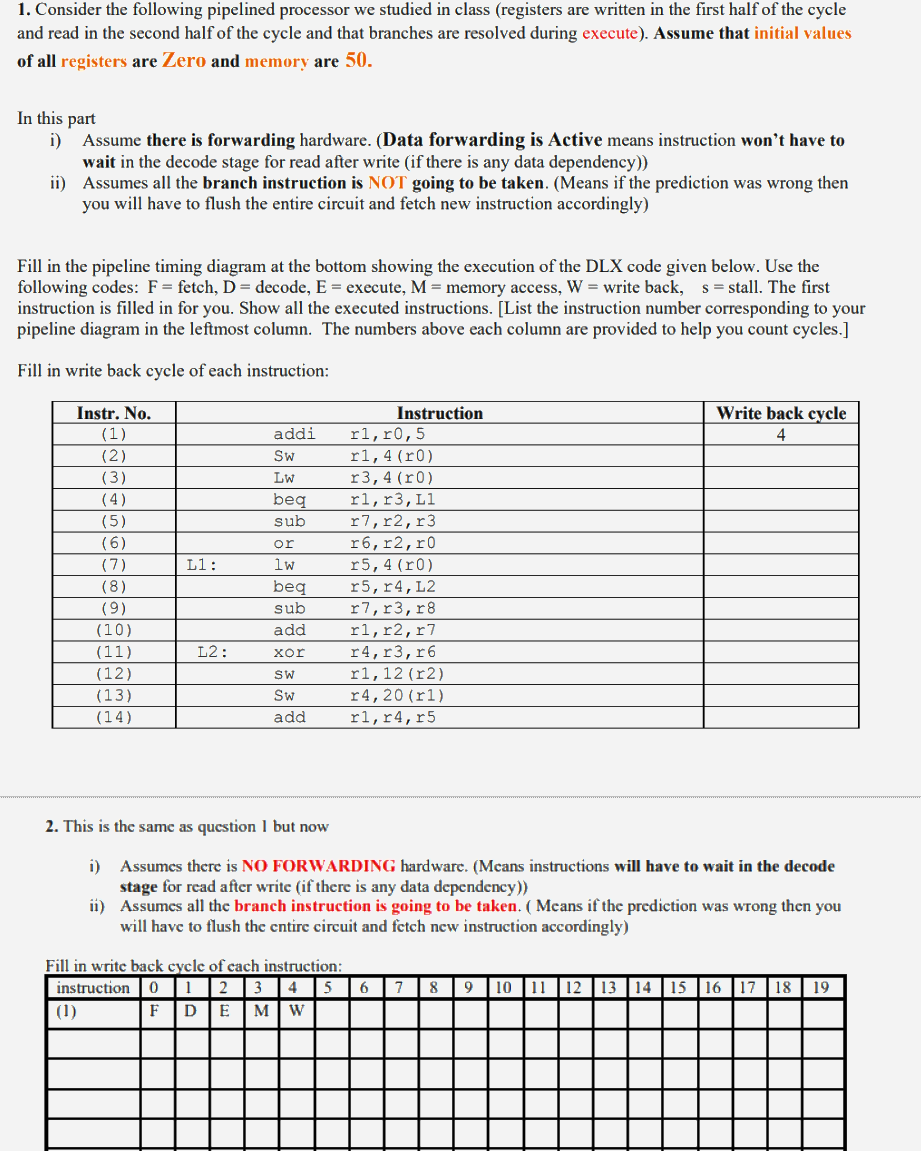
Consider the following pipelined processor we studied in class registers are written in the first half of the cycle and read in the second half of the cycle and that branches are resolved during execute Assume that initial values of all registers are Zero and memory are
In this part
i Assume there is forwarding hardware. Data forwarding is Active means instruction won't have to wait in the decode stage for read after write if there is any data dependency
ii Assumes all the branch instruction is NOT going to be taken. Means if the prediction was wrong then you will have to flush the entire circuit and fetch new instruction accordingly
Fill in the pipeline timing diagram at the bottom showing the execution of the DLX code given below. Use the following codes: fetch, decode, execute, memory access, write back, stall. The first instruction is filled in for you. Show all the executed instructions. List the instruction number corresponding to your pipeline diagram in the leftmost column. The numbers above each column are provided to help you count cycles.
Fill in write back cycle of each instruction:
tableInstr NoInstruction,Write back cycleaddi,rlrSwrrLWrrbeq,rrLsub,rrrorrrrL:rrbeq,rrLsub,rrradd,rrrxor,rrrSWrrSwrradd,rrr
This is the same as question I but now
i Assumes there is NO FORWARDING hardware. Mcans instructions will have to wait in the decode stage for read after write if there is any data dependency
ii Assumes all the branch instruction is going to be taken. Means if the prediction was wrong then you will have to flush the entire circuit and fetch new instruction accordingly
Fill in writc back cyclc of cach instruction:
tableinstructionFDEMW
Step by Step Solution
There are 3 Steps involved in it
1 Expert Approved Answer
Step: 1 Unlock

Question Has Been Solved by an Expert!
Get step-by-step solutions from verified subject matter experts
Step: 2 Unlock
Step: 3 Unlock
 Study Help