







Question: From the above case study Requirements Read the give information deeply and Drawing conclusions refers to information that is implied or inferred. ... Using these
From the above case study Requirements Read the give information deeply and Drawing conclusions refers to information that is implied or inferred. ... Using these clues to give for deeper understanding And provide the details Conclusions
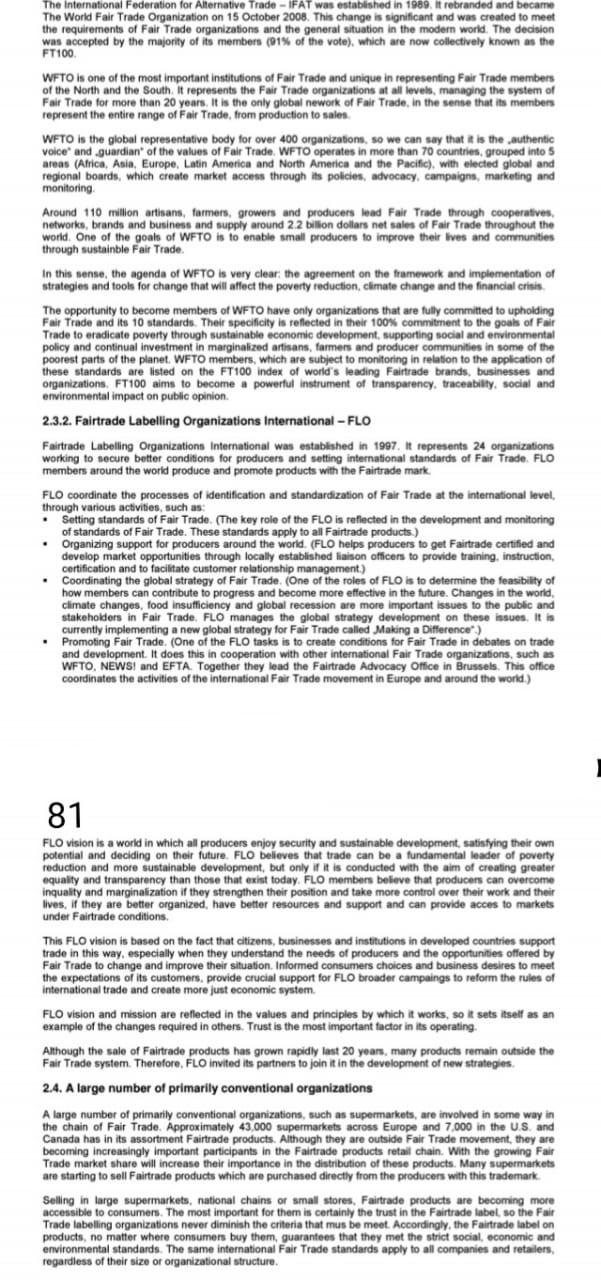
The International Federation for Alternative Trade-IFAT was established in 1989. It rebranded and became The World Fair Trade Organization on 15 October 2008. This change is significant and was created to meet the requirements of Fair Trade organizations and the general situation in the modern world. The decision was accepted by the majority of its members (91% of the vote), which are now collectively known as the FT100 WFTO is one of the most important institutions of Fair Trade and unique in representing Fair Trade members of the North and the South It represents the Fair Trade organizations at all levels, managing the system of Fair Trade for more than 20 years. It is the only global nework of Fair Trade in the sense that its members represent the entire range of Fair Trade from production to sales WFTO is the global representative body for over 400 organizations, so we can say that it is the authentic voice and guardians of the values of Fair Trade WFTO operates in more than 70 countries, grouped into 5 areas (Africa, Asia, Europe, Latin America and North America and the Pacific), with elected global and regional boards, which create market access through its policies, advocacy, campaigns, marketing and monitoring Around 110 million artisans, farmers, growers and producers lead Fair Trade through cooperatives networks, brands and business and supply around 2.2 billion dollars sales of Fair Trade throughout the world. One of the goals of WFTO is to enable small producers to improve their lives and communities through sustainble Fair Trade In this sense, the agenda of WFTO is very clear the agreement on the framework and implementation of strategies and tools for change that will affect the poverty reduction, climate change and the financial crisis The opportunity to become members of WFTO have only organizations that are fully committed to upholding Fair Trade and its 10 standards. Their specificity is reflected in their 100% commitment to the goals of Fair Trade to eradicate poverty through sustainable economic development, supporting social and environmental policy and continual investment in marginalized artisans, farmers and producer communities in some of the poorest parts of the planet. WFTO members, which are subject to monitoring in relation to the application of these standards are listed on the FT100 index of world's leading Fairtrade brands, businesses and organizations. FT100 aims to become a powerful Instrument of transparency, traceability, social and environmental impact on public opinion. 2.3.2. Fairtrade Labelling Organizations International - FLO Fairtrade Labelling Organizations International was established in 1997. It represents 24 organizations working to secure better conditions for producers and setting international standards of Fair Trade FLO members around the world produce and promote products with the Fairtrade mark FLO coordinate the processes of identification and standardization of Fair Trade at the international level, through various activities such as Setting standards of Fair Trade. (The key role of the FLO is reflected in the development and monitoring of standards of Fair Trade. These standards apply to all Fairtrade products.) Organizing support for producers around the world. (FLO helps producers to get Fairtrade certified and develop market opportunities through locally established liaison officers to provide training instruction, certification and to facilitate customer relationship management.) Coordinating the global strategy of Fair Trade (One of the roles of FLO is to determine the feasibility of how members can contribute to progress and become more effective in the future. Changes in the world, climate changes, food insufficiency and global recession are more important issues to the public and stakeholders in Fair Trade FLO manages the global strategy development on these issues. It is currently implementing a new global strategy for Fair Trade called Making a Difference") Promoting Fair Trade (One of the FLO tasks is to create conditions for Fair Trade in debates on trade and development. It does this in cooperation with other international Fair Trade organizations, such as WFTO, NEWS! and EFTA. Together they lead the Fairtrade Advocacy Office in Brussels. This office coordinates the activities of the international Fair Trade movement in Europe and around the world) . . 81 FLO vision is a world in which all producers enjoy security and sustainable development satisfying their own potential and deciding on their future. FLO believes that trade can be a fundamental leader of poverty reduction and more sustainable development, but only if it is conducted with the aim of creating greater equality and transparency than those that exist today. FLO members believe that producers can overcome inquality and marginalization if they strengthen their position and take more control over their work and their lives, if they are better organized, have better resources and support and can provide acces to markets under Fairtrade conditions. This FLO vision is based on the fact that citizens, businesses and institutions in developed countries support trade in this way, especially when they understand the needs of producers and the opportunities offered by Fair Trade to change and improve their situation. Informed consumers choices and business desires to meet the expectations of its customers, provide crucial support for FLO broader campaings to reform the rules of International trade and create more just economic system FLO vision and mission are reflected in the values and principles by which it works, so it sets itself as an example of the changes required in others. Trust is the most important factor in its operating Although the sale of Fairtrade products has grown rapidly fast 20 years, many products remain outside the Fair Trade system. Therefore, FLO invited its partners to join it in the development of new strategies. 2.4. A large number of primarily conventional organizations A large number of primarily conventional organizations, such as supermarkets, are involved in some way in the chain of Fair Trade. Approximately 43,000 supermarkets across Europe and 7.000 in the US, and Canada has in its assortment Fairtrade products. Although they are outside Fair Trade movement, they are becoming increasingly important participants in the Fairtrade products retail chain. With the growing Fair Trade market share will increase their importance in the distribution of these products. Many supermarkets are starting to sell Fairtrade products which are purchased directly from the producers with this trademark Selling in large supermarkets, national chains of small stores, Fairtrade products are becoming more accessible to consumers. The most important for them is certainly the trust in the Fairtrade label, so the Fair Trade labeling organizations never diminish the criteria that mus be meet. Accordingly, the Fairtrade label on products, no matter where consumers buy them, guarantees that they met the strict social, economic and environmental standards. The same international Fair Trade standards apply to all companies and retailers, regardless of their size or organizational structureStep by Step Solution
There are 3 Steps involved in it
1 Expert Approved Answer
Step: 1 Unlock

Question Has Been Solved by an Expert!
Get step-by-step solutions from verified subject matter experts
Step: 2 Unlock
Step: 3 Unlock
 Study Help