







Question: From the above case study Requirements Read the give information deeply and Drawing conclusions refers to information that is implied or inferred. ... Using these
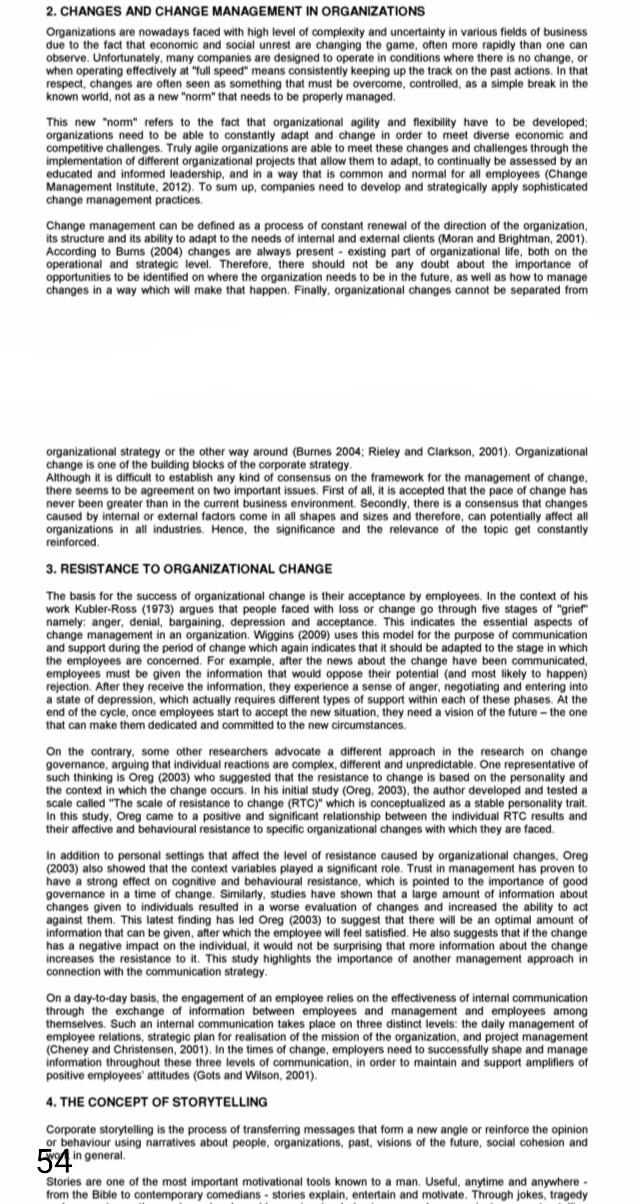
From the above case study Requirements Read the give information deeply and Drawing conclusions refers to information that is implied or inferred. ... Using these clues to give for deeper understanding And provide the details Conclusions
2. CHANGES AND CHANGE MANAGEMENT IN ORGANIZATIONS Organizations are nowadays faced with high level of complexity and uncertainty in various fields of business due to the fact that economic and social unrest are changing the game, often more rapidly than one can observe. Unfortunately, many companies are designed to operate in conditions where there is no change, or when operating effectively at "ull speed" means consistently keeping up the track on the past actions. In that respect, changes are often seen as something that must be overcome, controlled, as a simple break in the known world, not as a new "norm" that needs to be properly managed This new "norm" refers to the fact that organizational agility and flexibility have to be developed organizations need to be able to constantly adapt and change in order to meet diverse economic and competitive challenges. Truly agile organizations are able to meet these changes and challenges through the implementation of different organizational projects that allow them to adapt to continually be assessed by an educated and informed leadership, and in a way that is common and normal for all employees (Change Management Institute, 2012). To sum up, companies need to develop and strategically apply sophisticated change management practices Change management can be defined as a process of constant renewal of the direction of the organization, its structure and its ability to adapt to the needs of internal and external clients (Moran and Brightman, 2001) According to Burns (2004) changes are always present - existing part of organizational life, both on the operational and strategic level. Therefore, there should not be any doubt about the importance of opportunities to be identified on where the organization needs to be in the future, as well as how to manage changes in a way which will make that happen. Finally, organizational changes cannot be separated from organizational strategy or the other way around (Burnes 2004; Rieley and Clarkson, 2001), Organizational change is one of the building blocks of the corporate strategy Although it is difficult to establish any kind of consensus on the framework for the management of change, there seems to be agreement on two important issues. First of all, it is accepted that the pace of change has never been greater than in the current business environment. Secondly, there is a consensus that changes caused by intemal or external factors come in all shapes and sizes and therefore, can potentially affect all organizations in all industries. Hence, the significance and the relevance of the topic get constantly reinforced 3. RESISTANCE TO ORGANIZATIONAL CHANGE The basis for the success of organizational change is their acceptance by employees. In the context of his work Kubler-Ross (1973) argues that people faced with loss or change go through five stages of "grief namely: anger, denial, bargaining, depression and acceptance. This indicates the essential aspects of change management in an organization. Wiggins (2009) uses this model for the purpose of communication and support during the period of change which again indicates that it should be adapted to the stage in which the employees are concerned. For example, after the news about the change have been communicated, employees must be given the information that would oppose their potential and most likely to happen) rejection. After they receive the information, they experience a sense of anger, negotiating and entering into a state of depression, which actually requires different types of support within each of these phases. At the end of the cycle, once employees start to accept the new situation, they need a vision of the future the one that can make them dedicated and committed to the new circumstances On the contrary, some other researchers advocate a different approach in the research on change governance, arguing that individual reactions are complex, different and unpredictable. One representative of such thinking is Oreg (2003) who suggested that the resistance to change is based on the personality and the context in which the change occurs. In his initial study (Oreg, 2003), the author developed and tested a scale called "The scale of resistance to change (RTC)" which is conceptualized as a stable personality trait In this study, Oreg came to a positive and significant relationship between the individual RTC results and their affective and behavioural resistance to specific organizational changes with which they are faced In addition to personal settings that affect the level of resistance caused by organizational changes, Oreg (2003) also showed that the context variables played a significant role. Trust in management has proven to have a strong effect on cognitive and behavioural resistance, which is pointed to the importance of good governance in a time of change. Similarly, studies have shown that a large amount of information about changes given to individuals resulted in a worse evaluation of changes and increased the ability to act against them. This latest finding has led Oreg (2003) to suggest that there will be an optimal amount of information that can be given after which the employee will feel satisfied. He also suggests that if the change has a negative impact on the individual, it would not be surprising that more information about the change increases the resistance to it. This study highlights the importance of another management approach in connection with the communication strategy On a day-to-day basis, the engagement of an employee relies on the effectiveness of internal communication through the exchange of information between employees and management and employees among themselves. Such an internal communication takes place on three distinct levels: the daily management of employee relations, strategic plan for realisation of the mission of the organization, and project management (Cheney and Christensen, 2001). In the times of change, employers need to successfully shape and manage information throughout these three levels of communication, in order to maintain and support amplifiers of positive employees' attitudes (Gots and Wilson, 2001). 4. THE CONCEPT OF STORYTELLING 54" Corporate storytelling is the process of transferring messages that for a new angle or reinforce the opinion or behaviour using narratives about people, organizations, past, visions of the future, social cohesion and in general Stories are one of the most important motivational tools known to a man. Useful, anytime and anywhere - from the Bible to contemporary comedians stories explain, entertain and motivate. Through jokes, tragedyStep by Step Solution
There are 3 Steps involved in it
1 Expert Approved Answer
Step: 1 Unlock

Question Has Been Solved by an Expert!
Get step-by-step solutions from verified subject matter experts
Step: 2 Unlock
Step: 3 Unlock
 Study Help