







Question: From the above case study Requirements Read the give information deeply and Drawing conclusions refers to information that is implied or inferred. ... Using these
From the above case study Requirements Read the give information deeply and Drawing conclusions refers to information that is implied or inferred. ... Using these clues to give for deeper understanding And provide the details Conclusions
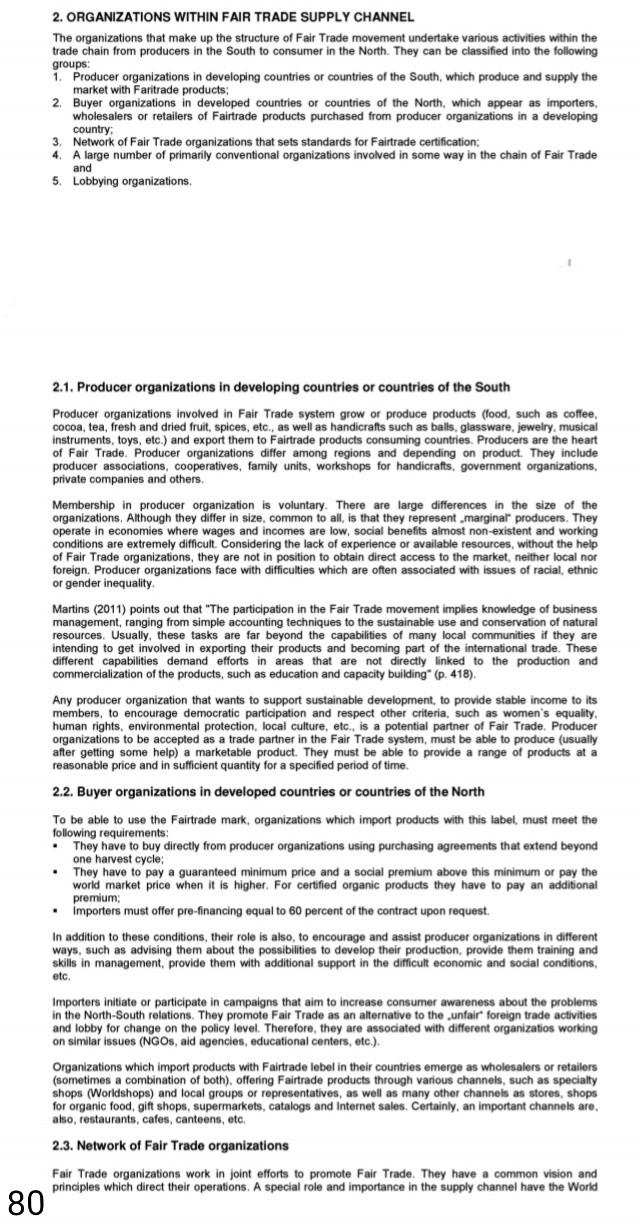
2. ORGANIZATIONS WITHIN FAIR TRADE SUPPLY CHANNEL The organizations that make up the structure of Fair Trade movement undertake various activities within the trade chain from producers in the South to consumer in the North. They can be classified into the following groups: Producer organizations in developing countries or countries of the South, which produce and supply the market with Faritrade products: 2. Buyer organizations in developed countries or countries of the North, which appear as importers, wholesalers or retailers of Fairtrade products purchased from producer organizations in a developing country 3. Network of Fair Trade organizations that sets standards for Fairtrade certification: 4 A large number of primarily conventional organizations involved in some way in the chain of Fair Trade and 5. Lobbying organizations 2.1. Producer organizations in developing countries or countries of the South Producer organizations involved in Fair Trade system grow or produce products (food, such as coffee, cocoa, tea, fresh and dried fruit, spices, etc., as well as handicrafts such as balls, glassware, jewelry, musical instruments, toys, etc.) and export them to Fairtrade products consuming countries. Producers are the heart of Fair Trade. Producer organizations differ among regions and depending on product. They include producer associations, cooperatives, family units, workshops for handicrafts, government organizations, private companies and others Membership in producer organization is voluntary. There are large differences in the size of the organizations. Although they differ in size, common to all, is that they represent marginal producers. They operate in economies where wages and incomes are low, social benefits almost non-existent and working conditions are extremely difficult. Considering the lack of experience or available resources, without the help of Fair Trade organizations, they are not in position to obtain direct access to the market, neither local nor foreign. Producer organizations face with difficulties which are often associated with issues of racial, ethnic or gender inequality Martins (2011) points out that "The participation in the Fair Trade movement implies knowledge of business management, ranging from simple accounting techniques to the sustainable use and conservation of natural resources. Usually, these tasks are far beyond the capabilities of many local communities if they are intending to get involved in exporting their products and becoming part of the international trade. These different capabilities demand efforts in areas that are not directly linked to the production and commercialization of the products, such as education and capacity building" (p. 418) Any producer organization that wants to support sustainable development, to provide stable income to its members, to encourage democratic participation and respect other criteria, such as women's equality human rights, environmental protection, local culture, etc., is a potential partner of Fair Trade. Producer organizations to be accepted as a trade partner in the Fair Trade system, must be able to produce (usually after getting some help) a marketable product. They must be able to provide a range of products at a reasonable price and in sufficient quantity for a specified period of time. 2.2. Buyer organizations in developed countries or countries of the North To be able to use the Fairtrade mark, organizations which import products with this label, must meet the following requirements: They have to buy directly from producer organizations using purchasing agreements that extend beyond one harvest cycle; They have to pay a guaranteed minimum price and a social premium above this minimum or pay the world market price when it is higher. For certified organic products they have to pay an additional premium Importers must offer pre-financing equal to 60 percent of the contract upon request. In addition to these conditions, their role is also, to encourage and assist producer organizations in different ways, such as advising them about the possibilities to develop their production, provide them training and skills in management, provide them with additional support in the difficult economic and social conditions, etc. Importers initiate or participate in campaigns that aim to increase consumer awareness about the problems in the North-South relations. They promote Fair Trade as an alternative to the unfair foreign trade activities and lobby for change on the policy level. Therefore, they are associated with different organizatios working on similar issues (NGOs, aid agencies, educational centers, etc.), Organizations which import products with Fairtrade lebel in their countries emerge as wholesalers or retailers (sometimes a combination of both), offering Fairtrade products through various channels, such as specialty shops (Worldshops) and local groups or representatives, as well as many other channels as stores, shops for organic food, gift shops, supermarkets, catalogs and Internet sales. Certainly, an important channels are, also, restaurants, cafes, canteens, etc. 2.3. Network of Fair Trade organizations Fair Trade organizations work in joint efforts to promote Fair Trade. They have a common vision and principles which direct their operations. A special role and importance in the supply channel have the World 80Step by Step Solution
There are 3 Steps involved in it
1 Expert Approved Answer
Step: 1 Unlock

Question Has Been Solved by an Expert!
Get step-by-step solutions from verified subject matter experts
Step: 2 Unlock
Step: 3 Unlock
 Study Help