







Question: From the above case study Requirements Read the give information deeply and Drawing conclusions refers to information that is implied or inferred. ... Using these
From the above case study Requirements Read the give information deeply and Drawing conclusions refers to information that is implied or inferred. ... Using these clues to give for deeper understanding And provide the details Conclusions
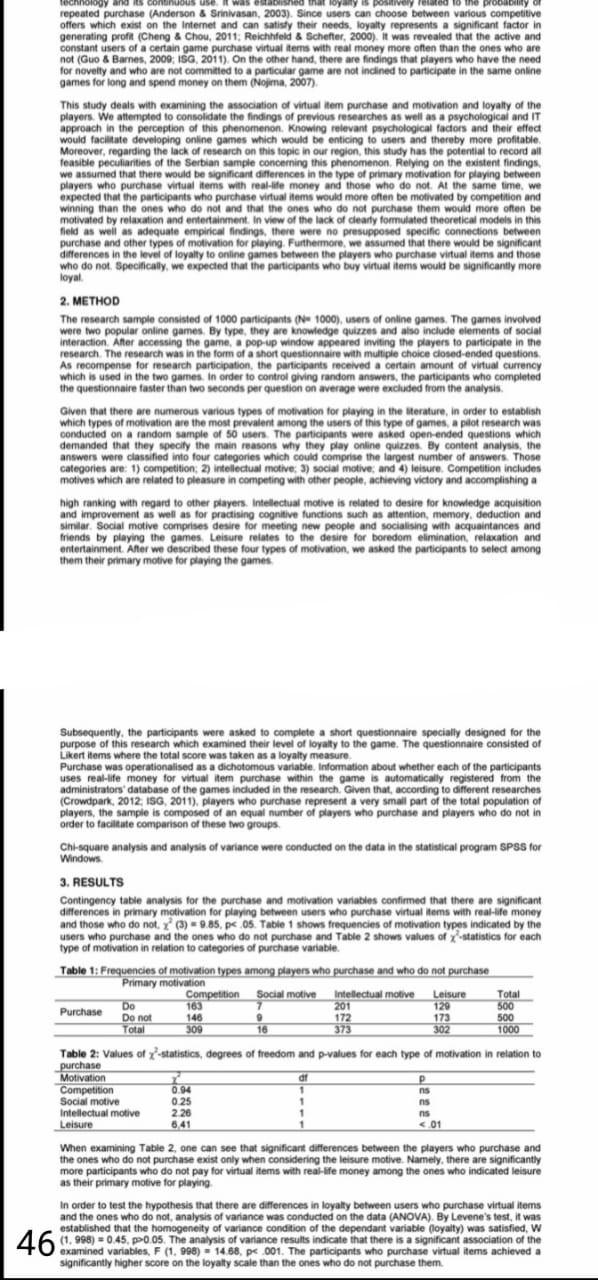
echnology and its conunuous use was one that loyany positively related to the proof repeated purchase (Anderson & Srinivasan, 2003). Since users can choose between various competitive offers which exist on the Internet and can satisfy their needs, loyalty represents a significant factor in generating profit (Cheng & Chou, 2011; Reichhfeld & Scheffer, 2000). It was revealed that the active and constant users of a certain game purchase virtual terns with real money more often than the ones who are not (Guo & Barnes, 2009. ISG, 2011). On the other hand, there are findings that players who have the need for novelty and who are not committed to a particular game are not inclined to participate in the same online games for long and spend money on them (Nojima, 2007) This study deals with examining the association of virtual item purchase and motivation and loyalty of the players. We attempted to consolidate the findings of previous researches as well as a psychological and IT approach in the perception of this phenomenon. Knowing relevant psychological factors and their effect would facilitate developing online games which would be enticing to users and thereby more profitable. Moreover, regarding the lack of research on this topic in our region, this study has the potential to record all feasible peculiarities of the Serbian sample concerning this phenomenon. Relying on the existent findings we assumed that there would be significant differences in the type of primary motivation for playing between players who purchase virtual items with real-life money and those who do not. At the same time, we expected that the participants who purchase virtual items would more often be motivated by competition and winning than the ones who do not and that the ones who do not purchase them would more often be motivated by relaxation and entertainment. In view of the lack of clearly formulated theoretical models in this field as well as adequate empirical findings, there were no presupposed specific connections between purchase and other types of motivation for playing. Furthermore, we assumed that there would be significant differences in the level of loyalty to online games between the players who purchase virtual items and those who do not. Specifically, we expected that the participants who buy virtual items would be significantly more loyal 2. METHOD The research sample consisted of 1000 participants (1000), users of online games. The games involved were two popular online games. By type, they are knowledge quizzes and also include elements of social research. The research was in the form of a short questionnaire with multiple choice closed ended questions , a As recompense for research participation, the participants received a certain amount of virtual currency which is used in the two games. In order to control giving random answers, the participants who completed the questionnaire faster than two seconds per question on average were excluded from the analysis Given that there are numerous various types of motivation for playing in the literature, in order to establish which types of motivation are the most prevalent among the users of this type of games, a pilot research was conducted on a random sample of 50 users. The participants were asked open-ended questions which demanded that they specify the main reasons why they play online quizzes. By content analysis, the answers were classified into four categories which could comprise the largest number of answers. Those categories are: 1) competition: 2) intellectual motive: 3) social motive, and 4) leisure Competition includes motives which are related to pleasure in competing with other people, achieving victory and accomplishing a high ranking with regard to other players. Intellectual motive is related to desire for knowledge acquisition and improvement as well as for practising cognitive functions such as attention, memory, deduction and similar. Social motive comprises desire for meeting new people and socialising with acquaintances and friends by playing the games. Leisure relates to the desire for boredom elimination, relaxation and entertainment. Alter we described these four types of motivation, we asked the participants to select among them their primary motive for playing the games Subsequently, the participants were asked to complete a short questionnaire specially designed for the purpose of this research which examined their level of loyalty to the game. The questionnaire consisted of Likert items where the total score was taken as a loyalty measure Purchase was operationalised as a dichotomous variable. Information about whether each of the participants uses real-life money for virtual item purchase within the game is automatically registered from the administrators database of the games included in the research. Given that, according to different researches (Crowdpark, 2012, ISG, 2011), players who purchase represent a very small part of the total population of players, the sample is composed of an equal number of players who purchase and players who do not in order to facilitate comparison of these two groups Chi-square analysis and analysis of variance were conducted on the data in the statistical program SPSS for Windows 3. RESULTS Contingency table analysis for the purchase and motivation variables confirmed that there are significant differences in primary motivation for playing between users who purchase virtual items with real-life money and those who do not X (3) - 985, pStep by Step Solution
There are 3 Steps involved in it
1 Expert Approved Answer
Step: 1 Unlock

Question Has Been Solved by an Expert!
Get step-by-step solutions from verified subject matter experts
Step: 2 Unlock
Step: 3 Unlock
 Study Help