







Question: From the above case study Requirements Read the give information deeply and Drawing conclusions refers to information that is implied or inferred. ... Using these
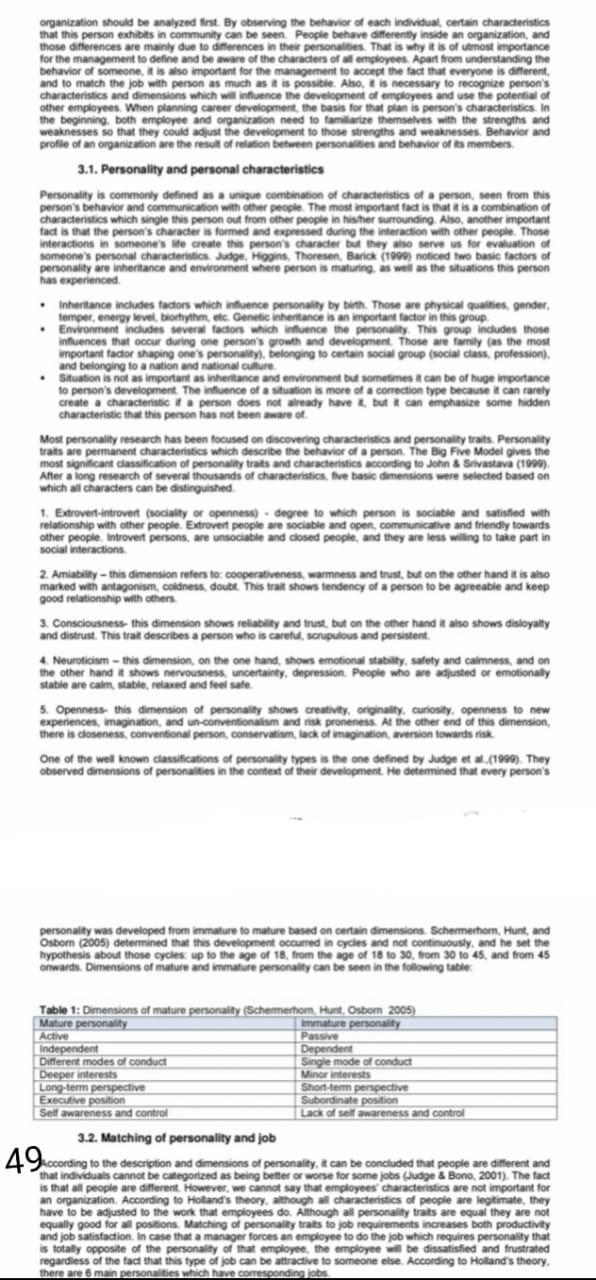
From the above case study Requirements Read the give information deeply and Drawing conclusions refers to information that is implied or inferred. ... Using these clues to give for deeper understanding And provide the details Conclusions
organization should be analyzed first. By observing the behavior of each individual certain characteristics that this person exhibits in community can be seen People behave differently inside an organization, and those differences are mainly due to differences in the personalities. That is why it is of utmost importance for the management to define and be aware of the characters of employees. Apart from understanding the behavior of someone is also important for the management to accept the fact that everyone is different, and to match the job with person as much as it is possible. Also, t is necessary to recognize person's characteristics and dimensions which will influence the development of employees and use the potential of other employees. When planning career development, the basis for that plan is person's characteristics. In the beginning, both employee and organization need to familiarize themselves with the strengths and weaknesses so that they could adjust the development to those strengths and weaknesses. Behavior and profile of an organization are the result of relation between personalities and behavior ofta members 3.1. Personality and personal characteristics Personality is commonly defined as a unique combination of characteristics of a person, seen from this person's behavior and communication with other people. The most important fad is that it is a combination of characteristics which single this person out from other people in hisher surrounding. Also, another important fact is that the person's character is formed and expressed during the interaction with other people. Those interactions in someone's We create this person's character but they also serve us for evaluation of someone's personal characteristics Judge. Higgins, Thoresen, Barick (1990) noticed two basic factors of personality are inheritance and environment where person is maturing, as well as the situations this person has experienced Inheritance includes factors which influence personality by birth. Those are physical qualities, gender, temper, energy level. Dortythm, etc Genetic inheritance is an important factor in this group Environment includes several factors which infoence the personality. This group includes those influences that occur during one person's growth and development. Those are family as the most important factor shaping ones personality), belonging to certain social group (social class, profession), and belonging to a nation and national culture Situation is not as important as inheritance and environment but sometimes it can be of huge mportance to person's development. The influence of a situation is more of a correction type because it can rarely create a characteristica person does not already have but I can emphasize some hidden characteristic that this person has not been ware of Most personality research has been focused on discovering characteristics and personality traits. Personality traits are permanent characteristics which describe the behavior of a person. The Big Five Model gives the most significant classification of personality traits and characteristics according to John & Srivastava (1999) After a long research of several thousands of characteristics, five basic dimensions were selected based on which all characters can be distinguished 1. Extrovert-introvert (sociality or openness) - degree to which personissociable and satisfied with relationship with other people. Extrovert people are sociable and open, communicative and friendly towards other people. Introvert persons, are un sociable and closed people, and they are less willing to take part in social interactions 2. Amiability - this dimension refers to cooperativeness, warmness and trust, but on the other hand it is also marked with antagonism. coldness, doubt. This trait shows tendency of a person to be agreeable and keep good relationship with others 3. Consciousness this dimension shows reliability and trust, but on the other hand also shows disloyalty and distrust. This trat describes a person who is careful, scrupulous and persistent. 4 Neuroticism - this dimension, on the one hand, shows emotional stability, safety and calmness, and on the other hand shows nervousness uncertainty, depression. People who are adjusted or emotionally stable are calm, stable, relaxed and feel safe 5. Openness this dimension of personality shows creativity, originality, curiosity, openness to new experiences, Imagination, and un-conventionalism and risk proneness. At the other end of this dimension, there is closeness, conventional person, conservatism, lack of imagination, aversion towards risk One of the well known classifications of personality types is the one defined by Judge et al. (1999). They observed dimensions of personalities in the context of their development. He determined that every person's personality was developed from immature to mature based on certain dimensions. Schermerhorn, Hunt, and Osbor (2005) determined that this development occurred in cycles and not continuously and he set the hypothesis about those cycles up to the age of 18. from the age of 18 to 30 from 30 to 45, and from 45 onwards. Dimensions of mature and immature personality can be seen in the following table: Table 1: Dimensions of mature personality (Schermerhom, Hunt Osborn 2005) Mature personality Immature personality Active Passive Independent Dependent Different modes of conduct Single mode of conduct Deeper interests Minor interests Long-term perspective Short-term perspective Executive position Subordinate position Self awareness and control Lack of sell awareness and control 3.2. Matching of personality and job According to the description and dimensions of personality, it can be concluded that people are different and that individuals cannot be categorized as being better or worse for some jobs (Judge & Bono, 2001). The fact is that all people are different. However, we cannot say that employees characteristics are not important for an organization. According to Holland's theory, although all characteristics of people are legitimate, they have to be adjusted to the work that employees do Although all personality traits are equal they are not equally good for all positions Matching of personality traits to job requirements increases both productivity and job satisfaction. In case that a manager forces an employee to do the job which requires personality that is totally opposite of the personality of that employee, the employee wil be dissatisfied and frustrated regardless of the fact that this type of job can be attractive to someone else. According to Holand's theory, there are 6 main personalities which have corresponding jobs 49Step by Step Solution
There are 3 Steps involved in it
1 Expert Approved Answer
Step: 1 Unlock

Question Has Been Solved by an Expert!
Get step-by-step solutions from verified subject matter experts
Step: 2 Unlock
Step: 3 Unlock
 Study Help