







Question: From the above case study Requirements Read the give information deeply and Drawing conclusions refers to information that is implied or inferred. ... Using these
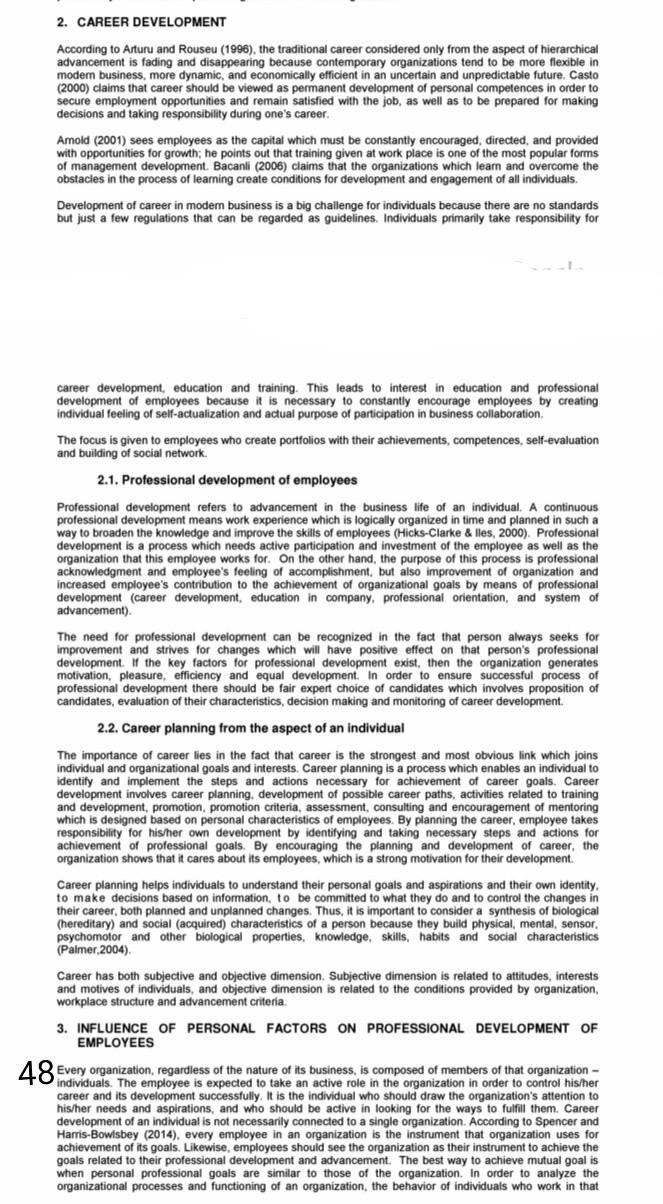
From the above case study Requirements Read the give information deeply and Drawing conclusions refers to information that is implied or inferred. ... Using these clues to give for deeper understanding And provide the details Conclusions
2. CAREER DEVELOPMENT According to Arturu and Rouseu (1996), the traditional career considered only from the aspect of hierarchical advancement is fading and disappearing because contemporary organizations tend to be more flexible in modem business, more dynamic, and economically efficient in an uncertain and unpredictable future. Casto (2000) claims that career should be viewed as permanent development of personal competences in order to secure employment opportunities and remain satisfied with the job, as well as to be prepared for making decisions and taking responsibility during one's career Amold (2001) sees employees as the capital which must be constantly encouraged, directed, and provided with opportunities for growth; he points out that training given at work place one of the most popular forms of management development. Bacanli (2006) claims that the organizations which leam and overcome the obstacles in the process of learning create conditions for development and engagement of all individuals Development of career in modern business is a big challenge for individuals because there are no standards but just a few regulations that can be regarded as guidelines. Individuals primarily take responsibility for career development, education and training. This leads to interest in education and professional development of employees because it is necessary to constantly encourage employees by creating individual feeling of self-actualization and actual purpose of participation in business collaboration The focus is given to employees who create portfolios with their achievements, competences, self-evaluation and building of social network 2.1. Professional development of employees Professional development refers to advancement in the business life of an individual. A continuous professional development means work experience which is logically organized in time and planned in such a way to broaden the knowledge and improve the skills of employees (Hicks-Clarke & lles, 2000). Professional development is a process which needs active participation and investment of the employee as well as the organization that this employee works for. On the other hand, the purpose of this process is professional acknowledgment and employee's feeling of accomplishment, but also improvement of organization and increased employee's contribution to the achievement of organizational goals by means of professional development (career development, education in company, professional orientation, and system of advancement). The need for professional development can be recognized in the fact that person always seeks for improvement and strives for changes which will have positive effect on that person's professional development. If the key factors for professional development exist, then the organization generates motivation, pleasure, efficiency and equal development. In order to ensure successful process of professional development there should be fair expert choice of candidates which involves proposition of candidates, evaluation of their characteristics, decision making and monitoring of career development. 2.2. Career planning from the aspect of an individual The importance of career lies in the fact that career is the strongest and most obvious link which joins individual and organizational goals and interests. Career planning is a process which enables an individual to identify and implement the steps and actions necessary for achievement of career goals. Career development involves career planning, development of possible career paths, activities related to training and development, promotion, promotion criteria, assessment, consulting and encouragement of mentoring which is designed based on personal characteristics of employees. By planning the career, employee takes responsibility for his/her own development by identifying and taking necessary steps and actions for achievement of professional goals. By encouraging the planning and development of career, the organization shows that it cares about its employees, which is a strong motivation for their development. Career planning helps individuals to understand their personal goals and aspirations and their own identity. to make decisions based on information, to be committed to what they do and to control the changes in their career, both planned and unplanned changes. Thus, it is important to consider a synthesis of biological (hereditary) and social (acquired) characteristics of a person because they build physical, mental, sensor, psychomotor and other biological properties, knowledge, skills, habits and social characteristics (Palmer, 2004) Career has both subjective and objective dimension. Subjective dimension is related to attitudes, interests and motives of individuals, and objective dimension is related to the conditions provided by organization, workplace structure and advancement criteria. 3. INFLUENCE OF PERSONAL FACTORS ON PROFESSIONAL DEVELOPMENT OF EMPLOYEES 48 Every organization, regardless of the nature of its business, is composed members of that organization - individuals. The employee is expected to take an active role in the organization in order to control his/her career and its development successfully. It is the individual who should draw the organization's attention to his/her needs and aspirations, and who should be active in looking for the ways to fulfill them. Career development of an individual is not necessarily connected to a single organization. According to Spencer and Harris-Bowisbey (2014), every employee in an organization is the instrument that organization uses for achievement of its goals. Likewise, employees should see the organization as their instrument to achieve the goals related to their professional development and advancement. The best way to achieve mutual goal is when personal professional goals are similar to those of the organization. In order to analyze the organizational processes and functioning of an organization, the behavior of individuals who work in thatStep by Step Solution
There are 3 Steps involved in it
1 Expert Approved Answer
Step: 1 Unlock

Question Has Been Solved by an Expert!
Get step-by-step solutions from verified subject matter experts
Step: 2 Unlock
Step: 3 Unlock
 Study Help