







Question: From the above case study Requirements Read the give information deeply and Drawing conclusions refers to information that is implied or inferred. ... Using these
From the above case study Requirements Read the give information deeply and Drawing conclusions refers to information that is implied or inferred. ... Using these clues to give for deeper understanding And provide the details Conclusions
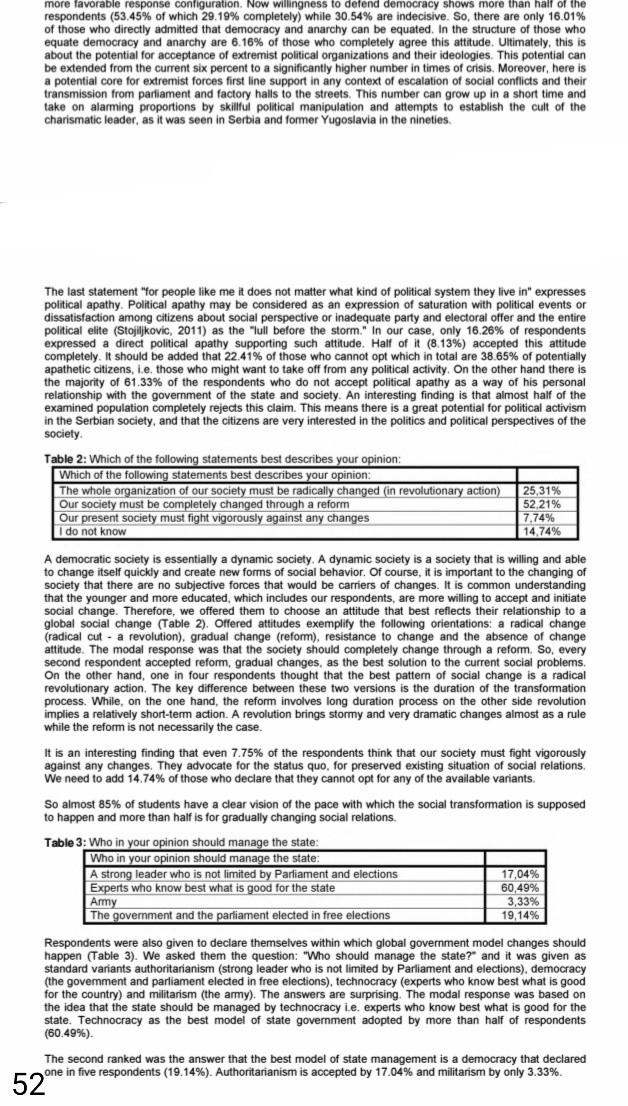
more favorable response configuration. Now willingness to defend democracy shows more than half of the respondents (53.45% of which 29.19% completely) while 30.54% are indecisive. So, there are only 16.01% of those who directly admitted that democracy and anarchy can be equated. In the structure of those who equate democracy and anarchy are 6.16% of those who completely agree this attitude. Ultimately, this is about the potential for acceptance of extremist political organizations and their ideologies. This potential can be extended from the current six percent to a significantly higher number in times of crisis. Moreover, here is a potential core for extremist forces first line support in any context of escalation of social conflicts and their transmission from parliament and factory halls to the streets. This number can grow up in a short time and take on alarming proportions by skillful political manipulation and attempts to establish the cult of the charismatic leader, as it was seen in Serbia and former Yugoslavia in the nineties The last statement "for people like me it does not matter what kind of political system they live in" expresses political apathy. Political apathy may be considered as an expression of saturation with political events or dissatisfaction among citizens about social perspective or inadequate party and electoral offer and the entire political elite (Stojiljkovic, 2011) as the "lull before the storm." In our case, only 16.26% of respondents expressed a direct political apathy supporting such attitude. Hall of it (8.13%) accepted this attitude completely. It should be added that 22.41% of those who cannot opt which in total are 38.65% of potentially apathetic citizens, i.e. those who might want to take off from any political activity. On the other hand there is the majority of 61.33% of the respondents who do not accept political apathy as a way of his personal relationship with the government of the state and society. An interesting finding is that almost half of the examined population completely rejects this claim. This means there is a great potential for political activism in the Serbian society, and that the citizens are very interested in the politics and political perspectives of the society Table 2: Which of the following statements best describes your opinion: Which of the following statements best describes your opinion: The whole organization of our society must be radically changed in revolutionary action) Our society must be completely changed through a reform Our present society must fight vigorously against any changes I do not know 25,31% 52,21% 7,74% 14,74% A democratic society is essentially a dynamic society. A dynamic society is a society that willing and able to change itself quickly and create new forms of social behavior. Of course, it is important to the changing of society that there are no subjective forces that would be carriers of changes. It is common understanding that the younger and more educated, which includes our respondents, are more willing to accept and initiate social change. Therefore, we offered them to choose an attitude that best reflects their relationship to a global social change (Table 2). Offered attitudes exemplify the following orientations: a radical change (radical cut - a revolution), gradual change (reform), resistance to change and the absence of change attitude. The modal response was that the society should completely change through a reform. So, every second respondent accepted reform, gradual changes, as the best solution to the current social problems. On the other hand, one in four respondents thought that the best pattern of social change is a radical revolutionary action. The key difference between these two versions is the duration of the transformation process. While, on the one hand, the reform involves long duration process on the other side revolution implies a relatively short-term action. A revolution brings stormy and very dramatic changes almost as a rule while the reform is not necessarily the case. It is an interesting finding that even 7.75% of the respondents think that our society must fight vigorously against any changes. They advocate for the status quo, for preserved existing situation of social relations We need to add 14.74% of those who declare that they cannot opt for any of the available variants. So almost 85% of students have a clear vision of the pace with which the social transformation is supposed to happen and more than half is for gradually changing social relations. Table 3: Who in your opinion should manage the state: Who in your opinion should manage the state strong who is not ited by Parliament and elections 17,04% Experts who know best what is good for the state 60,49% Army 3,33% The government and the parliament elected in free elections 19,14% Respondents were also given to declare themselves within which global government model changes should happen (Table 3). We asked them the question: "Who should manage the state?" and it was given as standard variants authoritarianism (strong leader who is not limited by Parliament and elections), democracy (the government and parliament elected in free elections), technocracy (experts who know best what is good for the country) and militarism (the army). The answers are surprising. The modal response was based on the idea that the state should be managed by technocracy i.e. experts who know best what is good for the state. Technocracy as the best model of state government adopted by more than half of respondents (60.49%). The second ranked was the answer that the best model of state management is a democracy that declared one in five respondents (19.14%). Authoritarianism is accepted by 17.04% and militarism by only 3.33% 52Step by Step Solution
There are 3 Steps involved in it
1 Expert Approved Answer
Step: 1 Unlock

Question Has Been Solved by an Expert!
Get step-by-step solutions from verified subject matter experts
Step: 2 Unlock
Step: 3 Unlock
 Study Help