







Question: In this exercise, you'll be working with a simplified assembly language that has three registers (R0, R1, and R2) and a few basic instructions.
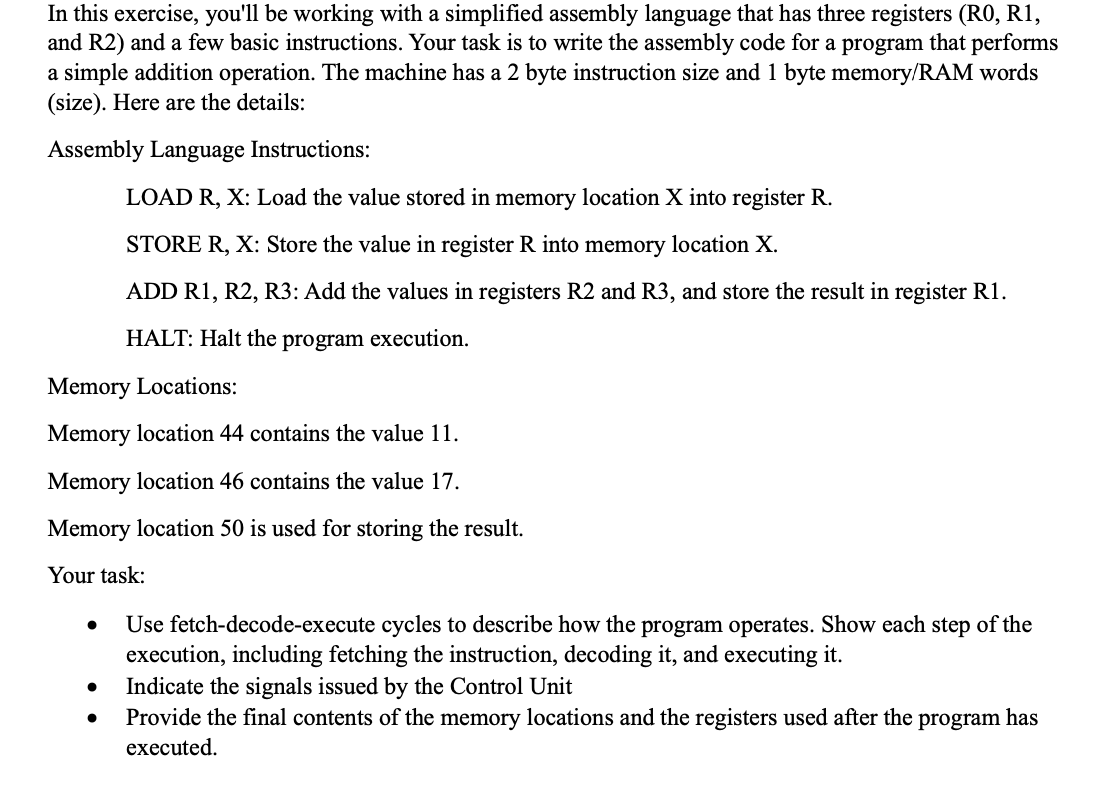
In this exercise, you'll be working with a simplified assembly language that has three registers (R0, R1, and R2) and a few basic instructions. Your task is to write the assembly code for a program that performs a simple addition operation. The machine has a 2 byte instruction size and 1 byte memory/RAM words (size). Here are the details: Assembly Language Instructions: LOAD R, X: Load the value stored in memory location X into register R. STORE R, X: Store the value in register R into memory location X. Memory Locations: Memory location 44 contains the value 11. Memory location 46 contains the value 17. Memory location 50 is used for storing the result. Your task: ADD R1, R2, R3: Add the values in registers R2 and R3, and store the result in register R1. HALT: Halt the program execution. Use fetch-decode-execute cycles to describe how the program operates. Show each step of the execution, including fetching the instruction, decoding it, and executing it. Indicate the signals issued by the Control Unit Provide the final contents of the memory locations and the registers used after the program has executed.
Step by Step Solution
There are 3 Steps involved in it
To perform the simple addition operation using the provided assembly language instructions and memor... View full answer

Get step-by-step solutions from verified subject matter experts
 Study Help