







Question: mcq - please answer all the questions 1. When managers present a job applicant with an event that is likely to occur on the job
mcq - please answer all the questions 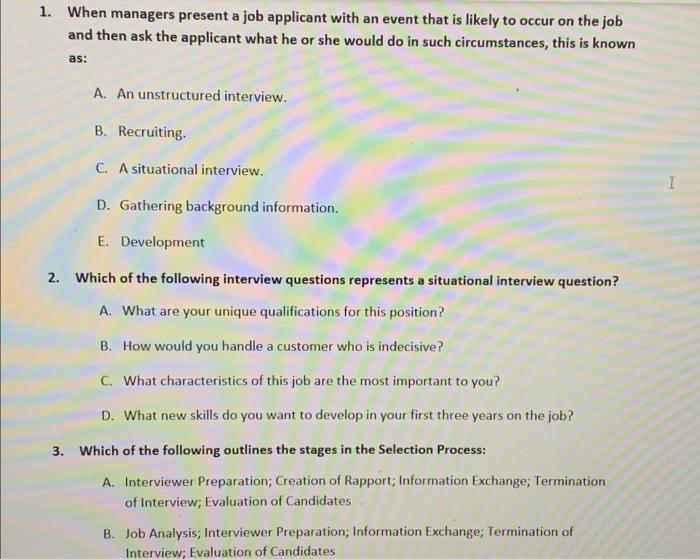
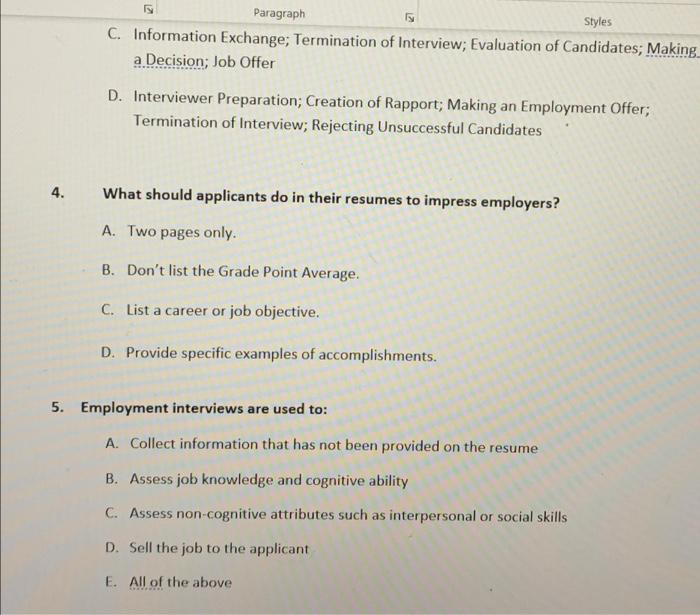
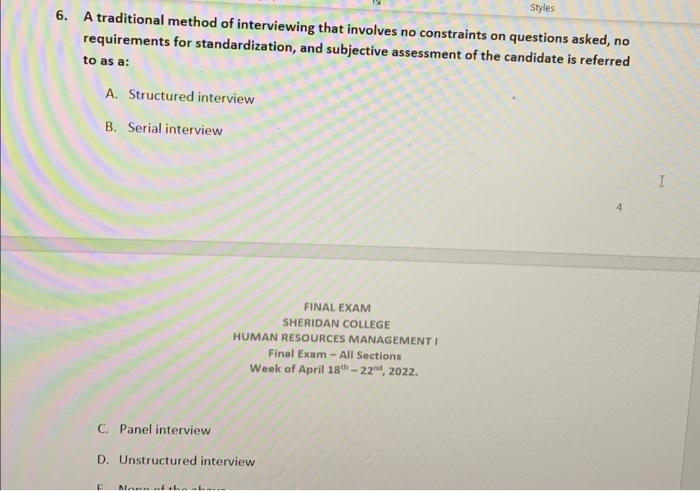
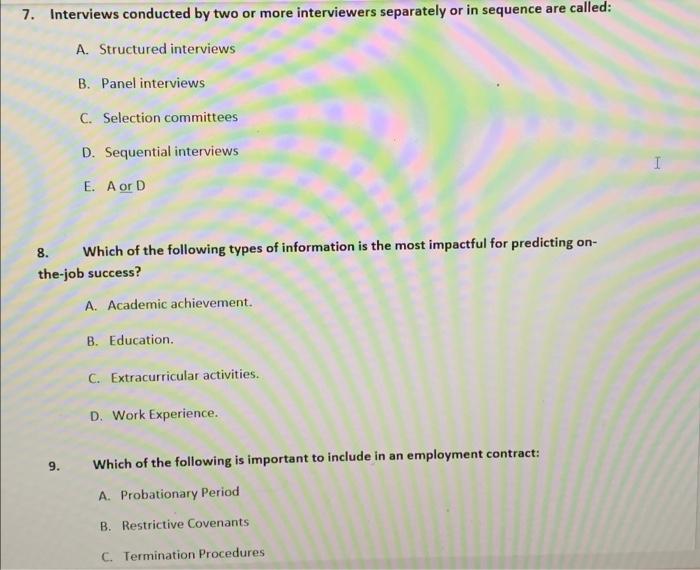
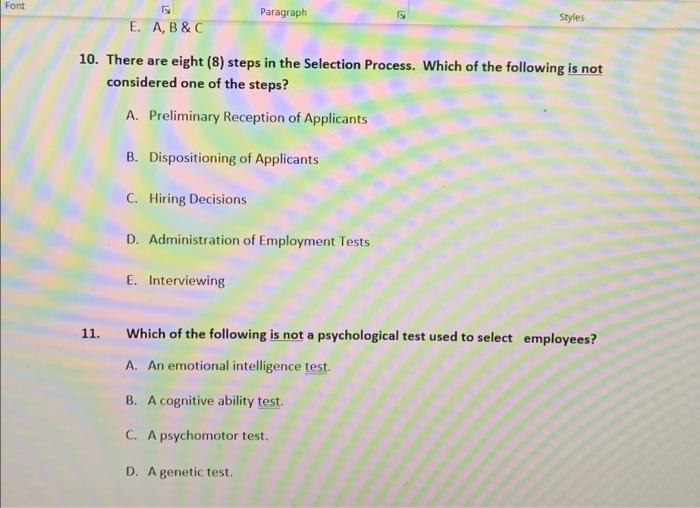
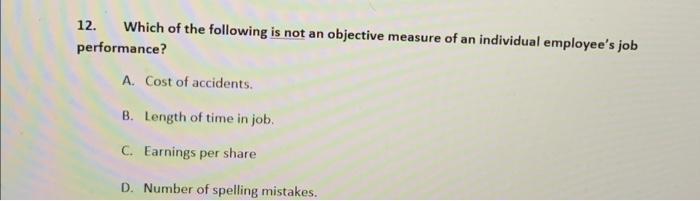
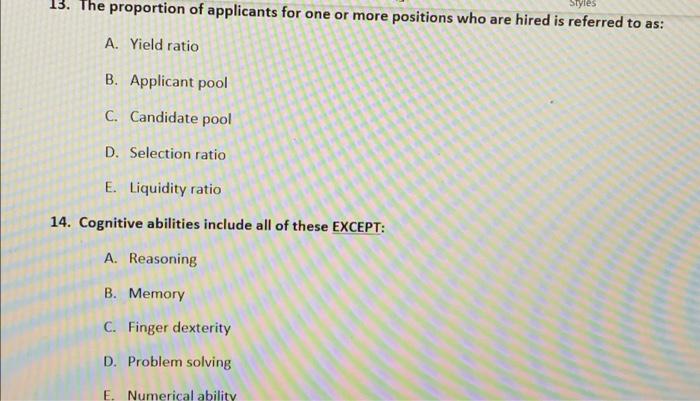
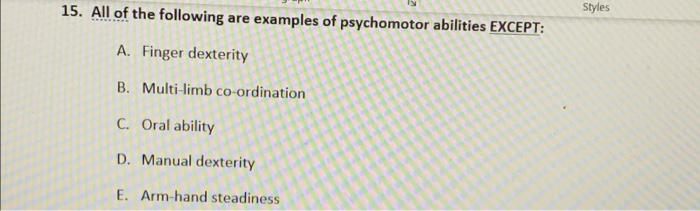
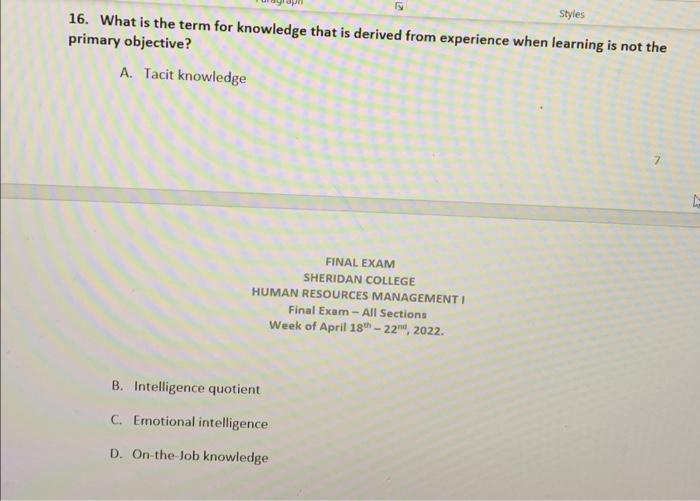
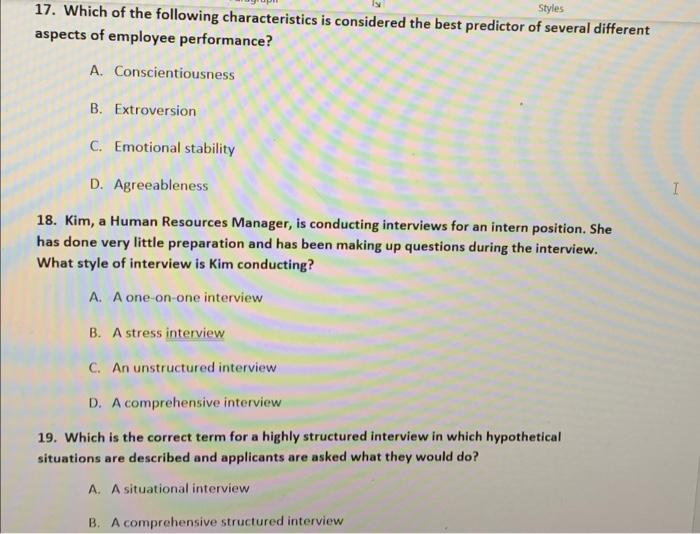
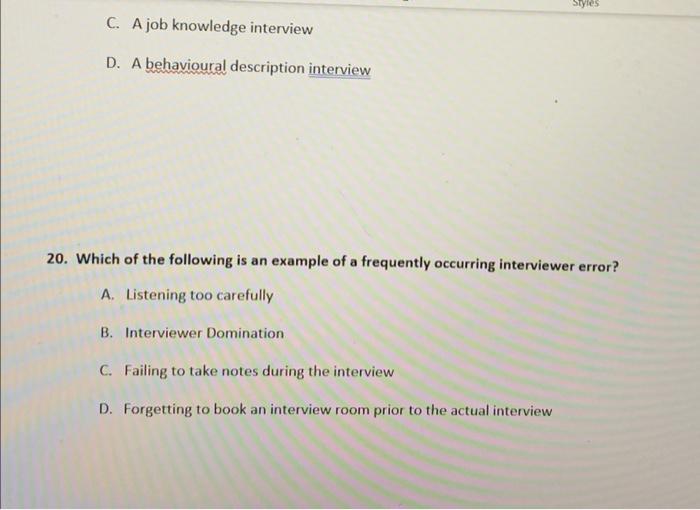
1. When managers present a job applicant with an event that is likely to occur on the job and then ask the applicant what he or she would do in such circumstances, this is known as: A. An unstructured interview. B. Recruiting C. A situational interview. I D. Gathering background information. E Development 2. Which of the following interview questions represents a situational interview question? A. What are your unique qualifications for this position? B. How would you handle a customer who is indecisive? C. What characteristics of this job are the most important to you? D. What new skills do you want to develop in your first three years on the job? 3. Which of the following outlines the stages in the Selection Process: A. Interviewer Preparation; Creation of Rapport; Information Exchange; Termination of Interview; Evaluation of Candidates B. Job Analysis; Interviewer Preparation; Information Exchange; Termination of Interview; Evaluation of Candidates Paragraph Styles C. Information Exchange; Termination of Interview; Evaluation of Candidates; Making. a Decision; Job Offer D. Interviewer Preparation; Creation of Rapport; Making an Employment Offer; Termination of Interview; Rejecting Unsuccessful Candidates 4. What should applicants do in their resumes to impress employers? A. Two pages only. B. Don't list the Grade Point Average. C. List a career or job objective. D. Provide specific examples of accomplishments. 5. Employment interviews are used to: A. Collect information that has not been provided on the resume B. Assess job knowledge and cognitive ability C. Assess non-cognitive attributes such as interpersonal or social skills D. Sell the job to the applicant E. All of the above Styles 6. A traditional method of interviewing that involves no constraints on questions asked, no requirements for standardization, and subjective assessment of the candidate is referred to as a: A. Structured interview B. Serial interview 4 FINAL EXAM SHERIDAN COLLEGE HUMAN RESOURCES MANAGEMENT Final Exam - All Sections Week of April 18h - 22,2022. C. Panel interview D. Unstructured interview Nanna 7. Interviews conducted by two or more interviewers separately or in sequence are called: A. Structured interviews B. Panel interviews C. Selection committees D. Sequential interviews E. A or D 8. Which of the following types of information is the most impactful for predicting on- the-job success? A. Academic achievement. B. Education. C. Extracurricular activities. D. Work Experience. 9. Which of the following is important to include in an employment contract: A. Probationary Period B. Restrictive Covenants C. Termination Procedures Font 5 Paragraph Styles E. A, B&C 10. There are eight (8) steps in the Selection Process. Which of the following is not considered one of the steps? A. Preliminary Reception of Applicants B. Dispositioning of Applicants C. Hiring Decisions D. Administration of Employment Tests E. Interviewing 11. Which of the following is not a psychological test used to select employees? A. An emotional intelligence test. B. A cognitive ability test. C. A psychomotor test. D. A genetic test 12. Which of the following is not an objective measure of an individual employee's job performance? A. Cost of accidents. B. Length of time in job. C. Earnings per share D. Number of spelling mistakes. 13. The proportion of applicants for one or more positions who are hired is referred to as: Styles A. Yield ratio B. Applicant pool C. Candidate pool D. Selection ratio E. Liquidity ratio 14. Cognitive abilities include all of these EXCEPT: A. Reasoning B. Memory C. Finger dexterity D. Problem solving E. Numerical ability 15. All of the following are examples of psychomotor abilities EXCEPT: Styles A. Finger dexterity B. Multi-limb co-ordination C. Oral ability D. Manual dexterity E. Arm-hand steadiness Styles 16. What is the term for knowledge that is derived from experience when learning is not the primary objective? A. Tacit knowledge FINAL EXAM SHERIDAN COLLEGE HUMAN RESOURCES MANAGEMENT I Final Exam - All Sections Week of April 18th - 221, 2022. B. Intelligence quotient C. Emotional intelligence D. On-the-Job knowledge Styles 17. Which of the following characteristics is considered the best predictor of several different aspects of employee performance? A. Conscientiousness B. Extroversion C. Emotional stability D. Agreeableness 18. Kim, a Human Resources Manager, is conducting interviews for an intern position. She has done very little preparation and has been making up questions during the interview. What style of interview is Kim conducting? A. A one-on-one interview B. A stress interview C. An unstructured interview D. A comprehensive interview 19. Which is the correct term for a highly structured interview in which hypothetical situations are described and applicants are asked what they would do? A. A situational interview B. A comprehensive structured interview Styles C. A job knowledge interview D. A behavioural description interview 20. Which of the following is an example of a frequently occurring interviewer error? A. Listening too carefully B. Interviewer Domination C. Failing to take notes during the interview D. Forgetting to book an interview room prior to the actual interview Step by Step Solution
There are 3 Steps involved in it
1 Expert Approved Answer
Step: 1 Unlock

Question Has Been Solved by an Expert!
Get step-by-step solutions from verified subject matter experts
Step: 2 Unlock
Step: 3 Unlock
 Study Help