



Question: Please answer these three questions: 1. Identify the source of resistance to change in this short case 2. Discuss whether this resistance is justified or
Please answer these three questions:
1. Identify the source of resistance to change in this short case
2. Discuss whether this resistance is justified or could be overcome
3. Recommend ways to minimize resistance to change in this incident or in future incidents.
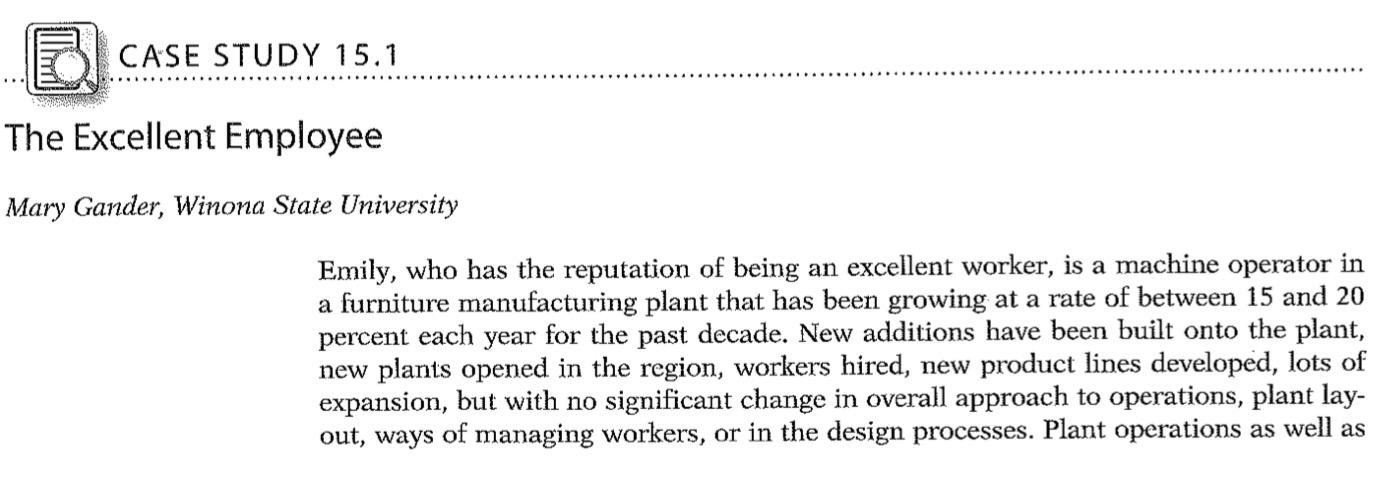
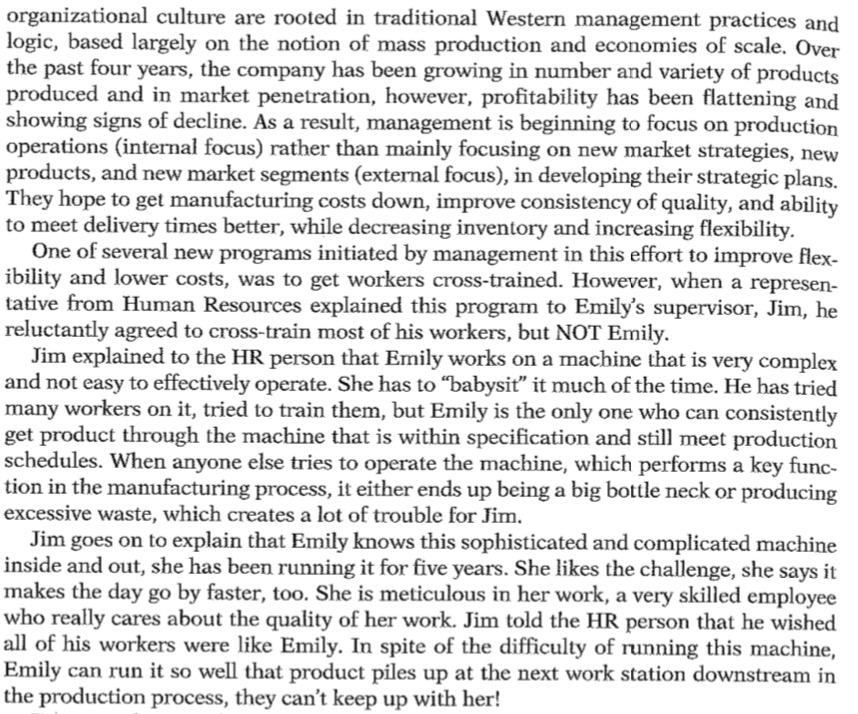
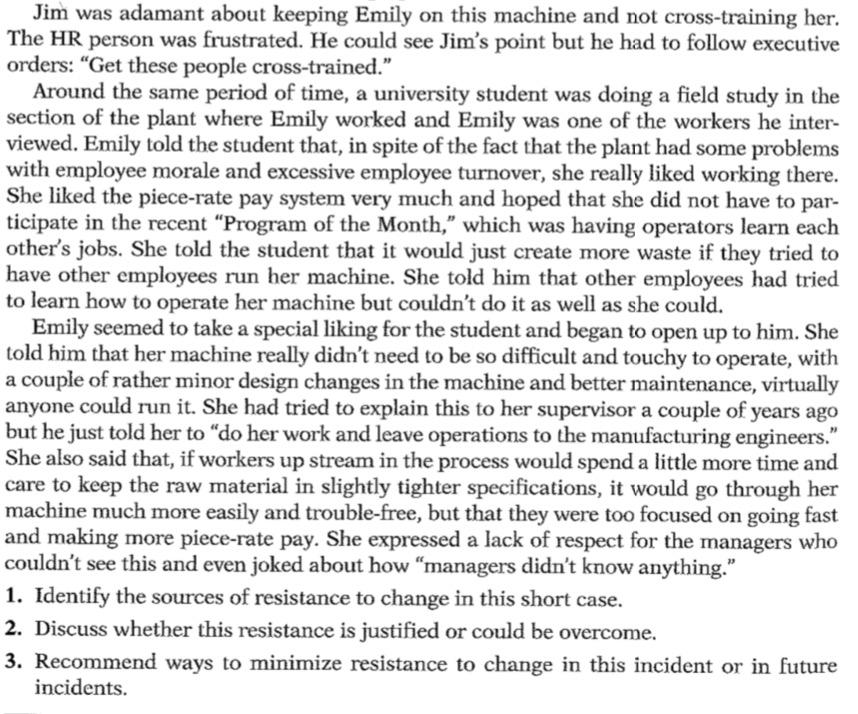
CASE STUDY 15.1 The Excellent Employee Mary Gander, Winona State University Emily, who has the reputation of being an excellent worker, is a machine operator in a furniture manufacturing plant that has been growing at a rate of between 15 and 20 percent each year for the past decade. New additions have been built onto the plant, new plants opened in the region, workers hired, new product lines developed, lots of expansion, but with no significant change in overall approach to operations, plant lay- out, ways of managing workers, or in the design processes. Plant operations as well as organizational culture are rooted in traditional Western management practices and logic, based largely on the notion of mass production and economies of scale. Over the past four years, the company has been growing in number and variety of products produced and in market penetration, however, profitability has been flattening and showing signs of decline. As a result, management is beginning to focus on production operations internal focus) rather than mainly focusing on new market strategies, new products, and new market segments (external focus), in developing their strategic plans. They hope to get manufacturing costs down, improve consistency of quality, and ability to meet delivery times better, while decreasing inventory and increasing flexibility. One of several new programs initiated by management in this effort to improve flex- ibility and lower costs, was to get workers cross-trained. However, when a represen- tative from Human Resources explained this program to Emily's supervisor, Jim, he reluctantly agreed to cross-train most of his workers, but NOT Emily. Jim explained to the HR person that Emily works on a machine that is very complex and not easy to effectively operate. She has to "babysit it much of the time. He has tried many workers on it, tried to train them, but Emily is the only one who can consistently get product through the machine that is within specification and still meet production schedules. When anyone else tries to operate the machine, which performs a key func- tion in the manufacturing process, it either ends up being a big bottle neck or producing excessive waste, which creates a lot of trouble for Jim. Jim goes on to explain that Emily knows this sophisticated and complicated machine inside and out, she has been running it for five years. She likes the challenge, she says it makes the day go by faster, too. She is meticulous in her work, a very skilled employee who really cares about the quality of her work. Jim told the HR person that he wished all of his workers were like Emily. In spite of the difficulty of running this machine, Emily can run it so well that product piles up at the next work station downstream in the production process, they can't keep up with her! Jim was adamant about keeping Emily on this machine and not cross-training her. The HR person was frustrated. He could see Jim's point but he had to follow executive orders: "Get these people cross-trained." Around the same period of time, a university student was doing a field study in the section of the plant where Emily worked and Emily was one of the workers he inter- viewed. Emily told the student that, in spite of the fact that the plant had some problems with employee morale and excessive employee turnover, she really liked working there. She liked the piece-rate pay system very much and hoped that she did not have to par- ticipate in the recent "Program of the Month," which was having operators learn each other's jobs. She told the student that it would just create more waste if they tried to have other employees run her machine. She told him that other employees had tried to learn how to operate her machine but couldn't do it as well as she could. Emily seemed to take a special liking for the student and began to open up to him. She told him that her machine really didn't need to be so difficult and touchy to operate, with a couple of rather minor design changes in the machine and better maintenance, virtually anyone could run it. She had tried to explain this to her supervisor a couple of years ago but he just told her to "do her work and leave operations to the manufacturing engineers. She also said that, if workers up stream in the process would spend a little more time and care to keep the raw material in slightly tighter specifications, it would go through her machine much more easily and trouble-free, but that they were too focused on going fast and making more piece-rate pay. She expressed a lack of respect for the managers who couldn't see this and even joked about how "managers didn't know anything." 1. Identify the sources of resistance to change in this short case. 2. Discuss whether this resistance is justified or could be overcome. 3. Recommend ways to minimize resistance to change in this incident or in future incidentsStep by Step Solution
There are 3 Steps involved in it
1 Expert Approved Answer
Step: 1 Unlock

Question Has Been Solved by an Expert!
Get step-by-step solutions from verified subject matter experts
Step: 2 Unlock
Step: 3 Unlock