







Question: Read the Case Study and answer the questions that follow. Atlas Com In its 50+ year history, Atlas Com has excelled in manufacturing state-of-the-art specialised
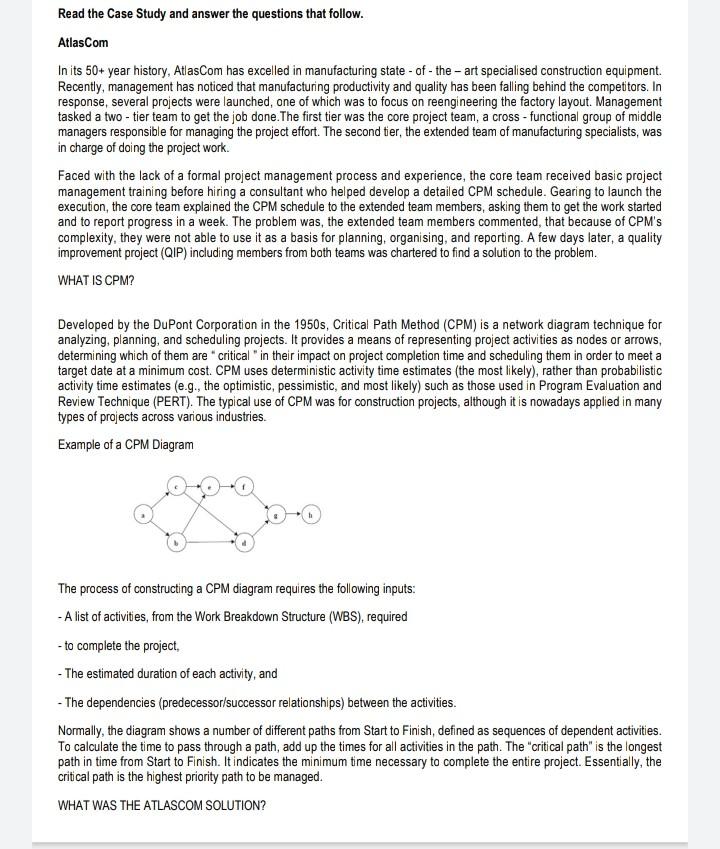
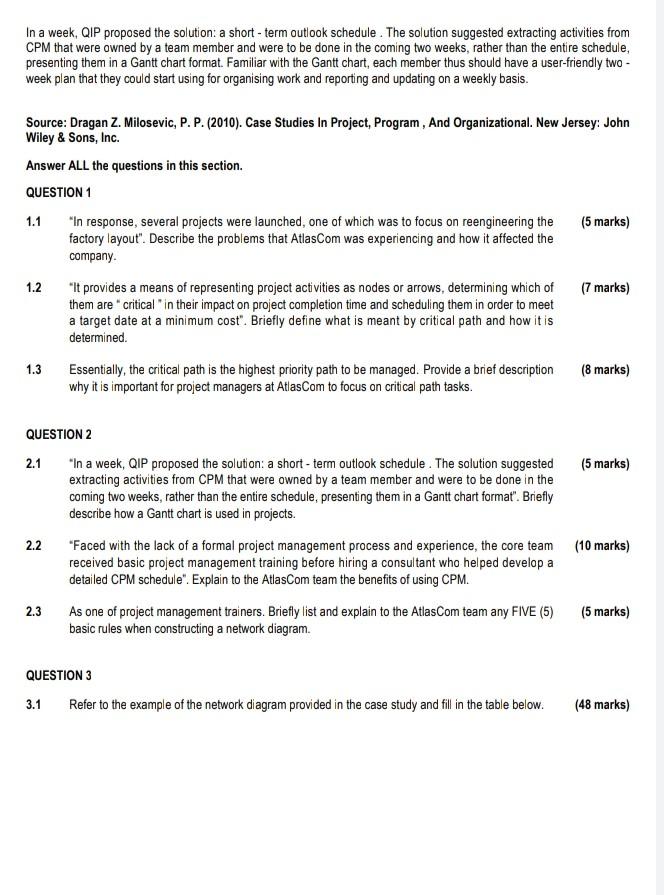
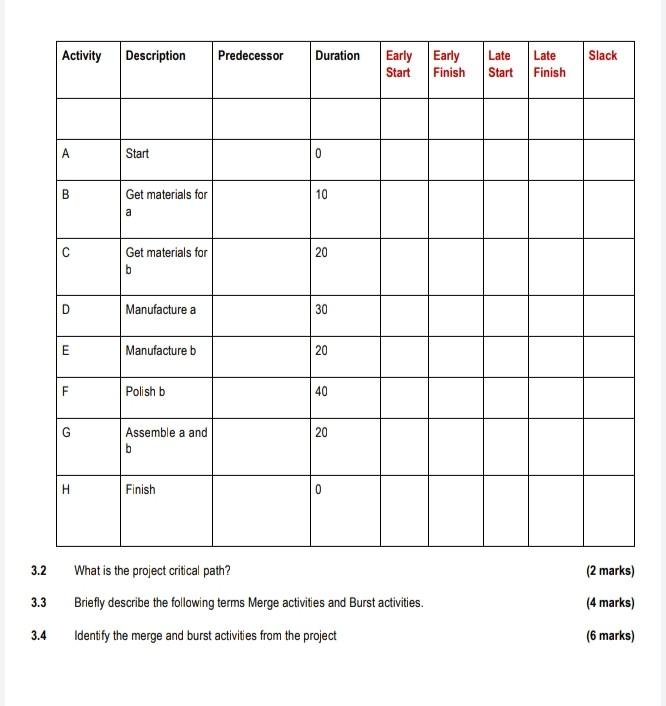
Read the Case Study and answer the questions that follow. Atlas Com In its 50+ year history, Atlas Com has excelled in manufacturing state-of-the-art specialised construction equipment. Recently, management has noticed that manufacturing productivity and quality has been falling behind the competitors. In response, several projects were launched, one of which was to focus on reengineering the factory layout. Management tasked a two-tier team to get the job done. The first tier was the core project team, a cross-functional group of middle managers responsible for managing the project effort. The second tier, the extended team of manufacturing specialists, was in charge of doing the project work. Faced with the lack of a formal project management process and experience, the core team received basic project management training before hiring a consultant who helped develop a detailed CPM schedule. Gearing to launch the execution, the core team explained the CPM schedule to the extended team members, asking them to get the work started and to report progress in a week. The problem was, the extended team members commented, that because of CPM's complexity, they were not able to use it as a basis for planning, organising, and reporting. A few days later, a quality improvement project (QIP) including members from both teams was chartered to find a solution to the problem. WHAT IS CPM? Developed by the DuPont Corporation in the 1950s, Critical Path Method (CPM) is a network diagram technique for analyzing, planning, and scheduling projects. It provides a means of representing project activities as nodes or arrows, determining which of them are " critical in their impact on project completion time and scheduling them in order to meet a target date at a minimum cost. CPM uses deterministic activity time estimates (the most likely), rather than probabilistic activity time estimates (e.g., the optimistic, pessimistic, and most likely) such as those used in Program Evaluation and Review Technique (PERT). The typical use of CPM was for construction projects, although it is nowadays applied in many types of projects across various industries. Example of a CPM Diagram The process of constructing a CPM diagram requires the following inputs: - A list of activities, from the Work Breakdown Structure (WBS), required - to complete the project - The estimated duration of each activity, and - The dependencies (predecessor/successor relationships) between the activities. Normally, the diagram shows a number of different paths from Start to finish, defined as sequences of dependent activities. To calculate the time to pass through a path, add up the times for all activities in the path. The "critical path" is the longest path in time from Start to finish. It indicates the minimum time necessary to complete the entire project. Essentially, the critical path is the highest priority path to be managed. WHAT WAS THE ATLASCOM SOLUTION? In a week, QIP proposed the solution: a short-term outlook schedule. The solution suggested extracting activities from CPM that were owned by a team member and were to be done in the coming two weeks, rather than the entire schedule, presenting them in a Gantt chart format. Familiar with the Gantt chart, each member thus should have a user-friendly two- week plan that they could start using for organising work and reporting and updating on a weekly basis. Source: Dragan Z. Milosevic, P. P. (2010). Case Studies In Project, Program, And Organizational. New Jersey: John Wiley & Sons, Inc. Answer ALL the questions in this section. QUESTION 1 1.1 (5 marks) "In response, several projects were launched, one of which was to focus on reengineering the factory layout". Describe the problems that Atlas Com was experiencing and how it affected the company. "It provides a means of representing project activities as nodes or arrows, determining which of them are critical "in their impact on project completion time and scheduling them in order to meet a target date at a minimum cost". Briefly define what is meant by critical path and how it is determined 1.2 (7 marks) 1.3 Essentially, the critical path is the highest priority path to be managed. Provide a brief description why it is important for project managers at Atlas Com to focus on critical path tasks. (8 marks) QUESTION 2 2.1 2.2 "In a week, QIP proposed the solution: a short-term outlook schedule. The solution suggested (5 marks) extracting activities from CPM that were owned by a team member and were to be done in the coming two weeks, rather than the entire schedule, presenting them in a Gantt chart format". Briefly describe how a Gantt chart is used in projects. "Faced with the lack of a formal project management process and experience, the core team (10 marks) received basic project management training before hiring a consultant who helped develop a detailed CPM schedule". Explain to the Atlas Com team the benefits of using CPM As one of project management trainers. Briefly list and explain to the AtlasCom team any FIVE (5) (5 marks) basic rules when constructing a network diagram. 2.3 QUESTION 3 3.1 Refer to the example of the network diagram provided in the case study and fill in the table below. (48 marks) Activity Description Predecessor Duration Slack Early Early Start Finish Late Late Start Finish A A Start 0 B Get materials for 10 a Get materials for b 20 D Manufacture a 30 E Manufacture b 20 F Polish b 40 G Assemble a and 20 H Finish 3.2 What is the project critical path? (2 marks) 3.3 (4 marks) Briefly describe the following terms Merge activities and Burst activities. Identify the merge and burst activities from the project 3.4 (6 marks)
Step by Step Solution
There are 3 Steps involved in it
1 Expert Approved Answer
Step: 1 Unlock

Question Has Been Solved by an Expert!
Get step-by-step solutions from verified subject matter experts
Step: 2 Unlock
Step: 3 Unlock
 Study Help