Question: Ryan Abrams, Human Resources manager at Anchore, has written the following e-mail message to several line managers asking for information. YOUR TASK Study the first
Ryan Abrams, Human Resources manager at Anchore, has written the following e-mail message to several line managers asking for information.
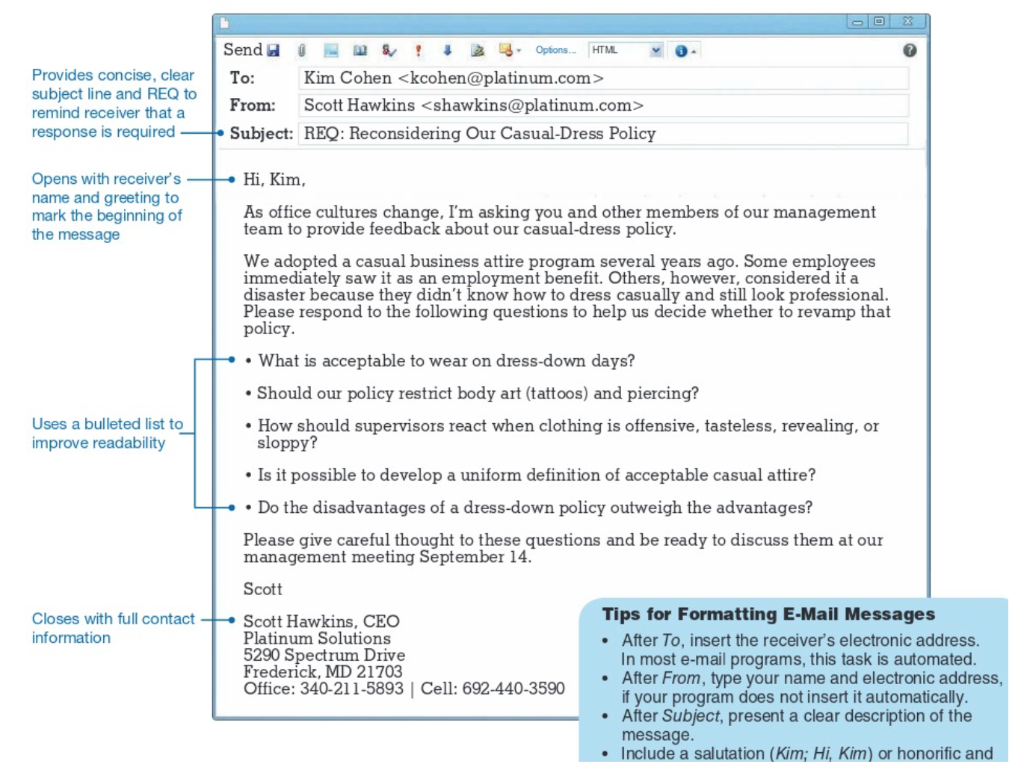
YOUR TASK Study the first draft of his poorly organized message and list its weaknesses. Then revise it to create a concise, clear message. Consider patterning your revision on Model Document 7.1 in this chapter.
To : Norberto Savala nsavala@anchore.com
From: Ryan.Adams radams@anchore.com
Subject: Need Your Input!
Norberto,
It has come to the attention of management here at Anchore that we may be missing an opportunity to find quality new employees. At a recent meeting many of us remarked about the feasibility of an internship program. Perhaps the time has come that we look into the tracking of employees and the monitoring of your vital functions on the job and outside the workplace? Can you think of other vulnerable technologies? What advice would you give someone who is not sure how to handle invasive technologies that may threaten privacy and security?
Here is Document 7.1
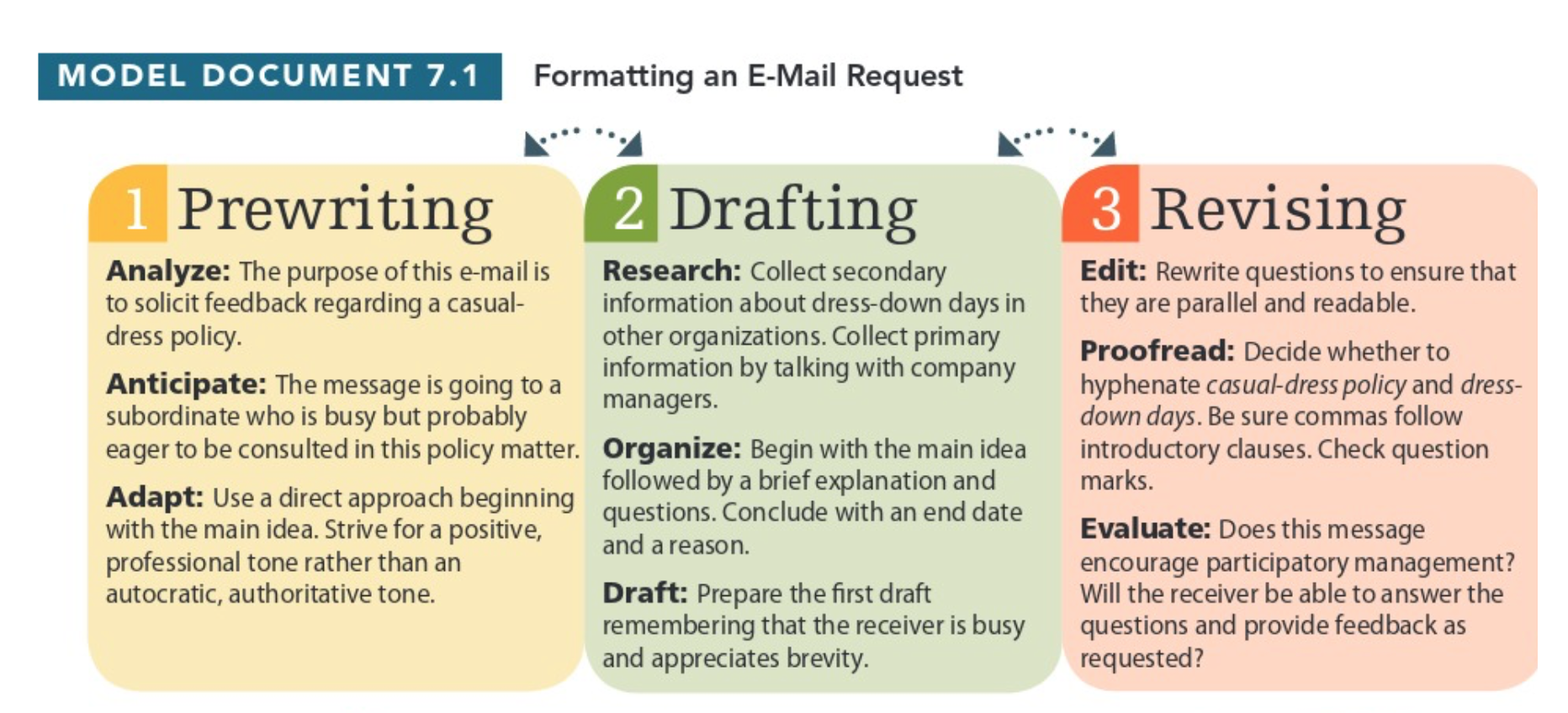
MODEL DOCUMENT 7.1 Formatting an E-Mail Request 1 Prewriting 2 Drafting 3 Revising Analyze: The purpose of this e-mail is Research: Collect secondary to solicit feedback regarding a casual- information about dress-down days in dress policy. other organizations. Collect primary Anticipate: The message is going to a information by talking with company subordinate who is busy but probably managers. eager to be consulted in this policy matter. Organize: Begin with the main idea Adapt: Use a direct approach beginning followed by a brief explanation and with the main idea. Strive for a positive, questions. Conclude with an end date and a reason. professional tone rather than an autocratic, authoritative tone. Draft: Prepare the first draft remembering that the receiver is busy and appreciates brevity. Edit: Rewrite questions to ensure that they are parallel and readable. Proofread: Decide whether to hyphenate casual-dress policy and dress- down days. Be sure commas follow introductory clauses. Check question marks. Evaluate: Does this message encourage participatory management? Will the receiver be able to answer the questions and provide feedback as requested? - X Provides concise, clear subject line and REQ to remind receiver that a response is required Send ! Options HTML To: Kim Cohen
From: Scott Hawkins Subject: REQ: Reconsidering Our Casual Dress Policy Opens with receiver's - Hi, Kim, name and greeting to mark the beginning of As office cultures change, I'm asking you and other members of our management the message team to provide feedback about our casual-dress policy. We adopted a casual business attire program several years ago. Some employees immediately saw it as an employment benefit. Others, however, considered if a disaster because they didn't know how to dress casually and still look professional. Please respond to the following questions to help us decide whether to revamp that policy. What is acceptable to wear on dress-down days? Should our policy restrict body art (tattoos) and piercing? Uses a bulleted list to How should supervisors react when clothing is offensive, tasteless, revealing, or improve readability sloppy? Is it possible to develop a uniform definition of acceptable casual attire? Do the disadvantages of a dress-down policy outweigh the advantages? Please give careful thought to these questions and be ready to discuss them at our management meeting September 14. Scott Closes with full contact Scott Hawkins, CEO Tips for Formatting E-Mail Messages information Platinum Solutions After To, insert the receiver's electronic address. 5290 Spectrum Drive In most e-mail programs, this task is automated. Frederick, MD 21703 After From, type your name and electronic address, Office: 340-211-5893 Cell: 692-440-3590 if your program does not insert it automatically. After Subject, present a clear description of the message. Include a salutation (Kim; Hi, Kim) or honorific and









 Study Help