



Question: Select the correct response: Question 1 (0.5 points] Which of the following is true with respect to property of the estate? .; Section 541(a) defines
Select the correct response:
![Select the correct response: Question 1 (0.5 points] Which of the following](https://dsd5zvtm8ll6.cloudfront.net/si.experts.images/questions/2024/11/67386e47e17da_49567386e47bd668.jpg)
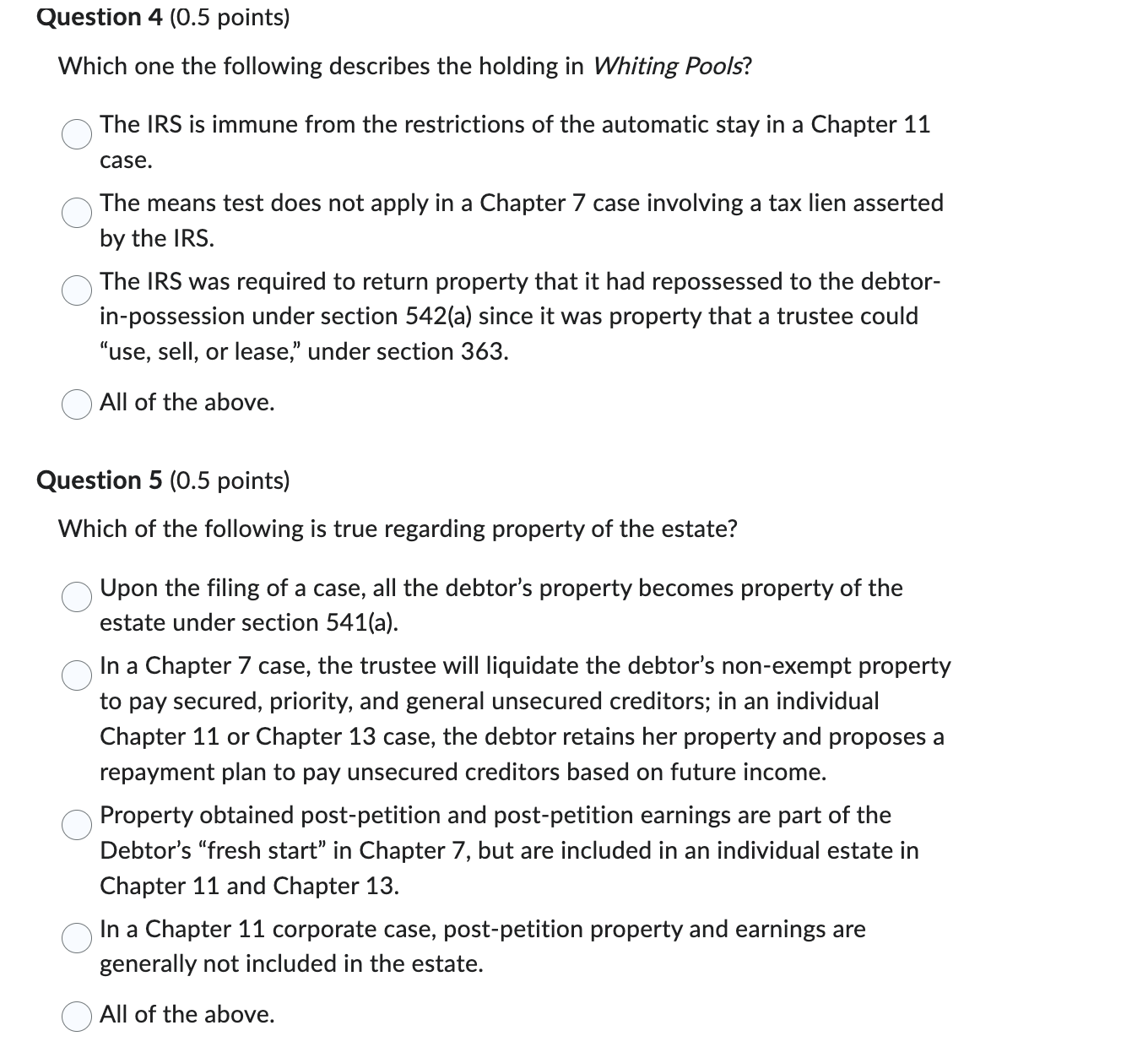
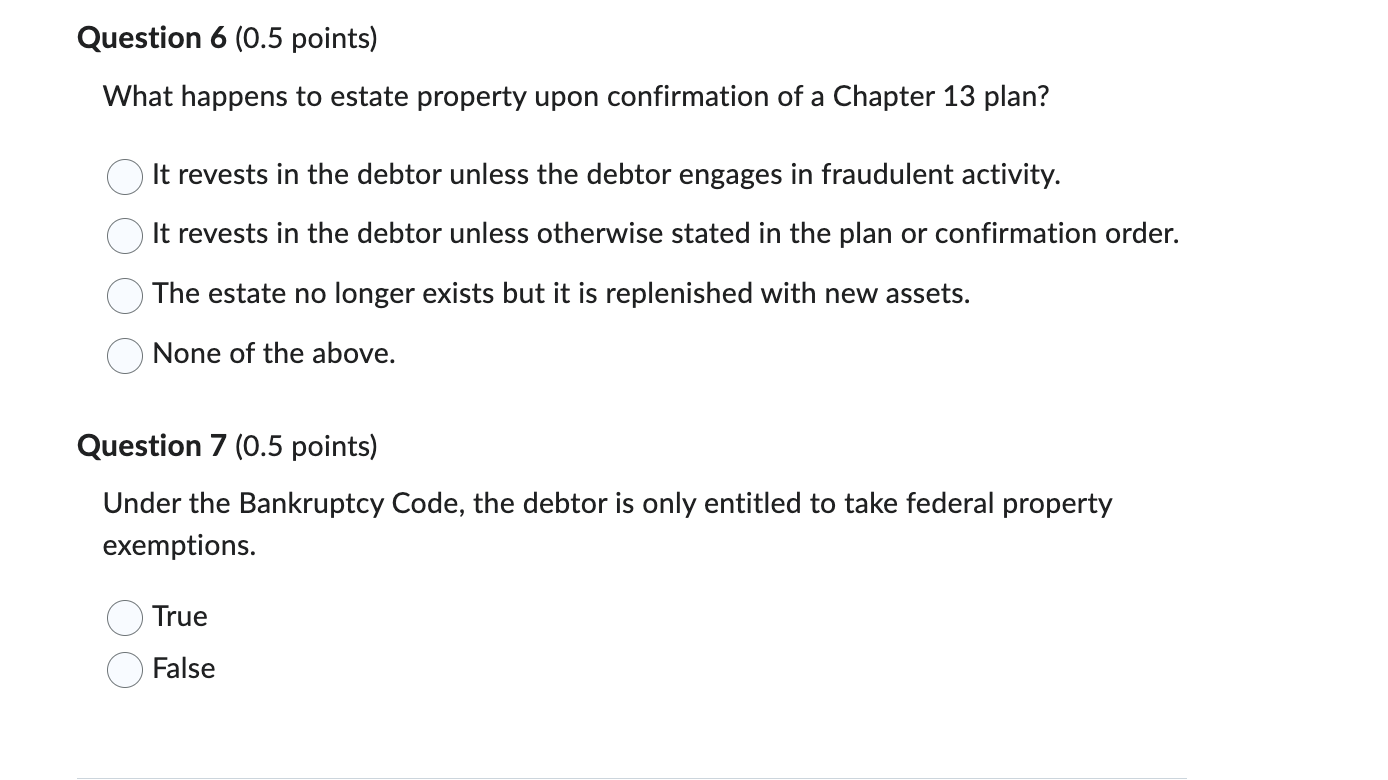
Question 1 (0.5 points] Which of the following is true with respect to property of the estate? .; Section 541(a) defines the "bankruptcy estate" as applying to all chapters but ' each chapter has its own rules with respect to after-acquired property and income. .; Property that is held in another county, or that the debtor deems has no value, is d not property of the estate. .; If someone else is living in the property or paying rent to the debtor, it is not ' property of the estate. If property is received through an inheritance, it is not property of the estate. Question 2 (0.5 points) Property of the estate includes "all legal and equitable interests of the debtor\" when the case is filed regardless of where the property is located or whether the debtor is in possession. True False Question 3 (0.5 points] Property claimed as \"exempt\" under section 522- or abandoned by the trustee to the debtor under section 554- is excluded from the estate. True False Question 4 (0.5 points) Which one the following describes the holding in Whiting Pools? The IRS is immune from the restrictions of the automatic stay in a Chapter 11 case. .1 The means test does not apply in a Chapter 7 case involving a tax lien asserted I by the IRS. The IRS was required to return property that it had repossessed to the debtor- \" in-possession under section 542(a) since it was property that a trustee could \"use, sell, or lease," under section 363. All of the above. Question 5 (0.5 points) Which of the following is true regarding property of the estate? ,1 Upon the filing of a case, all the debtor's property becomes property of the J estate under section 541(a). ,: In a Chapter 7 case, the trustee will liquidate the debtor's non-exempt property J to pay secured, priority, and general unsecured creditors; in an individual Chapter 11 or Chapter 13 case, the debtor retains her property and proposes a repayment plan to pay unsecured creditors based on future income. ,: Property obtained post-petition and post-petition earnings are part of the X Debtor's "fresh start" in Chapter 7, but are included in an individual estate in Chapter 11 and Chapter 13. ,: In a Chapter 11 corporate case, post-petition property and earnings are J generally not included in the estate. All of the above. Question 6 (0.5 points) What happens to estate property upon confirmation of a Chapter 13 plan? I: It revests in the debtor unless the debtor engages in fraudulent activity. .1: It revests in the debtor unless otherwise stated in the plan or confirmation order. .1: The estate no longer exists but it is replenished with new assets. '1: None of the above. Question 7 (0.5 points) Under the Bankruptcy Code, the debtor is only entitled to take federal property exemptions. ( True '1: False
Step by Step Solution
There are 3 Steps involved in it

Get step-by-step solutions from verified subject matter experts