







Question: Task 1 . Calculation of Dead loads and Live Loads on Roof Task 2 . Calculation of Bending and Shear Forces on Roof Task 3
Task Calculation of Dead loads and Live Loads on Roof
Task Calculation of Bending and Shear Forces on Roof
Task Design of Structure
Slab Design Roof Level
Details Roof Leve
Task Quality of report in terms of overall format,
professional presentation, appropriate summary
and calculationProject Description
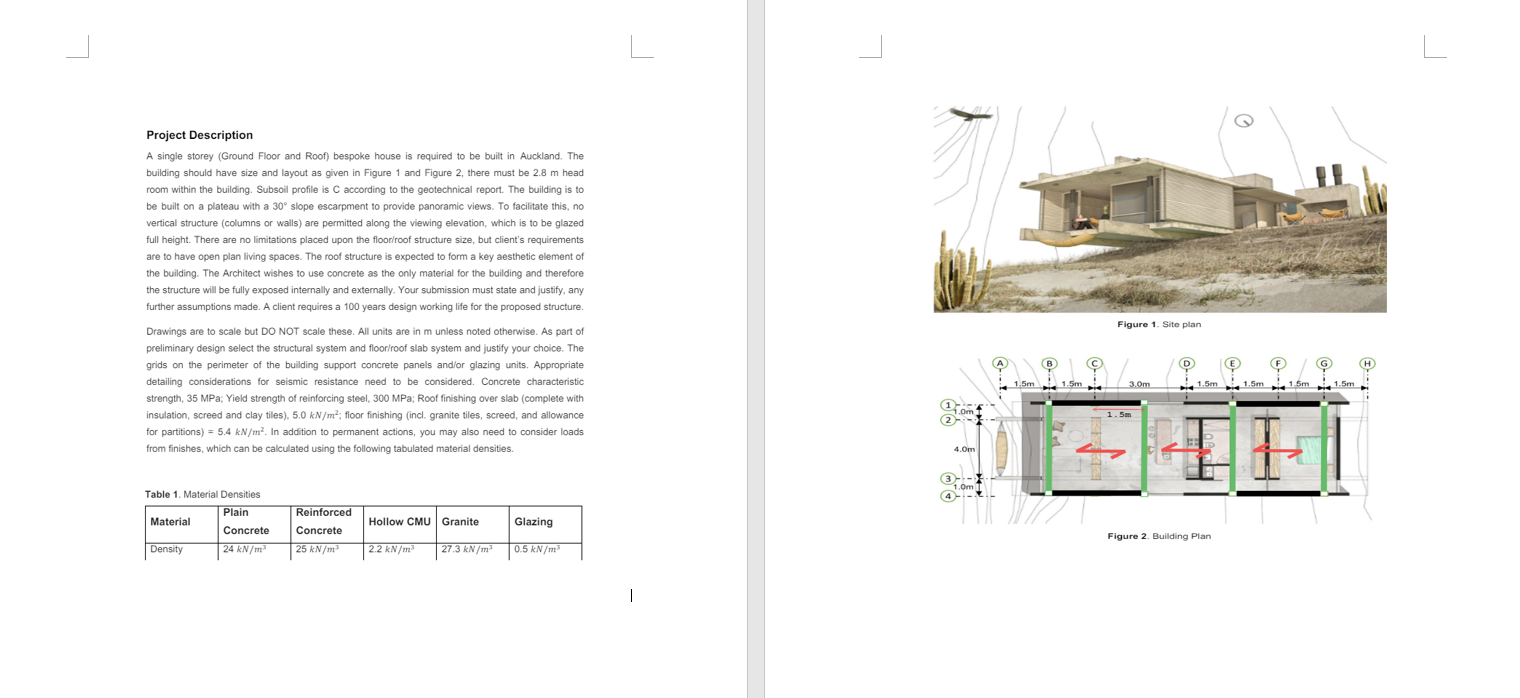
A single storey Ground Floor and Roof bespoke house is required to be built in Auckland. The
building should have size and layout as given in Figure and Figure there must be head
room within the building. Subsoil profile is according to the geotechnical report. The building is to
be built on a plateau with a slope escarpment to provide panoramic views. To facilitate this, no
vertical structure columns or walls are permitted along the viewing elevation, which is to be glazed
full height. There are no limitations placed upon the floorroof structure size, but client's requirements
are to have open plan living spaces. The roof structure is expected to form a key aesthetic element of
the building. The Architect wishes to use concrete as the only material for the building and therefore
the structure will be fully exposed internally and externally. Your submission must state and justify, any
further assumptions made. A client requires a years design working life for the proposed structure.
Drawings are to scale but DO NOT scale these. All units are in m unless noted otherwise. As part of
preliminary design select the structural system and floorroof slab system and justify your choice. The
grids on the perimeter of the building support concrete panels andor glazing units. Appropriate
detailing considerations for seismic resistance need to be considered. Concrete characteristic
strength, MPa; Yield strength of reinforcing steel, MPa Roof finishing over slab complete with
insulation, screed and clay tiles; floor finishing incl granite tiles, screed, and allowance
for partitions In addition to permanent actions, you may also need to consider loads
from finishes, which can be calculated using the following tabulated material densities.
Table Material Densities
Step by Step Solution
There are 3 Steps involved in it
1 Expert Approved Answer
Step: 1 Unlock

Question Has Been Solved by an Expert!
Get step-by-step solutions from verified subject matter experts
Step: 2 Unlock
Step: 3 Unlock
 Study Help