





Question: The continuous stopwatch timing method was used to obtain the observed times in minutes for a worker-machine task. The average observed time for each element
The continuous stopwatch timing method was used

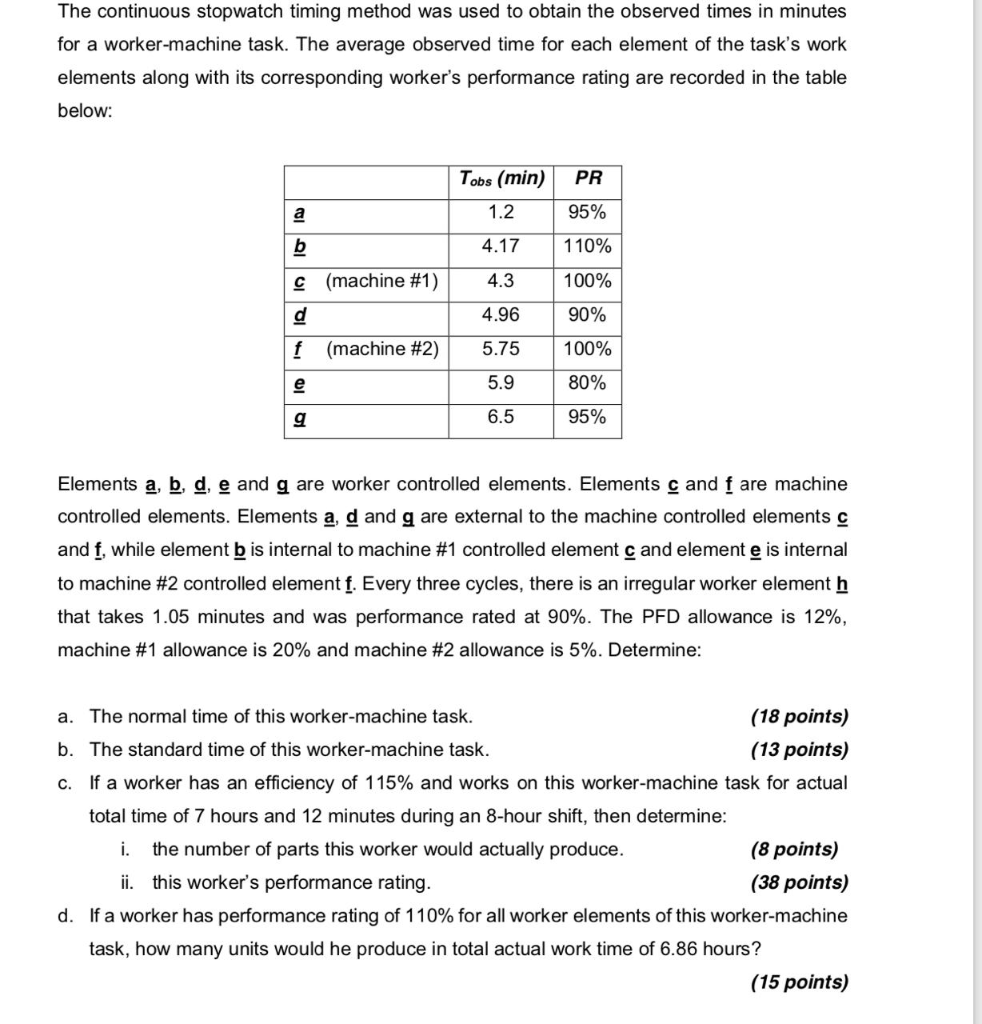
The continuous stopwatch timing method was used to obtain the observed times in minutes for a worker-machine task. The average observed time for each element of the task's work elements along with its corresponding worker's performance rating are recorded in the table below: Tobs (min) 1.2 PR 95% 4.17 110% C (machine #1) 4.3 100% f (machine #2) 4.96 5.75 5.9 6.5 90% 100% 80% 95% 10 10 Elements a, b, d, e and g are worker controlled elements. Elements c and f are machine controlled elements. Elements a, d and g are external to the machine controlled elements c and f, while element b is internal to machine #1 controlled element c and elemente is internal to machine #2 controlled element f. Every three cycles, there is an irregular worker element h that takes 1.05 minutes and was performance rated at 90%. The PFD allowance is 12%, machine #1 allowance is 20% and machine #2 allowance is 5%. Determine: a. The normal time of this worker-machine task. (18 points) b. The standard time of this worker-machine task. (13 points) c. If a worker has an efficiency of 115% and works on this worker-machine task for actual total time of 7 hours and 12 minutes during an 8-hour shift, then determine: i. the number of parts this worker would actually produce. (8 points) ii. this worker's performance rating. (38 points) d. If a worker has performance rating of 110% for all worker elements of this worker-machine task, how many units would he produce in total actual work time of 6.86 hours? (15 points) The continuous stopwatch timing method was used to obtain the observed times in minutes for a worker-machine task. The average observed time for each element of the task's work elements along with its corresponding worker's performance rating are recorded in the table below: Tobs (min) 1.2 PR 95% 4.17 110% C (machine #1) 4.3 100% f (machine #2) 4.96 5.75 5.9 6.5 90% 100% 80% 95% 10 10 Elements a, b, d, e and g are worker controlled elements. Elements c and f are machine controlled elements. Elements a, d and g are external to the machine controlled elements c and f, while element b is internal to machine #1 controlled element c and elemente is internal to machine #2 controlled element f. Every three cycles, there is an irregular worker element h that takes 1.05 minutes and was performance rated at 90%. The PFD allowance is 12%, machine #1 allowance is 20% and machine #2 allowance is 5%. Determine: a. The normal time of this worker-machine task. (18 points) b. The standard time of this worker-machine task. (13 points) c. If a worker has an efficiency of 115% and works on this worker-machine task for actual total time of 7 hours and 12 minutes during an 8-hour shift, then determine: i. the number of parts this worker would actually produce. (8 points) ii. this worker's performance rating. (38 points) d. If a worker has performance rating of 110% for all worker elements of this worker-machine task, how many units would he produce in total actual work time of 6.86 hours? (15 points)

Step by Step Solution

There are 3 Steps involved in it

1 Expert Approved Answer
Step: 1 Unlock blur-text-image

Question Has Been Solved by an Expert!

Get step-by-step solutions from verified subject matter experts

Step: 2 Unlock
Step: 3 Unlock

Students Have Also Explored These Related General Management Questions!