







Question: The data in the table to the right are based on the results of a survey comparing the commute Commute time of adults to their
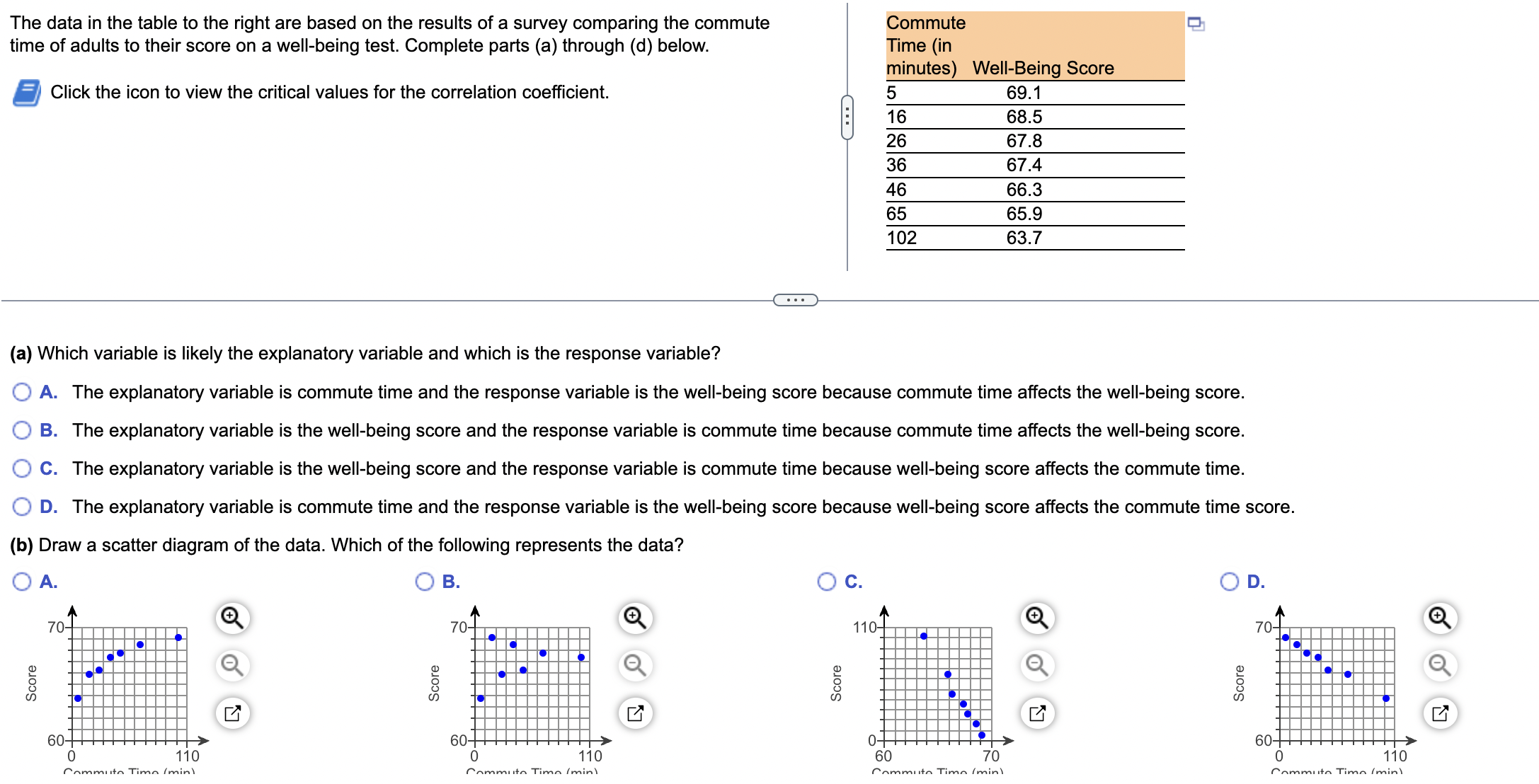
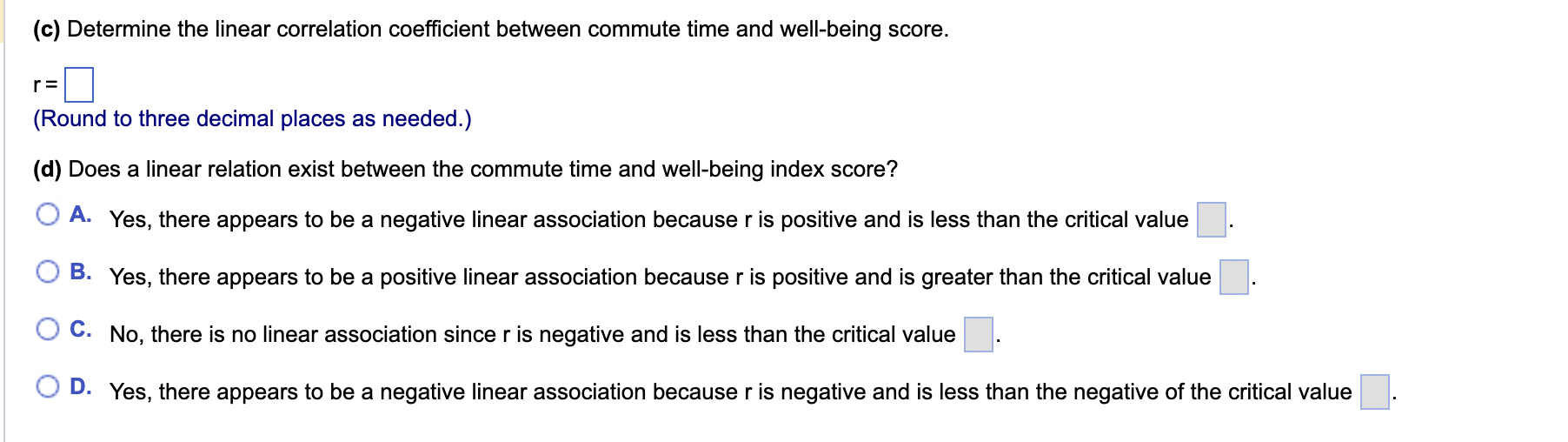
The data in the table to the right are based on the results of a survey comparing the commute Commute time of adults to their score on a well-being test. Complete parts (a) through (d) below. Time (in minutes) Well-Being Score Click the icon to view the critical values for the correlation coefficient. 5 59.1 16 68.5 26 67.8 36 67.4 46 66.3 65 65.9 102 63.7 (a) Which variable is likely the explanatory variable and which is the response variable? O A. The explanatory variable is commute time and the response variable is the well-being score because commute time affects the well-being score. O B. The explanatory variable is the well-being score and the response variable is commute time because commute time affects the well-being score. O C. The explanatory variable is the well-being score and the response variable is commute time because well-being score affects the commute time. O D. The explanatory variable is commute time and the response variable is the well-being score because well-being score affects the commute time score. (b) Draw a scatter diagram of the data. Which of the following represents the data? O A. O B. O c. OD. 70- 70- 110- 70- Score Score Score Score 60- 60# 0 110 0 110 60# Commits Time ( min ) 60 70 SammiIts Time ( min ) 0 110 Commits Tima / min ) SammiIts Time ( min)(c) Determine the linear correlation coefficient between commute time and well-being score. [ (Round to three decimal places as needed.) (d) Does a linear relation exist between the commute time and well-being index score? (U A. Yes, there appears to be a negative linear association because r is positive and is less than the critical value O B. Yes, there appears to be a positive linear association because r is positive and is greater than the critical value () . No, there is no linear association since r is negative and is less than the critical value O D. Yes, there appears to be a negative linear association because r is negative and is less than the negative of the critical value
Step by Step Solution
There are 3 Steps involved in it

Get step-by-step solutions from verified subject matter experts
 Study Help