Question: This is a question from a chapter I am working on and struggling with. I have attached the referenced chapter if needed. Thanks for any
This is a question from a chapter I am working on and struggling with. I have attached the "referenced" chapter if needed.
Thanks for any help in solving it.
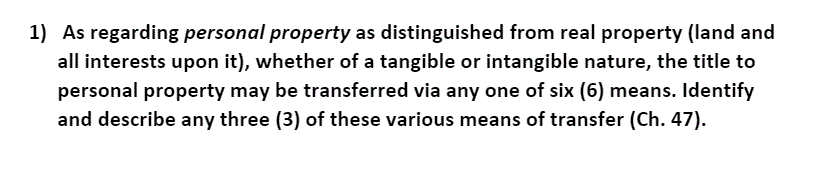
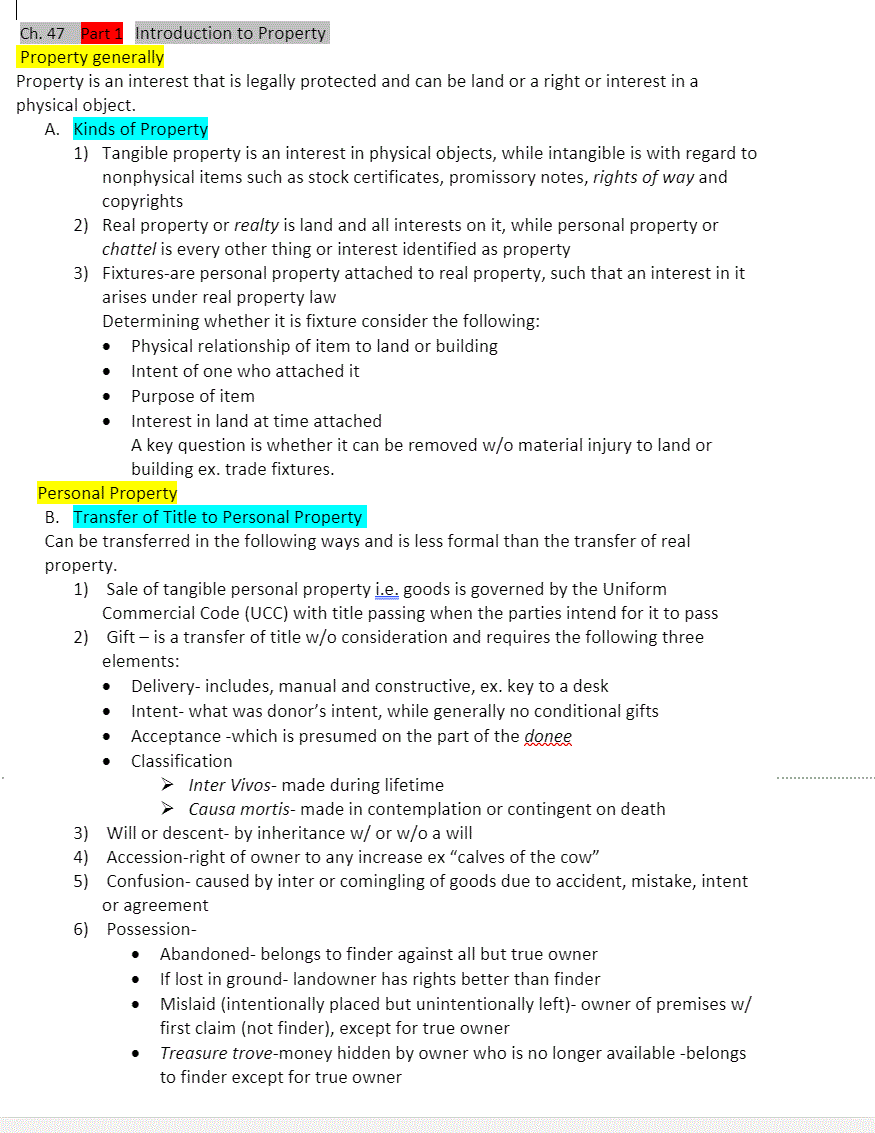
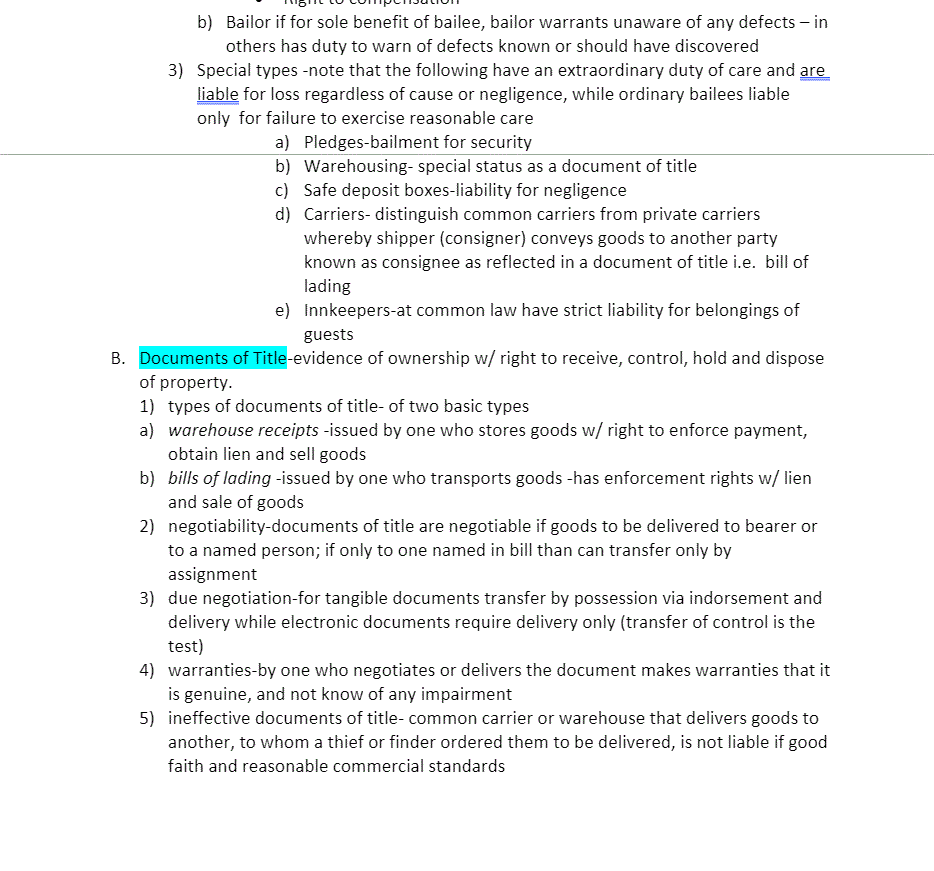
1) As regarding personal property as distinguished from real property (land and all interests upon it), whether of a tangible or intangible nature, the title to personal property may be transferred via any one of six (6) means. Identify and describe any three (3) of these various means of transfer (Ch. 47). Ch. 47 Part Introduction to Property Property generally Property is an interest that is legally protected and can be land or a right or interest in a physical object. A. Kinds of Property 1) Tangible property is an interest in physical objects, while intangible is with regard to nonphysical items such as stock certificates, promissory notes, rights of way and copyrights 2) Real property or realty is land and all interests on it, while personal property or chattel is every other thing or interest identified as property 3) Fixtures-are personal property attached to real property, such that an interest in it arises under real property law Determining whether it is fixture consider the following: Physical relationship of item to land or building Intent of one who attached it Purpose of item Interest in land at time attached A key question is whether it can be removed w/o material injury to land or building ex. trade fixtures. Personal Property B. Transfer of Title to Personal Property Can be transferred in the following ways and is less formal than the transfer of real property. 1) Sale of tangible personal property i.e. goods is governed by the Uniform Commercial Code (UCC) with title passing when the parties intend for it to pass 2) Gift - is a transfer of title w/o consideration and requires the following three elements: Delivery includes, manual and constructive, ex. key to a desk Intent- what was donor's intent, while generally no conditional gifts Acceptance-which is presumed on the part of the donee Classification > Inter Vivos-made during lifetime > Causa mortis-made in contemplation or contingent on death 3) Will or descent-by inheritance w/ or w/o a will 4) Accession-right of owner to any increase ex "calves of the cow" 5) Confusion-caused by inter or comingling of goods due to accident, mistake, intent or agreement 6) Possession- Abandoned-belongs to finder against all but true owner If lost in ground-landowner has rights better than finder Mislaid (intentionally placed but unintentionally left)- owner of premises w/ first claim (not finder), except for true owner Treasure trove-money hidden by owner who is no longer available -belongs to finder except for true owner . . . . Property Insurance Ch 47 Introduction In effect, insurance is a contractual arrangement to distribute risk of loss among a larger number (insured) through an insurance company i.e. insurer. Insurance law is in fact a branch of contract law. A. Fire and Property Insurance Protects owner of real or personal property from loss including creditors and holders of the mortgage. 1) Types of fire-covers hostile fires i.e. outside its intended location, but not friendly fires that are as intended ex. fireplace 2) Co-insurance clauses-refers to reduction in benefits for underinsuring value 3) Multiple insurers-by which liability will be allocated or distributed pro rata 4) Types of policies Valued policy-cover full value as agreed upon at time of loss Open policy-covers fair market value prior to loss B. Nature of Insurance Contracts whereby basic principles of contract law apply. 1) Offer and acceptance applicant makes offer and contract is created when the company accepts, which may be conditioned on premium payment Binder -temporary contract which is binding pending contract 2) Insurable interest-represents a financial interest in property that justifies insuring property and which lessens the "moral hazard" 3) Premiums - the amount paid for the policy 4) Defenses of insurer include: a) Ordinary contract defenses b) Policy language ex. coverage limitations c) Misrepresentation of material fact w/ reliance d) Breach of warranty-which are conditions that need be met ex. condition precedent (payment of premium) or subsequent (timely filing of claim) e) Concealment- failure to disclose material fact 5) Waiver-intentional relinquishment of a right while estoppel is whereby one is prevented by their own conduct from asserting a position 6) Termination - by due performance or cancellation Bailments and Documents of Title Ch 47 . A. Bailments-temporary transfer of personal property by one party to another Relationship whereby the bailor transfers possession by delivery w/o transfer of title to bailee for a certain purpose after which property need be returned to bailor or disposed of as directed.. It includes transportation, storage, repair and rental Introduction It includes keeping a car in a garage, renting a car, checking a coat in a restaurant, leaving clothing at the laundry, etc. Classification - bailments can be any of the following: bailor's sole benefit ex. repair of goods w/o compensation bailee's sole benefit-loan of personal property for use mutual benefit-commercial transactions such as giving your auto to a parking lot attendant 1) Essential elements are: a) Separation of ownership and possession b) Duty to redeliver identical property to owner or dispose as directed c) It must be personal property, but need not be tangible; must be possession for a defined period of time w/ duty to return it and not take title; and restoration of possession to bailor; if returned to wrong person the tort of conversion can be asserted 2) Rights and duties of bailor and bailee a) Bailee Exercise of due care-as a reasonable person would take under same circumstances; dependent upon for whose benefit bailment exists Absolute liability to return property as per agreement, as per custom of industry, and property need not be used in an unauthorized . . manner . Right to limit liability-some such as common carriers and public warehouses can do so only by statute, others can do so by contract; professional bailees such as garages need draw attention to a "writing, inform bailor of limit and limitation either by agreement or upon completion of work, and not due to unequal bargaining power Right to compensation b) Bailor if for sole benefit of bailee, bailor warrants unaware of any defects - in others has duty to warn of defects known or should have discovered 3) Special types -note that the following have an extraordinary duty of care and are liable for loss regardless of cause or negligence, while ordinary bailees liable only for failure to exercise reasonable care a) Pledges-bailment for security b) Warehousing-special status as a document of title c) Safe deposit boxes-liability for negligence d) Carriers- distinguish common carriers from private carriers whereby shipper (consigner) conveys goods to another party known as consignee as reflected in a document of title i.e. bill of lading b) Bailor if for sole benefit of bailee, bailor warrants unaware of any defects in others has duty to warn of defects known or should have discovered 3) Special types -note that the following have an extraordinary duty of care and are liable for loss regardless of cause or negligence, while ordinary bailees liable only for failure to exercise reasonable care a) Pledges-bailment for security b) Warehousing- special status as a document of title c) Safe deposit boxes-liability for negligence d) Carriers- distinguish common carriers from private carriers whereby shipper (consigner) conveys goods to another party known as consignee as reflected in a document of title i.e. bill of lading e) Innkeepers-at common law have strict liability for belongings of guests B. Documents of Title-evidence of ownership w/ right to receive, control, hold and dispose of property. 1) types of documents of title of two basic types a) warehouse receipts -issued by one who stores goods w/ right to enforce payment, obtain lien and sell goods b) bills of lading -issued by one who transports goods -has enforcement rights w/ lien and sale of goods 2) negotiability-documents of title are negotiable if goods to be delivered to bearer or to a named person; if only to one named in bill than can transfer only by assignment 3) due negotiation-for tangible documents transfer by possession via indorsement and delivery while electronic documents require delivery only (transfer of control is the test) 4) warranties-by one who negotiates or delivers the document makes warranties that it is genuine, and not know of any impairment 5) ineffective documents of title-common carrier or warehouse that delivers goods to another, to whom a thief or finder ordered them to be delivered, is not liable if good faith and reasonable commercial standards









 Study Help