







Question: Use information guve to make a flow chart for seperation and confirmation to identify the negative ions in solution. Qualitative Analysis of Anions Qualitative analysis
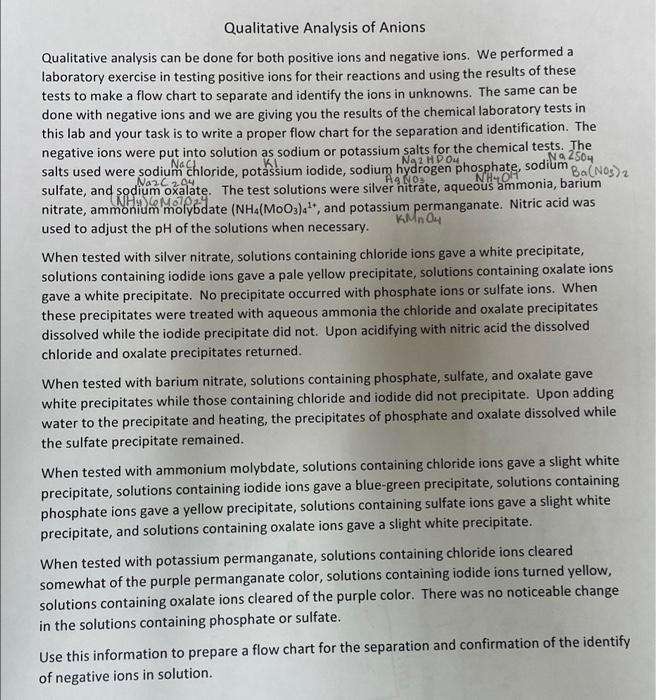
Qualitative Analysis of Anions Qualitative analysis can be done for both positive ions and negative ions. We performed a laboratory exercise in testing positive ions for their reactions and using the results of these tests to make a flow chart to separate and identify the ions in unknowns. The same can be done with negative ions and we are giving you the results of the chemical laboratory tests in this lab and your task is to write a proper flow chart for the separation and identification. The negative ions were put into solution as sodium or potassium salts for the chemical tests. The salts used were sodium um chloride, potassium iodide , sodium hydrogen phosphate, sodium ea inos) a 2504 Naz 2.94 sulfate, and sodium oxalate. The test solutions were silver nitrate, aqueous ammonia, barium HOME nitrate, ammonium molybdate (NH4(MoO3), and potassium permanganate. Nitric acid was used to adjust the pH of the solutions when necessary. KMnO4 When tested with silver nitrate, solutions containing chloride ions gave a white precipitate, solutions containing iodide ions gave a pale yellow precipitate, solutions containing oxalate ions gave a white precipitate. No precipitate occurred with phosphate ions or sulfate ions. When these precipitates were treated with aqueous ammonia the chloride and oxalate precipitates dissolved while the iodide precipitate did not. Upon acidifying with nitric acid the dissolved chloride and oxalate precipitates returned. When tested with barium nitrate, solutions containing phosphate, sulfate, and oxalate gave white precipitates while those containing chloride and iodide did not precipitate. Upon adding water to the precipitate and heating, the precipitates of phosphate and oxalate dissolved while the sulfate precipitate remained. When tested with ammonium molybdate, solutions containing chloride ions gave a slight white precipitate, solutions containing iodide ions gave a blue-green precipitate, solutions containing phosphate ions gave a yellow precipitate, solutions containing sulfate ions gave a slight white precipitate, and solutions containing oxalate ions gave a slight white precipitate. When tested with potassium permanganate, solutions containing chloride ions cleared somewhat of the purple permanganate color, solutions containing iodide ions turned yellow, solutions containing oxalate ions cleared of the purple color. There was no noticeable change in the solutions containing phosphate or sulfate. Use this information to prepare a flow chart for the separation and confirmation of the identify of negative ions in solution
Step by Step Solution
There are 3 Steps involved in it

Get step-by-step solutions from verified subject matter experts
 Study Help