New Semester
Started
Get
50% OFF
Study Help!
--h --m --s
Claim Now
Question Answers
Textbooks
Find textbooks, questions and answers
Oops, something went wrong!
Change your search query and then try again
S
Books
FREE
Study Help
Expert Questions
Accounting
General Management
Mathematics
Finance
Organizational Behaviour
Law
Physics
Operating System
Management Leadership
Sociology
Programming
Marketing
Database
Computer Network
Economics
Textbooks Solutions
Accounting
Managerial Accounting
Management Leadership
Cost Accounting
Statistics
Business Law
Corporate Finance
Finance
Economics
Auditing
Tutors
Online Tutors
Find a Tutor
Hire a Tutor
Become a Tutor
AI Tutor
AI Study Planner
NEW
Sell Books
Search
Search
Sign In
Register
study help
sciences
cambridge igcse chemistry
Chemistry 3rd Edition Bryan Earl, Doug Wilford - Solutions
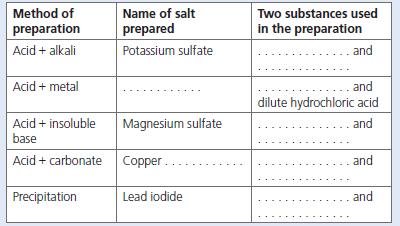
a. Copy out and complete the table, which covers the different methods of preparing salts.b. Write word and balanced chemical equations for each reaction shown in your table. Also write ionic equations where appropriate. Name of salt prepared Two substances used in the preparation Method of
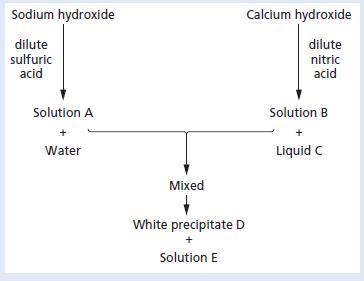
Study the following scheme.a. Give the names and formulae of substances A to E.b. Describe a test which could be used to identify the presence of water.c. Which indicator is suitable for the initial reaction between the hydroxides and the dilute acids shown?d. Write balanced chemical equations for
In a titration involving 24.0 cm3 potassium hydroxide solution against a solution containing 1 mol dm−3 of sulfuric acid, 28.0 cm3 of the acid was found to just neutralise the alkali completely.a. Write a word and balanced chemical equation for the reaction.b. Name a suitable indicator for the
Explain the following, with the aid of examples:a. Neutralisationb. Titrationc. Soluble saltd. Insoluble salt.
Read the following passage and then answer the questions which follow.Sodium carbonate decahydrate effloresces quite readily. With some substances, such as solid sodium hydroxide, the reverse of efflorescence occurs – they deliquesce. There are some substances, such as concentrated sulfuric acid,
Copper(ii) sulfate crystals exist as the pentahydrate, CuSO4.5H2O. It is a salt hydrate. If it is heated quite strongly, the water of crystallisation is driven off and the anhydrous salt remains.a. Explain the meaning of the terms shown in italics.b. Describe the experiment you would carry out to
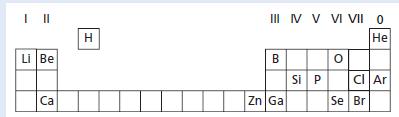
The diagram below shows part of the Periodic Table.Using only the symbols of the elements shown above, write down the symbol for an element which:a. Is a pale green coloured toxic gasb. Is stored under oil c. Has five electrons in its outer electron energy shelld. is the most reactive Group II
The proton number of barium (Ba) is 56. It is in Group II of the Periodic Table. a. How many electrons would you expect a barium atom to contain in its outer energy level?b. How would you expect barium to react with chlorine? Write a word and balanced chemical equation for this reaction.c. How
Find the element germanium (Ge) in the Periodic Table.a. Which group of the Periodic Table is this element in?b. How many electrons will it have in its outer energy level (shell)?c. Is germanium a metal or a non-metal?d. What is the formula of the chloride of germanium?e. Name and give the symbols
Three members of the halogens are: 35.517 Cl, 8035Br and 12753I.a. (i) Write down the electronic structure of an atom of chlorine.(ii) Why is the relative atomic mass of chlorine not a whole number?(iii) How many protons are there in an atom of bromine?(iv) How many neutrons are there in an atom of
‘By using displacement reactions it is possible to deduce the order of reactivity of the halogens.’ Discuss this statement with reference to the elements bromine, iodine and chlorine only.
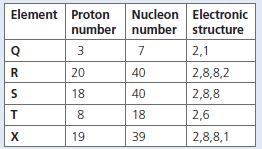
Use the information given in the table below to answer the questions below concerning the elements Q, R, S, T and X.a. Which element has 22 neutrons in each atom?b. Which element is a noble gas?c. Which two elements form ions with the same electronic structure as neon?d. Which two elements are in
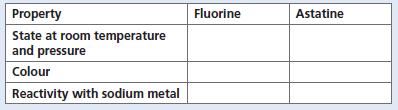
a. Consider the chemical properties and physical properties of the halogens chlorine, bromine and iodine. Using these properties, predict the following about the other two halogens, fluorine and astatine.b. (i) Write a word equation for the reaction of fluorine gas with sodium chloride
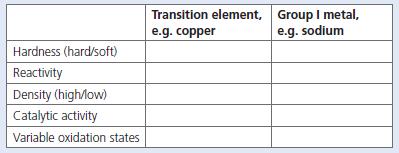
Some of the most important metals we use are found in the transition element section of the Periodic Table. One of these elements is copper. Sodium, a Group I metal, has very different properties from those of copper. Complete the table below to show their differences. Transition element, Group I
Use the following list of metals to answer the questions a to i: iron, calcium, potassium, gold, aluminium, magnesium, sodium, zinc, platinum, titanium.a. Which of the metals is found native?b. Which of the metals is found in nature as the ore:(i) Rock salt? (ii) Rutile?c. Which metal has a
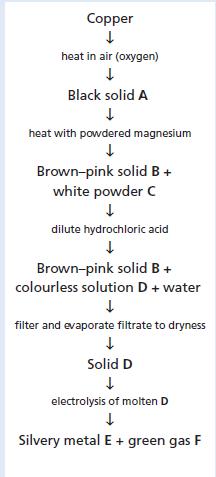
a. Name and give the formulae of the substances A to F.b. Write balanced chemical equations for the reactions in which:(i) Black solid A was formed(ii) White powder C and brown–pink solid B were formed(iii) Colourless solution D was formed.c. The reaction between black solid A and magnesium is a
Explain the following:a. Metals such as gold and silver occur native in the Earth’s crustb. The parts of shipwrecks made of iron rust more slowly in deep waterc. Zinc bars are attached to the structure of oil rigs to prevent them from rustingd. Copper roofs quickly become covered with a green
Iron is extracted from its ores haematite and magnetite. Usually it is extracted from haematite (iron(iii) oxide). The ore is mixed with limestone and coke and reduced to the metal in a blast furnace. The following is a brief outline of the reactions involved. a. Name the gases X and Y.b. Give
The iron obtained from the blast furnace is known as pig or cast iron. Because of the presence of impurities, such as carbon, it has a hard and brittle nature. Most of this type of iron is therefore converted into steel in the basic oxygen process. During this process either all or some of the
The metal titanium is extracted from its ore rutile (TiO2).a. Describe the processes involved in the extraction f titanium from rutile.b. Name the area of the Periodic Table in which titanium is found.c. The final part of the process involves the following reaction:TiCl4(l) + 4Na(l) → 4NaCl(s) +
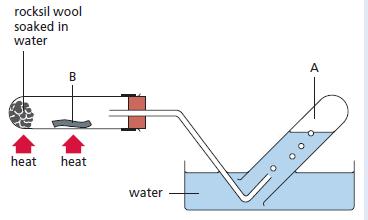
Zinc can be reacted with steam using the apparatus shown. When gas A is collected, mixed with air and ignited it gives a small pop. A white solid B remains in the test tube when the reaction has stopped and the apparatus cooled down.a. Name and give the formula of gas A.b. (i) Name the product
Copper is extracted in the final stage by roasting copper(i) sulfide (Cu2S) in a current of air. This converts the sulfide to the metal.Cu2S(s) + O2(g) → 2Cu(s) + SO2(g)a (i) What is the name of the chemical process by which copper(i) sulfide is converted to copper?(ii) At what temperature does
Showing 100 - 200
of 122
1
2
Step by Step Answers

 Get 50% OFF
Claim Now
Get 50% OFF
Claim Now