New Semester
Started
Get
50% OFF
Study Help!
--h --m --s
Claim Now
Question Answers
Textbooks
Find textbooks, questions and answers
Oops, something went wrong!
Change your search query and then try again
S
Books
FREE
Study Help
Expert Questions
Accounting
General Management
Mathematics
Finance
Organizational Behaviour
Law
Physics
Operating System
Management Leadership
Sociology
Programming
Marketing
Database
Computer Network
Economics
Textbooks Solutions
Accounting
Managerial Accounting
Management Leadership
Cost Accounting
Statistics
Business Law
Corporate Finance
Finance
Economics
Auditing
Tutors
Online Tutors
Find a Tutor
Hire a Tutor
Become a Tutor
AI Tutor
AI Study Planner
NEW
Sell Books
Search
Search
Sign In
Register
study help
sciences
essential university physics
Essential University Physics 3rd Edition Volume 2 Richard Wolfsonby - Solutions
Two 5.0-cm-diameter conducting spheres are 8.0 m apart, and each carries 0.12 μC. Determine(a) The potential on each sphere,(b) The field strength at the surface of each sphere,(c) the potential midway between the spheres(d) The potential difference between the spheres.
Two metal spheres each 1.0 cm in radius are far apart. One sphere carries 38 nC, the other -10 nC.(a) What’s the potential on each?(b) If the spheres are connected by a thin wire, what will be the potential on each once equilibrium is reached?(c) How much charge moves between the spheres in order
The electric potential in a region is given by V = -V0(r/R), where V0 and R are constants and r is the radial distance from the origin. Find expressions for the magnitude and direction of the electric field in this region.
The potential in a region is given by V = axy, where a is a constant.(a) Determine the electric field in the region.(b) Sketch some equipotentials and field lines.
The potential at the center of a uniformly charged ring is 45 kV, and 15 cm along the ring axis the potential is 33 kV. Find the ring’s radius and total charge.
A thin ring of radius R carries charge 3Q distributed uniformly over three-fourths of its circumference, and -Q over the rest. Find the potential at the ring’s center.
A thin plastic rod 20 cm long carries 3.2 nC distributed uniformly over its length.(a) If the rod is bent into a ring, find the potential at its center.(b) If it’s bent into a semicircle, find the potential at the center of the semicircle.
A dipole of moment p = 2.9 nC m consists of two charges separated by far less than 10 cm. Find the potential 10 cm from the dipole (a) on its axis, (b) at 45° to its axis, (c) on its perpendicular bisector.
Two identical charges q lie on the x-axis at ±a.(a) Find an expression for the potential at all points in the x–y plane.(b) Show that your result reduces to the potential of a point charge for distances large compared with a.
A charge +Q lies at the origin and -3Q at x = a. Find two points on the x-axis where V = 0.
Three equal charges q form an equilateral triangle of side a. Find the potential, relative to infinity, at the center of the triangle.
The potential difference between the surface of a 3.0-cm-diameter power line and a point 1.0 m distant is 3.9 kV. Find the line charge density on the power line.
Find the potential as a function of position in the electric field E(vector) = axî, where a is a constant and where you’re taking V = 0 at x = 0.
A solid sphere of radius R carries charge Q distributed uniformly throughout its volume. Find the potential difference from the sphere’s surface to its center.
A thin spherical shell has radius R and total charge Q distributed uniformly over its surface. Find the potential at its center.
Proton-beam therapy can be preferable to X rays for cancer treatment (although much more expensive) because protons deliver most of their energy to the tumor, with less damage to healthy tissue. A cyclotron used to accelerate protons for cancer treatment repeatedly passes the protons through a
A sphere of radius R carries negative charge of magnitude Q, distributed in a spherically symmetric way. Find an expression for the escape speed for a proton at the sphere’s surface that is, the speed that would enable the proton to escape to arbitrarily large distances starting at the sphere’s
Points A and B lie 32.0 cm apart on a line extending radially from a point charge Q, and the potentials at these points are VA = 362 V and VB = 146 V. Find Q and the distance r between point A and the charge.
A 5.0-g object carries 3.8 μC. It acquires speed v when accelerated from rest through a potential difference V. If a 2.0-g object acquires twice the speed under the same circumstances, what’s its charge?
An electron passes point A moving at 6.5 Mm/s. At point B it comes to a stop. Find the potential difference ∆VAB
Two flat metal plates are a distance d apart, where d is small compared with the plate size. If the plates carry surface charge densities ±σ, show that the magnitude of the potential difference between them is V = σd/ε0.
What’s the charge on an ion that gains 1.6x10⁻¹⁵ J when it moves through a potential difference of 2500 V?
What’s the potential difference between the terminals of a battery that can impart 7.2x10⁻¹⁹ J to each electron that moves between the terminals?
The electric field within a cell membrane is approximately 8.0 MV/m and is essentially uniform. If the membrane is 10 nm thick, what’s the potential difference across the membrane?
Two points A and B lie 15 cm apart in a uniform electric field, with the path AB parallel to the field. If the potential difference ∆VAB is 840 V, what’s the field strength?
A large metal sphere has three times the diameter of a smaller sphere and carries three times the charge. Both spheres are isolated, so their surface charge densities are uniform. Compare(a) The potentials (relative to infinity)(b) The electric field strengths at their surfaces.
You’re an automotive engineer working on the ignition system for a new engine. Its spark plugs have center electrodes made from 2.0-mm-diameter wire. The electrode ends gradually wear to a hemispherical shape, so they behave approximately like charged spheres. Your job is to specify the minimum
The electric potential in region is given b y V = 2xy - 3zx + 5y2, with V in volts and the coordinates in meters. Find(a) The potential(b) The components of the electric field at the point x = 1 m, y = 1 m, z = 1 m. Section 22.4 Charged Conductors
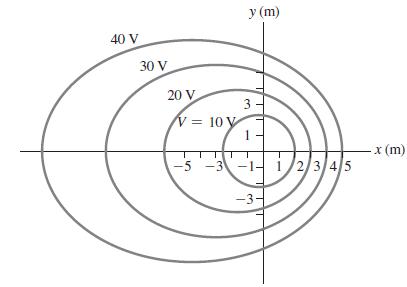
Figure 22.23 shows some equipotentials in the x-y plane. (a) In what region is the electric field strongest? What are (b) the direction and (c) the magnitude of the field in this region?Figure 22.23 y (m) 40 V 30 V 20 V 3 V = 10 y x (m) -5 -3 -1- i /2/3/4/5 -3-
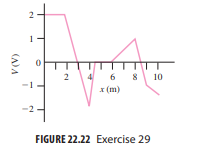
Figure 22.22 shows a plot of potential versus position along the x-axis. Make a plot of the x-component of the electric field for this situation. 2 4 6 8 10 x (m) FIGURE 22.22 Exercise 29 (A)A
In a uniform electric field, equipotential planes that differ by 5.00 V are 2.54 cm apart. What’s the field strength?
A 3.5-cm-diameter isolated metal sphere carries 0.86 μC.(a) Find the potential at the sphere’s surface.(b) If a proton were released from rest at the surface, what would be its speed far from the sphere?
You’re developing a switch for high-voltage power lines. The smallest part in your design is a 5.0-cm-diameter metal sphere. What do you specify for the maximum potential on your switch if the electric field at the sphere’s surface isn’t to exceed the 3-MV/m breakdown field of air?
The potential at the surface of a 10-cm-radius sphere is 4.8 kV. What’s the sphere’s total charge, assuming charge is distributed in a spherically symmetric way?
The classical picture of the hydrogen atom has the electron orbiting 0.0529 nm from the proton. What’s the electric potential associated with the proton’s electric field at this distance?
An electric field is given by E(Vector) = E0 ĵ, where E0 is a constant. Find the potential as a function of position, taking V = 0 at y = 0.
The potential difference across a typical cell membrane is about 80 mV. How much work is done on a singly ionized potassium ion moving through the membrane?
A proton, an alpha particle (a bare helium nucleus), and a singly ionized helium atom are accelerated through a 100-V potential difference. How much energy does each gain?
A charge of 3.1 C moves from the positive to the negative terminal of a 9.0-V battery. How much energy does the battery impart to the charge?
Find the magnitude of the potential difference between two points located 1.4 m apart in a uniform 650-N/C electric field, if a line between the points is parallel to the field.
Show that 1 V/m is the same as 1 N/C.
It takes 45 J to move a 15-mC charge from point A to point B. What’s the potential difference ∆VAB?
The potential difference between the two sides of an ordinary electric outlet is 120 V. How much energy does an electron gain when it moves from one side to the other?
How much work does it take to move a 50μC charge against a 12-V potential difference?
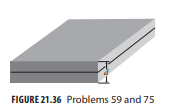
Repeat Problem 59 for the case where the charge density in the slab is given by ? = ?0 |x/d|, where ?0 is a constant. Data From Problem 59 A charged slab extends infinitely in two dimensions and has thickness d in the third dimension, as shown in Fig. 21.36. The slab carries a uniform volume charge
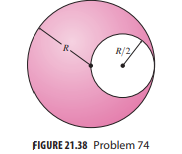
74. A solid sphere of radius R carries a uniform volume charge density ?. A hole of radius R/2 occupies a region from the center to the edge of the sphere, as shown in Fig. 21.38. Show that the electric field everywhere in the hole points horizontally and has magnitude ?R/6??0. Hint: Treat the hole
An infinitely long solid cylinder of radius R carries a nonuniform charge density given by ρ = ρ0(r/R), where ρ0 is a constant and r is the distance from the cylinder’s axis. Find an expression for the magnitude of the electric field as a function of position r within the cylinder.
A solid sphere of radius R carries a nonuniform volume charge density ρ = ρ0er/R, where 0 is a constant and r is the distance from the center. Find an expression for the electric field strength at the sphere’s surface.
The charge density within a charged sphere of radius R is given by ρ = ρ0 - ar2, where r0 and a are constants and r is the distance from the center. Find an expression for a such that the electric field outside the sphere is zero.
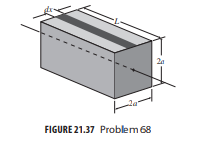
Figure 21.37 shows a rectangular box with sides 2a and length L surrounding a line carrying uniform line charge density ?. The line passes directly through the center of the box faces. Integrate the field of the line charge over strips of width dx as shown to find the electric flux through one face
The volume charge density inside a solid sphere of radius a is ρ = ρ0r/a, where ρ0 is a constant. Find(a) The total charge(b) The electric field strength within the sphere, as a function of distance r from the center.
A point charge q is at the center of a spherical shell of radius R carrying charge 2q spread uniformly over its surface. Write expressions for the electric field strength at(a) 1/2 R(b) 2R.
A point charge -q is at the center of a spherical shell carrying charge +2q. That shell, in turn, is concentric with a larger shell carrying -3/2 q. Draw a cross section of this structure, and sketch the electric field lines using the convention that eight lines correspond to a charge of magnitude
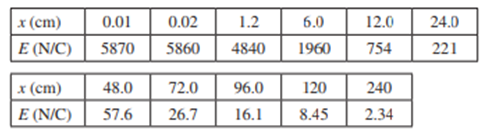
You measure the electric field strength at points directly above the center of a square plate carrying charge spread uniformly over its surface. The data are tabulated in the next column, with x the perpendicular distance from the center of the plate. Use the data to determine(a) the total charge
An irregular conductor containing an irregular, empty cavity carries a net charge Q.(a) Show that the electric field inside the cavity must be zero.(b) If you put a point charge inside the cavity, what value must it have in order to make the charge density on the outer surface of the conductor
A 250-nC point charge is placed at the center of an uncharged spherical conducting shell 20 cm in radius. Find(a) the surface charge density on the outer surface of the shell(b) the electric field strength at the shell’s outer surface.
A nonconducting square plate 75 cm on a side carries a uniform surface charge density. The electric field strength 1 cm from the plate, not near an edge, is 45 kN/C. What’s the approximate field strength 15 m from the plate?
An electric field is given by E (Vector) = E0 (y/a)k̂, where E0 and a are constants. Find the flux through the square in the x-y plane bounded by the points (0, 0), (0, a), (a, a), (a, 0).
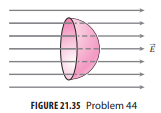
What?s the flux through the hemispherical open surface of radius R in a uniform field of magnitude E shown in Fig. 21.35? FIGURE 21.35 Problem 44
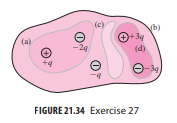
What?s the electric flux through the closed surfaces marked (a), (b), (c), and (d) in Fig. 21.34? +q -q -2q +3q -3q (a) (b) (c) (d) Figure 21.34 (c) b) +3g -24 (d) +4 FIGURE 21.34 Exercise 27
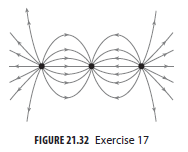
In Fig. 21.32, the magnitude of the middle charge is 3 ?C. What?s the net charge shown? FIGURE 21.32 Exercise 17
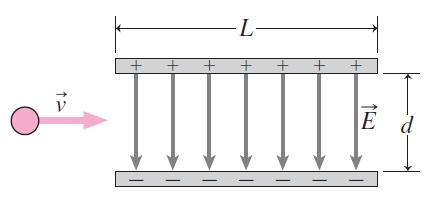
You’re working on the design of an ink-jet printer. Ink drops of mass m, speed v, and charge q will enter a region of uniform electric field E between two charged plates (Fig. 20.37). The drops enter midway between the plates, and the electric field deflects them toward the correct place on the
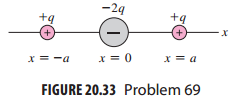
An electric quadrupole consists of two oppositely directed di-poles in close proximity.? (a) Calculate the field of the quadrupole shown in Fig. 20.33 for points to the right of x =a? (b) show that for x >>a the quadrupole field falls off as 1/x4 -29 +q (+) +q (+) x = -a X = 0 x = a FIGURE
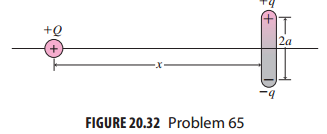
A dipole with charges {q and separation 2a is located a distance x from a point charge +Q,oriented as shown in Fig. 20.32. Find expressions for the magnitude of (a) the net torque(b) the net force on the dipole, both in the limit x >>a.(c) What?s the direction of the net force? +Q 2a + b.
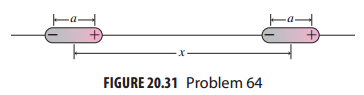
Two identical dipoles, each of charge q and separation a, are a distance x apart, as shown in Fig. 20.31.(a) By considering forces between pairs of charges in the different dipoles, calculate the force between the dipoles and show that, in the limit a4?,where p=qa is the dipole moment.(b) Is the
Show that the field on the x-axis for the dipole of Example 20.5 is given by Equation 20.6b, for |x|>>a. 2kp E dipole field for x > a, on axis (20.6b)
A solid sphere 10 cm in radius carries a 40μC charge distributed uniformly throughout its volume. It’s surrounded by a concentric shell 20 cm in radius, also uniformly charged with 40 μC. Find the electric field(a) 5.0 cm,(b) 15 cm,(c) 30 cm from the center.
If you “painted” positive charge on the floor, what surface charge density would be necessary to suspend a 15μC, 5.0-g particle above the floor?
A long, solid rod 4.5 cm in radius carries a uniform volume charge density. If the electric field strength at the surface of the rod (not near either end) is 16 kN/C, what’s the volume charge density?
An infinitely long rod of radius R carries a uniform volume charge density ρ. Show that the electric field strengths outside and inside the rod are given, respectively, by E = ρ R2 /2ε0 r and E = ρr/2ε0, where r is the distance from the rod axis. (Although an infinite rod is an impossibility,
A long, thin wire carrying 5.6 nC/m runs down the center of a long, thin-walled, pipe with radius 1.0 cm carrying -4.2 nC/m spread uniformly over its surface. Find the electric field (a) 0.50 cm from the wire and (b) 1.5 cm from the wire.
A thick, spherical shell of inner radius a and outer radius b carries a uniform volume charge density ?. Find an expression for the electric field strength in the region a Or E (field inside uniformly charged sphere) (21.5) %3D 4TE,R
A spherical shell 30 cm in diameter carries 85 μC distributed uniformly over its surface. A 1.0μC point charge is located at the shell’s center. Find the electric field strength(a) 5.0 cm from the center(b) 45 cm from the center.(c) How would your answers change if the charge on the shell were
A spherical shell of radius 15 cm carries 4.8 μC distributed uniformly over its surface. At the center of the shell is a point charge. If the electric field at the sphere’s surface is 750 kN/C and points outward, what are (a) the point charge and (b) the field just inside the shell?
A friend is working on a biology experiment and needs to create an electric field of magnitude 430 N/C at 10 cm from the central portion of a large nonconducting square plate 4.5 m on each side. She needs to know how much charge to put on the plate. What do you tell her?
A point charge of -2Q is at the center of a spherical shell of radius R carrying charge Q spread uniformly over its surface. Find the electric field at(a) r = 1/2R(b) r = 2R.(c) How would your answers change if the charge on the shell were doubled?
A solid sphere 2.0 cm in radius carries a uniform volume charge density. The electric field 1.0 cm from the sphere’s center has magnitude 39 kN/C.(a) At what other distance does the field have this magnitude?(b) What’s the net charge on the sphere?
Positive charge is spread uniformly over the surface of a spherical balloon 70 cm in radius, resulting in an electric field of 26 kN/C at the balloon’s surface. Find the field strength(a) 50 cm from the balloon’s center (b) 190 cm from the center.(c) What’s the net charge on the balloon?
A study shows that mammalian red blood cells (RBCs) carry electric charge resulting from 4.4 million (for rabbit cells) to 15 million (for human cells) excess electrons spread over their surfaces. Approximating rabbit and human RBCs as spheres with radii 30 μm and 36 μm, respectively, find the
The electric field in a certain region is given by E(vector) = axî, where a = 40 N/Cm and x is in meters. Find the volume charge density in the region. (Apply Gauss’s law to a cube 1 m on a side.)
A molecule has its dipole moment aligned with a 1.2-kN/C electric field. If it takes 3.1*10-27 J to reverse the molecule’s orientation, what’s its dipole moment?
Find the line charge density on a long wire if the electric field 45 cm from the wire has magnitude 260 kN/C and points toward the wire.
A total charge of 18μC is applied to a thin, square metal plate 75 cm on a side. Find the electric field strength near the plate’s surface.
A positive point charge q lies at the center of a spherical conducting shell carrying net charge 3/2 q. Sketch the field lines both inside and outside the shell, using eight field lines to represent a charge of magnitude q.
A net charge of 5.0 μC is applied on one side of a solid metal sphere 2.0 cm in diameter. Once electrostatic equilibrium is reached, and assuming no other conductors or charges nearby, what are(a) the volume charge density inside the sphere(b) the surface charge density on the sphere?
What is the electric field strength just outside the surface of a conducting sphere carrying surface charge density 1.4 μC/m2 ?
What’s the approximate field strength 1 cm above a sheet of paper carrying uniform surface charge density s = 45 nC/m2 ?
A rod 50 cm long and 1.0 cm in radius carries a 2.0μC charge distributed uniformly over its length. Find the approximate magnitude of the electric field (a) 4.0 mm from the rod surface, not near either end, or (b) 23 m from the rod.
What surface charge density on an infinite sheet will produce a 1.4-kN/C electric field?
Find the field produced by a uniformly charged sheet carrying 87 pC/m2.
An electron close to a large, flat sheet of charge is repelled from the sheet with a 1.8-pN force. Find the surface charge density on the sheet.
The electric field strength outside a charge distribution and 18 cm from its center has magnitude 55 kN/C. At 23 cm the field strength is 43 kN/C. Does the distribution have spherical or line symmetry?
A 15-nC point charge is at the center of a thin spherical shell of radius 10 cm, carrying -22 nC of charge distributed uniformly over its surface. Find the magnitude and direction of the electric field (a) 2.2 cm, (b) 5.6 cm, and (c) 14 cm from the point charge.
A solid sphere 25 cm in radius carries 14 μC, distributed uniformly throughout its volume. Find the electric field strength(a) 15 cm,(b) 25 cm,(c) 50 cm from its center.
The electric field at the surface of a 5.0-cm-radius uniformly charged sphere is 90 kN/C. What’s the field strength 10 cm from the surface?
A 2.6μC charge is at the center of a cube 7.5 cm on each side. What’s the electric flux through one face of the cube? (Think about symmetry, and don’t do an integral.).
A 6.8μC charge and a -4.7μC charge are inside an uncharged sphere. What’s the electric flux through the sphere?
A sock comes out of the dryer with a trillion (1012) excess electrons. What’s the electric flux through a surface surrounding the sock?
In the figure with GOT IT? 21.2, take E = 1.75 kN/C and s = 125 cm. Find the flux through faces B and C of cubes (a) and (b).
A flat surface with area 0.14 m2 lies in the x-y plane, in a uniform electric field E = 5.1î + 2.1ĵ + 3.5k̂ kN/C. Find the flux through the surface.
Showing 1200 - 1300
of 1601
First
3
4
5
6
7
8
9
10
11
12
13
14
15
16
17
Step by Step Answers

 Get 50% OFF
Claim Now
Get 50% OFF
Claim Now