New Semester
Started
Get
50% OFF
Study Help!
--h --m --s
Claim Now
Question Answers
Textbooks
Find textbooks, questions and answers
Oops, something went wrong!
Change your search query and then try again
S
Books
FREE
Study Help
Expert Questions
Accounting
General Management
Mathematics
Finance
Organizational Behaviour
Law
Physics
Operating System
Management Leadership
Sociology
Programming
Marketing
Database
Computer Network
Economics
Textbooks Solutions
Accounting
Managerial Accounting
Management Leadership
Cost Accounting
Statistics
Business Law
Corporate Finance
Finance
Economics
Auditing
Tutors
Online Tutors
Find a Tutor
Hire a Tutor
Become a Tutor
AI Tutor
AI Study Planner
NEW
Sell Books
Search
Search
Sign In
Register
study help
sciences
essential university physics
Essential University Physics 3rd Edition Volume 2 Richard Wolfsonby - Solutions
There’s a 2.5-V potential difference between opposite ends of a 6.0-m-long iron wire 1.0 mm in diameter. Assuming a uniform electric field in the wire, find(a) the current density(b) the total current.
In a study of proteins mediating cell membrane transport, biologists measure current versus time through the cell membranes of oocytes (nearly mature egg cells) taken from the African clawed frog, Xenopus. The measured current versus time is given approximately by I = 60t + 200t2 + 4.0t3 with t in
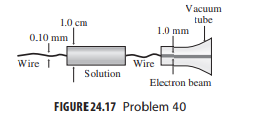
In Fig. 24.17, a 100-mA current flows through a copper wire 0.10 mm in diameter, a salt solution in a 1.0-cm-diameter glass tube, and a vacuum tube where the current is carried by an electron beam 1.0 mm in diameter. The density of conduction electrons in copper is 1.1x1029 m-3. The current in the
A copper wire joins an aluminum wire whose diameter is twice that of the copper. The same current flows in both wires. The density of conduction electrons in copper is 1.1x1029 m-3; in aluminum, it’s 2.1x1029 m-3.(a) the drift speeds(b) the current densities in each wire.
A gold film in an integrated circuit measures 1.85 μm thick by 0.120 mm wide. It carries a current density of 0.482 MA/m2. What’s the total current?
A lightbulb filament has diameter 0.050 mm and carries 0.833 A. Find the current density(a) in the filament(b) in the 12-gauge wire (diameter 2.1 mm) supplying current to the lightbulb.
An ion channel in a cell membrane carries 2.4 pA when it’s open, which is only 20% of the time.(a) What’s the average current in the channel?(b) If the channel opens for 1.0 ms, how many singly ionized ions pass through in this time?
You have a typical resistance of 100 kΩ.(a) How much current could a 12-V car battery pass through you?(b) Would you feel this?
You touch a defective appliance while standing on the ground, and you feel the tingle of a 2.5-mA current. What’s your resistance, assuming you’re touching the “hot” side of the 120-V household wiring?
Though rare, electrocution has been reported under wet conditions with voltages as low as 30 V. What resistance would be necessary for this voltage to drive a fatal current of 100 mA?
An incandescent lightbulb draws 0.50 A, while a compact fluorescent with the same light output draws 125 mA. Both operate on standard 120-V household power. How do their energy-consumption rates compare?
A 35Ω electric stove burner consumes 1.5 kW of power. At what voltage does it operate?
A watch uses energy at the rate of 240 μW. What current does it draw from its 1.5-V battery?
A 4.5-W flashlight bulb draws 750 mA.(a) At what voltage does it operate?(b) What’s its resistance?
A car’s starter motor draws 125 A with 11 V across its terminals. What’s its power consumption?
A uniform wire of resistance R is stretched until its length doubles. Assuming its density and resistivity remain constant, what’s its new resistance?
What current flows when a 45-V potential difference is imposed across a 1.8kΩ resistor?
The “third rail” that carries electric power to a subway train is an iron bar whose rectangular cross section measures 10 cm by 15 cm. Find the resistance of a 5.0-km length of this rail.
What’s the current in a 47kΩ resistor with 110 V across it?
What voltage does it take to drive 300 mA through a 1.2kΩ resistance?
Find the resistance of a heating coil that draws 4.8 A when the voltage across it is 120 V.
A 1.0-cm-diameter rod carries a 50-A current when the electric field in the rod is 1.4 V/m. What’s the resistivity of the rod material?
What electric field is necessary to drive a 7.5-A current through a 0.95-mm-diameter silver wire?
What electric field is necessary to drive a 7.5-A current through a 0.95-mm-diameter silver wire?
The electric field in an aluminum wire is 85 mV/m. Find the current density in the wire.
The National Electrical Code specifies a maximum current of 10 A in 16-gauge (1.29-mm-diameter) copper wire. What’s the corresponding current density?
Biologists measure the total current due to potassium ions moving through the membrane of a rock crab neuron cell as 30 nA. How many ions pass through the membrane each second?
A 12-V car battery is rated at 80 ampere-hours, meaning it can supply 80 A of current for 1 hour before it becomes discharged. If you accidentally leave the headlights on until the battery discharges, how much charge moves through the lights?
A wire carries 1.5 A. How many electrons pass through the wire in one second?
An unknown capacitor C is connected in series with a 3.0μF capacitor; this pair is placed in parallel with a 1.0μF capacitor, and the entire combination is put in series with a 2.0μF capacitor.(a) Make a circuit diagram of this network.(b) When a potential difference of 100 V is applied across
(a) Write the electrostatic potential energy of a pair of oppositely charged, closely spaced parallel plates as a function of their separation x, their area A, and the charge magnitude Q.(b) Differentiate with respect to x to find the magnitude of the attractive force between the plates. Why
An infinitely long rod of radius R carries uniform volume charge density λ. Find an expression for the electrostatic energy per unit length contained within the rod.
A transmission line consists of two parallel wires, of radius a and separation b, carrying uniform line charge densities ±λ, respectively. With a << b, their electric field is the superposition of the fields from two long straight lines of charge. Find the capacitance per unit length
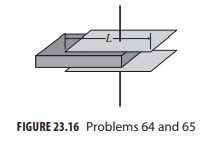
Repeat parts (b) and (c) of Problem 64, now assuming the battery remains connected while the slab is inserted. Data From Problem 64 (b) the stored energy, and (c) the force on the slab in terms of C0, V0 , k, and the plate length L. FIGURE 23.16 Problems 64 and 65
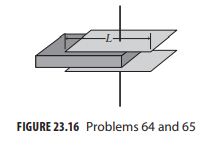
An air-insulated parallel-plate capacitor of capacitance C0 is charged to voltage V0 and then disconnected from the charging battery. A slab with dielectric constant k and thickness equal to the capacitor spacing is then inserted halfway into the capacitor (Fig. 23.16). Determine(a) the new
A solid sphere contains a uniform volume charge density. What fraction of the total electrostatic energy of this configuration is contained within the sphere?
Show that the result of Problem 61 reduces to that of a parallel-plate capacitor when the separation b - a is much less than the radius a.Data From Problem 61A capacitor consists of a conducting sphere of radius a surrounded by a concentric conducting shell of radius b. Show that its capacitance is
A capacitor consists of a conducting sphere of radius a surrounded by a concentric conducting shell of radius b. Show that its capacitance is C = ab/k(b – a).
A 2.1-mm-diameter wire carries a uniform line charge density l = 28 μC/m. Find the energy in a region 1.0 m long within one wire diameter of the wire surface.
Two widely separated 4.0-mm-diameter water drops each carry 15 nC. Assuming all charge resides on the drops’ surfaces, find the change in electrostatic potential energy if they’re brought together to form a single spherical drop.
A uranium-235 nucleus has diameter 6.6 fm and contains 92 protons and 143 neutrons. Assuming that charge is distributed uniformly throughout the nucleus, calculate the total electrostatic energy of this configuration.
A sphere of radius R carries total charge Q distributed uniformly over its surface. Show that the energy stored in its electric field is U = kQ2 /2R.
A sphere of radius R contains charge Q spread uniformly throughout its volume. Find an expression for the electrostatic energy contained within the sphere itself.
A cubical region 1.0 m on a side is located between x = 0 and x = 1 m. The region contains an electric field whose magnitude varies with x but is independent of y and z: E = E0(x/x0), where E0 = 24 kV/m and x0 = 6.0 m. Find the total energy in the region.
Your company is still stuck with those 2μF capacitors from Problem 44. They turn out to be so cheap that their capacitances are all too low, ranging from 1.7 μF to 1.9 μF. A colleague suggests you put variable “trimmer” capacitors in parallel with the cheap capacitors and adjust the
The first accurate estimate of cell membrane thickness used a capacitive technique, which determined the capacitance per unit area of cell membrane in a macroscopic suspension of cells; the result was about 1 μF/cm2. Assuming a dielectric constant of about 3 for the membrane, find the membrane’s
A 470-pF capacitor consists of two 15-cm-radius circular plates, insulated with polystyrene. Find(a) The thickness of the polystyrene(b) The capacitor’s working voltage.
A parallel-plate capacitor has plates with area 50 cm2 separated by 25 μm of polyethylene. Find its(a) Capacitance(b) Working voltage.
You’re evaluating a new hire in your company’s engineering department. Together you’re working on a circuit where a 0.1μF, 50-V capacitor is in series with a 0.2μF, 200-V capacitor. The new engineer claims you can safely put 250 V across the combination. What do you say?
Capacitors C1 and C2 are in series, with voltage V across the combination. Show that the voltages across the individual capacitors are V1 = C2V/(C1 + C2) and V2 = C1V/(C1 + C2).
Your company’s purchasing department bought lots of cheap 2.0μF, 50-V capacitors. Your budget is maxed out and they won’t let you buy additional capacitors for a circuit you’re designing. You need 2.0μF, 100-V capacitors and 0.5μF, 50-V capacitors. How will you combine the available
A camera requires 5.0 J of energy for a flash lasting 1.0 ms.(a) What power does the flashtube use while it’s flashing?(b) If the flashtube operates at 200 V, what size capacitor is needed to supply the flash energy?(c) If the flashtube is fired once every 10 s, what’s its average power
A medical defibrillator stores 950 J in a 100μF capacitor.(a) What is the voltage across the capacitor?(b) If the capacitor discharges 300 J of its stored energy in 2.5 ms, what’s the power delivered during this time?
A 0.01μF, 300-V capacitor costs 25.; a 0.1μF, 100-V capacitor costs 35¢; and a 30μF, 5-V capacitor costs 88¢.(a) Which can store the most charge?(b) Which can store the most energy?(c) Which is the most cost-effective energy-storage device, measured in J/¢.?
Which can store more energy: a 1.0μF capacitor rated at 250 V or a 470-pF capacitor rated at 3 kV?
The potential difference across a cell membrane is 65 mV. On the outside are 1.5 x10⁶ singly ionized potassium atoms. Assuming an equal negative charge on the inside, find the membrane’s capacitance.
Two closely spaced square conducting plates measure 10 cm on a side. The electric-field energy density between them is 4.5 kJ/m3. What’s the charge on the plates?
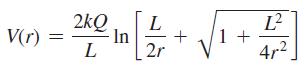
A thin rod of length L carries charge Q distributed uniformly over its length.(a) Show that the potential in the plane that perpendicularly bisects the rod is given bywhere r is the perpendicular distance from the rod center and where the zero of potential is taken at infinity.(b) Show that this
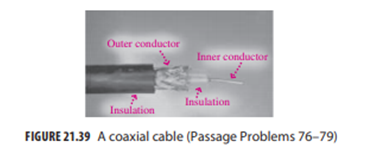
Coaxial cables are widely used with audio-visual technology, electronic instrumentation, and radio broadcasting, because they minimize interference with or from signals traveling on the cable. Coaxial cables consist of a wire inner conductor surrounded by a thin cylindrical conducting shield,
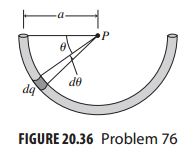
A semicircular loop of radius a carries positive charge Q distributed uniformly. Find the electric field at the loop?s center (point P in Fig. 20.36). (Divide the loop into charge elements dq as shown, write dq in terms of the angle d?,then integrate over ?.) -a- de da FIGURE 20.36 Problem 76
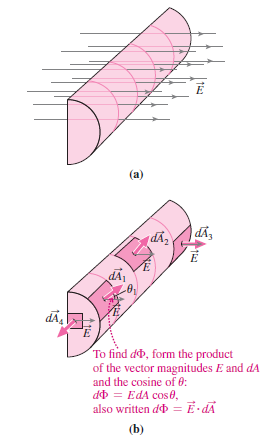
In Fig. 21.8, take the half-cylinder?s radius and length to be 3.4 cm and 15 cm, respectively. If the electric field has magnitude 6.8 kN/C, find the flux through the half-cylinder. You don?t need to do an integral! Why not?? (a) To find dP, form the product of the vector magnitudes E and dA and
A conducting sphere of radius a is surrounded by a concentric spherical shell of radius b. Both are initially uncharged. How much work does it take to transfer charge from one to the other until they carry charges ± Q?
A charge Q0 is at the origin. A second charge, Qx = 2Q0, is brought from infinity to the point x = a, y = 0. Then a third charge Qy is brought from infinity to x = 0, y = a. If it takes twice as much work to bring in Qy as it did Qx, what’s Qy in terms of Q0?
Consider a proton to be a uniformly charged sphere 1 fm in radius. Find the electric energy density at the proton’s surface.
Air undergoes dielectric breakdown at a field strength of 3 MV/m. Could you store energy in an electric field in air with the same energy density as gasoline?
A car battery stores about 4 MJ of energy. If this energy were used to create a uniform 30-kV/m electric field, what volume would it occupy?
The energy density in a uniform electric field is 3.0 J/m3. What’s the field strength?
You’re given three capacitors: 1.0 μF, 2.0 μF, and 3.0 μF. Find(a) The maximum,(b) The minimum,(c) Two intermediate capacitances you could achieve using combinations of all three capacitors.
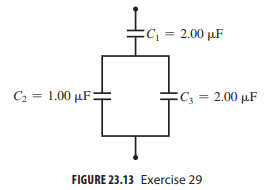
(a) Find the equivalent capacitance of the combination shown in Fig. 23.13.(b) The charge(c) The voltage on each capacitor when a 12.0-V battery is connected across the combination. 2.00 μF C2 = 1.00 µF: C; = 2.00 µF FIGURE 23.13 Exercise 29
Two capacitors are connected in series and the combination is charged to 100 V. If the voltage across each capacitor is 50 V, how do their capacitances compare?
You have a 1.0μF and a 2.0μF capacitor. What capacitances can you get by connecting them in series or in parallel?
Find the capacitance of a capacitor that stores 350 μJ when the potential difference across its plates is 100 V.
The power supply in a stereo receiver contains a 2500 μF capacitor charged to 35 V. How much energy does it store?
A parallel-plate capacitor with 1.1-mm plate spacing has ± 2.3 μC on its plates when charged to 150 V. What’s the plate area?
Find the capacitance of a parallel-plate capacitor with circular plates 20 cm in radius separated by 1.5 mm.
Show that the units of ε0 may be written as F/m.
A capacitor’s plates hold 1.3 μC when charged to 60 V. What’s its capacitance?
An uncharged capacitor has parallel plates 5.0 cm on a side, spaced 1.2 mm apart.(a) How much work is required to transfer 7.2 μC from one plate to the other?(b) How much work is required to transfer an additional 7.2 μC?
A capacitor consists of square conducting plates 25 cm on a side and 5.0 mm apart, carrying charges ±1.1 μC. Find(a) the electric field,(b) the potential difference between the plates,(c) the stored energy.
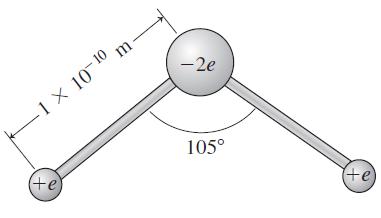
A crude model of the water molecule has a negatively charged oxygen atom and two protons, as shown in Fig. 23.12. Calculate the electrostatic energy of this configuration, which is therefore the magnitude of the energy released in forming this molecule. Exercise 17Figure 23.12 -2e -1 ×
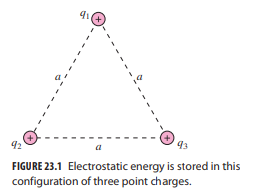
If the three particles in Fig. 23.1 have identical charge q and mass m, and if they?re released from their positions on the triangle, what speed v will they have when they?re far away? ? 92 93 a FIGURE 23.1 Electrostatic energy is stored in this configuration of three point charges.
Repeat Exercise 14 for the case when the fourth charge is -q.Data From Problem 14Three point charges +q and a fourth, -1/2 q, are assembled to form a square of side a. Find an expression for the electrostatic energy of this charge distribution.
Three point charges +q and a fourth, -1/2 q, are assembled to form a square of side a. Find an expression for the electrostatic energy of this charge distribution.
Four 75μC charges, initially far apart, are brought onto a line where they’re spaced at 5.0-cm intervals. How much work does it take to assemble this charge distribution?
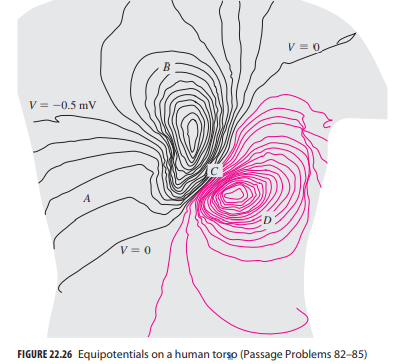
Standard electrocardiography measures time-dependent potential differences between multiple points on the body, giving cardiologists multiple perspectives on the heart?s electrical activity. In contrast, Fig. 22.26 is a ?snapshot? showing a more detailed picture at an instant of time. The lines are
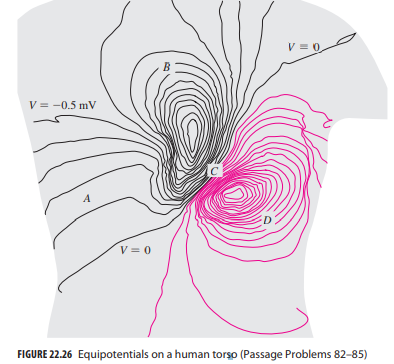
Standard electrocardiography measures time-dependent potential differences between multiple points on the body, giving cardiologists multiple perspectives on the heart?s electrical activity. In contrast, Fig. 22.26 is a ?snapshot? showing a more detailed picture at an instant of time. The lines are
You’re sizing a new electric transmission line, and you can save money with thinner wire. The potential difference between the line and the ground, 60 m below, is 115 kV. The field at the wire surface cannot exceed 25% of the 3-MV/m breakdown field in air. Neglecting charges in the ground itself,
Repeat Problem 79 for the charge distribution λ = λ0 x/L. (What does this charge distribution resemble at large distances?)Data From Problem 79A line charge extends along the x-axis from -L/2 to L/2. Its line charge density is λ= λ0(x/L2) , where λ0 is a constant. Find an expression for the
A line charge extends along the x-axis from -L/2 to L/2. Its line charge density is λ= λ0(x/L2) , where λ0 is a constant. Find an expression for the potential on the x-axis for x > L/2. Check that your expression reduces to an expected result for x >> L.
An open-ended cylinder of radius a and length 2a carries charge q spread uniformly over its surface. Find the potential at the center of the cylinder. (Treat the cylinder as a stack of charged rings, and integrate.)
A disk of radius a carries nonuniform surface charge density σ = σ0(r/a), where σ0 is a constant.(a) Find the potential at an arbitrary point x on the disk axis, where x = 0 is the disk center.(b) Use the result of (a) to find the electric field on the disk axis,(c) show that the field reduces
For the rod of the preceding problem,(a) Find an expression for the magnitude of the electric field in the perpendicular bisecting plane as a function of the distance r from the rod center.(b) Show that your expression reduces to an expected result when r >> L.(c) What’s the direction of
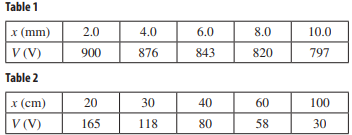
Measurements of the potential at points on the axis of a charged disk are given in the two tables below, one for measurements made close to the disk and the other for measurements made far away. In both tables x is the coordinate measured along the disk axis with the origin at the disk center, and
The Taser, an ostensibly nonlethal weapon used by police to subdue unruly suspects, shoots two conducting darts into the victim’s body. Thin wires connect the darts back to the weapon, and once the darts are embedded the weapon applies a 1200-V potential across them and delivers short pulses of
A uranium nucleus (mass 238 u, charge 92e) decays, emitting an alpha particle (mass 4 u, charge 2e) and leaving a thorium nucleus (mass 234 u, charge 90e). At the instant the alpha particle leaves the nucleus, the centers of the two are 7.4 fm apart and essentially at rest. Treating each particle
The potential on the axis of a uniformly charged disk at 5.0 cm from the disk center is 150 V; the potential 10 cm from the disk center is 110 V. Find the disk radius and its total charge.
A conducting sphere 5.0 cm in radius carries 60 nC. It’s surrounded by a concentric spherical conducting shell of radius 15 cm carrying -60 nC.(a) Find the potential at the sphere’s surface, taking V = 0 at infinity.(b) Repeat for the case when the shell carries +60 nC.
The potential as a function of position in a region is given by V(x) = 3x - 2x2 – x3, with x in meters and V in volts. Find(a) All points on the x-axis where V = 0,(b) An expression for the electric field, and (c) all points on the x-axis where E = 0.
A sphere of radius R carries a nonuniform but spherically symmetric volume charge density that results in an electric field in the sphere given by E(vector) = E0(r/R)2r̂, where E0 is a constant. Find the potential difference from the sphere’s surface to its center.
A 2.0-cm-radius metal sphere carries 75 nC and is surrounded by a concentric spherical conducting shell of radius 10 cm carrying -75 nC.(a) Find the potential difference between shell and sphere.(b) How would your answer change if the shell’s charge were +150 nC?
Showing 1100 - 1200
of 1601
First
3
4
5
6
7
8
9
10
11
12
13
14
15
16
17
Step by Step Answers

 Get 50% OFF
Claim Now
Get 50% OFF
Claim Now