New Semester
Started
Get
50% OFF
Study Help!
--h --m --s
Claim Now
Question Answers
Textbooks
Find textbooks, questions and answers
Oops, something went wrong!
Change your search query and then try again
S
Books
FREE
Study Help
Expert Questions
Accounting
General Management
Mathematics
Finance
Organizational Behaviour
Law
Physics
Operating System
Management Leadership
Sociology
Programming
Marketing
Database
Computer Network
Economics
Textbooks Solutions
Accounting
Managerial Accounting
Management Leadership
Cost Accounting
Statistics
Business Law
Corporate Finance
Finance
Economics
Auditing
Tutors
Online Tutors
Find a Tutor
Hire a Tutor
Become a Tutor
AI Tutor
AI Study Planner
NEW
Sell Books
Search
Search
Sign In
Register
study help
sciences
essential university physics
Essential University Physics 3rd Edition Volume 2 Richard Wolfsonby - Solutions
The ground-state energy of a harmonic oscillator is 4.0 eV. Find the energy separation between adjacent quantum states.
A harmonic oscillator emits a 1.1-eV photon as it undergoes a transition between adjacent states. Find its classical oscillation frequency f.
Find the ground-state energy for a particle in a harmonic oscillator potential whose classical angular frequency ω is 1.0x10¹⁷ s-1.
A quantum harmonic oscillator has ground-state energy 0.14 eV. What would be the system’s classical oscillation frequency f?
An alpha particle (mass 4 u) is trapped in a uranium nucleus with diameter 15 fm. Treating the system as a one-dimensional square well, what would be the minimum energy for the alpha particle?
A 3-g snail crawls at 0.5 mm/s between two rocks 15 cm apart. Treating this system as an infinite square well, determine the approximate quantum number. Does the correspondence principle permit the use of the classical approximation in this case?
A particle is confined to a 1.0-nm-wide infinite square well. If the energy difference between the ground state and the first excited state is 1.13 eV, is the particle an electron or a proton?
One reason we don’t notice quantum effects in everyday life is that Planck’s constant h is so small. Treating yourself as a particle (mass 60 kg) in a room-sized one-dimensional infinite square well (width 2.6 m), how big would h have to be if your minimum possible energy corresponded to a
A carbon nanotube traps an electron in a hollow cylindrical structure 0.48 nm in diameter. Approximating the nanotube as a one dimensional infinite square well, find the energies in eV of(a) the ground state(b) the first excited state.
Find the width of a square well in which a proton’s first excited state has energy 1.5 keV.
Determine the ground-state energy for an electron in an infinite square well of width 10.0 nm.
A particle in an infinite square well makes a transition from a higher to a lower energy state; the corresponding energy decrease is 33 times the ground-state energy. Find the quantum numbers of the initial and final states.
What’s the quantum number for a particle in an infinite square well if the particle’s energy is 25 times the ground-state energy?
The solution to the Schrödinger equation for a particular potential is ψ = 0 for |x| > a and ψ = A sin(πx/a) for -a ≤x ≤a, where A and a are constants. In terms of a, what value of A is required to normalize ψ?
A particle’s wave function is ψ = Ae-x^2 /a^2, where A and a are constants.(a) Where is the particle most likely to be found?(b) Where is the probability per unit length half its maximum value?
What are the units of the wave function ψ (x) in a one-dimensional situation?
Some philosophers argue that the strict determinism of classical physics is inconsistent with human free will, but that the indeterminacy of quantum mechanics does leave room for free will. Others claim that physics has no bearing on the question of free will. What do you think?
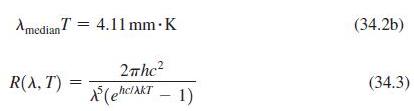
Perform a numerical integration of Equation 34.3 to the wavelength given by Equation 34.2b. Divide by the result of Problem 79, and thus verify that Equation 34.2b gives the wavelength above and below which a blackbody radiates half its energy. Amedian T = 4.11 mm K (34.2b) 2nhc? R(A, T) (34.3) (e
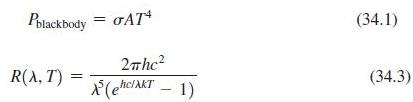
Integrate Equation 34.3 over all wavelengths to get the total power radiated per unit area. Show that your result is equivalent to Equation 34.1, with the Stefan–Boltzmann constant given by σ = 2π5k4/15c2h3. (Use hc/λkT as the integration variable.) Polackbody oAT (34.1) 2nhc? R(A, T) (34.3)
What would the constant in Equation 34.2a be if blackbody radiance were defined for fixed intervals of frequency rather than wavelength? (Use λ = c/f to express the radiance as R(f, T), then differentiate to find the maximum, and solve the resulting relation numerically. Express your answer in a
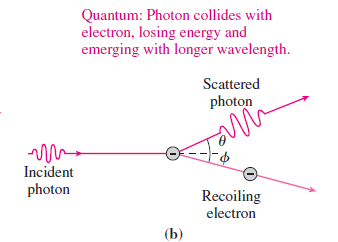
Consider an elastic collision between a photon with initial wavelength λ0 moving in the x-direction and a stationary electron, as depicted in Fig. 34.9b. Use relativistic expressions for energy and momentum from Chapter 33 to show that conservation of energy and momentum yield the equations hc/λ0
Show that Wien’s law (Equation 34.2a) follows from Planck’s law (Equation 34.3). (Differentiate Planck’s law with respect to wavelength.) ApeakT= 2.898 mm. K (Wien's law) (34.2a)
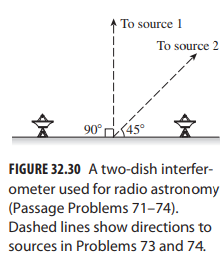
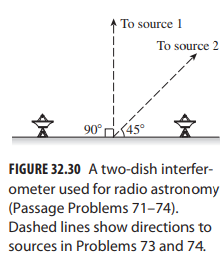
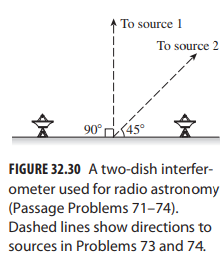
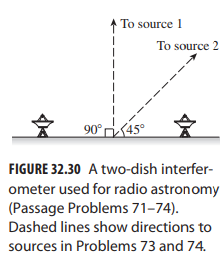
Even the nearest stars are so distant that a single diffraction limited telescope capable of imaging Earth-size planets orbiting them would be hopelessly large (see Problem 45). Astronomers get around this limitation using interferometry to combine data from several telescopes, producing an
Even the nearest stars are so distant that a single diffraction limited telescope capable of imaging Earth-size planets orbiting them would be hopelessly large (see Problem 45). Astronomers get around this limitation using interferometry to combine data from several telescopes, producing an
Even the nearest stars are so distant that a single diffraction limited telescope capable of imaging Earth-size planets orbiting them would be hopelessly large (see Problem 45). Astronomers get around this limitation using interferometry to combine data from several telescopes, producing an
Even the nearest stars are so distant that a single diffraction limited telescope capable of imaging Earth-size planets orbiting them would be hopelessly large (see Problem 45). Astronomers get around this limitation using interferometry to combine data from several telescopes, producing an
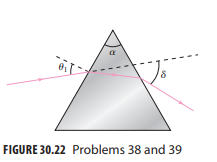
The prism in Fig. 30.22 has n = 1.52 and a = 60? and is surrounded by air. A light beam is incident at u1 = 37?. Find the angle d through which the beam is deflected. FIGURE 30.22 Problems 38 and 39
Laser eye surgery uses ultraviolet light with wavelength 193 nm. What’s the UV light’s wavelength within the eye’s lens, where n = 1.39?
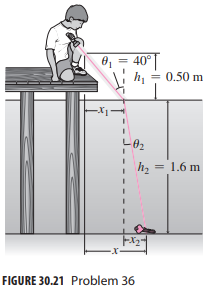
You?ve dropped your car keys at night off the end of a dock into water 1.6m deep. A flashlight held directly above the dock edge and 0.50 m above the water illuminates the keys when it?s aimed at 40? to the vertical, as shown in Fig. 30.21. What?s the horizontal distance x from the edge of the dock
You’re standing 2.3m horizontally from the edge of a 4.5-m-deep lake, with your eyes 1.7 m above the water’s surface. A diver holding a flashlight at the lake bottom shines the light so you can see it. If the light in the water makes a 42° angle with the vertical, at what horizontal distance
You look at the center of one face of a solid glass cube of glass, on a line of sight making a 55° angle with the normal to the cube face. What minimum refractive index of the glass will let you see through the cube’s opposite face?
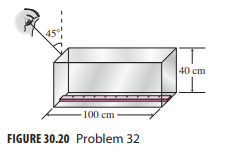
A meter stick lies on the bottom of the rectangular tank in Fig. 30.20, with its zero mark at the tank?s left edge. You look into the long dimension of the tank at a 45? angle, with your line of sight just grazing the top edge, as shown. What mark on the meter stick do you see when the tank is(a)
An unlabeled bottle of liquid has spilled, and you?re trying to find out whether it?s relatively harmless ethyl alcohol or toxic benzene. You submerge a glass block with n = 1.52 in the liquid, and shine a laser beam so it strikes the submerged glass with incidence angle 31.5?. You measure the
Two plane mirrors make an angle Φ. A light ray enters the system and is reflected once off each mirror. Show that the ray is turned through an angle 360° - 2Φ.
The refractive index of a human cornea is 1.40. If 550-nm light strikes a cornea at incidence angle 25°, find(a) the angle of refraction (b) the wavelength in the cornea.
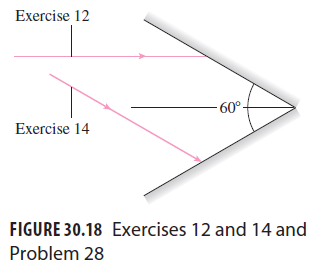
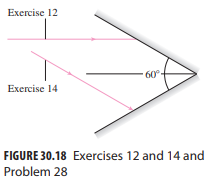
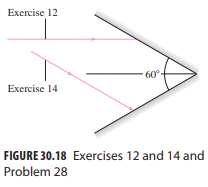
Suppose the 60? angle in Fig. 30.18 is changed to 75?. A ray enters the mirror system parallel to the axis.(a) How many reflections does it make?(b) Through what angle is it turned when it exits the system? Exercise 12 - 60°- Exercise 14 FIGURE 30.18 Exercises 12 and 14 and Problem 28
A drop of water is trapped in a block of ice. What’s the critical angle for total internal reflection at the water–ice interface?
Find the critical angle for total internal reflection in(a) ice,(b) polystyrene, (c) rutile, when the surrounding medium is air.
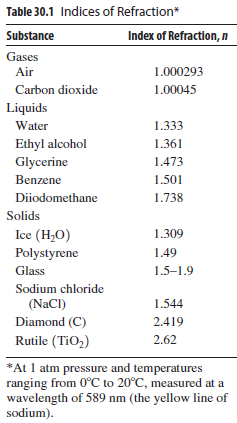
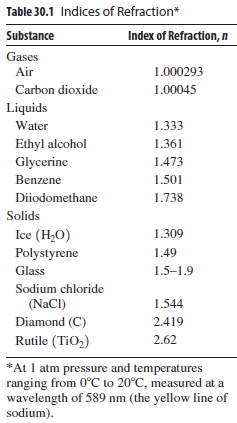
In which substance in Table 30.1 does the speed of light have the value 2.292x10⁸ m/s? Table 30.1 Indices of Refraction* Substance Index of Refraction, n Gases Air 1.000293 Carbon dioxide 1.00045 Liquids Water 1.333 Ethyl alcohol Glycerine 1.361 1.473 Benzene 1.501 Diiodomethane 1.738 Solids Ice
If a light ray enters the mirror system of Fig. 30.18 propagating in the plane of the page and parallel to one mirror, through what angle will it be turned? ? Exercise 12 60 Exercise 14 FIGURE 30.18 Exercises 12 and 14 and Problem 28
To what angular accuracy must two ostensibly perpendicular mirrors be aligned so that an incident ray returns within 1° of its incident direction?
The mirrors in Fig. 30.18 make a 60? angle. A light ray enters parallel to the symmetry axis, as shown.(a) How many reflections does it make?(b) Where and in what direction does it exit the mirror system? ? Exercise 12 60 Exercise 14 FIGURE 30.18 Exercises 12 and 14 and Problem 28
Through what angle should you rotate a mirror so that a reflected ray rotates through 30°?
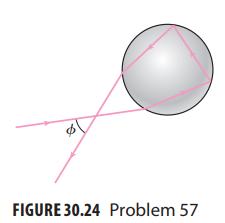
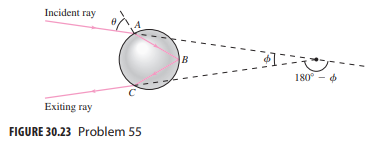
Figure 30.24 shows the approximate path of a light ray that undergoes internal reflection twice in a spherical water drop. Repeat Problems 55 and 56 for this case to find the angle at which the secondary rainbow occurs. ? Data From Problem 55 & 56? 55. Figure 30.23 shows light passing through a
A scuba diver sets off a camera flash at depth h in water with refractive index n. Show that light emerges from the water’s surface through a circle of diameter 2h/ √ (n2 - 1).
For the interface between air (refractive index 1) and a material with refractive index n, show that the critical angle and the polarizing angle are related by sin θc = cot θp.
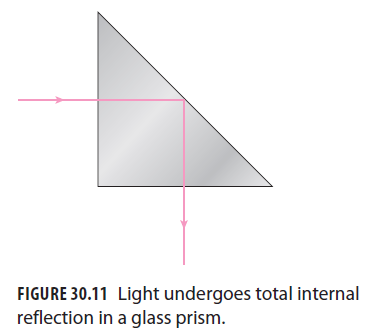
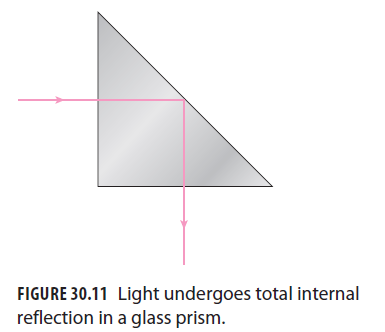
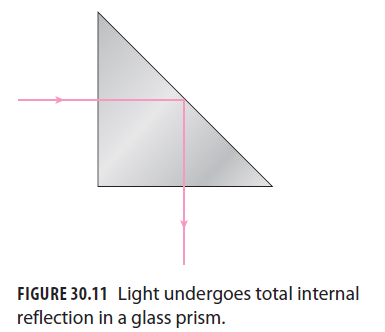
The prism of Fig. 30.11 has n = 1.52. When it?s immersed in a liquid, a beam incident as shown in the figure ceases to undergo total reflection. What?s the minimum value for the liquid?s refractive index? ? FIGURE 30.11 Light undergoes total internal reflection in a glass prism.
Find the speed of light in a material for which the critical angle at an interface with air is 61°.
Where and in what direction would the main beam emerge if the prism in Fig. 30.11 were made of ice, surrounded by air? FIGURE 30.11 Light undergoes total internal reflection in a glass prism.
Find the minimum refractive index for the prism in Fig. 30.11 if total internal reflection occurs as shown when the prism is surrounded by air. FIGURE 30.11 Light undergoes total internal reflection in a glass prism.
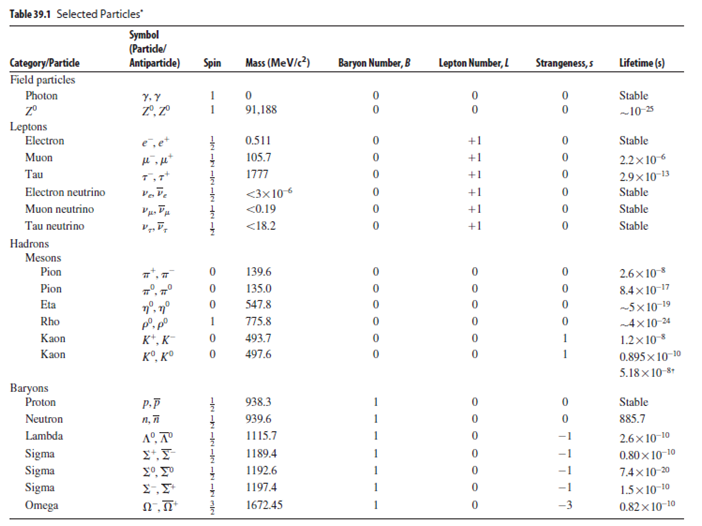
A mix of particles starts with equal numbers of the three types of sigma particles listed in Table 39.1. Find the relative portion of each after(a) 5x10-20?s ?(b) 5x10⁻¹⁰ s. Give your answer in a reference frame in which the particles are at rest.? Table 39.1 Selected Particles Symbol (Partide/
Many particles are far too short-lived for their lifetimes to be measured directly. Instead, tables of particle properties often list “width,” measured in energy units and indicating the width of the distribution of measured rest energies. For example, the Z0 has mass 91.18 GeV and width 2.5
Pions are the lightest mesons, with mass some 270 times that of the electron. Charged pions decay typically into a muon and a neutrino or antineutrino. This makes pion beams useful for producing beams of neutrinos, which physicists use to study those elusive particles. In a medical application
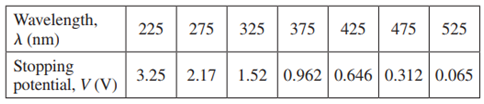
The table below lists the stopping potential as a function of wavelength in a photoelectric effect experiment. Determine quantities to plot that should yield a straight line. Make your plot, establish a best-fit line, and use your line to determine(a) an experimental value for Planck?s constant (b)
Show that in the Bohr model, the frequency of a photon emitted in a transition between levels n + 1 and n, in the limit of large n, is equal to the electron’s orbital frequency. (This is an example of Bohr’s correspondence principle.)
Show that the frequency range of the hydrogen spectral line series involving transitions ending at the nth level is ∆f = cRH/(n + 1)2 .
A photon’s wavelength is equal to the Compton wavelength of a particle with mass m. Show that the photon’s energy is equal to the particle’s rest energy.
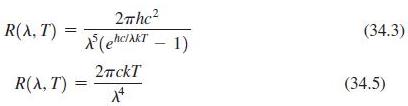
Use the series expansion for ex (Appendix A) to show that Planck’s law (Equation 34.3) reduces to the Rayleigh–Jeans law (Equation 34.5) when l >> hc/kT. 2rhc? R(A, T) (34.3) (ehc/AKT - 1) 2nckT R(A, T) (34.5)
An electron is moving at 106m/s and you wish to measure its energy to an accuracy of ±0.0. What’s the minimum time necessary for this measurement?
Typically, an atom remains in an excited state for about 10-8 s before it drops to a lower state, emitting a photon in the process. What’s the uncertainty in the energy of this transition?
An electron is trapped in a “quantum well” 23 nm wide. Find its minimum possible speed.
You’re a cell biologist who wants to image microtubules that form the “skeletons” of living cells. The microtubules are 25 nm in diameter, and, as Chapter 32 shows, you need to image with waves whose wavelength is at least this small. You can use either an inexpensive electron microscope that
Find the minimum electron speed that would make an electron microscope superior to an optical microscope using 450-nm light.
Through what potential difference should you accelerate an electron from rest so its de Broglie wavelength will be the size of a hydrogen atom, about 0.1 nm?
Helium with one of its two electrons removed acts very much like hydrogen, and the Bohr model successfully describes it. Find(a) the radius of the ground-state electron orbit(b) the photon energy emitted in a transition from the n = 2 to the n = 1 state in this singly ionized helium.
Ultraviolet light with wavelength 75 nm shines on hydrogen atoms in their ground states, ionizing some of the atoms. What’s the energy of the electrons freed in this process?
A hydrogen atom is in its ground state when its electron absorbs a 48-eV photon. What’s the energy of the resulting free electron?
A Rydberg hydrogen atom makes a downward transition to the n = 225 state, emitting a 9.32μeV photon. What was the original state?
The wavelengths of a spectral line series tend to a limit as n1 → ∞. Evaluate the series limit for(a) the Lyman series(b) the Balmer series in hydrogen.
Find(a) the wavelength(b) the energy in electronvolts of the photon emitted when a Rydberg hydrogen atom drops from the n = 180 level to the n = 179 level.
(a) Find the highest possible energy for a photon emitted as the electron jumps between two adjacent energy levels in the Bohr hydrogen atom.(b) Which energy levels are involved?
An experimental transistor uses a single electron trapped in a channel 6.6 nm wide. What’s the minimum kinetic energy this electron could have, consistent with the uncertainty principle? Give your answer in joules and in eV.
Find the de Broglie wavelength of an electron that’s been accelerated from rest through a 4.5-kV potential difference.
An electron is known to be somewhere inside a carbon nanotube that’s 370 nm long and 1.2 nm in diameter. Find the minimum uncertainties in the components of its velocity(a) along the tube(b) perpendicular to the tube’s long dimension.
A cosmic-ray particle interacts with an energy-measuring device for a mere 12 zs. What’s the minimum uncertainty in the measured energy? Express your answer in joules and in eV.
A photocathode ejects electrons with maximum energy 0.85 eV when illuminated with 430-nm blue light. Will it eject electrons when illuminated with 633-nm red light? If so, what will be the maximum electron energy?
Find the kinetic energy of an initially stationary electron after a 0.10-nm X-ray photon scatters from it at 90°.
A 150-pm X-ray photon Compton-scatters off an electron and emerges at 135° to its original direction. Find(a) the wavelength of the scattered photon(b) the electron’s kinetic energy.
The maximum electron energy in a photoelectric experiment is 2.8 eV. When the wavelength of the illuminating radiation is increased by 50%, the maximum energy drops to 1.1 eV. Find(a) the work function of the emitting surface (b) the original wavelength.
When light shines on potassium, the photoelectrons’ maximum speed is 4.2x10⁵ m/s. Find the light’s wavelength.
Find the initial wavelength of a photon that loses half its energy when it Compton-scatters from an electron and emerges at 90° to its initial direction.
Chlorophyll is a photosynthetic molecule common in green plants. On a per-unit-wavelength basis, its ability to absorb visible light has two peaks, at 430 nm and 662 nm.(a) Find the corresponding photon energies.(b) Use these peak wavelengths to explain why plants are green.
The stopping potential in a photoelectric experiment is 1.8V when the illuminating radiation has wavelength 365 nm. Determine(a) the work function of the emitting surface (b) the stopping potential for 280-nm radiation.
(a) Find the cutoff frequency for the photoelectric effect in copper.(b) Find the maximum energy of the ejected electrons if the copper is illuminated with light of frequency 1.8x10¹⁵ Hz.
Electrons in a photoelectric experiment emerge from an aluminum surface with maximum kinetic energy 1.3 eV. Find the wavelength of the illuminating radiation.
Find the rate of photon production by(a) a radio antenna broadcasting 1.0 kW at 89.5 MHz,(b) a laser producing 1.0 mW of 633-nm light, (c) an X-ray machine producing 0.10-nm X rays with total power 2.5 kW.
(a) Find the Compton wavelength for a proton.(b) Find the energy in electronvolts of a gamma ray whose wavelength equals the proton’s Compton wavelength.
The radiance of a blackbody peaks at 558 nm.(a) What’s its temperature?(b) How does its radiance at 382 nm (violet light) compare with that at 694 nm (red light)?
For a 2.0-kK blackbody, by what percentage is the Rayleigh-Jeans law in error at wavelengths of(a) 1.0 mm,(b) 10μm,(c) 1.0μm
Treating the Sun as a 5800-K blackbody, compare its UV radiance at 200 nm with its visible radiance at its 500-nm peak wavelength.
Find the power per unit area emitted by a 3000-K incandescent lamp filament in the wavelength interval from 500 nm to 502 nm.
Find the minimum energy for a neutron in a uranium nucleus whose diameter is 15fm.
An electron is moving in the +x-direction with speed measured at 50 Mm/s, accurate to ±10%. What’s the minimum uncertainty in its position?
A proton has velocity v = (1500 ± 0.25)m/s. What’s the uncertainty in its position?
Is it possible to determine an electron’s velocity accurate to ±1m/s while simultaneously finding its position to within ±1μm? What about a proton?
A proton is confined to a space 1 fm wide (about the size of an atomic nucleus). What’s the minimum uncertainty in its velocity?
Find the de Broglie wavelength of electrons with kinetic energies(a) 10 eV,(b) 1.0 keV, (c) 10 keV.
How slowly must an electron be moving for its de Broglie wavelength to be 1mm?
Find the de Broglie wavelength of(a) Earth, orbiting the Sun at 30 km/s, and(b) An electron moving at 10 km/s. 30. How slowly must an electron be moving for its de Broglie wavelength to be 1mm?
At what energy level does the Bohr hydrogen atom have diameter 5.18nm?
Showing 400 - 500
of 1601
1
2
3
4
5
6
7
8
9
10
11
12
13
14
15
Last
Step by Step Answers

 Get 50% OFF
Claim Now
Get 50% OFF
Claim Now