New Semester
Started
Get
50% OFF
Study Help!
--h --m --s
Claim Now
Question Answers
Textbooks
Find textbooks, questions and answers
Oops, something went wrong!
Change your search query and then try again
S
Books
FREE
Study Help
Expert Questions
Accounting
General Management
Mathematics
Finance
Organizational Behaviour
Law
Physics
Operating System
Management Leadership
Sociology
Programming
Marketing
Database
Computer Network
Economics
Textbooks Solutions
Accounting
Managerial Accounting
Management Leadership
Cost Accounting
Statistics
Business Law
Corporate Finance
Finance
Economics
Auditing
Tutors
Online Tutors
Find a Tutor
Hire a Tutor
Become a Tutor
AI Tutor
AI Study Planner
NEW
Sell Books
Search
Search
Sign In
Register
study help
sciences
essential university physics
Essential University Physics 3rd Edition Volume 2 Richard Wolfsonby - Solutions
What’s the maximum wavelength of light that can ionize hydrogen in its ground state? In what spectral region is this?
Which spectral line of the hydrogen Paschen series (n2 = 3) has wavelength 1282 nm?
Calculate the wavelengths of the first three lines in the Lyman series for hydrogen.
A red laser at 650 nm and a blue laser at 450 nm emit photons at the same rate. How do their total power outputs compare?
A microwave oven uses electromagnetic radiation at 2.4 GHz.(a) What’s the energy of each microwave photon?(b) At what rate does a 900-W oven produce photons?
The human eye is sensitive to wavelengths from about 400 nm to 700nm. What’s the corresponding range of photon energies?
Find the energy in electronvolts of(a) a 1.0-MHz radio photon,(b) a 5.0x10¹⁴ Hz optical photon, and(c) a 3.0 x10¹⁸ Hz X-ray photon.
The Sun approximates a blackbody at 5800 K. (a) Find the wavelength of peak radiance on the per-unit-wavelength basis implicit in Equation 34.2a.
Spacecraft instruments measure the radiation from an asteroid, and the data show that the power per unit wavelength peaks at 40μm. Assuming the asteroid is a blackbody, find its surface temperature.
Find λpeak and λmedian for Earth considered a 288-K blackbody.
The surface temperature of the star Rigel is 104 K. Find(a) the power radiated per square meter of its surface,(b) its λpeak,(c) its λmedia.
If you double a blackbody’s temperature, by what factor does its radiated power increase?
If you measure a particle’s position with perfect accuracy, what do you know about its momentum?
You’ve been named captain of NASA’s first interstellar mission since the Voyager robotic spacecraft. You board your spaceship, accelerate quickly to 0.8c, and cruise at constant speed toward Proxima Centauri, the closest star to our Sun. Proxima Centauri is 4 light-years distant as measured in
You’ve been named captain of NASA’s first interstellar mission since the Voyager robotic spacecraft. You board your spaceship, accelerate quickly to 0.8c, and cruise at constant speed toward Proxima Centauri, the closest star to our Sun. Proxima Centauri is 4 light-years distant as measured in
You’ve been named captain of NASA’s first interstellar mission since the Voyager robotic spacecraft. You board your spaceship, accelerate quickly to 0.8c, and cruise at constant speed toward Proxima Centauri, the closest star to our Sun. Proxima Centauri is 4 light-years distant as measured in
You’ve been named captain of NASA’s first interstellar mission since the Voyager robotic spacecraft. You board your spaceship, accelerate quickly to 0.8c, and cruise at constant speed toward Proxima Centauri, the closest star to our Sun. Proxima Centauri is 4 light-years distant as measured in
The table below lists the total energy and corresponding momentum for a particle. They?re measured in MeV and MeV/c, respectively commonly used units in particle physics. Determine suitable functions of these quantities to plot such that the resulting plot should be a straight line. Plot your data,
Consider a line of positive charge with line charge density ? as measured in a frame S at rest with respect to the charges.(a) Show that the electric field a distance r from this charged line has magnitude E = ?/2??0r, and that there?s no magnetic field (no relativity needed here). Now consider the
It’s the 24th century, and you’re a curator at the Starfleet Museum of Ancient Technology. Archaeologists have unearthed a “TV tube,” an ancient device for displaying moving images. Your job is to get it working. One reference says the device accelerated electrons, which then bombarded a
Consider a relativistic particle of mass m moving along a straight line. Use Equation 33.7 to find an expression for the force on the particle, defined as F = dp/dt, in terms of its acceleration a = du/dt.
Equation 33.5a transforms the velocity u(vector) of an object moving in the x-direction the same direction as the relative velocity v(vector) of the two reference frames. Now suppose the object?s velocity also has a component uy perpendicular to the two frames? relative velocity v(vector). Find the
Use the Lorentz transformations to show that if two events are separated in space and time so that a light signal leaving one event cannot reach the other, then there is an observer for whom the two events are simultaneous. Show that the converse is also true: If a light signal can get from one
When an object’s speed increases by 5%, its momentum increases by a factor of 5. What was its original speed?
The highest-energy cosmic rays ever detected are protons with energies on the order of 300 EeV.(a) What’s Earth’s radius as measured in the reference frame of such a proton as it approaches Earth?(b) Compare the high-energy proton’s total energy with that of a 143-g baseball moving at 100
At what speed are a particle’s kinetic and rest energies equal?
How fast would you have to travel to reach the Crab Nebula, 6500 light years from Earth, in 15 years? Give your answer to seven significant figures.
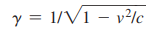
Show from the Lorentz transformations that the space time interval of Equation 33.6 has the same value in all reference frames. (As)? = c²(At)? – [(Ax)? + (Ay)? + (Az)*] (33.6)
Show that Equation 33.10 follows from the expressions for relativistic momentum and total energy. E² = p°c² + (mc²)² (energy-momentum relation) (33.10)
Use the binomial approximation (Appendix A) to show that Equation 33.8 reduces to the Newtonian expression for kinetic energy in the limit u << c. mc? K = V1 mc = ymc? mc? (33.8) ulc?
Find the speed of an electron with kinetic energy(a) 100 eV,(b) 100 keV,(c) 1MeV,(d) 1 GeV.Use suitable approximations where possible.
Find the kinetic energy of an electron moving at(a) 0.0010c,(b) 0.60c,(c) 0.99c.Use suitable approximations where possible.
In a nuclear-fusion reaction, two deuterium nuclei combine to make a helium nucleus plus a neutron, releasing 3.3MeV of energy in the process. By how much do the combined masses of the helium nucleus and the neutron differ from the combined masses of the original deuterium nuclei?
A large city consumes electrical energy at the rate of 1GW. If you converted all the rest mass in a 1-g raisin to electrical energy, for how long could it power the city?
The Large Hadron Collider accelerates protons to energies of 14TeV.(a) Compare that proton energy with the kinetic energy of a 25-mg bug crawling at 2.0 mm/s.(b) Compare the proton momentum with that of the same bug.
Find(a) the speed(b) the momentum of a proton with kinetic energy 500MeV.
When a particle’s speed doubles, its momentum increases by a factor of 3. What was its original speed?
Event A occurs at x = 0 and t = 0 in reference frame S. Event B occurs at x = 3.8 light years and t = 1.6 years in S. Find(a) the distance(b) the time between A and B in a frame moving at 0.80c along the x-axis of S.
Compare the momentum changes needed to boost a spacecraft(a) from 0.10c to 0.20c(b) from 0.80c to 0.90c.
A light beam is emitted at event A and arrives at event B. Show that the spacetime interval between the two events is zero.
Use Equation 33.6 to calculate the square of the spacetime interval between the events (a) of Problem 39 and (b) of Problem 40. Comment on the signs of your answers in relation to the possibility of a causal relationship between the events. ? Data From Problem 39 & 40 Repeat Problem 39, now
A spaceship travels at 0.80c from Earth to a star 10 light years distant, as measured in the Earth–star reference frame. Let event A be the ship’s departure from Earth and event B its arrival at the star.(a) Find the distance and time between the two events in the Earth–star frame.(b) Repeat
An advanced civilization has developed a spaceship that goes, with respect to the galaxy, only 50 km/s slower than light.(a) According to the ship’s crew, how long does it take to cross the galaxy’s 100,000-1y diameter?(b) What’s the galactic diameter measured in the ship’s reference frame?
How fast would you have to go to reach a star 240 light years away in an 85-year human lifetime?
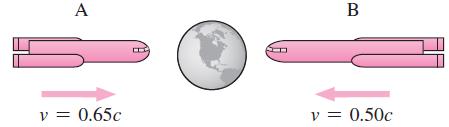
You’re a consultant for the director of a sci-fi movie. The film starts with two spaceships, each measuring 25 m long in its rest frame, approaching Earth in opposite directions with speeds shown in Fig. 33.24. The director wants to know how long to make ship B for scenes shotFigure 33.24(a) In
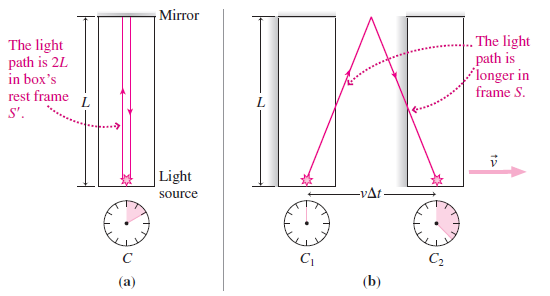
In the light box of Fig. 33.6, let event A be the emission of the light flash and event B its return to the source. Assign suitable space and time coordinates to these events in the frame in which the box moves with speed v. Apply the Lorentz transformations to show that the time between the two
Derive the Lorentz transformations for time from the transformations for space.
The Curiosity rover touched down on Mars when Earth and Mars were 14 light-minutes apart. At the instant of touchdown, clocks at Mission Control in Pasadena, California, read 10:31 pm. As judged by observers on a spacecraft heading along the Earth– Mars line at 0.35c, did touchdown occur before
Could there be observers who would judge the two events in Problem 39 to be simultaneous? If so, how fast and in what direction must these observers be moving?Data From Problem 39You’re writing a galactic history involving two civilizations that evolve on opposite sides of a 1.0x10⁵ -ly-diameter
Repeat Problem 39, now assuming that civilization B lags A by 1.2 million years in the galaxy’s reference frame.Data From Problem 39You’re writing a galactic history involving two civilizations that evolve on opposite sides of a 1.0x10⁵ -ly-diameter galaxy. In the galaxy’s reference frame,
You’re writing a galactic history involving two civilizations that evolve on opposite sides of a 1.0x10⁵ -ly-diameter galaxy. In the galaxy’s reference frame, civilization B launched its first spacecraft 45,000 years after civilization A. You and your readers, from a more advanced civilization,
Earth and Sun are 8.33 light minutes apart. Event A occurs on Earth at time t = 0 and event B on the Sun at t = 2.45 min, as measured in the Earth–Sun frame. Find the time order and time difference between A and B for observers(a) moving on a line from Earth to Sun at 0.750c,(b) moving on a line
Use relativistic velocity addition to show that if an object moves at speed v < c relative to some inertial reference frame, then its speed relative to any other inertial frame must also be less than c.
Two spaceships are racing. The “slower” one passes Earth at 0.70c, and the “faster” one moves at 0.40c relative to the slower one. What’s the faster ship’s speed relative to Earth?
Two distant galaxies are receding from Earth at 0.75c in opposite directions. How fast does an observer in one galaxy measure the other to be moving?
Radioactive oxygen-15 decays at such a rate that half the atoms in a given sample decay every 2 min. If a tube containing 1000 O-15 atoms is moved at 0.80c relative to Earth for 6.67min according to clocks on Earth, how many atoms will be left at the end of that time?
Twins A and B live on Earth. On their 20th birthday, twin B climbs into a spaceship and makes a round-trip journey at 0.95c to a star 30 light years distant, as measured in the Earth–star reference frame. What are their ages when twin B returns to Earth?
The nearest star beyond our solar system is about 4 light years away. If a spaceship can get to the star in 5 years, as measured on Earth,(a) how long would the ship’s pilot judge the journey to take?(b) How far from Earth would the pilot find the star to be?
You wish to travel to a star N light years from Earth. How fast must you go if the one-way journey is to occupy N years of your life?
You’re the communications officer on a fast spaceship that takes 50 years in ship time to reach the Andromeda Galaxy, 2 million light years from Earth in the common rest frame of Earth and Andromeda. As soon as you reach Andromeda, your captain orders you to send a radio message to Earth
Earth and Sun are 8.3 light minutes apart, as measured in their rest frame.(a) What’s the speed of a spacecraft that makes the trip in 5.0 min according to its on-board clocks?(b) What’s the trip time as measured by clocks in the Earth–Sun reference frame?
You’re designing a Michelson interferometer in which a speed of light difference of 100m/s in two perpendicular directions is supposed to shift the interference pattern so a bright fringe of 550-nm light ends up where the adjacent dark fringe would be in the absence of a speed difference. How
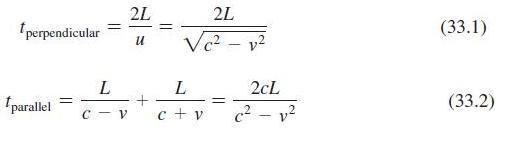
Show that the time of Equation 33.2 is longer than that of Equation 33.1 when 0 < v < c. 2L 2L ' perpendicular (33.1) Vc - v2 L 2cL parallel c + v c2 - v? (33.2) C - V
At what speed will the relativistic and Newtonian expressions for kinetic energy differ by 10%?
Find(a) the total energy(b) the kinetic energy of an electron moving at 0.97c.
A particle is moving at 0.90c. If its speed increases by 10%, by what factor does its momentum increase?
At what speed will the Newtonian expression for momentum be in error by 1%?
At what speed will the momentum of a proton (mass 1 u) equal that of an alpha particle (mass 4 u) moving at 0.5c?
By what factor does an object’s momentum change if you double its speed when its original speed is(a) 25m/s and(b) 100Mm/s?
A hospital’s linear accelerator produces electron beams for cancer treatment. The accelerator is 1.6 m long and the electrons reach a speed of 0.98c. How long is the accelerator in the electrons’ reference frame?
How fast would you have to move relative to a meter stick for it to be 99 cm long in your reference frame?
An extraterrestrial spacecraft whizzes through the solar system at 0.80c. How long does it take to go the 8.3 light-minute-distance from Earth to Sun(a) according to an observer on Earth(b) according to an alien aboard the ship?
A spaceship passes by you at half the speed of light, and you determine that it’s 35m long. Find its length as measured in its rest frame.
How long would it take a spacecraft traveling at 0.65c to get from Earth to Pluto according to clocks(a) on Earth(b) on the spacecraft? Assume Earth and Pluto are on the same side of the Sun.
Two stars are 50 ly apart, measured in their common rest frame. How far apart are they to a spaceship moving between them at 0.75c?
Consider a Michelson–Morley experiment with 11-m light paths perpendicular and parallel to the ether wind. What would be the difference in light travel times on the two paths if Earth moved relative to the ether at(a) its orbital speed(b) 0.01c;(c) 0.5c;(d) 0.99c
An airplane makes a round trip between two points 1800 km apart, flying with airspeed 800 km/h. What’s the round trip flying time(a) if there’s no wind,(b) with wind at 130 km/h perpendicular to a line joining the two points, (c) with wind at 130km/h along a line joining the two points?
You’re investigating an oil spill for your state environmental protection agency. There’s a thin film of oil on water, and you know its refractive index is noil = 1.38. You shine white light vertically on the oil, and use a spectrometer to determine that the most strongly reflected wavelength
You’re on an international panel charged with allocating “real estate” for communications satellites in geostationary orbit. The panel needs to know how many satellites could fit in geostationary orbit without receivers on the ground picking up multiple signals. Assume all satellites
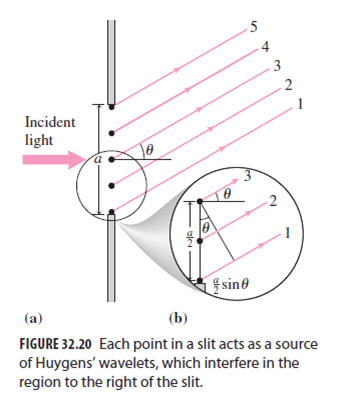
The intensity of the single-slit diffraction pattern can be calculated by summing the amplitudes of infinitely many field amplitudes corresponding to waves from every infinitesimal part of the slit. (a) Referring to Fig. 32.20, show that the field from an element of slit width dy, a distance y from
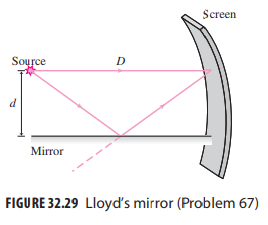
An arrangement known as Lloyd?s mirror ?(Fig. 32.29) allows interference between direct and reflected beams from the same source. Find an expression for the separation of bright fringes on the screen, given the distances d and D and the light?s wavelength ?. Screen Source d Mirror FIGURE 32.29
Light is incident on a diffraction grating at angle a to the normal. Show that the condition for maximum light intensity becomes d(sinθ±sinα) = mλ.
A thin-walled glass tube of length L containing a gas of unknown refractive index is placed in one arm of a Michelson interferometer using light of wavelength λ. The tube is then evacuated. During the process, m bright fringes pass a fixed point in the viewer. Find an expression for the refractive
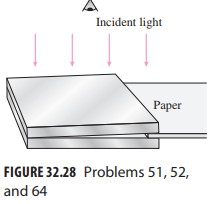
An air wedge like that of Fig. 32.28 displays 10,003 bright bands when illuminated from above. If the region between the plates is then evacuated, the number of bands drops to 10,000. Find the refractive index of the air. Incident light Раper FIGURE 32.28 Problems 51, 52, and 64
You’re a biologist studying rhinoviruses, which cause the common cold. These are among the smallest viruses, some 50 nm in diameter, and you can’t image them with your optical microscope using visible light (average wavelength about 560 nm). A sales rep tries to sell you an expensive microscope
Under the best conditions, atmospheric turbulence limits ground-based telescopes’ resolution to about 1 arcsecond (1/3600 of a degree). For what apertures is this limitation more severe than that of diffraction at 550 nm? (Your answer shows why large ground-based telescopes don’t generally
While driving at night, your eyes’ irises dilate to 3.1-mm diameter. If your vision were diffraction limited, what would be the greatest distance at which you could see as distinct the two headlights of an oncoming car, spaced 1.5 m apart? Take λ = 550 nm.
The CIA wants your help identifying individual terrorists in a photo of a training camp taken from a spy satellite at 100-km altitude. You ask for details of the optical system used, but they’re classified. However, they do tell you that the optics are diffraction limited and can resolve facial
A camera has an f/1.4 lens, meaning the ratio of focal length to lens diameter is 1.4. Find the smallest spot diameter (i.e., the diameter of the first diffraction minimum) to which this lens can focus parallel light with 580-nm wavelength.
Suppose one of the 10-m-diameter Keck Telescopes in Hawaii is trained on San Francisco, 3400 km away. Assuming 550-nm light, and ignoring atmospheric distortion, would it be possible to read(a) newspaper headlines or(b) a billboard sign at this distance?(c) Repeat for the case of the Keck optical
A proposed “star wars” antimissile laser is to focus infrared light with 2.8μm wavelength to a 50-cm-diameter spot on a missile 2500 km distant. Find the minimum diameter for a concave mirror that can achieve this spot size, given the diffraction limit. (Your answer suggests one of many
Your stereo is in a dead spot caused by direct reception from an FM radio station at 89.5 MHz interfering with the signal reflecting off a wall behind you. How much farther from the wall should you move so that the interference is fully constructive?
One arm of a Michelson interferometer is 42.5 cm long and is enclosed in a box that can be evacuated. The box initially contains air, which is gradually pumped out. In the process, 388 bright fringes pass a point in the viewer. If the interferometer uses light with wavelength 641.6 nm, what’s the
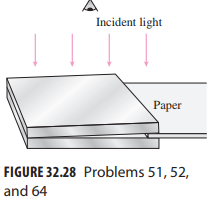
An air wedge like that of Fig.?32.28 shows N bright bands when illuminated from above. Find an expression for the number of bands if the air is replaced by a liquid of refractive index n different from that of the glass. Incident light Раper FIGURE 32.28 Problems 51, 52, and 64
The table below lists the angular positions of the bright fringes that result when monochromatic laser light shines through a diffraction grating, as a function of order m. The spacing between lines of the grating is d = 3.2?m. Determine a quantity that, when plotted against m, should give a
Find the wavelength of light used in a Michelson interferometer if 550 bright fringes go by a fixed point when the mirror moves 0.150mm.
A Michelson interferometer uses light from glowing hydrogen at 486.1 nm. As you move one mirror, 530 bright fringes pass a fixed point in the viewer. How far did the mirror move?
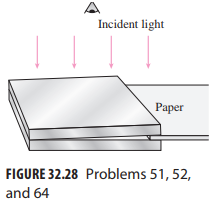
Two perfectly flat glass plates are separated at one end by a sheet of paper 0.065mm thick. 550-nm light illuminates the plates from above, as shown in Fig. 32.28. How many bright bands appear to an observer looking down on the plates? Incident light Раper FIGURE 32.28 Problems 51, 52, and 64
An oil film with refractive index 1.25 floats on water. The film thickness varies from 0.80μm to 2.1μm. If 630-nm light is incident normally on the film, at how many locations will it undergo enhanced reflection?
As a soap bubble with n = 1.333 evaporates and thins, reflected colors gradually disappear. What are(a) the bubble thickness just as the last vestige of color vanishes(b) the last color seen?
Showing 500 - 600
of 1601
1
2
3
4
5
6
7
8
9
10
11
12
13
14
15
Last
Step by Step Answers

 Get 50% OFF
Claim Now
Get 50% OFF
Claim Now






![(As)? = c²(At)? – [(Ax)? + (Ay)? + (Az)*] (33.6)](https://dsd5zvtm8ll6.cloudfront.net/si.question.images/images/question_images/1607/5/8/1/7775fd1c051ce4c21607581777635.jpg)