New Semester
Started
Get
50% OFF
Study Help!
--h --m --s
Claim Now
Question Answers
Textbooks
Find textbooks, questions and answers
Oops, something went wrong!
Change your search query and then try again
S
Books
FREE
Study Help
Expert Questions
Accounting
General Management
Mathematics
Finance
Organizational Behaviour
Law
Physics
Operating System
Management Leadership
Sociology
Programming
Marketing
Database
Computer Network
Economics
Textbooks Solutions
Accounting
Managerial Accounting
Management Leadership
Cost Accounting
Statistics
Business Law
Corporate Finance
Finance
Economics
Auditing
Tutors
Online Tutors
Find a Tutor
Hire a Tutor
Become a Tutor
AI Tutor
AI Study Planner
NEW
Sell Books
Search
Search
Sign In
Register
study help
chemistry
physical chemistry
Chemical Principles 7th edition Steven S. Zumdahl, Donald J. DeCoste - Solutions
Hydrogen cyanide gas is commercially prepared by the reaction of methane [CH4(g)], ammonia [NH3(g)], and oxygen [O2(g)] at a high temperature. The other product is gaseous water.a. Write a balanced chemical equation for the reaction.b. Methane and ammonia gases flow into a reactor at a rate of 20.0
A sealed balloon is filled with 1.00 L of helium at 23oC and 1.00 atm. The balloon rises to a point in the atmosphere where the pressure is 220. torr and the temperature is 231oC. What is the change in the volume of the balloon as it ascends from 1.00 atm to a pressure of 220. torr?
Consider a children’s cartoon illustrating a child holding the strings of several helium balloons and being lifted into the sky.a. Estimate the minimum number of 10-L balloons it would take to lift a 50-lb child. Assume air has an average molar mass of 29 g/ mol, and assume the masses of the
A 16.0-g sample of methane (CH4) reacts with 64.0 g of oxygen gas in a container fitted with a piston (at 1.00 atm and 425 K). Methane can react with oxygen to form carbon dioxide and water vapor or carbon monoxide and water vapor. After the combustion reaction is complete, the gas density at the
You have two samples of helium gas at the same pressure in separate steel containers of the same volume. You want the number of collisions of helium atoms with the walls of container 1 to be twice the number of collisions of helium atoms with the walls of container 2. Assume ideal behavior.a. How
A mixture of chromium and zinc weighing 0.362 g was reacted with an excess of hydrochloric acid. After all the metals in the mixture reacted, 225 mL of dry hydrogen gas was collected at 27oC and 750. torr. Determine the mass percent of Zn in the metal sample. [Zinc reacts with hydrochloric acid to
You have a sealed, flexible balloon filled with argon gas. The atmospheric pressure is 1.00 atm and the temperature is 25oC. The air has a mole fraction of nitrogen of 0.79, the rest being oxygen.a. Explain why the balloon would float when heated. Make sure to discuss which factors change and which
Derive a linear relationship between gas density and tem-perature, and use it to estimate the value of absolute zero temperature (in oC to the nearest 0.1oC) from an air sample whose density is 1.2930 g/ L at 0.0oC and 0.9460 g/ L at 100.0oC. Assume air obeys the ideal gas law and that the pressure
A chemist weighed out 5.14 g of a mixture containing unknown amounts of BaO(s) and CaO(s) and placed the sample in a 1.50-L flask containing CO2(g) at 30.0oC and 750. torr. After the reaction to form BaCO3(s) and CaCO3(s) was completed, the pressure of CO2(g) remaining was 230. torr. Calculate the
The density of a pure gaseous compound was measured at 0.00oC as a function of pressure to give the following results:Density (g/ L) …………………………. Pressure (atm)0.17893 ….................................................. 0.25000.35808
Consider separate 1.0-L samples of He(g) and UF6(g), both at 1.00 atm and containing the same number of moles. What ratio of temperatures for the two samples would produce the same collision frequency with the vessel walls?
The most probable velocity ump is the velocity possessed by the greatest number of gas particles. At a certain temperature, the probability that a gas particle has the most probable velocity is equal to one- half the probability that the same gas particle has the most probable velocity at 300. K.
A piece of solid carbon dioxide, with a mass of 22.0 g, is placed in an otherwise empty 4.00-L container at 278C. What is the pressure in the container after all the carbon dioxide vaporizes? If 22.0 g of solid carbon dioxide was placed in a similar container already containing air at 740. torr,
Derive Dalton’s law of partial pressures from the kinetic molecular theory of gases. What assumptions are necessary?
One of the assumptions of the kinetic molecular theory is that the volume of a gas particle is negligible. If this were the case, the ratio of the number of collisions of gas particles with the walls of the container compared to the number of collisions a given gas particle experiences with other
Consider a sample of a hydrocarbon (a compound con-sisting of only carbon and hydrogen) at 0.959 atm and 298 K. Upon combusting the entire sample in oxygen, you collect a mixture of gaseous carbon dioxide and water vapor at 1.51 atm and 375 K. This mixture has a density of 1.391 g/ L and occupies a
A steel cylinder contains 5.00 moles of graphite (pure carbon) and 5.00 moles of O2. The mixture is ignited and all the graphite reacts. Combustion produces a mixture of CO gas and CO2 gas. After the cylinder has cooled to its original temperature, it is found that the pressure of the cylinder has
You have an equimolar mixture of the gases SO2 and O2, along with some He, in a container fitted with a piston. The density of this mixture at STP is 1.924 g/ L. Assume ideal behavior and constant temperature.a. What is the mole fraction of He in the original mixture?b. The SO2 and O2 react to
Methane (CH4) gas flows into a combustion chamber at a rate of 200. L/ min at 1.50 atm and ambient temperature. Air is added to the chamber at 1.00 atm and the same temperature, and the gases are ignited.a. To ensure complete combustion of CH4 to CO2(g) and H2O(g), three times as much oxygen as is
A spherical vessel with a volume of 1.00 L was evacuated and sealed. Twenty- four hours later the pressure of air in the vessel was found to be 1.20 × 10⁻⁶ atm. During this 24-h period, the vessel had been surrounded by air at 27oC and 1.00 atm. Assuming that air is 78 mole percent nitrogen and
Calculate the number of stages needed to change a mixture of 13CO2 and 12CO2 that is originally 0.10% (by moles) 13CO2 to a mixture that is 0.010% 13CO2 by a gaseous diffusion process. (The mass of 13C is 13.003355 amu.)
Two samples of gas are separated in two rectangular 1.00-L chambers by a thin metal wall. One sample is pure helium and the other is pure radon. Both samples are at 27°C and show a pressure of 2.00 × 10⁻⁶ atm. Assuming that the metal wall separating the gases suddenly develops a circular hole of
You have a helium balloon at 1.00 atm and 25oC. You want to make a hot-air balloon with the same volume and same lift as the helium balloon. Assume air is 79.0% nitrogen and 21.0% oxygen by volume. The “lift” of a balloon is given by the difference between the mass of air displaced by the
An ideal gas is in a cylinder with a volume of 5.0 × 10² mL at a temperature of 30.oC and a pressure of 710 torr. The gas is compressed to a volume of 25 mL, and the temperature is raised to 820oC. What is the new pressure?
Consider an equimolar mixture (equal number of moles) of two diatomic gases (A2 and B2) in a container fitted with a piston. The gases react to form one product (which is also a gas) with the formula AxBy. The density of the sample after the reaction is complete (and the temperature returns to its
You are given an unknown gaseous binary compound (that is, a compound consisting of two different elements). When 10.0 g of the compound is burned in excess oxygen, 16.3 g of water is produced. The compound has a density 1.38 times that of oxygen gas at the same conditions of temperature and
Use the following information to identify element A and compound B, then answer questions a and b. An empty glass container has a mass of 658.572 g. It has a mass of 659.452 g after it has been filled with nitrogen gas at a pressure of 790. torr and a temperature of 15oC. When the container is
Suppose two 200.0- L tanks are to be filled separately with the gases helium and hydrogen. What mass of each gas is needed to produce a pressure of 135 atm in its respective tank at 24oC?
An ideal gas at 7oC is in a spherical flexible container having a radius of 1.00 cm. The gas is heated at constant pressure to 88oC. Determine the radius of the spherical container after the gas is heated. (Volume of a sphere = 4/3 π3.)
A flask that can withstand an internal pressure of 2500 torr, but no more, is filled with a gas at 21.0oC and 758 torr and heated. At what temperature will it burst?
A gas sample containing 1.50 moles at 25oC exerts a pressure of 400. torr. Some gas is added to the same container, and the temperature is increased to 50oC. If the pressure increases to 800. torr, how many moles of gas were added to the container? Assume a constant- volume container.
Consider the following chemical equation:2NO2(g) → N2O4(g)If 25.0 mL of NO2 gas is completely converted to N2O4 gas under the same conditions, what volume will the N2O4 occupy?
A bicycle tire is filled with air to a pressure of 75 psi at a temperature of 19oC. Riding the bike on asphalt on a hot day increases the temperature of the tire to 58oC. The volume of the tire increases by 4.0%. What is the new pressure in the bicycle tire?
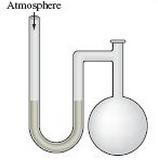
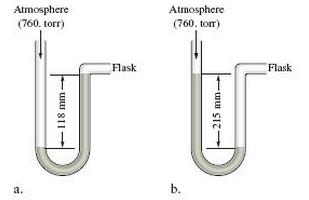
A diagram for an open- tube manometer is shown below. If the flask is open to the atmosphere, the mercury levels are equal. For each of the following situations in which a gas is contained in the flask, calculate the pressure in the flask in torr, atmospheres, and pascals.c. Calculate the
A hot-air balloon is filled with air to a volume of 4.00 × 10³ m3 at 745 torr and 21oC. The air in the balloon is then heated to 62oC, causing the balloon to expand to a volume of 4.20 × 10³ m3. What is the ratio of the number of moles of air in the heated balloon to the original number of moles
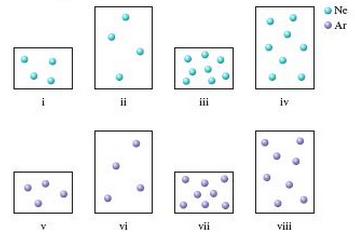
Determine the partial pressure of each gas as shown in the figure below. The relative numbers of each type of gas are depicted in the figure.
Consider the flasks in the following diagrams.a. Which is greater, the initial pressure of helium or initial pressure of neon? How much greater?b. Assuming the connecting tube has negligible volume, draw what each diagram will look like after the stopcock between the two flasks is opened.c. Solve
A sample of nitrogen gas was collected over water at 20.oC and a total pressure of 1.00 atm. A total volume of 2.50 × 10² mL was collected. What mass of nitrogen was collected? (At 20.oC the vapor pressure of water is 17.5 torr.)
Helium is collected over water at 25oC and 1.00 atm total pressure. What total volume of gas must be collected to obtain 0.586 g of helium? (At 25oC the vapor pressure of water is 23.8 torr.)
A 2.00- L sample of O2(g) was collected over water at a total pressure of 785 torr and 25oC. When the O2(g) was dried (water vapor removed), the gas had a volume of 1.94 L at 25oC and 785 torr. Calculate the vapor pres-sure of water at 25oC.
In a mixture of the two gases, the partial pressures of CH4(g) and O2(g) are 0.175 atm and 0.250 atm, respectively.a. What is the mole fraction of each gas in the mixture?b. If the mixture occupies a volume of 10.5 L at 65oC, calculate the total number of moles of gas in the mixture.c. Calculate
A 1.00- L gas sample at 100oC and 600. torr contains 50.0% helium and 50.0% xenon by mass. What are the partial pressures of the individual gases?
At 0oC a 1.0 L flask contains 5.0 × 10⁻² mole of N2, 1.5 × 10² mg O2, and 5.0 × 10⁻¹ molecules of NH3. What is the partial pressure of each gas, and what is the total pressure in the flask?
Given that a sample of air is made up of nitrogen, oxygen, and argon in the mole fractions 78% N2, 21% O2, and 1.0% Ar, what is the density of air at standard temperature and pressure?
The gravitational force exerted by an object is given by F = mg where F is the force in newtons, m is the mass in kilograms, and g is the acceleration due to gravity, 9.81 m/ s2. Calculate the force exerted per unit of area by a column of mercury (density = 13.59 g/ cm3) that is 76.0 cm high. How
Consider two different containers, each filled with 2 moles of Ne(g). One of the containers is rigid and has constant volume. The other container is flexible (like a balloon) and is capable of changing its volume to keep the external pressure and internal pressure equal to each other. If you raise
An unknown diatomic gas has a density of 3.164 g/ L at STP. What is the identity of the gas?
A compound contains only nitrogen and hydrogen and is 87.4% nitrogen by mass. A gaseous sample of the com-pound has a density of 0.977 g/ L at 710. torr and 100oC. What is the molecular formula of the compound?
A compound has the empirical formula CHCl. A 256-mL flask, at 373 K and 750. torr, contains 0.800 g of the gaseous compound. Give the molecular formula.
One of the chemical controversies of the nineteenth century concerned the element beryllium (Be). Berzelius originally claimed that beryllium was a trivalent element (forming Be3+ ions) and that it formed an oxide with the formula Be2O3. This assumption resulted in a calculated atomic mass of 13.5
Discrepancies in the experimental values of the molar mass of nitrogen provided some of the first evidence for the existence of the noble gases. If pure nitrogen is collected from the decomposition of ammonium nitriteIts measured molar mass is 28.01. If O2, CO2, and H2O are removed from air, the
A sample of methane (CH4) gas contains a small amount of helium. Calculate the volume percentage of helium if the density of the sample is 0.70902 g/ L at 0.0oC and 1.000 atm.
Metallic molybdenum can be produced from the mineral molybdenite (MoS2). The mineral is first oxidized in air to molybdenum trioxide and sulfur dioxide. Molybde-num trioxide is then reduced to metallic molybdenum using hydrogen gas. The balanced equations areMoS2(s) + 7/2O2(g) → MoO3(s) +
In 1897 the Swedish explorer Andreé tried to reach the North Pole in a balloon. The balloon was filled with hydrogen gas. The hydrogen gas was prepared from iron splints and diluted sulfuric acid. The reaction isFe(s) + H2SO4(aq) → FeSO4(aq) + H2(g)The volume of the balloon was 4800 m3, and the
Urea (H2NCONH2) is used extensively as a nitrogen source in fertilizers. It is produced commercially from the reaction of ammonia and carbon dioxide:Ammonia gas at 223oC and 90. atm flows into a reactor at a rate of 500. L/ min. Carbon dioxide at 223oC and 45 atm flows into the reactor at a rate of
a. If the open-tube manometer in Exercise 22 contains a nonvolatile silicone oil (density = 1.30 g/cm3) instead of mercury (density = 13.6 g/ cm3), what are the pressures in the flask as shown in parts a and b in torr, atmospheres, and pascals?b. What advantage would there be in using a less dense
Methanol (CH3OH) can be produced by the following reaction:CO(g) + 2H2(g) → CH3OH(g)Hydrogen at STP flows into a reactor at a rate of 16.0 L/min. Carbon monoxide at STP flows into the re-actor at a rate of 25.0 L/ min. If 5.30 g of methanol is produced per minute, what is the percent yield of the
Consider the reaction between 50.0 mL of liquid methanol (CH3OH; density = 0.850 g/ mL) and 22.8 L of O2 at 27oC and a pressure of 2.00 atm. The products of the reaction are CO2(g) and H2O(g). Calculate the number of moles of H2O formed if the reaction goes to completion.
Some very effective rocket fuels are composed of light-weight liquids. The fuel composed of dimethylhydrazine [(CH3) 2N2H2] mixed with dinitrogen tetroxide was used to power the lunar lander in its missions to the moon. The two components react according to the following equation: (CH3)2N2H2(l) +
Air bags are activated when a severe impact causes a steel ball to compress a spring and electrically ignite a detonator cap. This action causes sodium azide (NaN3) to decompose explosively according to the following reaction: 2NaN3(s) → 2Na(s) + 3N2(g) What mass of NaN3(s) must be reacted to
At elevated temperatures, sodium chlorate decomposes to produce sodium chloride and oxygen gas. A 0.8765-g sample of impure sodium chlorate was heated until the production of oxygen gas ceased. The oxygen gas collected over water occupied 57.2 mL at a temperature of 22oC and a pressure of 734 torr.
Xenon and fluorine will react to form binary compounds when a mixture of these two gases is heated to 400oC in a nickel reaction vessel. A 100.0-mL nickel container is filled with xenon and fluorine giving partial pressures of 1.24 atm and 10.10 atm, respectively, at a temperature of 25oC. The
The nitrogen content of organic compounds can be determined by the Dumas method. The compound in question is first reacted by passage over hot CuO(s):The gaseous products are then passed through a concentrated solution of KOH to remove the CO2. After passage through the KOH solution, the gas
An organic compound contains C, H, N, and O. Combustion of 0.1023 g of the compound in excess oxygen yielded 0.2766 g of CO2 and 0.0991 g of H2O. A sample of 0.4831 g of the compound was analyzed for nitrogen by the Dumas method. At STP, 27.6 mL of dry N2 was obtained. In a third experiment, the
Nitric acid is produced commercially by the Ostwald process. In the first step, ammonia is oxidized to nitric oxide:4NH3(g) + 5O2(g) → 4NO(g) + 6H2O(g)Assume this reaction is carried out in the apparatus diagramed below.The stopcock between the two reaction containers is opened, and the reaction
Consider the following balanced equation in which gas X forms gas X2: 2X(g) → X2(g) Equal moles of X are placed in two separate containers. One container is rigid, so the volume cannot change; the other container is flexible, so the volume changes to keep the internal pressure equal to the
Freon-12 (CF2Cl2) is commonly used as the refrigerant in central home air conditioners. The system is initially charged to a pressure of 4.8 atm. Express this pressure in each of the following units (1 atm = 14.7 psi).a. mm Hgb. torrc. Pad. psi
As NH3(g) is decomposed into nitrogen gas and hydrogen gas at constant pressure and temperature, the volume of the product gases collected is twice the volume of NH3 reacted. Explain. As NH3(g) is decomposed into nitrogen gas and hydrogen gas at constant volume and temperature, the total pressure
Use the postulates of the kinetic molecular theory (KMT) to explain why Boyle’s law, Charles’s law, Avogadro’s law, and Dalton’s law of partial pressures hold true for ideal gases. Use the KMT to explain the P versus n (at constant V and T) relationship and the P versus T (at constant V and
You have a gas in a container fitted with a piston and you change one of the conditions of the gas such that a change takes place, as shown below:State two distinct changes you can make to accomplish this, and explain why each would work.
You have a gas in a container fitted with a piston and you change one of the conditions of the gas such that a change takes place, as shown below:
Consider two gases, A and B, each in a 1.0- L container with both gases at the same temperature and pressure. The mass of gas A in the container is 0.34 g, and the mass of gas B in the container is 0.48 g.a. Which gas sample has the most molecules present? Explain. b. Which gas sample has the
Consider the following samples of gases at the same temperature.Arrange each of these samples in order from lowest to highest.a. Pressureb. Average kinetic energyc. Densityd. Root mean square velocitySome samples of gases may have equal values for these attributes. Assume the larger containers have
Calculate the average kinetic energies of the CH4 and N2 molecules at 273 K and 546 K.
Calculate the root mean square velocities of CH4 and N2 molecules at 273 K and 546 K.
Do all the molecules in a 1-mole sample of CH4(g) have the same kinetic energy at 273 K? Do all the molecules in a 1-mole sample of N2(g) have the same velocity at 546 K? Explain.
Consider separate 1.0- L gaseous samples of H2, Xe, Cl2, and O2, all at STP.a. Rank the gases in order of increasing average kinetic energy.b. Rank the gases in order of increasing average velocity.c. How can separate 1.0- L samples of O2 and H2 both have the same average velocity?
Draw a qualitative graph to show how the first property varies with the second in each of the following (assume 1 mole of an ideal gas and T in kelvins).a. PV versus V with constant Tb. P versus T with constant Vc. T versus V with constant Pd. P versus V with constant Te. P versus 1/ V with
Consider three identical flasks filled with different gases. Flask A: CO at 760 torr and 0oC Flask B: N2 at 250 torr and 0oC Flask C: H2 at 100 torr and 0oCa. In which flask will the molecules have the greatest average kinetic energy?b. In which flask will the molecules have the greatest root mean
Consider a 1.0- L container of neon gas at STP. Will the average kinetic energy, root mean square velocity, frequency of collisions of gas molecules with each other, frequency of collisions of gas molecules with the walls of the container, and energy of impact of gas molecules with the container
Freon-12 is used as a refrigerant in central home air conditioners. The rate of effusion of Freon- 12 to Freon- 11 (molar mass = 137.4 g/ mol) is 1.07: 1. The formula of Freon-12 is one of the following: CF4, CF3Cl, CF2Cl2, CFCl3, or CCl4. Which formula is correct for Freon-12?
One way of separating oxygen isotopes is by gaseous dif-fusion of carbon monoxide. The gaseous diffusion process behaves like an effusion process. Calculate the relative rates of effusion of 12C16O, 12C17O, and 12C18O. List some advantages and disadvantages of separating oxygen isotopes by gaseous
The rate of effusion of a particular gas was measured to be 24.0 mL/ min. Under the same conditions, the rate of effusion of pure methane gas (CH4) is 47.8 mL/ min. What is the molar mass of the unknown gas?
It took 4.5 minutes for 1.0 L of helium to effuse through a porous barrier. How long will it take for 1.0 L of Cl2 gas to effuse under identical conditions?
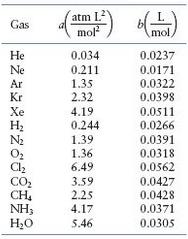
Calculate the pressure exerted by 0.5000 mole of N2 in a 1.0000-L container at 25.0oC. (See Table)a. Use the ideal gas law.b. Use the van der Waals equation.c. Compare the results from parts a and b.Table
Calculate the pressure exerted by 0.5000 mole of N2 in a 10.000- L container at 25.0oC. (See Table)a. Use the ideal gas law.b. Use the van der Waals equation.c. Compare the results from parts a and b.d. Compare the results with those in Exercise 87.Table
Why do real gases not always behave ideally? Under what conditions does a real gas behave most ideally? Why?
Consider the following velocity distribution curves A and B.a. If the plots represent the velocity distribution of 1.0 L of He(g) at STP versus 1.0 L of Cl2(g) at STP, which plot corresponds to each gas? Explain your reasoning. b. If the plots represent the velocity distribution of 1.0 L of O2(g)
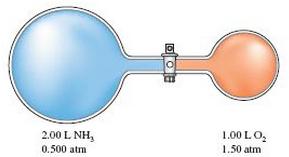
Consider the flasks in the following diagrams.Assuming the connecting tube has negligible volume, draw what each diagram will look like after the stopcock between the two flasks is opened. Also, solve for the fi-nal pressure in each case, in terms of the original pres-sure. Assume temperature is
In the van der Waals equation, why is a term added to the observed pressure and why is a term subtracted from the container volume to correct for nonideal gas behavior?
From the values in Table for the van der Waals constant a for the gases H2, CO2, N2, and CH4, predict which molecule shows the strongest intermolecular attractions.Table
The Maxwell–Boltzmann distribution function f(u) increases at small values of u and decreases at large values of u. Identify the parts of the function responsible for this behavior.
Calculate the root mean square, the most probable, and the average velocities for N2(g) at 227°C.
Calculate the kinetic energy possessed by 1.00 × 10²⁰ molecules of methane gas (CH4) at T = 27oC, assuming ideal behavior.
A flask contains 13 mole of H2 and 23 mole of He. Compare the force on the wall per impact of H2 relative to that for He.
A certain sample of uranium is reacted with fluorine to form a mixture of 235UF6(g) and 238UF6(g). After 100 diffusion steps, the gas contains 1526 235UF6 molecules per 1.000 × 10⁵ total number of molecules in the gas (235UF6 + 238UF6). What is the ratio of 235U to 238U atoms in the original
Consider separate 1.0-L samples of O2(g) and He(g), both at 25°C and the same pressure. Compare the change in momentum per impact and the number of impacts per second in the two samples.
Consider separate 1.00-L samples of Ar(g), both containing the same number of moles, one at 27oC and the other at 77oC. Compare the change in momentum per impact and the number of impacts per second in the two samples.
Calculate the intermolecular collision frequency and the mean free path in a sample of helium gas with a volume of 5.0 L at 27oC and 3.0 atm. Assume that the diameter of a helium atom is 50 pm.
Consider the flask diagramed below. What are the final partial pressures of H2 and N2 after the stopcock between the two flasks is opened? (Assume the final volume is 3.00 L.) What is the total pressure (in torr)?
Showing 1100 - 1200
of 4001
First
5
6
7
8
9
10
11
12
13
14
15
16
17
18
19
Last
Step by Step Answers

 Get 50% OFF
Claim Now
Get 50% OFF
Claim Now


.png)
.png)



.png)
.png)
.png)
.png)
.png)
.png)
.png)
.png)


