New Semester
Started
Get
50% OFF
Study Help!
--h --m --s
Claim Now
Question Answers
Textbooks
Find textbooks, questions and answers
Oops, something went wrong!
Change your search query and then try again
S
Books
FREE
Study Help
Expert Questions
Accounting
General Management
Mathematics
Finance
Organizational Behaviour
Law
Physics
Operating System
Management Leadership
Sociology
Programming
Marketing
Database
Computer Network
Economics
Textbooks Solutions
Accounting
Managerial Accounting
Management Leadership
Cost Accounting
Statistics
Business Law
Corporate Finance
Finance
Economics
Auditing
Tutors
Online Tutors
Find a Tutor
Hire a Tutor
Become a Tutor
AI Tutor
AI Study Planner
NEW
Sell Books
Search
Search
Sign In
Register
study help
computer sciences
operating system
Operating Systems Internals and Design Principles 8th edition William Stallings - Solutions
Evaluate the banker’s algorithm for its usefulness in an OS.
Why is the capability to relocate processes desirable?
Why is it not possible to enforce memory protection at compile time?
What are some reasons to allow two or more processes to all have access to a particular region of memory?
In a fixed-partitioning scheme, what are the advantages of using unequal-size partitions?
What is the difference between internal and external fragmentation?
What are the distinctions among logical, relative, and physical addresses?
What is the difference between a page and a segment?
Section 2.3, we listed five objectives of memory management, and in Section 7.1, we listed five requirements. Argue that each list encompasses all of the concerns addressed in the other.
Consider a dynamic partitioning scheme. Show that, on average, the memory contains half as many holes as segments.
To implement the various placement algorithms discussed for dynamic partitioning (Section 7.2), a list of the free blocks of memory must be kept. For each of the three methods discussed (best-fit, first-fit, next-fit), what is the average length of the search?
Another placement algorithm for dynamic partitioning is referred to as worst-fit. In this case, the largest free block of memory is used for bringing in a process.a. Discuss the pros and cons of this method compared to first-, next-, and best-fit.b. What is the average length of the search for
This diagram shows an example of memory configuration under dynamic partitioning, after a number of placement and swapping-out operations have been carried out.Addresses go from left to right; gray areas indicate blocks occupied by processes; white areas indicate free memory blocks. The last
A 1-Mbyte block of memory is allocated using the buddy system.a. Show the results of the following sequence in a figure similar to Figure 7.6:Request 70; Request 35; Request 80; Return A; Request 60; Return B; Return D; Return C.b. Show the binary tree representation following Return B.
Let buddyk(x) = address of the buddy of the block of size 2k whose address is x. Write a general expression for buddyk(x).
The Fibonacci sequence is defined as follows:a. Could this sequence be used to establish a buddy system?b. What would be the advantage of this system over the binary buddy system described in this chapter?
During the course of execution of a program, the processor will increment the contents of the instruction register (program counter) by one word after each instruction fetch, but will alter the contents of that register if it encounters a branch or call instruction that causes execution to continue
Consider a simple paging system with the following parameters: 232 bytes of physical memory; page size of 210 bytes; 216 pages of logical address space.a. How many bits are in a logical address?b. How many bytes in a frame?c. How many bits in the physical address specify the frame?d. How many
Write the binary translation of the logical address 0001010010111010 under the following hypothetical memory management schemes, and explain your answer:a. A paging system with a 256-address page size, using a page table in which the frame number happens to be four times smaller than the page
Consider a simple segmentation system that has the following segment table:Starting Address ……….. Length (bytes)660 …………………………………. …. 2481,752 ………………………………. ….. 422222
Consider a memory in which contiguous segments S1, S2, …, Sn are placed in their order of creation from one end of the store to the other, as suggested by the following figure:When segment Sn+1 is being created, it is placed immediately after segment Sn even though some of the segments S1, S2,
What is the difference between simple paging and virtual memory paging?
Why is the principle of locality crucial to the use of virtual memory?
What elements are typically found in a page table entry? Briefly define each element.
What is the difference between resident set management and page replacement policy?
What is accomplished by page buffering?
Why is it not possible to combine a global replacement policy and a fixed allocation policy?
What is the difference between demand cleaning and pre-cleaning?
Suppose the page table for the process currently executing on the processor looks like the following. All numbers are decimal, everything is numbered starting from zero, and all addresses are memory byte addresses. The page size is 1,024 bytes.a. Describe exactly how, in general, a virtual address
Consider the following program. #define Size 64 int A[Size; Size], B[Size; Size], C[Size; Size]; int register i, j; for (j = 0; j< Size; j ++) for (i = 0; i< Size; i++) C[i; j] = A[i; j] + B[i; j]; Assume that the program is running on a system using demand paging and the page size is 1 Kilobyte.
a. How much memory space is needed for the user page table of Figure?b. Assume you want to implement a hashed inverted page table for the same addressing scheme as depicted in Figure, using a hash function that maps the 20-bit page number into a 6-bit hash value. The table entry contains the page
Consider the following string of page references 7, 0, 1, 2, 0, 3, 0, 4, 2, 3, 0, 3, 2. Complete a figure similar to Figure 8.14, showing the frame allocation for:a. FIFO (first-in-first-out)b. LRU (least recently used)c. Clockd. Optimal (assume the page reference string continues with 1, 2, 0, 1,
A process references five pages, A, B, C, D, and E, in the following order:Assume that the replacement algorithm is first-in-first-out and find the number of page transfers during this sequence of references starting with an empty main memory with three page frames. Repeat for four page frames.
A process contains eight virtual pages on disk and is assigned a fixed allocation of four page frames in main memory. The following page trace occurs:a. Show the successive pages residing in the four frames using the LRU replacement policy. Compute the hit ratio in main memory. Assume that the
In the VAX, user page tables are located at virtual addresses in the system space. What is the advantage of having user page tables in virtual rather than main memory? What is the disadvantage?
Suppose the program statementfor (i = 1; i 6 6 = n; i + +) a[i] = b[i] + c[i];Is executed in a memory with page size of 1,000 words. Let n = 1,000. Using a machine that has a full range of register-to-register instructions and employs index registers, write a
The IBM System/370 architecture uses a two-level memory structure and refers to the two levels as segments and pages, although the segmentation approach lacks many of the features described earlier in this chapter. For the basic 370 architecture, the page size may be either 2 Kbytes or 4 Kbytes,
Assuming a page size of 4 Kbytes and that a page table entry takes 4 bytes, how many levels of page tables would be required to map a 64-bit address space, if the top-level page table fits into a single page?
Consider a system with memory mapping done on a page basis and using a single-level page table. Assume that the necessary page table is always in memory.a. If a memory reference takes 200 ns, how long does a paged memory reference take?b. Now we add an MMU that imposes an overhead of 20 ns on a hit
In discussing a page replacement algorithm, one author makes an analogy with a snowplow moving around a circular track. Snow is falling uniformly on the track and a lone snowplow continually circles the track at constant speed. The snow that is plowed W the track disappears from the system. a. For
In the S/370 architecture, a storage key is a control field associated with each page-sized frame of real memory. Two bits of that key that are relevant for page replacement are the reference bit and the change bit. The reference bit is set to 1 when any address within the frame is accessed for
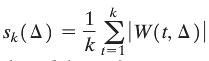
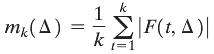
Consider the following sequence of page references (each element in the sequence represents a page number):Define the mean working set size after the kth reference asAnd define the missing page probability after the kth reference asWhere F (t, Δ) = 1 if a page fault occurs at virtual time t and 0
A key to the performance of the VSWS resident set management policy is the value of Q. Experience has shown that with a fixed value of Q for a process, there are considerable differences in page fault frequencies at various stages of execution. Furthermore, if a single value of Q is used for
Assume that a task is divided into four equal-sized segments and that the system builds an eight-entry page descriptor table for each segment. Thus, the system has a combination of segmentation and paging. Assume also that the page size is 2 Kbytes.a. What is the maximum size of each segment?b.
Consider a paged logical address space (composed of 32 pages of 2 Kbytes each) mapped into a 1-Mbyte physical memory space. a. What is the format of the processor’s logical address? b. What is the length and width of the page table (disregarding the “access rights” bits)? c. What is the
The UNIX kernel will dynamically grow a process’s stack in virtual memory as needed, but it will never try to shrink it. Consider the case in which a program calls a C subroutine that allocates a local array on the stack that consumes 10 K. The kernel will expand the stack segment to accommodate
Briefly describe the three types of processor scheduling.
What is the difference between preemptive and non-preemptive scheduling?
Briefly define shortest-remaining-time scheduling.
Briefly define feedback scheduling.
Consider the following workload:a. Show the schedule using shortest remaining time, non-preemptive priority (a smaller priority number implies higher priority) and round robin with quantum 30 ms. Use time scale diagram as shown below for the FCFS example to show the schedule for each requested
Consider the following set of processes:Perform the same analysis as depicted in Table 9.5 and Figure 9.5 for this set.
Prove that, among non-preemptive scheduling algorithms, SPN provides the minimum average waiting time for a batch of jobs that arrive at the same time. Assume that the scheduler must always execute a task if one is available.
Assume the following burst-time pattern for a process: 6, 4, 6, 4, 13, 13, 13, and assume that the initial guess is 10. Produce a plot similar to those of Figure.
Consider the following pair of equations as an alternative to Equation (9.3):Where Ubound and Lbound are pre-chosen upper and lower bounds on the estimated value of T. The value of Xn + 1 is used in the shortest-process-next algorithm, instead of the value of Sn + 1. What functions do a and b
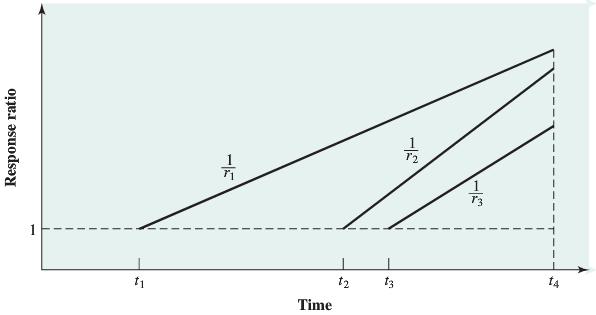
In a non-preemptive uni-processor system, the ready queue contains three jobs at time t immediately after the completion of a job. These jobs arrived at times t1, t2, and t3 with estimated execution times of r1, r2, and r3, respectively. Figure shows the linear increase of their
Prove that the minimax response ratio algorithm of the preceding problem minimizes the maximum response ratio for a given batch of jobs.
Define residence time Tr as the average total time a process spends waiting and being served. Show that for FIFO, with mean service time Ts, we have Tr = Ts/(1 €“ p), where p is utilization.
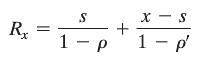
A processor is multiplexed at infinite speed among all processes present in a ready queue with no overhead. Show that for Poisson input from an infinite source with exponential service times, the mean response time Rx of a process with service time x is given by Rx = x/(1 – p).
Consider a variant of the RR scheduling algorithm where the entries in the ready queue are pointers to the PCBs.a. What would be the effect of putting two pointers to the same process in the ready queue?b. What would be the major advantage of this scheme?c. How could you modify the
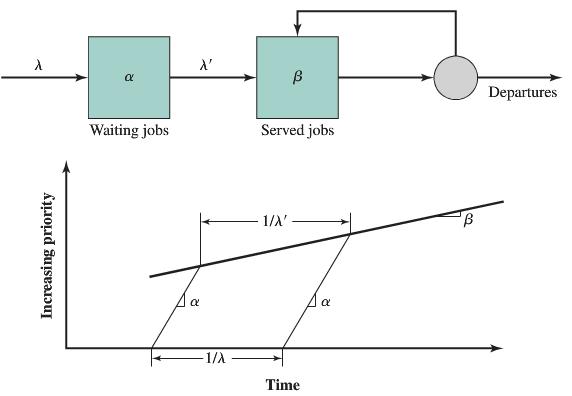
In a queuing system, new jobs must wait for a while before being served. While a job waits, its priority increases linearly with time from zero at a rate α. A job waits until its priority reaches the priority of the jobs in service; then, it begins to share the processor equally
An interactive system using round-robin scheduling and swapping tries to give guaranteed response to trivial requests as follows: After completing a round-robin cycle among all ready processes, the system determines the time slice to allocate to eachReady process for the next cycle by dividing a
Five batch jobs, A through E, arrive at a computer center at essentially the same time. They have an estimated running time of 15, 9, 3, 6, and 12 minutes, respectively. Their (externally defined) priorities are 6, 3, 7, 9, and 4, respectively, with a lower value corresponding to a higher priority.
List and briefly define five different categories of synchronization granularity.
List and briefly define four techniques for thread scheduling.
List and briefly define three versions of load sharing.
What is the difference between hard and soft real-time tasks?
What is the difference between periodic and aperiodic real-time tasks?
List and briefly define five general areas of requirements for a real-time operating system.
List and briefly define four classes of real-time scheduling algorithms.
What items of information about a task might be useful in real-time scheduling?
Consider a set of three periodic tasks with the execution profiles of Table. Develop scheduling diagrams similar to those of Figure for this set of tasks.
Consider a set of five aperiodic tasks with the execution profiles of Table. Develop scheduling diagrams similar to those of Figure for this set of tasks.
10.3. Least laxity first (LLF) is a real-time scheduling algorithm for periodic tasks. Slack time, or laxity, is the amount of time between when a task would complete if it started now and its next deadline. This is the size of the available scheduling window. Laxity can be expressed asLaxity =
Repeat Problem 10.3d for the execution profiles of Table 10.9b. Comment on the results.Consider a set of three periodic tasks with the execution profiles of Table 10.9a. Develop scheduling diagrams similar to those of Figure for this set of tasks that compare rate monotonic, earliest-deadline
Maximum urgency first (MUF) is a real-time scheduling algorithm for periodic tasks. Each task is assigned an urgency that is defined as a combination of two fixed priorities and one dynamic priority. One of the fixed priorities, the criticality, has precedence over the dynamic priority. Meanwhile,
Repeat Problem 10.4, adding MUF to the diagrams. Comment on the results.Consider a set of three periodic tasks with the execution profiles of Table 10.9a. Develop scheduling diagrams similar to those of Figure for this set of tasks that compare rate monotonic, earliest-deadline first, and LLF.
This problem demonstrates that although Equation (10.2) for rate monotonic scheduling is a sufficient condition for successful scheduling, it is not a necessary condition (i.e., sometimes successful scheduling is possible even if Equation (10.2) is not satisfied). a. Consider a task set with the
Draw a diagram similar to that of Figure that shows the sequence events for this same example using priority ceiling.
List and briefly define three techniques for performing I/O.
What is the difference between logical I/O and device I/O?
What is the difference between block-oriented devices and stream-oriented devices? Give a few examples of each.
Briefly define the disk scheduling policies illustrated in Figure.
Briefly define the seven RAID levels.
Consider a program that accesses a single I/O device and compare un-buffered I/O to the use of a buffer. Show that the use of the buffer can reduce the running time by at most a factor of two.
a. Perform the same type of analysis as that of Table for the following sequence of disk track requests: 27, 129, 110, 186, 147, 41, 10, 64, 120. Assume that the disk head is initially positioned over track 100 and is moving in the direction of decreasing track number.b. Do the same analysis, but
Consider a disk with N tracks numbered from 0 to (N €“ 1) and assume that requested sectors are distributed randomly and evenly over the disk. We want to calculate the average number of tracks traversed by a seek.a. Calculate the probability of a seek of length j when the head is
The following equation was suggested both for cache memory and disk cache memory: TS = TC + M * TD Generalize this equation to a memory hierarchy with N levels instead of just 2.
Calculate how much disk space (in sectors, tracks, and surfaces) will be required to store 300,000 120-byte logical records if the disk is fixed sector with 512 bytes/sector, with 96 sectors/track, 110 tracks per surface, and 8 usable surfaces. Ignore any file header record(s) and track indexes,
Consider the disk system described in Problem 11.7, and assume that the disk rotates at 360 rpm. A processor reads one sector from the disk using interrupt-driven I/O, with one interrupt per byte. If it takes 2.5 μs to process each interrupt, what percentage of the time will the processor spend
Consider the disk system described in Problem 11.7, and assume that the disk rotates at 360 rpm. A processor reads one sector from the disk using interrupt-driven I/O, with one interrupt per byte. If it takes 2.5 μs to process each interrupt, what percentage of the time will the processor spend
A 32-bit computer has two selector channels and one multiplexor channel. Each selector channel supports two magnetic disk and two magnetic tape units. The multiplexor channel has two line printers, two card readers, and ten VDT terminals connected to it. Assume the following transfer rates: Disk
It should be clear that disk striping can improve the data transfer rate when the strip size is small compared to the I/O request size. It should also be clear that RAID 0 provides improved performance relative to a single large disk, because multiple I/O requests can be handled in parallel.
Consider a 4-drive, 200 GB-per-drive RAID array. What is the available data storage capacity for each of the RAID levels, 0, 1, 3, 4, 5, and 6?
What is the difference between a file and a database?
List and briefly define five file organizations.
What is the relationship between a pathname and a working directory?
List and briefly define three blocking methods.
List and briefly define three file allocation methods.
Define:B = block sizeR = record sizeP = size of block pointerF = blocking factor; expected number of records within a blockGive a formula for F for the three blocking methods depicted in Figure.
Showing 100 - 200
of 1171
1
2
3
4
5
6
7
8
9
10
11
12
Step by Step Answers

 Get 50% OFF
Claim Now
Get 50% OFF
Claim Now


.png)
.png)
.png)


.png)
.png)
.png)
.png)

-1.png)
-2.png)
.png)
.png)
.png)
.png)

.png)
-1.png)
-2.png)
-1.png)
-2.png)
.png)
.png)
.png)
.png)
.png)
.png)
.png)



