New Semester
Started
Get
50% OFF
Study Help!
--h --m --s
Claim Now
Question Answers
Textbooks
Find textbooks, questions and answers
Oops, something went wrong!
Change your search query and then try again
S
Books
FREE
Study Help
Expert Questions
Accounting
General Management
Mathematics
Finance
Organizational Behaviour
Law
Physics
Operating System
Management Leadership
Sociology
Programming
Marketing
Database
Computer Network
Economics
Textbooks Solutions
Accounting
Managerial Accounting
Management Leadership
Cost Accounting
Statistics
Business Law
Corporate Finance
Finance
Economics
Auditing
Tutors
Online Tutors
Find a Tutor
Hire a Tutor
Become a Tutor
AI Tutor
AI Study Planner
NEW
Sell Books
Search
Search
Sign In
Register
study help
engineering
mechanical engineering
Vector Mechanics For Engineers Statics And Dynamics 8th Edition Ferdinand Beer, E. Russell Johnston, Jr., Elliot Eisenberg, William Clausen, David Mazurek, Phillip Cornwell - Solutions
Halley’s comment travels in an elongated elliptic orbit for which the minimum distance from the sun is approximately 1/2 rE, where rE = 92.9 × 10⁶ mi is the mean distance from the sun to the earth. Knowing that the periodic time of Halley’s comet is about 76 years, determine the maximum
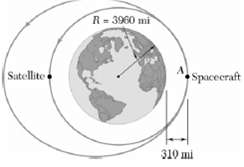
A spacecraft and a satellite are at diametrically opposite positions in the same circular orbit of altitude 310 mi above the earth. As it passes through point A, the spacecraft fires its engine for a short interval of time to increase its speed and enter an elliptic orbit. Knowing that the
Based on observations made during the 1996 sighting of the comet Hyakutake, it was concluded that the trajectory of the comet is a highly elongated ellipse for which the eccentricity is approximately ε = 0.999887. Knowing that for the 1996 sighting the minimum distance between the comet and
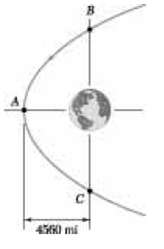
It was observed that during its first flyby of the earth, the Galileo spacecraft had a velocity of 6.48 mi/s as it reached its minimum distance of 4560 mi from the center of the earth. Assuming that the trajectory of the spacecraft was parabolic, determine the time needed for the spacecraft to
A space shuttle is in an elliptic orbit of eccentricity 0.0356 and a minimum altitude of 182 mi above the surface of the earth. Knowing that the radius of the earth is 3960 mi, determine the periodic time for theorbit.
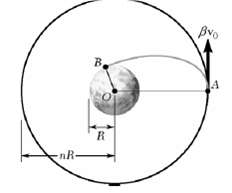
A space probe is describing a circular orbit of radius nR with a speed v0 about a planet of radius R and center O. As the probe passes through point A, its speed is reduced from v0 to 0 βv0 , where β
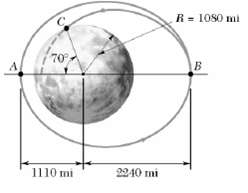
Prior to the Apollo missions to the moon, several Lunar Orbiter spacecraft were used to photograph the lunar surface to obtain information regarding possible landing sites. At the conclusion of each mission, the trajectory of the spacecraft was adjusted so that the spacecraft would crash on the
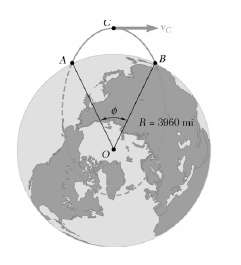
A long-range ballistic trajectory between points A and B on the earth??s surface consists of a portion of an ellipse with the apogee at point C. Knowing that point C is 930 mi above the surface of the earth and the range R? of the trajectory is 3700 mi, determine(a) The velocity of the projectile
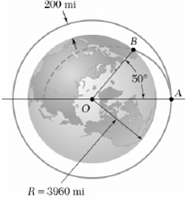
A space shuttle is describing a circular orbit at an altitude of 200 mi above the surface of the earth. As it passes through A it fires its engine for ashort interval of time to reduce its speed by 6 percent and begin its descent toward the earth. Determine the altitude of the shuttle at point B,
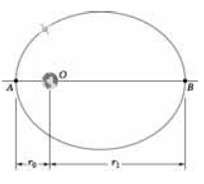
A satellite describes an elliptic orbit about a planet. Denoting by r0 and r1 the distances corresponding, respectively, to the perigee and apogee of the orbit, show that the curvature of the orbit at each of these two points can be expressed as 1/p = ? (1/r0 +1/r1).
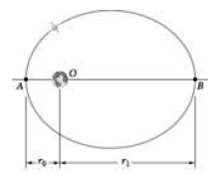
(a) Express the eccentricity ε of the elliptic orbit described by a satellite about a planet in terms of the distances ances r0 and r1 corresponding, respectively, to the perigee and apogee of the orbit. (b) Use the result obtained in part a and the data given in Prob. 12.113, where Rε=93.0×10⁶
Derive Kepler’s third law of planetary motion from Eqs. (12.39) and (12.45).
Show that the angular momentum per unit mass h of a satellite describing an elliptic orbit of semimajor axis a and eccentricity ε about a planet of mass M can be expressed as h =√GMa (1 – ε2)
Determine the maximum theoretical speed that an automobile starting from rest can reach after traveling 1320 ft. Assume that the coefficient of static friction is 0.80 between the tires and the pavement and that(a) The automobile has front-wheel drive and the front wheels support 65 percent of the
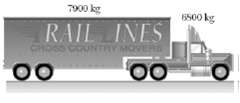
A tractor-trailer is traveling at 90 km/h when the driver applies his brakes. Knowing that the braking forces of the tractor and the trailer are 16 kN and 60 kN, respectively, determine(a) The distance traveled by the tractortrailer before it comes to a stop,(b) The horizontal component of the
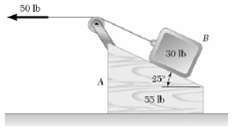
The 30-lb block B is supported by the 55-lb block A and is attached to a cord to which a 50-lb horizontal force is applied as shown. Neglecting friction, determine(a) The acceleration of block A,(b) The acceleration of block B relative toA.
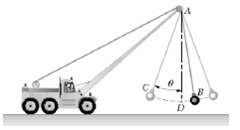
A 180-lb wrecking ball B is attached to a 40-ft-long steel cable AB and swings in the vertical arc shown. Determine the tension in the cable (a) At the top C of the swing, where θ = 30?, (b) At the bottom D of the swing, where the speed of B is 18.6 ft/s.
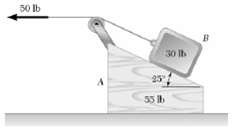
The 30-lb block B is supported by the 55-lb block A and is attached to a cord to which a 50-lb horizontal force is applied as shown. Neglecting friction, determine (a) The acceleration of block A, (b) The acceleration of block B relative toA.
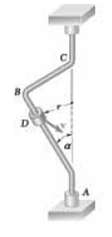
A small 8-oz collar D can slide on portion AB of a rod which is bent as shown. Knowing that the rod rotates about the vertical AC at a constant rate and that α = 40? and r = 24 in., determine the range of values of the speed v for which the collar will not slide on the rod if the coefficient of
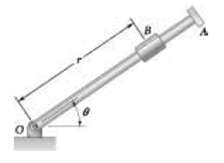
Rod OA rotates about O in a horizontal plane. The motion of the 400-g collar B is defined by the relations r = 500 + 300 sin ?t and ? = 2?(t2 ?2t), where r is expressed in millimeters, t in seconds, and ? in radians. Determine the radial and transverse components of the force exerted on the collar
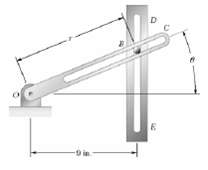
The 4-oz pin B slides along the slot in the rotating arm OC and along the slot DE which is cut in a fixed horizontal plate. Neglecting friction and knowing that arm OC rotates at a constant rate te ?0 = 10 rad/s, determine for any given value of ?(a) The radial and transverse components of the
Determine the mass of the earth knowing that the mean radius of the moon’s orbit about the earth is 384.5 Mm and that the moon requires 27.32 days to complete one full revolution about the earth.
A 540 kg spacecraft first is placed into a circular orbit about the earth at an altitude of 4500 km and then is transferred to a circular orbit about themoon. Knowing that the mass of the moon is 0.01230 times the mass of the earth and that the radius of the moon is 1740 km, determine(a) The
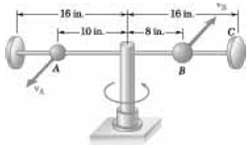
A 1-lb ball A and a 2-lb ball B are mounted on a horizontal rod which rotates freely about a vertical shaft. The balls are held in the positions shown by pins. The pin holding B is suddenly removed and the ball moves to position C as the rod rotates. Neglecting friction and the mass of the rod and
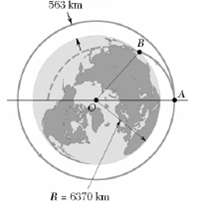
A space shuttle is describing a circular orbit at an altitude of 563 km above the surface of the earth. As it passes through point A, it fires its engine for a short interval of time to reduce its speed by 152 m/s and begin its descent toward the earth. Determine the angle AOB so that the altitude
A 1000-lb satellite is placed in a circular orbit 3000 mi above the surface of the earth. At this elevation the acceleration of gravity is 8.03 ft/s2. Knowing that its orbital speed is 14,000 mi/h, determine the kinetic energy of the satellite.
A 500-kg communications satellite is in a circular geosynchronous orbit and completes one revolution about the earth in 23 h and 56 min at an altitude of 35 800 km above the surface of the earth. Knowing that the radius of the earth is 6370 km, determine the kinetic energy of the satellite.
A 2-kg stone is dropped from a height h and strikes the ground with a velocity of 24 m/s.(a) Find the kinetic energy of the stone as it strikes the ground and the height h from which it was dropped.(b) Solve part a, assuming that the same stone is dropped on the moon. (Acceleration of gravity on
A golfer hits a 1.62-oz ball with an initial velocity of 160 ft/s at an angle of 25° with the horizontal. Determine(a) The initial kinetic energy of the ball,(b) The kinetic energy of the ball when it reaches its maximum height.
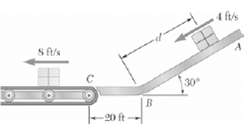
Packages are thrown down an incline at A with a velocity of 4 ft/s. The packages slide along the surface ABC to a conveyor belt which moves with a velocity of 8 ft/s. Knowing that μk = 0.25 between the packages and the surface ABC, determine the distance d if the packages are to arrive at C with a
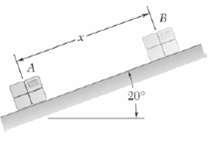
A 50-lb package is projected up a 20? incline with an initial velocity of 40 ft/s. Knowing that the coefficient of kinetic friction between the package and the incline is 0.15, determine (a) The maximum distance x that the package will move up the incline, (b) The velocity of the package as it
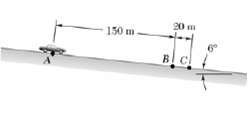
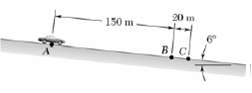
A 2000-kg automobile starts from rest at point A on a 6o incline and coasts through a distance of 150 m to point B. The brakes are then applied, causing the automobile to come to a stop at point C, 20 m from B. Knowing that slipping is impending during the braking period and neglecting air
A 2000-kg automobile starts from rest at point A on a 6oincline and coasts through a distance of 150 m to point B. The brakes are then fully applied, causing the automobile to skid to a stop at point C, 20 m from B. Knowing that the coefficient of dynamic friction between the tires and the road is
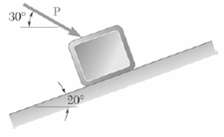
A 90-lb package is at rest on an incline when a constant force P is applied to it. The coefficient of kinetic friction between the package and the incline is 0.35. Knowing that the speed of the package is 2 ft/s after it has moved 3 ft up the incline, determine the magnitude of the force P.
A 3-lb model rocket is launched vertically from rest with a constant thrust of 5.5 lb until the rocket reaches an altitude of 50 ft and the thrust ends. Neglecting air resistance, determine(a) The speed of the rocket when the thrust ends,(b) The maximum height reached by the rocket,(c) The speed of
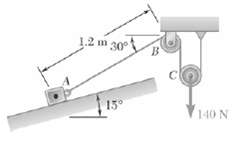
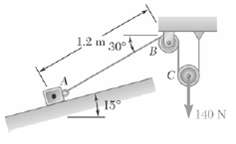
The 7-kg block A is released from rest in the position shown. Neglecting the effect of friction and the masses of the pulleys, determine the velocity of the block after it has moved 0.6 m up the incline.
The 7-kg block A is released in the position shown with a velocity of 1.5 m/s up the incline. Knowing that the velocity of the block is 3 m/s after it has moved 0.6 m up the incline, determine the work done by the friction force exerted on the block. Neglect the masses of the pulleys.
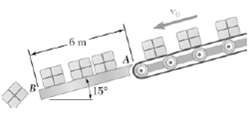
Boxes are transported by a conveyor belt with a velocity v0 to a fixed incline at A where they slide and eventually fall off at B. Knowing that μk = 0.40, determine the velocity of the conveyor belt if the boxes leave the incline at B with a velocity of 2 m/s.
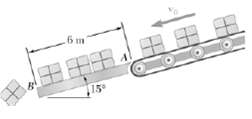
Boxes are transported by a conveyor belt with a velocity v0 to a fixed incline at A where they slide and eventually fall off at B. Knowing that μk = 0.40, determine the velocity of the conveyor belt if the boxes are to have a zero velocity at B.
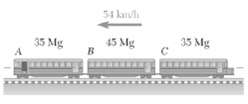
(a) The distance required to bring the train to a stop,(b) The force in eachcoupling.
Solve Prob. 13.15, assuming that the brakes are applied only on the wheels of car A .
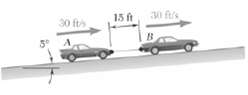
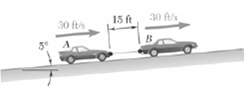
Car B is towing car A with 15-ft cable at a constant speed of 30 ft/s on an uphill grade when the brakes of car B are fully applied causing it to skid to a stop. Car A, whose driver had not observed that car B was slowing down, then strikes the rear of car B. Neglecting air resistance and rolling
Car B is towing car A at a constant speed of 30 ft/s on an uphill grade when the brakes of car A are fully applied causing all four wheels to skid. The driver of car B does not change the throttle setting or change gears. The weights of cars A and B are 3000 lb and 2500 lb, respectively, and the
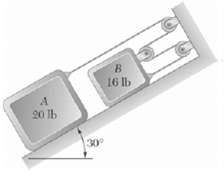
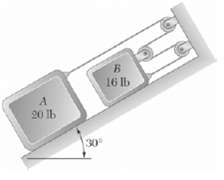
The two blocks shown are released from rest. Neglecting the masses of the pulleys and the effect of friction in the pulleys and between the blocks and the incline, determine (a) The velocity of block A after it has moved 1.5 ft, (b) The tension in the cable.
The two blocks shown are released from rest. Neglecting the masses of the pulleys and the effect of friction in the pulleys and knowing that the coefficients of friction between both blocks and the incline are μs = 0.25 and μk = 0.20, determine. (a) The velocity of block A after it has moved 1.5
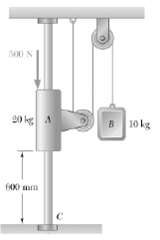
The system shown, consisting of a 20-kg collar A and a 10-kg counterweight B, is at rest when a constant 500-N force is applied to collar A.(a) Determine the velocity of A just before it hits the support at C.(b) Solve part a assuming that the counterweight B is replaced by a 98.1-N downward force.
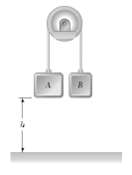
The 10-kg block A and the 4-kg block B are both at a height h = 0.5 m above the ground when the system is released from rest. After A hits the ground without rebound it is observed that B reaches a maximum height of 1.18 m. Determine (a) The speed of A just before impact, (b) The amount of energy
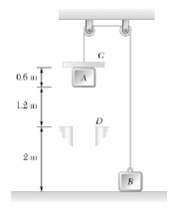
Two blocks A and B, of mass 8 kg and 10 kg, respectively, are connected by a cord which passes over pulleys as shown. A 6-kg collar C is placed on block A and the system is released from rest. After the blocks move 1.8 m, collar C is removed and blocks A and B continue to move.Determine the speed
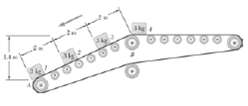
Four 3-kg packages are held in place by friction on a conveyor which is disengaged from its drive motor. When the system is released from rest, package 1 leaves the belt at A just as package 4 comes onto the inclined portion of the belt at B. Determine (a) The velocity of package 2 as it leaves the
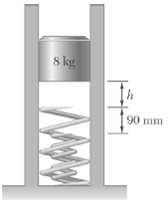
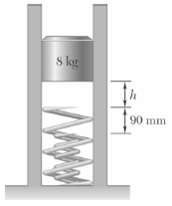
An 8-kg plunger is released from rest in the position shown and is stopped by two nested springs; the constant of the outer spring is k1 = 3 kN/m and the constant of the inner spring is k2 = 10 kN/m. If the maximum deflection of the outer spring is observed to be 150 mm, determine the height h from
An 8-kg plunger is released from rest in the position shown and is stopped by two nested springs; the constant of the outer spring is k1 = 3 kN/m and the constant of the inner spring is k2 = 10 kN/m. If the plunger is released from a height h = 600 mm, determine the maximum deflection of the outer
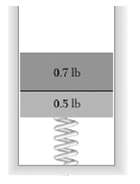
A 0.7-lb block rests on top of a 0.5-lb block supported by but not attached to a spring of constant 9 lb/ft. The upper block is suddenly removed. Determine (a) The maximum velocity reached by the 0.5-lb block, (b) The maximum height reached by the 0.5-lb block.
Solve Prob. 13.27, assuming that the 0.5-lb block is attached to the spring.
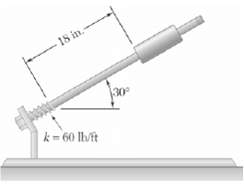
A 7.5-lb collar is released from rest in the position shown, slides down the inclined rod, and compresses the spring. The direction of motion is reversed and the collar slides up the rod. Knowing that the maximum deflection of the spring is 5 in., determine (a) The coefficient of kinetic friction
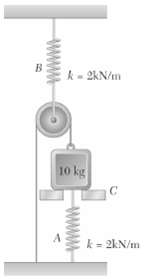
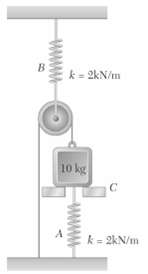
A 10-kg block is attached to spring A and connected to spring B by a cord and pulley. The block is held in the position shown with both springs unstretched when the support is removed and the block is released with no initial velocity. Knowing that the constant of each spring is 2 kN/m,
A 10-kg block is attached to spring A and connected to spring B by a cord and pulley. The block is held in the position shown with spring A stretched 25 mm and spring B unstretched when the support is removed and the block is released with no initial velocity. Knowing that the constant of each
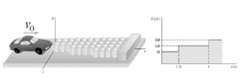
An uncontrolled automobile traveling at 100 km/h strikes squarely a highway crash cushion of the type shown in which the automobile is brought to rest by successively crushing steel barrels. The magnitude F of the force required to crush the barrels is shown as a function of the distance x the
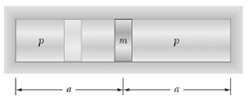
A piston of mass m and cross-sectional area A is in equilibrium under the pressure p at the center of a cylinder closed at both ends. Assuming that the piston is moved to the left a distance a/2 and released, and knowing that the pressure on each side of the piston varies inversely with the volume,
Express the acceleration ion of gravity gh at an altitude h above the surface of the earth in terms of the acceleration of gravity g0 at the surface of the earth, the altitude h, and the radius R of the earth. Determine the percent error if the weight that an object has on the surface of the earth
A rocket is fired vertically from the surface of the moon with a speed v0. Derive a formula for the ratio hn/hu of heights reached with a velocity v, if Newton’s law of gravitation is used to calculate hn and a uniform gravitational field is used to calculate hu . Express your answer in terms of
A meteor starts from rest at a very great distance from the earth. Knowing that the radius of the earth is 3960 mi and neglecting all forces except the gravitational attraction of the earth, determine the speed of the meteor(a) When it enters the ionosphere at an altitude of 620 mi,(b) When it
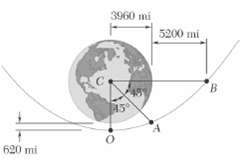
During a flyby of the earth, the velocity of a spacecraft is 6.5 mi/s as it reaches its minimum altitude of 620 mi above the surface at point O. At point B the spacecraft is observed to have an altitude of 5200 mi. Assuming that the trajectory of the spacecraft is parabolic, determine its speed
A bullet is fired straight up from the surface of the moon with an initial velocity of 600 m/s. Determine the maximum elevation reached by the bullet,(a) Assuming a uniform gravitational field with g = 1.62 m/s2,(b) Using Newton’s law of gravitation. (Radius of moon = 1740 km.)
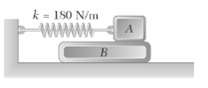
A 1.5-kg block A rests on a 1.5-kg block B and is attached to a spring of constant 180 N/m. The coefficients of friction between the two blocks are μs = 0.95 and μk = 0.90 and the coefficients of friction between block B and the horizontal surface are 0.15 μs = and 0.10. μk = Knowing that the
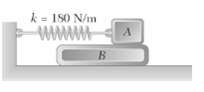
A 1.5-kg block A rests on a 1.5-kg block B and is attached to a spring of constant 180 N/m. The coefficients of friction between the two blocks are 0.35 μs = and 0.30 μk = and the coefficients of friction between block B and the horizontal surface are 0.15 μs = and 0.10. μk = Knowing that the
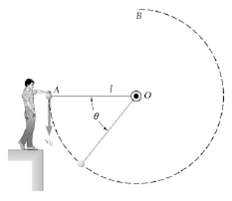
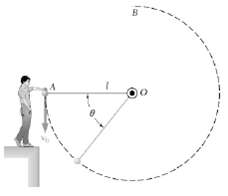
The sphere at A is given a downward velocity v0 and swings in a verticalcircle of radius l and center O. Determine the smallest velocity v0 for which the sphere will reach point B as it swings about point O (a) If AO is a rope, (b) If AO is a slender rod of negligible mass.
The sphere at A is given a downward velocity v0 of magnitude 16 ft/s and swings in a vertical plane at the end of a rope of length l = 6 ft attached to a support at O. Determine the angle θ at which the rope will break, knowing that it can withstand a maximum tension equal to twice the weight of
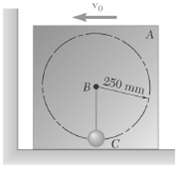
Sphere C and block A are both moving to the left with a velocity v0 when the block is suddenly stopped by the wall. Determine the smallest velocity v0 for which the sphere C will swing in a full circle about the pivot B (a) If BC is a slender rod of negligible mass, (b) If BC is a cord.
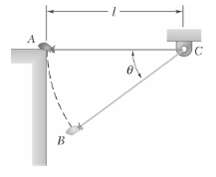
A bag is gently pushed off the top of a wall at A and swings in a vertical plane at the end of a rope of length l Determine the angle θ for which the rope will break, knowing that it can withstand a maximum tension equal to twice the weight of the bag.
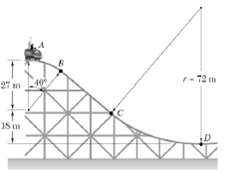
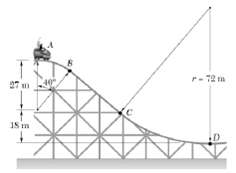
A section of track for a roller coaster consists of two circular arcs AB and CD joined by a straight portion BC. The radius of AB is 27 m and the radius of CD is 72 m. The car and its occupants, of total mass 250 kg, reach point A with practically no velocity and then drop freely along the track.
A section of track for a roller coaster consists of two circular arcs AB and CD joined by a straight portion BC. The radius of AB is 27 m and the radius of CD is 72 m. The car and its occupants, of total mass 250 kg, reach point A with practically no velocity and then drop freely along the track.
A 150-lb sprinter starts from rest and accelerates uniformly for 5.4 s over a distance of 110 ft. Neglecting air resistance, determine the average power developed by the sprinter.
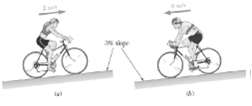
(a) A 60-kg woman rides a 7-kg bicycle up a 3 percent slope at a constant speed of 2 m/s. How much power must be developed by the woman? (b) A 90-kg man on a 9-kg bicycle starts down the same slope and maintains a constant speed of 6 m/s by braking. How much power is dissipated by the brakes?
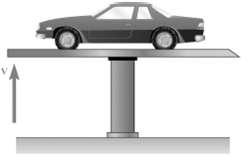
It takes 16 s to raise a 2800-lb car and the supporting 650-lb hydraulic car-lift platform to a height of 6.5 ft. Knowing that the overall conversion efficiency from electric to mechanical power for the system is 82 percent, determine (a) The average output power delivered by the hydraulic pump to
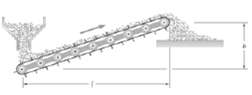
(a) In the SI system of units, for the power P in kW, in terms of the mass flow rate m in kg/h, the height b, and the horizontal distance l in meters, and (b) In U.S. customary units, for the power in hp, in terms of the mass flow rate m in tons/h, and the height b and horizontal distance l in feet.
The fluid transmission of a 15-Mg truck allows the engine to deliver an essentially constant power of 50 kW to the driving wheels. Determine the time required and the distance traveled as the speed of the truck is increased(a) From 36 km/h to 54 km/h,(b) From 54 km/h to 72 km/h.
A 60-kg runner increases her speed from 2 m/s to 4.3 m/s in 5 s. Assuming she develops constant power during this time interval and neglecting air resistance, determine(a) The power developed,(b) The distance traveled.
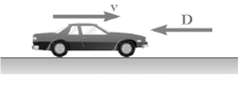
A 3000-lb automobile starts from rest and travels 1200 ft during a performance test. The motion of the automobile is defined by the relation12,000 ln(cosh 0.03 x = t), where x and t are expressed in feet and seconds, respectively. The magnitude of the aerodynamic drag is D = 0.01v2, where D and v
A 3000-lb automobile starts from rest and travels 1200 ft during a performance test. The motion of the automobile is defined by the relation a = 11e??0.0005x , where a and x are expressed in ft/s2 and feet, respectively. The magnitude of the aerodynamic drag is D = 0.01v2, where D and e are
A force P is slowly applied to a plate that is attached to two springs and causes a deflection n x0. In each of the two cases shown, derive an expression for the constant ke, in terms of k1 and k2, of the single spring equivalent to the given system, that is, of the single spring which will undergo
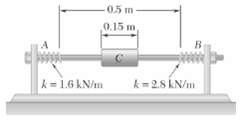
A collar C of weight m slides without friction on a horizontal rod between springs A and B. If the collar is pushed to the left until spring A is compressed 0.1 m and released, determine the distance through which the collar will travel and the maximum velocity it will reach (a) If m = 1 kg, (b) If
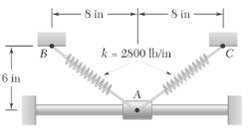
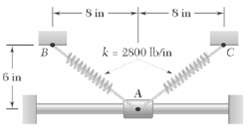
A 4-lb collar can slide without friction along a horizontal rod and is in equilibrium at A when it is pushed 1 in. to the right and released from rest. The springs are undeformed when the collar is at A and the constant of each spring is 2800 lb/in. Determine the maximum velocity of the collar.
A 4-lb collar can slide without friction along a horizontal rod and is released from rest at A. The undeformed lengths of springs BA and CA are 10 in. and 9 in., respectively, and the constant of each spring is 2800 lb/in. Determine the velocity of the collar when it has moved 1 in. to the right.
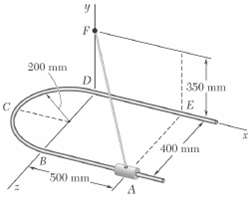
A 750-g collar can slide along the horizontal rod shown. It is attached to an elastic cord with an undeformed length of 300 mm and a spring constant of 150 N/m. Knowing that the collar is released from rest at A and neglecting friction, determine the speed of the collar (a) At B, (b) At E.
Solve Prob. 13.59, assuming that the elastic cord has an undeformed length of 450 mm and a spring constant of 150 N/m. Note that the cord becomes slack during part of the motion.
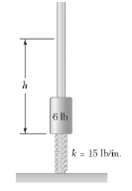
A 6-lb collar can slide without friction on a vertical rod and is resting in equilibrium on a spring. It is pushed down, compressing the spring 6 in., and released. Knowing that the spring constant is k = 15 lb/in., determine (a) The maximum height h reached by the collar above its equilibrium
A 6-lb collar can slide without friction on a vertical rod and is held so it just touches an undeformed spring. Determine the maximum deflection of the spring (a) If the collar is slowly released until it reaches an equilibrium position, (b) If the collar is suddenly released.
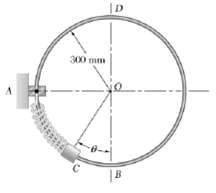
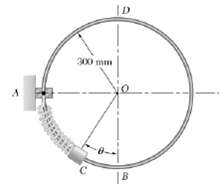
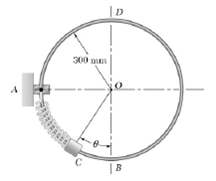
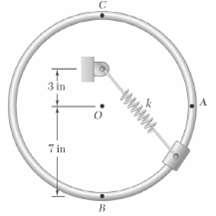
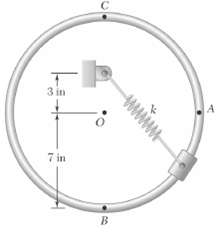
A thin circular rod is supported in a vertical plane by a bracket at A. Attached to the bracket and loosely wound around the rod is a spring of constant k = 40 N/m and undeformed length equal to the arc of circle AB. A 200-g collar C, not attached to the spring, can slide without friction along the
A thin circular rod is supported in a vertical plane by a bracket at A. Attached to the bracket and loosely wound around the rod is a spring of constant k = 40 N/m and undeformed length equal to the arc of circle AB. A 200-g collar C, not attached to the spring, can slide without friction along the
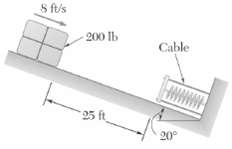
A spring is used to stop a 200-lb package which is moving down a 20? incline. The spring has a constant k = 125 lb/in. and is held by cables so that it is initially compressed 6 in. Knowing that the velocity of the package is 8 ft/s when it is 25 ft from the spring and neglecting friction,
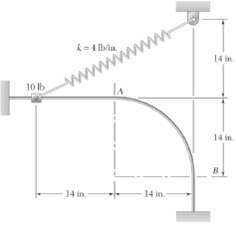
A 10-lb collar is attached to a spring and slides without friction along a fixed rod in a vertical plane. The spring has an undeformed length of 14 in. and a constant k = 4 lb/in. Knowing that the collar is released from rest in the position shown, determine the speed of the collar at (a) Point
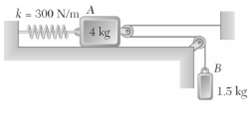
Blocks A and B have masses of 4 kg and 1.5 kg, respectively, and are connected by a cord-and-pulley system and released from rest in the position shown with the spring undeformed. Knowing that the constant of the spring is 300 N/m, determine (a) The velocity of block B after it has moved 150
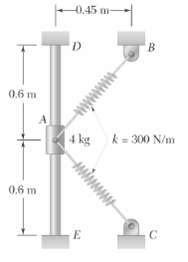
An 4-kg collar A can slide without friction along a vertical rod and is released from rest in the position shown with the springs undeformed. Knowing that the constant of each spring is 300 N/m, determine the velocity of the collar after it has moved (a) 100 mm, (b) 190 mm.
A thin circular rod is supported in a vertical plane by a bracket at A. Attached to the bracket and loosely wound around the rod is a spring of constant k = 40 N/m and undeformed length equal to the arc of circle AB. A 200-g collar C is unattached to the spring and can slide without friction along
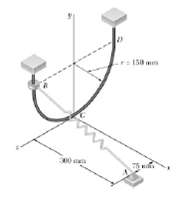
A 500-g collar can slide without friction along the semicircular rod BCD. The spring is of constant 320 N/m and its undeformed length is 200 mm. Knowing that the collar is released from rest at B, determine (a) The speed of the collar as it passes through C, (b) The force exerted by the rod on the
A 2.5-lb collar is attached to a spring and slides without friction along a circular rod in a vertical plane. The spring has an undeformed length of 4 in. and a constant 20 lb/k = /ft. Knowing that the collar is at rest at C and is given a slight push to get it moving, determine the velocity of the
A 2.5-lb collar is attached to a spring and slides without friction along a circular rod in a vertical plane. The spring has an undeformed length of 4 in. and a constant k. The collar is at rest at C and is given a slight push to get it moving, Knowing that the maximum velocity of the collar is
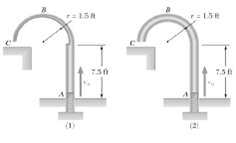
An 8-oz package is projected upward with a velocity v0 by a spring at A; it moves around a frictionless loop and is deposited at C. For each of the two loops shown, determine (a) The smallest velocity v0 for which the package will reach C, (b) The corresponding force exerted by the package on the
If the package of Prob. 13.73 is not to hit the horizontal surface at C with a speed greater than 10 ft/s,(a) Show that this requirement can be satisfied only by the second loop,(b) Determine the largest allowable initial velocity v0 when the second loop is used.
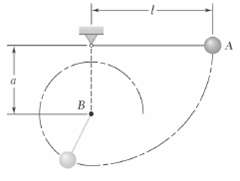
The pendulum shown is released from rest at A and swings through 90? before the cord touches the fixed peg B. Determine the smallest value of a for which the pendulum bob will describe a circle about the peg.
Showing 10800 - 10900
of 18200
First
102
103
104
105
106
107
108
109
110
111
112
113
114
115
116
Last
Step by Step Answers

 Get 50% OFF
Claim Now
Get 50% OFF
Claim Now