New Semester
Started
Get
50% OFF
Study Help!
--h --m --s
Claim Now
Question Answers
Textbooks
Find textbooks, questions and answers
Oops, something went wrong!
Change your search query and then try again
S
Books
FREE
Study Help
Expert Questions
Accounting
General Management
Mathematics
Finance
Organizational Behaviour
Law
Physics
Operating System
Management Leadership
Sociology
Programming
Marketing
Database
Computer Network
Economics
Textbooks Solutions
Accounting
Managerial Accounting
Management Leadership
Cost Accounting
Statistics
Business Law
Corporate Finance
Finance
Economics
Auditing
Tutors
Online Tutors
Find a Tutor
Hire a Tutor
Become a Tutor
AI Tutor
AI Study Planner
NEW
Sell Books
Search
Search
Sign In
Register
study help
engineering
mechanical engineering
Vector Mechanics For Engineers Statics And Dynamics 8th Edition Ferdinand Beer, E. Russell Johnston, Jr., Elliot Eisenberg, William Clausen, David Mazurek, Phillip Cornwell - Solutions
If an automobile’s braking distance from 100 km/h is 60 m on level pavement, determine the automobile’s braking distance from 100 km/h when it is(a) Going up a 6° incline,(b) Going down a 2-percent incline.
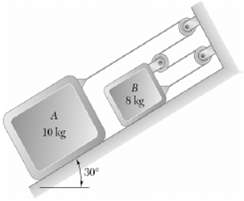
The two blocks shown are originally at rest. Neglecting the masses of the pulleys and the effect of friction in the pulleys and between the blocks and the incline, determine (a) The acceleration of each block, (b) The tension in thecable.
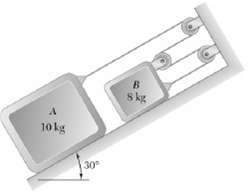
The two blocks shown are originally at rest. Neglecting the masses of the pulleys and the effect of friction in the pulleys and assuming that the coefficients of friction between both blocks and the incline are μs = 0.25 and μk = 0.20, determine (a) The acceleration of each block, (b) The tension
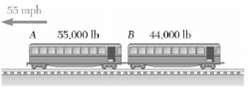
A light train made up of two cars is traveling at 55 mi/h when the brakes are applied to both cars. Knowing that car A has a weight of 55,000 lb and car B has a weight of 44,000 lb and that the braking force is 7000 lb on each car, determine (a) The distance traveled by the train before it comes to
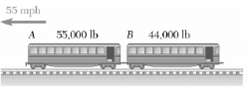
Solve Prob. 12.14, assuming that the brakes of car B fail to operate. Problem 12.14: A light train made up of two cars is traveling at 55 mi/h when the brakes are applied to both cars. Knowing that car A has a weight of 55,000 lb and car B has a weight of 44,000 lb and that the braking force is
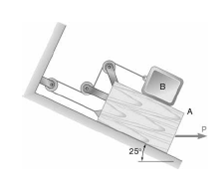
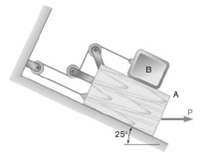
Block A weighs 80 lb, and block B weighs 16 lb. The coefficients of friction between all surfaces of contact are e 0.20 μs = and 0.15. μk = Knowing that P = 0, determine(a) The acceleration of block B,(b) The tension in the cord.
Block A weighs 80 lb, and block B weighs 16 lb. The coefficients of friction between all surfaces of contact are 0.20 μs = and 0.15. μk = Knowing that P = 10 lb ?? determine (a) The acceleration of block B, (b) The tension in the cord.
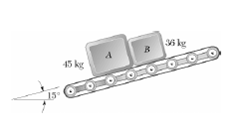
Boxes A and B are at rest on a conveyor belt that is initially at rest. The belt is suddenly started in an upward direction so that slipping occurs between the belt and the boxes. Knowing that the coefficients of kinetic friction between the belt and the boxes are (μk)A = 0.30 and
The system shown is initially at rest. Neglecting the masses of the pulleys and the effect of friction in the pulleys, determine (a) The acceleration of each block, (b) The tension in eachcable.
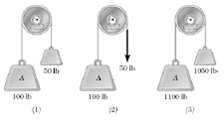
Each of the systems shown is initially at rest. Neglecting axle friction and the masses of the pulleys, determine for each system(a) The acceleration of block A,(b) The velocity of block A after it has moved through 5 ft,(c) The time required for block A to reach a velocity of 10ft/s.
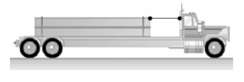
The flat-bed trailer carries two 3000-lb beams with the upper beam secured by a cable. The coefficients of static friction between the two beams and between the lower beam and the bed of the trailer are 0.25 and 0.30, respectively. Knowing that the load does not shift, determine (a) The maximum
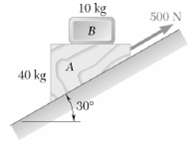
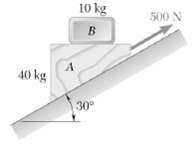
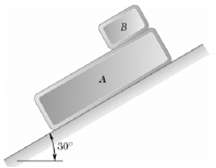
The 10-kg block B is supported by the 40-kg block A which is pulled up an incline by a constant 500 N force. Neglecting friction between the block and the incline and knowing that block B does not slip on block A, determine the smallest allowable value of the coefficient of static friction between
A package is at rest on a conveyor belt which is initially at rest. The belt is started and moves to the right for 1.5 s with a constant acceleration of 3.2 m/s2. The belt then moves with a constant deceleration 2 a and comes to a stop after a total displacement of 4.6 m. Knowing that the
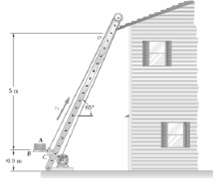
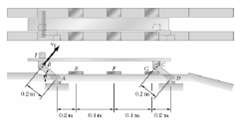
To transport a series of bundles of shingles A to a roof, a contractor uses a motor-driven lift consisting of a horizontal platform BC which rides on rails attached to the sides of a ladder. The lift starts from rest and initially moves with a constant acceleration a1 as shown. The lift then
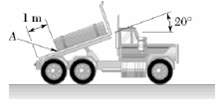
To unload a bound stack of plywood from a truck, the driver first tilts the bed of the truck and then accelerates from rest. Knowing that the coefficients of friction between the bottom sheet of plywood and the bed are 0.40 ?s = and 0.30, ?k = determine (a) the smallest acceleration of the truck
The propellers of a ship of mass m can produce a propulsive ve force F0; they produce a force of the same magnitude but opposite direction when the engines are reversed. Knowing that the ship was proceeding forward at its maximum speed v0 when the engines were put into reverse, determine the
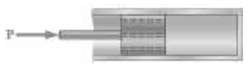
A constant force P is applied to a piston and rod of total mass m to make them move in a cylinder filled with oil. As the piston moves, the oil is forced through orifices in the piston and exerts on the piston a force of magnitude kv in a direction opposite to the motion of the piston. Knowing that
A 4-kg projectile is fired vertically with an initial velocity of 90 m/s, reaches a maximum height and falls to the ground. The aerodynamic drag D has a magnitude D = 0.0024 v2 where D and v are expressed in newtons and m/s, respectively. Knowing that the direction of the drag is always opposite to
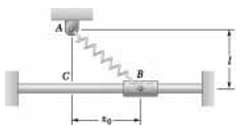
A spring AB of constant k is attached to a support A and to a collar of mass m. The unstretched length of the spring is ??. Knowing that the collar is released from rest at x = x0 and neglecting friction between the collar and the horizontal rod, determine the magnitude of the velocity of the
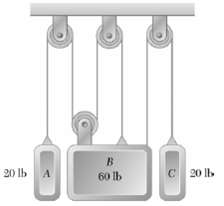
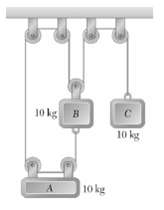
The system of three identical 10-kg blocks is supported in a vertical plane and is initially at rest. Neglecting the masses of the pulleys and the effect of friction in the pulleys, determine(a) The change in position of block A after 0.5 s,(b) The tension in thecable.
The coefficients of friction between block B and block A are 0.12 μs = and 0.10 μk = and the coefficients of friction between block A and the incline are 0.24 μs = and 0.20. μk = The masses of block A and block B are 10 kg and 5 kg, respectively. Knowing that the system is released from rest in
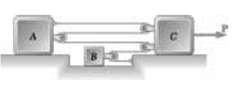
The weights of blocks A, B, and C are WA = WC = 20 lb, and B W = 10 lb. Knowing that P = 50 lb and neglecting the masses of the pulleys and the effect of friction, determine (a) The acceleration of each block, (b) The tension in thecable.
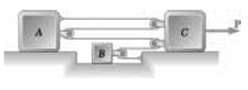
The coefficients of friction between the three blocks and the horizontal surfaces are μs = 0.25 and μk = 0.20. The weights of the blocks are WA = WC = 20 lb, and WB = 10 lb. Knowing that the blocks are initially at rest and that C moves to the right through 2.4 ft in 0.4 s, determine (a) The
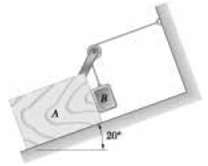
A 25-kg block A rests on an inclined surface, and a 15-kg counterweight B is attached to a cable as shown. Neglecting friction, determine the acceleration of A and the tension in the cable immediately after the system is released fromrest.
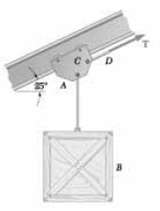
A 250-kg crate B is suspended from a cable attached to a 20-kg trolley A which rides on an inclined I-beam as shown. Knowing that at the instant shown the trolley has an acceleration n of 0.4 m/s2 up to the right, determine (a) The acceleration of B relative to A, (b) The tension in cableCD.
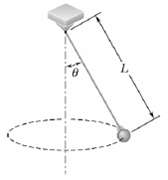
A 2-kg ball revolves in a horizontal circle as shown at a constant speed of 1.5 m/s. Knowing that L = 600 mm, determine (a) The angle θ that the cord forms with the vertical, (b) The tension in the cord.
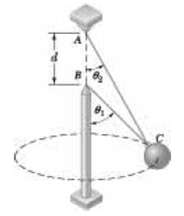
A single wire ACB of length 2 m passes through a ring at C that is attached to a sphere which revolves at a constant speed v in the horizontal circle shown. Knowing that θ1 = 60? and θ2 = 30? and that the tension is the same in both portions of the wire, determine the speed v.
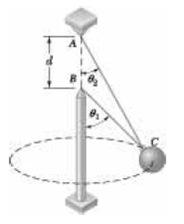
Two wires AC and BC are tied to a 15-lb sphere which revolves at a constant speed v in the horizontal circle shown. Knowing that θ1 = 50? and θ2 = 25? and that d = 4 ft, determine the range of values of v for which both wires are taut.
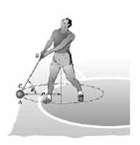
During a hammer thrower??s practice swings, the 16-lb head A of the hammer revolves at a constant speed v in a horizontal circle as shown. If ρ = 3 ft and θ =60?, determine (a) The tension in wire BC, (b) The speed of the hammer??s head.
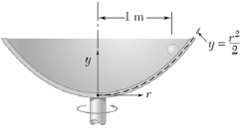
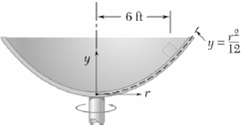
A 1-kg sphere is at rest relative to a parabolic dish which rotates at a constant rate about a vertical axis. Neglecting friction and knowing that r = 1 m, determine(a) The speed v of the sphere,(b) The magnitude of the normal force exerted by the sphere on the inclined surface of thedish.
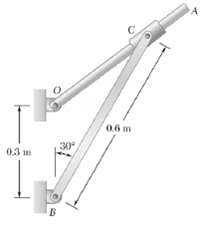
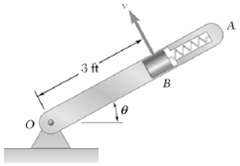
A 1-kg collar C slides without friction along the rod OA and is attached to rod BC by a frictionless pin. The rods rotate in the horizontal plane. At the instant shown BC is rotating counterclockwise and the speed of C is 1 m/s, increasing at a rate of 1.3 m/s Determine at this instant, (a) The
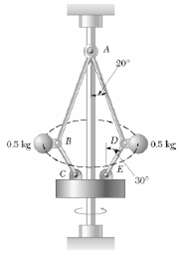
The 0.5-kg flyballs of a centrifugal governor revolve at a constant speed v in the horizontal circle of 150-mm radius shown. Neglecting the mass of links AB, BC, AD, and DE and requiring that the links support only tensile forces, determine the range of the allowable values of v so that the
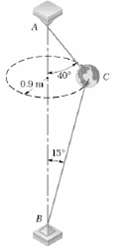
As part of an outdoor display, a 5-kg model C of the earth is attached to wires AC and BC and revolves at a constant speed v in the horizontal circle shown. Determine the range of the allowable values of v if both wires are to remain taut and if the tension in either of the wires is not to exceed
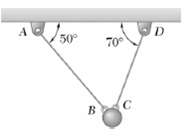
A small sphere of weight W is held as shown by two wires AB and CD. Ifwire AB is cut, determine the tension in the other wire(a) Before AB is cut,(b) Immediately after AB has beencut.
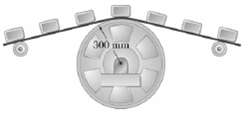
A series of small packages being moved by a thin conveyor belt that passes over a 300-mm-radius idler pulley. The belt starts from rest at time t = 0 and its speed increases at a constant rate of 150 mm/s2 Knowing that the coefficient of static friction between the packages and the belt is 0.75,
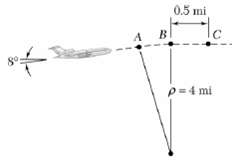
An airline pilot climbs to a new flight level along the path shown. Knowing that the speed of the airplane decreases at a constant rate from 540 ft/s at point A to 480 ft/s at point C, determine the magnitude of the abrupt change in the force exerted on a 200-lb passenger as the airplane passes
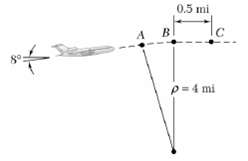
An airline pilot climbs to a new flight level along the path shown. The motion of the airplane between A and B is defined by the relation s = 3t (180 ? t), where s is the arc length in feet, t is the time in seconds, and t = 0 when the airplane is at point A. Determine the force exerted by his seat
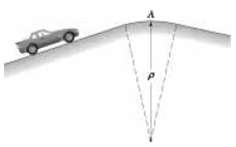
During a high-speed chase, an 1100-kg sports car traveling at a speed of 160 km/h just loses contact with the road as it reaches the crest A of a hill.(a) Determine the radius of curvature ? of the vertical profile of the road at A.(b) Using the value of ? found in part a, determine the force
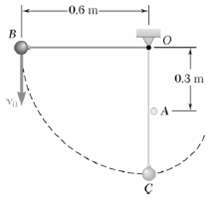
A small 0.2 kg sphere B is given a downward velocity 0 v and swings freely in the vertical plane, first about O and then about the peg A after the cord comes in contact with the peg. Determine the largest allowable velocity 0 v if the tension in the cord is not to exceed 10N.
A 0.5-lb block B fits inside a small cavity cut in arm OA, which rotates in the vertical plane at a constant rate such that v = 9 ft/s. Knowing that the spring exerts on block B a force of magnitude P = 0.3 lb and neglecting the effect of friction, determine the range of values of ? for which block
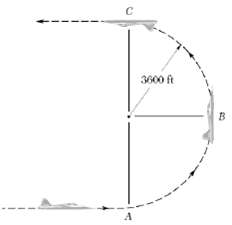
A 120-lb pilot flies a jet trainer in a half vertical loop of 3600-ft radius so that the speed of the trainer decreases at a constant rate. Knowing that the pilot??s apparent weights at points A and C are 380 lb and 80 lb, respectively, determine the force exerted on her by the seat of the trainer
A car is traveling on a banked road at a constant speed v. Determine the range of values of v for which the car does not skid. Express your answer in terms of the radius r of the curve, the banking angle θ , and the angle of static friction φs between the tires and the pavement.
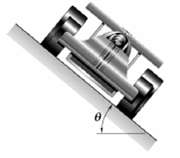
A curve in a speed track has a radius of 200 m and a rated speed of 180 km/h. (See Sample Prob. 12.6 for the definition of rated speed.) Knowing that a racing car starts skidding on the curve when traveling at a speed of 320 km/h, determine (a) The banking angle θ, (b) The coefficient of static
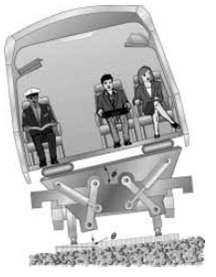
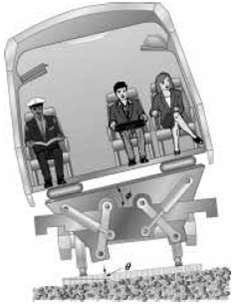
Tilting trains such as the Acela, which runs from Washington to New York to Boston, are designed to travel safely at high speeds on curved sections of track which were built for slower, conventional trains. As it enters a curve, each car is tilted by hydraulic actuators mounted on its trucks. The
Tests carried out with the tilting trains described in Prob. 12.54 revealed that passengers feel queasy when they see through the car windows that the train is rounding a curve at high speed, yet do not feel any side force. Designers, therefore, prefer to reduce, but not eliminate that force. For
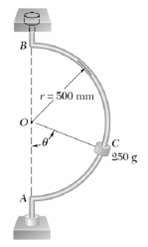
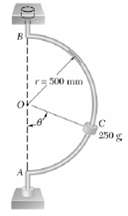
A small 250-g collar C can slide on a semicircular rod which is made to rotate about the vertical AB at a constant rate of 7.5 rad/s. Determine the three values of θ for which the collar will not slide on the rod, assuming no friction between the collar and the rod.
For the collar and rod of Prob. 12.56, and assuming that the coefficients of friction are ?s = 0.25 and ?k = 0.20, indicate whether the collar will slide on the rod if it is released in the position corresponding to(a) ? = 75?,(b) ? = 40?. Also, determine the magnitude and direction of the friction
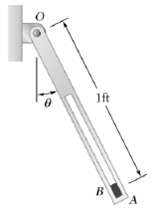
A small block B fits inside a slot cut in arm OA which rotates in a vertical plane at a constant rate. The block remains in contact with the end of the slot closest to A and its speed is 4.2 ft/s for 0 ?? θ ?? 150?. Knowing that the block begins to slide when θ =150?, determine the coefficient of
A 6-lb block is at rest relative to a parabolic dish which rotates at a constant rate about a vertical axis. Knowing that the coefficient of static friction is 0.5 and that r = 6 ft, determine the maximum allowable speed v of theblock.
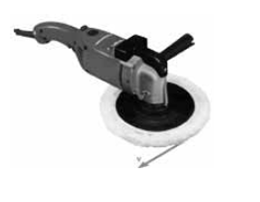
Four seconds after a polisher is started from rest, small tufts of fleece from along the circumference of the 10-in.-diameter polishing pad are observed to fly free of the pad. If the polisher is started so that the fleece along the circumference undergoes a constant tangential acceleration of 12
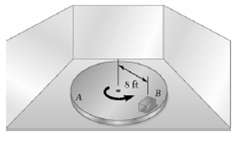
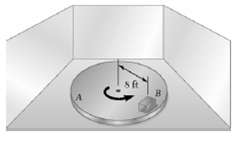
A turntable A is built into a stage for use in a theatrical production. It is observed during a rehearsal that a trunk B starts to slide on the turntable 12 s after the turntable begins to rotate. Knowing that the trunk undergoes a constant tangential acceleration n of 0.75 ft/s2 , determine the
A turntable A is built into a stage for use in a theatrical production. It is observed during a rehearsal that a trunk B starts to slide on the turntable 12 s after the turntable begins to rotate. Knowing that the trunk undergoes a constant tangential acceleration n of 0.75 ft/s2 , determine the
Knowing that the coefficients of friction between the component I and member BC of the mechanism of Prob. 12.62 are 0.35 μs = and 0.25, μk = determine (a) The maximum allowable speed vB if the component is not to slide on BC while being transferred, (b) The values of θ for which sliding is
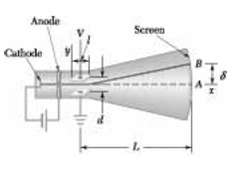
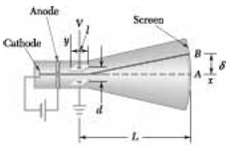
In the cathode-ray tube shown, electrons emitted by the cathode and attracted by the anode pass through a small hole in the anode and then travel in a straight line with a speed v0 until they strike the screen at A. However, if a difference of potential V is established between the two parallel
In Prob. 12.64, determine the smallest allowable value of the ratio d/?? in terms of e, m, v0 , and V if at x = ?? the minimum permissible distance between the path of the electrons and the positive plate is 0.075d. Problem 12.64: In the cathode-ray tube shown, electrons emitted by the cathode and
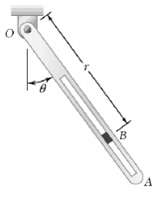
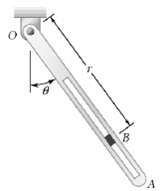
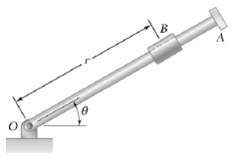
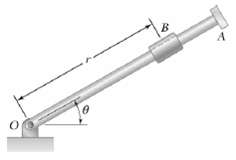
A 0.5-kg block B slides without friction inside a slot cut in arm OA which rotates in a vertical plane at a constant rate, θ = 2 rad/s. At the instant when θ =30?, r = 0.6 m and the force exerted on the block by the arm is zero. Determine, at this instant, (a) The relative velocity of the block
A 0.5-kg block B slides without friction inside a slot cut in arm OA which rotates in a vertical plane. The motion of the rod is defined by the relation θ = 10 rad/s2 , constant. At the instant when θ = 45?, r = 0.8 m and the velocity of the block is zero. Determine, at this instant, (a) The
The motion of a 4-lb block B in a horizontal plane is defined by the relations r = 3t2 ? t3 and ? = 2t2 , where r is expressed in feet, t in seconds, and ? in radians. Determine the radial and transverse components of the force exerted on the block when(a) t = 0,(b) t = 1s.
The motion of a 1-lb block B in a horizontal plane is defined by the relations r = 6 (1 + cos 2πt) and θ = 2πt , where r is expressed in feet, t in seconds, and θ in radians. Determine the radial and transverse components of the force exerted on the block when (a) t = 0, (b) t = 0.75 s.
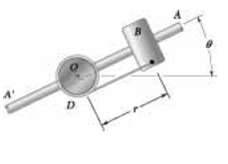
The 6-lb collar B slides on the frictionless arm AA??. The arm is attached to drum D and rotates about O in a horizontal plane at the rate θ = 0.8t, where θ and t are expressed in rad/s and seconds, respectively. As the arm-drum assembly rotates, a mechanism within the drum releases cord so that
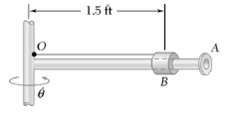
The horizontal rod OA rotates about a vertical shaft according to the relation θ = 10t, where θ and t are expressed in rad/s and seconds, respectively. A 0.5-lb collar B is held by a cord with a breaking strength of 4 lb. Neglecting friction, determine, immediately after the cord breaks, (a) The
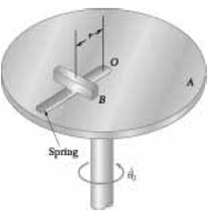
Disk A rotates in a horizontal plane about a vertical axis at the constant rate of θ0 =15 rad/s. Slider B has a mass of 230 g and moves in a frictionless slot cut in the disk. The slider is attached to a spring of constant k = 60 N/m, which is undeformed when r = 0. Knowing that at a given instant
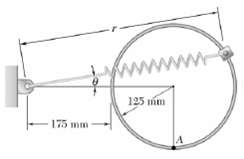
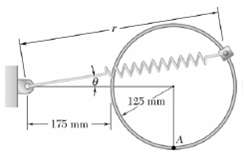
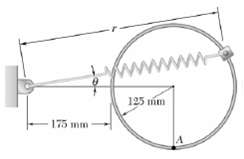
A 1.5-kg collar is attached to a spring and slides without friction along a circular rod in a vertical plane. Knowing that the tension in the spring is70 N and the speed of the collar is 3.8 m/s as it passes through point A, determine, at that instant, the radial and transverse components of
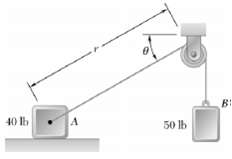
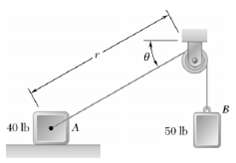
The two blocks are released from rest when r = 2.4 ft and d θ = 30?. Neglecting the mass of the pulley and the effect of friction in the pulley and between block A and the horizontal surface, determine (a) The initial tension in the cable, (b) The initial acceleration of block A, (c) The initial
The velocity of block A is 6 ft/s to the right at the instant when r = 2.4 ft and θ =30?. Neglecting the mass of the pulley and the effect of friction in the pulley and between block A and the horizontal surface, determine, at this instant, (a) The tension in the cable, (b) The acceleration of
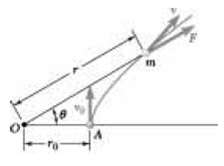
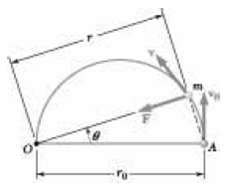
A particle of mass m is projected from point A with an initial velocity 0 v perpendicular to line OA and moves under a central force F directed away from the center of force O. Knowing that the particle follows a path defined by the equation r = r0/??cos 2θ and using Eq. (12.27), express the
A 1.5-kg collar is attached to a spring and slides without friction along a circular rod in a vertical plane. Knowing that the tension in the spring is70 N and the speed of the collar is 3.8 m/s as it passes through point A, determine, at that instant, the radial and transverse components of
A particle of mass m is projected from point A with an initial velocity 0 v perpendicular to line OA and moves under a central force F along a semicircular path of diameter OA. Observing that 0 r=r cosθ and using Eq. (12.27), show that the speed of the particle is v = v0 / cos2 θ ..
For the particle of Prob. 12.78, determine the tangential component Ft of the central force F along the tangent to the path of the particle for (a) θ = 0, (b) θ =45?.
The radius of the orbit of a moon of a given planet is three times as large as the radius of that planet. Denoting by ρ the mean density of the planet, show that the time required by the moon to complete one full revolution about the planet is 9(π/Gρ)1/2, where G is the constant of gravitation.
Communication satellites are placed in a geosynchronous orbit, that is, in a circular orbit such that they complete one full revolution about the earth in one sidereal day (23.394 h), and thus appear stationary with respect to the ground. Determine (a) The altitude of these satellites above the
Show that the radius r of the orbit of a moon of a given planet can be determined from the radius R of the planet, the acceleration of gravity at the surface of the planet, and the time τ required by the moon to complete one full revolution about the planet. Determine the acceleration of gravity
The orbit of the planet Venus is nearly circular with an orbital velocity of 78.3 3 × 10³ mi/h. Knowing that the mean distance from the center of the sun to the center of Venus is 67.2 × 10⁶ mi and that the radius of the sun is 432 × 103 mi, determine(a) The mass of the sun,(b) The acceleration
The periodic times of the planet Jupiter’s satellites, Ganymede and Callisto, have been observed to be 7.15 days and 16.69 days, respectively. Knowing that the mass of Jupiter is 319 times that of the earth and that the orbits of the two satellites are circular, determine(a) The radius of the
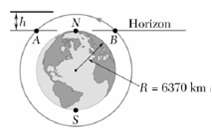
The periodic time (see Prob. 12.84) of an earth satellite in a circular polar orbit is 120 min. Determine (a) The altitude h of the satellite, (b) The time during which the satellite is above the horizon for an observer located at the northpole.
A space vehicle is in a circular orbit 200 mi above the surface of the moon. Knowing that the radius and mass of the moon are 1080 mi and 5.03 × 10²¹ lb ⋅ s2 / ft , respectively, determine(a) The acceleration of gravity at the surface of the moon,(b) The periodic time (see Prob. 12.84) of the
The periodic times (see Prob. 12.84) of the planet Saturn's satellites Tethys and Rhea have been observed to be 1.888 days and 4.52 days, respectively. Assuming the orbits are circular and knowing that the radius of the orbit of Tethys is 183.3 × 10³ mi, determine (a) The radius of the orbit of
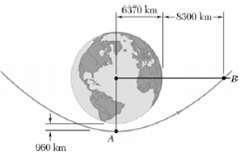
During a flyby of the earth, the velocity of a spacecraft is 10.4 × 10³ m/s as it reaches its minimum altitude of 960 km above the surface at point A. At point B the spacecraft is observed to have an altitude of 8300 km. Assuming that the trajectory of the spacecraft is parabolic, determine its
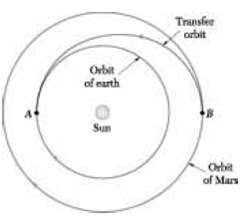
As a first approximation to the analysis of a space flight from the earth to Mars, assume the orbits of the earth and Mars are circular and coplanar. The mean distances from the sun to the earth and to Mars are 92.96 × 10⁶ mi and 141.5 × 10⁶ mi, respectively. To place the spacecraft into an
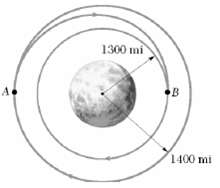
A space vehicle is in a circular orbit of 1400-mi radius around the moon. To transfer to a smaller orbit of 1300-mi radius, the vehicle is first placed in an elliptic path AB by reducing its speed by 86 ft/s as it passes through A. Knowing that the mass of the moon is 5.03×10²¹ lb??s2/ft,
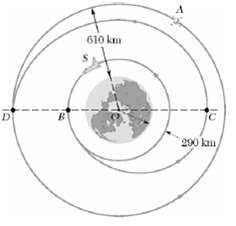
A space shuttle S and a satellite A are in the circular orbits shown. In order for the shuttle to recover the satellite, the shuttle is first placed in an elliptic path BC by increasing its speed by ΔvB = 85 m/s as it passes through B. As the shuttle approaches C, its speed is increased by ΔvC =
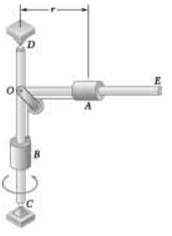
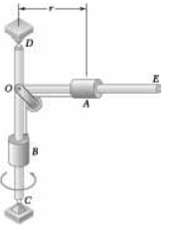
Two 2.6-lb collars A and B can slide without friction on a frame, consisting of the horizontal rod OE and the vertical rod CD, which is free to rotate about CD. The two collars are connected by a cord running over a pulley that is attached to the frame at O and a stop prevents collar B from moving.
Two 2.6-lb collars A and B can slide without friction on a frame, consisting of the horizontal rod OE and the vertical rod CD, which is free to rotate about CD. The two collars are connected by a cord running over a pulley that is attached to the frame at O and a stop prevents collar B from moving.
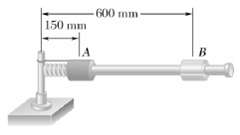
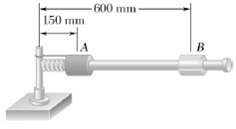
A 300-g collar can slide on a horizontal rod which is free to rotate about a vertical shaft. The collar is initially held at A by a cord attached to the shaft and compresses a spring of constant 5 N/m, which is undeformed when the collar is located 750 mm from the shaft. As the rod rotates at the
In Prob. 12.94, determine for position B of the collar, (a) The radial component of the velocity of the collar, (b) The value e of θ.
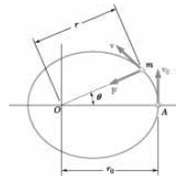
A particle of mass m is projected from point A with an initial velocity v0 perpendicular to OA and moves under a central force F along an elliptic path defined by the equation r = r0/(2 ?? cosθ). Using Eq. (12.37), show that F is inversely proportional to the square of the distance r from the
A particle of mass m describes the path defined by the equation r = r0 (6 cosθ ??5) under a central force F directed away from the center of force O. Using Eq. (12.37), show that F is inversely proportional to the square of the distance r from the particle to O.
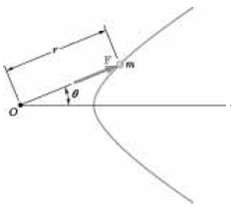
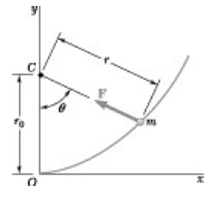
A particle of mass m describes the parabola y = x2 4r0 under a central force F directed toward the center of force C. Using Eq. (12.37) and Eq. (12.39?) with ? = 1, show that F is inversely proportional to the square of the distance r from the particle to the center of force and that the angular
A particle of mass m describes the logarithmic spiral r = r0 ebθ under a central force F directed toward the center of force O. Using Eq. (12.37) show that F is inversely proportional to the cube of the distance r from the particle to O.
It was observed that as the spacecraft Voyager 1 reached the point on its trajectory closest to the planet Jupiter, it was at a distance of 350 × 103 km from the center of the planet and had a velocity of 26.9 km/s. Determine the mass of Jupiter, assuming that the trajectory of the spacecraft was
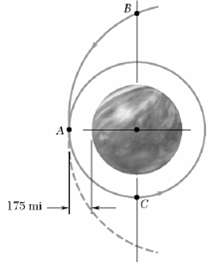
As a space probe approaching the planet Venus on a parabolic trajectory reaches point A closest to the planet, its velocity is decreased to insert itinto a circular orbit. Knowing that the mass and the radius of Venus are 334 × 1021 lb??s2/ft and 3761 mi, respectively, determine (a) The velocity
It was observed that as the Galileo spacecraft reached the point of its trajectory closest to Io, a moon of the planet Jupiter, it was at a distance of 2820 km from the center of Io and had a velocity of 15 km/s. Knowing that the mass of Io is 0.01496 times the mass of the earth, determine the
A small satellite of Jupiter, discovered in 2002, was reported to be an orbit of semimajor jor axis 23.6 × 10⁶ km and eccentricity 0.45. Knowing that the mass of Jupiter is 318 times the mass of the earth, determine the maximum and minimum speeds of the satellite.
A satellite describes an elliptic orbit about a planet of mass M. Denoting by r0 and r1 , respectively, the minimum and maximum values of the distance r from the satellite to the center of the planet, derive the relation 1/r0 + 1/r1 = 2GM/h2 where h is the angular momentum per unit mass of the
A satellite describes an elliptic orbit about a planet of mass M. Denoting by r0 and r1 , respectively, the minimum and maximum values of the distance r from the satellite to the center of the planet, derive the relation 1/r0 + 1/r1 = 2GM/h2 where h is the angular momentum per unit mass of the
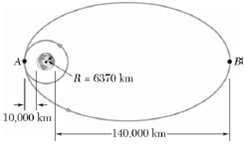
The Chandra X-ray observatory, launched in 1999, achieved an elliptical orbit of minimum altitude 10 000 km and maximum altitude 140 000 km above the surface of the earth. Assuming that the observatory was transferred to this orbit from a circular orbit of altitude 10 000 km at point A,
As it describes an elliptic orbit about the sun, a spacecraft reaches a maximum distance of 325 × 106 km from the center of the sun at point A (called the aphelion) and a minimum distance of 148 × 106 km at point B (called the perihelion). To place the spacecraft in a smaller elliptic orbit with
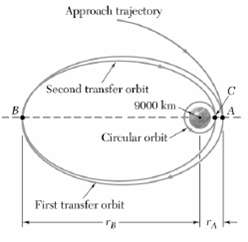
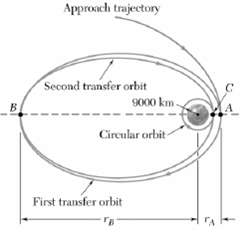
A space probe is to be placed in a circular orbit of 9000-km radius about the planet Venus in a specified plane. As the probe reaches A, the point of its original trajectory closest to Venus, it is inserted in a first elliptic transfer orbit by reducing its s speed of ?vA . This orbit brings it to
For the space probe of Prob. 12.108, it is known that rA = 15 × 103 km and that the velocity of the probe is reduced to 6500 m/s as it passes through A. Determine(a) The distance from the center of Venus to point B,(b) The amounts by which the velocity of the probe should be reduced at B and
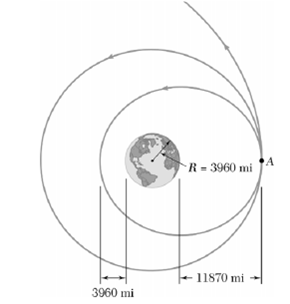
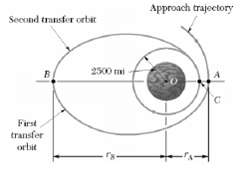
A space probe is to be placed in a circular orbit of radius 2500 mi about the planet Mars. As the probe reaches A, the point of its original trajectory closest to Mars, it is inserted into a first elliptic transfer orbit by reducing its speed. This orbit brings it to point B with a much reduced
Showing 10700 - 10800
of 18200
First
101
102
103
104
105
106
107
108
109
110
111
112
113
114
115
Last
Step by Step Answers

 Get 50% OFF
Claim Now
Get 50% OFF
Claim Now