New Semester
Started
Get
50% OFF
Study Help!
--h --m --s
Claim Now
Question Answers
Textbooks
Find textbooks, questions and answers
Oops, something went wrong!
Change your search query and then try again
S
Books
FREE
Study Help
Expert Questions
Accounting
General Management
Mathematics
Finance
Organizational Behaviour
Law
Physics
Operating System
Management Leadership
Sociology
Programming
Marketing
Database
Computer Network
Economics
Textbooks Solutions
Accounting
Managerial Accounting
Management Leadership
Cost Accounting
Statistics
Business Law
Corporate Finance
Finance
Economics
Auditing
Tutors
Online Tutors
Find a Tutor
Hire a Tutor
Become a Tutor
AI Tutor
AI Study Planner
NEW
Sell Books
Search
Search
Sign In
Register
study help
engineering
mechanical engineering
Vector Mechanics For Engineers Statics And Dynamics 8th Edition Ferdinand Beer, E. Russell Johnston, Jr., Elliot Eisenberg, William Clausen, David Mazurek, Phillip Cornwell - Solutions
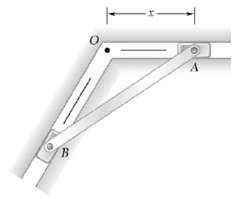
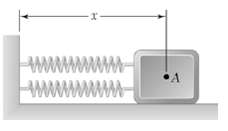
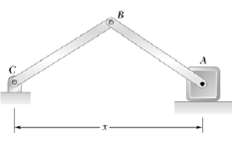
The motion of the slider A is defined by the relation x = 50sin (k1t ??k2t2), where x and t are expressed in millimeters and seconds, respectively. The constants k1 and k2 are known to be 1 rad/s and 0.5 rad/s2, respectively. Consider the range 0
The motion of a particle is defined by the relation x = t3 −6t2 + 9t +5, where x is expressed in feet and t in seconds. Determine(a) When the velocity is zero,(b) The position, acceleration, and total distance traveled when t =5s.
The motion of a particle is defined by the relation n x = t2 − (t− 2)3, where x and t are expressed in feet and seconds, respectively. Determine (a) The two positions at which the velocity is zero, (b) The total distance traveled by the particle from t = 0 to t = 4 s.
The acceleration of a particle is defined by the relation a = 3e−0.2t, where a and t are expressed in ft/s2 and seconds, respectively. Knowing that x = 0 and v = 0 at t = 0, determine the velocity and position of the particle when t = 0.5 s.
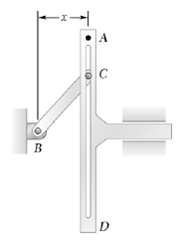
The acceleration of point A is defined by the relation a = ? 5.4 sin kt, where a and t are expressed in ft/s2 and seconds, respectively, and k = 3 rad/s. Knowing that x = 0 and v = 1.8 ft/s when t = 0, determine the velocity and position of point A when t = 0.5 s.
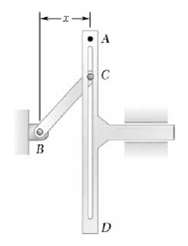
The acceleration of point A is defined by the relation a = ? 3.24 sin kt ? 4.32cos kt, where a and t are expressed in ft/s2 and seconds, respectively, and k = 3 rad/s. Knowing that x = 0.48 ft and v = 1.08 ft/s when t = 0, determine the velocity and position of point A when t = 0.5 s.
The acceleration of a particle is directly proportional to the time t. At t = 0, the velocity of the particle is 400 mm/s. Knowing that v = 370 mm/s and x = 500 mm when t = 1 s, determine the velocity, the position, and the total distance traveled when t = 7 s.
The acceleration of a particle is defined by the relation a = 0.15 m/s2. Knowing that x = −10 m when t = 0 and v = − 0.15 m/s when t = 2 s, determine the velocity, the position, and the total distance traveled when t = 5 s.
The acceleration of a particle is defined by the relation a = 9 − 3t2. The particle starts at t = 0 with v = 0 and x = 5 m. Determine(a) The time when the velocity is again zero,(b) The position and velocity when t = 4 s,(c) The total distance traveled by the particle from t = 0 to t = 4 s.
The acceleration of a particle is defined by the relation a = kt2. (a) Knowing that v = –10 m/s when t = 0 and that v = 10 m/s when t = 2 s, determine the constant k. (b) Write the equations of motion, knowing also that x = 0 when t = 2 s.
Point A oscillates with an acceleration a = 40 ?? 160x, where a and x are expressed in m/s2 and meters, respectively. The magnitude of the velocity is 0.3 m/s when x = 0.4 m. Determine (a) The maximum velocity of A, (b) The two positions at which the velocity of A is zero.
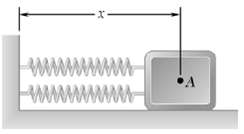
Point A oscillates with an acceleration a = 100 (0.25 ? x), where a and x are expressed in m/s2 and meters, respectively. Knowing that the system starts at time t = 0 with v = 0 and x = 0.2 m, determine the position and the velocity of A when t = 0.2 s.
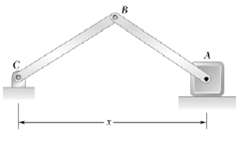
The acceleration of point A is defined by the relation a = 600x (1 + kx2), where a and x are expressed in ft/s2 and feet, respectively, and k is a constant. Knowing that the velocity of A is 7.5 ft/s when x = 0 and 15 ft/s when x = 0.45 ft, determine the value ofk.
The acceleration of point A is defined by the relation a = 800x + 3200x3, where a and x are expressed in ft/s2 and feet, respectively. Knowing that the velocity of A is 10 ft/s and x = 0 when t = 0, determine the velocity and position of A when t = 0.05s.
The acceleration of a particle is defined by the relation a = 12x − 28, where a and x are expressed in m/s2 and meters, respectively. Knowing that v = 8m/s when x = 0, determine (a) The maximum value of x, (b) The velocity when the particle has traveled a total distance of m3.
The acceleration of a particle is defined by the relation n a = k (1− e− x), where k is a constant. Knowing that the velocity of the particle is v = +9 m/s when x = −3m and that the particle comes to rest at the origin, determine(a) The value of k,(b) The velocity of the particle when x = −
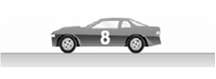
Starting from x = 0 with no initial velocity, the acceleration of a race car is defined by the relation a = 6.8e–0.00057x, where a and x are expressed in m/s2 and meters, respectively. Determine the position of the race car when v = 30 m/s.
The acceleration of a particle is defined by the relation a = – 0.4 v, where a is expressed in mm/s2 and v in mm/s. Knowing that at t = 0 the velocity is 75 mm/s, determine(a) The distance the particle will travel before coming to rest,(b) The time required for the velocity of the particle to be
The acceleration of a particle is defined by the relation a = –kv2, where a is expressed in m/s2 and v in m/s. The particle starts at x = 0 with a velocity of 9 m/s and when x = 13 m the velocity is found to be 7 m/s. Determine the distance the particle will travel(a) Before its velocity drops to
The acceleration of a particle is defined by the relation a= −k √v, where k is a constant. Knowing that x = 0 and v = 25 ft/s at t = 0, and that v = 12 ft/s when x = 6 ft, determine (a) The velocity of the particle when x = 8 ft, (b) The time required for the particle to come to
Starting g from x = 0 with no initial velocity, a particle is given an acceleration a = 0.8√v2+49, where a and v are expressed in ft/s2 and ft/s, respectively. Determine (a) The position of the particle when v = 24 ft/s, (b) The speed of the particle when x = 40 ft.
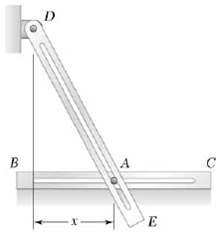
The acceleration of slider A is defined by the relation a= ??2k??k2 ?? v2, where a and v are expressed in ft/s2 and ft/s, respectively, and k is a constant. The system starts at time t = 0 with x = 1.5 ft and v = 0. Knowing that x = 1.2 ft when t = 0.2 s, determine the value of k.
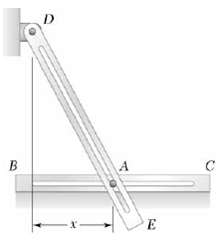
The acceleration of slider A is defined by the relation n a = ??2??1??v2, where a and v are expressed in ft/s2 and ft/s, respectively. The system starts at time t = 0 with x = 1.5 ft and v = 0. Determine (a) The position of A when v = ?? 0.6 ft/s, (b) The position of A when t = 0.3 s.
Starting from x = 0 with no initial velocity, the velocity of a race car is defined by the relation v = 154 ??1??e??0.00057x, where v and x are expressed in m/s and meters, respectively. Determine the position and acceleration of the race car when (a) V = 20 m/s, (b) V = 40 m/s.
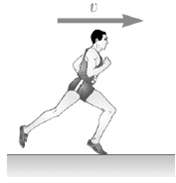
Based on observations, the speed of a jogger can be approximated by the relation v = 7.5 (1 0.04x) 0.3, where v and x are expressed in km/h and kilometers, respectively. Knowing that x = 0 at t = 0, determine (a) The distance the jogger has run when t = 1 h, (b) The jogger??s acceleration in m/s2
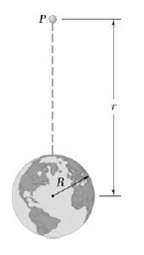
The acceleration due to gravity of a particle falling toward the earth is a = ?gR2/r2, where r is the distance from the center of the earth to the particle, R is the radius of the earth, and g is the acceleration due to gravity at the surface of the earth. If R = 3960 mi, calculate the escape
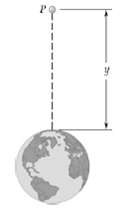
The acceleration due to gravity at an altitude y above the surface of the earth can be expressed as a = ?? 32.2 / [1+(y/20.9 x 106)]2 where a and y are expressed in ft/s2 and feet, respectively. Using this expression, compute the height reached by a projectile fired vertically upward from the
The velocity of a slider is defined by the relation v = v ‘sin (ωnt + ϕ). Denoting the velocity and the position of the slider at t = 0 by v0 and x0, respectively, and knowing that the maximum displacement of the slider is 2x0, show that (a) v'= (v20 + x20 ω2n) /2x0ωn, (b)
The velocity of a particle is v = v0 [1 sin – (πt/T)]. Knowing that the particle starts from the origin with an initial velocity v0, determine(a) Its position and its acceleration at t = 3T,(b) Its average velocity during the interval t = 0 to t = T.
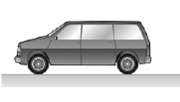
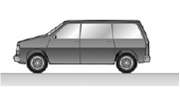
A minivan is tested for acceleration and braking. In the street-start acceleration test, elapsed time is 8.2 s for a velocity increase from 10 km/h to 100 km/h. In the braking test, the distance traveled is 44 m during braking to a stop from 100 km/h. Assuming constant values of acceleration and
In Prob. 11.35, determine(a) The distance traveled during the street-start acceleration test,(b) The elapsed time for the brakingtest.
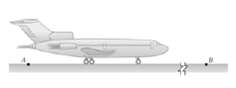
An airplane begins its take-off run at A with zero velocity and a constant acceleration a. Knowing that it becomes airborne 30 s later at B and that the distance AB is 2700 ft, determine (a) The acceleration a, (b) The takeoff velocityvB.
Steep safety ramps are built beside mountain highways to enable vehicles with defective brakes to stop safely. A truck enters a 750-ft ramp at a high speed v0 and travels 540 ft in 6 s at constant deceleration before its speed is reduced to v0/ 2. Assuming the same constant deceleration,
A sprinter in a 400-m race accelerates uniformly for the first 130 m and then runs with constant velocity. If the sprinter’s time for the first 130 m is 25 s, determine (a) His acceleration, (b) His final velocity, (c) His time for the race.
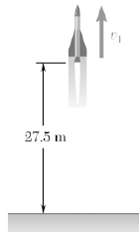
A group of students launches a model rocket in the vertical direction. Based on tracking data, they determine that the altitude of the rocket was 27.5 m at the end of the powered portion of the flight and that the rocket landed 16 s later. Knowing that the descent parachute failed to deploy so that
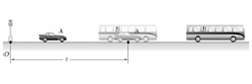
Automobile A starts from O and accelerates at the constant rate of 0.75 m/s2. A short time later it is passed by bus B which is traveling in the opposite direction at a constant speed of 6 m/s. Knowing that bus B passes point O 20 s after automobile A started from there, determine when and where
Automobiles A and B are traveling in adjacent highway lanes and at t = 0 have the positions and speeds shown. Knowing that automobile A has a constant acceleration of 0.6 m/s2 and that B has a constant deceleration of 0.4 m/s2, determine(a) When and where A will overtake B,(b) The speed of each
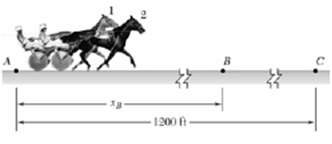
In a close harness race, horse 2 passes horse 1 at point A, where the two velocities are v2 = 21 ft/s and v1 = 20.4 ft/s. Horse 1 later passes horse 2 at point B and goes on to win the race at point C, 1200 ft from A. The elapsed times from A to C for horse 1 and horse 2 are t1 = 61.5 s and t2 =
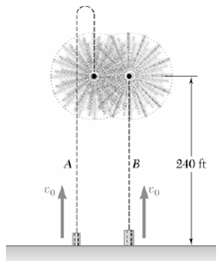
Two rockets are launched at a fireworks performance. Rocket A is launched with an initial velocity v0 and rocket B is launched 4 s later with the same initial velocity. The two rockets are timed to explode simultaneously at a height of 240 ft, as A is falling and B is rising. Assuming a constant
In a boat race, boat A is leading boat B by 38 m and both boats are traveling at a constant speed of 168 km/h. At t = 0, the boats accelerate at constant rates. Knowing that when B passes A, t = 8 s and vA = 228 km/h, determine(a) The acceleration of A,(b) The acceleration of B.
Car A is parked along the northbound lane of a highway, and car B is traveling in the southbound lane at a constant speed of 96 km/h. At t = 0, A starts and accelerates at a constant rate aA, while at t = 5 s, B begins to slow down with a constant deceleration of magnitude aA/ 6. Knowing that when
Two automobiles A and B traveling in the same direction in adjacent lanes are stopped at a traffic signal. As the signal turns green, automobile A accelerates at a constant rate of 6.5 ft/s2. Two seconds later, automobile B starts and accelerates at a constant rate of 11.7 ft/s2. Determine (a) When
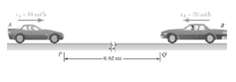
Two automobiles A and B are approaching each other in adjacent highway lanes. At t = 0, A and B are 0.62 mi apart, their speeds are vA = 68 mi/h and vB = 39 mi/h, and they are at points P and Q, respectively. Knowing that A passes point Q 40 s after B was there and that B passes point P 42 s after
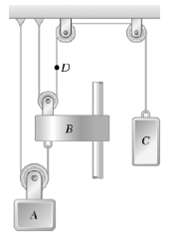
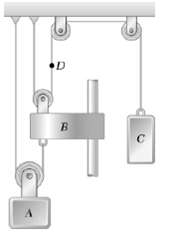
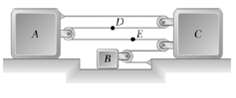
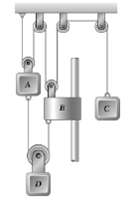
Block A moves down with a constant velocity of 1 m/s. Determine(a) The velocity of block C,(b) The velocity of collar B relative to block A,(c) The relative velocity of portion D of the cable with respect to blockA.
Block C starts from rest and moves down with a constant acceleration. Knowing that after block A has moved 0.5 m its velocity is 0.2 m/s, determine(a) The accelerations of A and C,(b) The velocity and the change in position of block B after 2s.
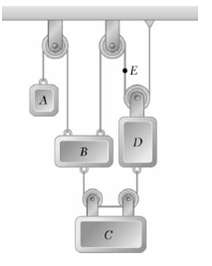
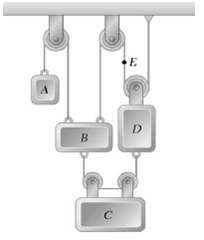
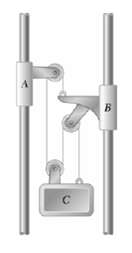
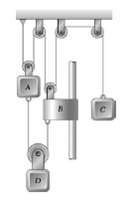
Block C moves downward with a constant velocity of 2 ft/s. Determine(a) The velocity of block A,(b) The velocity of blockD.
Block C starts from rest and moves downward with a constant acceleration. Knowing that after 5 s the velocity of block A relative to block D is 8 ft/s, determine (a) The acceleration of block C, (b) The acceleration of portion E of thecable.
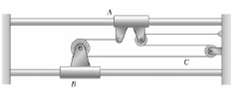
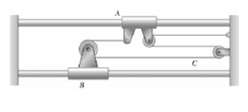
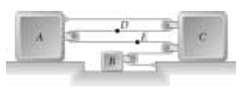
In the position shown, collar B moves to the left with a constant velocity of 300 mm/s. Determine(a) The velocity of collar A,(b) The velocity of portion C of the cable,(c) The relative velocity of portion C of the cable with respect to collarB.
Collar A starts from rest and moves to the right with a constant acceleration. Knowing that after 8 s the relative velocity of collar B with respect to collar A is 610 mm/s, determine(a) The accelerations of A and B,(b) The velocity and the change in position of B after 6s.
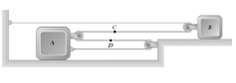
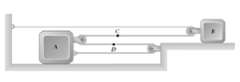
At the instant shown, slider block B is moving to the right with a constant acceleration, and its speed is 6 in./s. Knowing that after slider block A has moved 10 in. to the right its velocity is 2.4 in./s, determine(a) The accelerations of A and B,(b) The acceleration of portion D of the cable,(c)
Slider block B moves to the right with a constant velocity of 12 in./s. Determine(a) The velocity of slider block A,(b) The velocity of portion C of the cable,(c) The velocity of portion D of the cable,(d) The relative velocity of portion C of the cable with respect to slider blockA.
Slider block b moves to the left with a constant velocity of 50 mm/s. At t = 0, slider block A is moving to the right with a constant acceleration and a velocity of 100 mm/s. Knowing that at t = 2 s slider block C has moved 40 mm to the right, determine (a) The velocity of slider block C at t =
Slider block A starts with an initial velocity at t = 0 and a constant acceleration of 270 mm/s2 to the right. Slider block C starts from rest at t = 0 and moves to the right with constant acceleration. Knowing that at t = 2 s, the velocities of A and B are 420 mm/s to the right and 30 mm/s to the
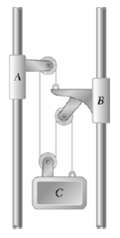
Collar A starts from rest at t = 0 and moves upward with a constant acceleration of 3.6 in/s2. Knowing that collar B moves downward with a constant velocity of 18 in/s, determine(a) The time at which the velocity of block C is zero,(b) The corresponding position of blockC.
Collars A and B start from rest and move with the following accelerations: aA = 2.5t in/s2 upward and aB = 15 in/s2 downward. Determine(a) The time at which the velocity of block C is again zero,(b) The distance through which block C will have moved at thattime.
The system shown starts from rest and each component moves with a constant acceleration. If the relative acceleration of block C with respect to collar B is 120 mm/s2 upward and the relative acceleration of block D with respect to block A is 220 mm/s2 downward, determine (a) The velocity of block C
The system shown starts from rest, and the length of the upper cord is adjusted so that A, B, and C are initially at the same level. Each component moves with a constant acceleration. Knowing that when the relative velocity of collar B with respect to block A is 40 mm/s downward, the displacements
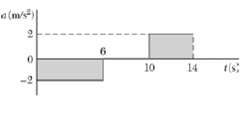
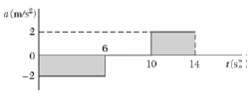
A particle moves in a straight line with a constant acceleration of ??2 m/s2 for 6 s, zero acceleration for the next 4 s, and a constant acceleration of +2 m/s2 for the next 4 s. Knowing that the particle starts from the origin and that its velocity is 4 ?? m/s during the zero acceleration time
A particle moves in a straight line with a constant acceleration of ?2 m/s2 for 6 s, zero acceleration for the next 4 s, and a constant acceleration of +2 m/s2 for the next 4 s. Knowing that the particle starts from the origin with v0 = 8 m/s, (a) Construct the v ? t and x ? t curves for 0 ? t ?
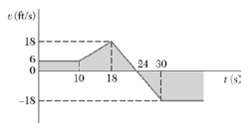
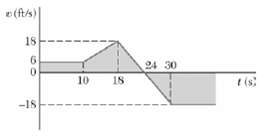
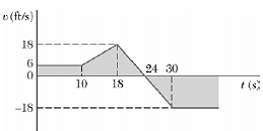
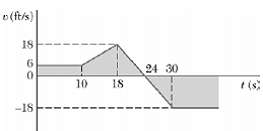
A particle moves in a straight line with the velocity shown in the figure. Knowing that x = ?? 48 ft at t = 0, draw the a??t and x??t curves for 0 (a) The maximum value of the position coordinate of the particle, (b) The values of t for which the particle is at a distance of 108 ft from theorigin.
For the particle and motion of Prob. 11.65, plot the a??t and x??t curves for 0 (a) The total distance traveled by the particle during the period t = 0 to t = 30 s, (b) The two values of t for which the particle passes through theorigin.
A machine component is spray-painted while it is mounted on a pallet that travels 12 ft in 20 s. The pallet has an initial velocity of 3 in/s and can be accelerated at a maximum rate of 2 in/s2, Knowing that the painting process requires 15 s to complete and is performed as the pallet moves with a
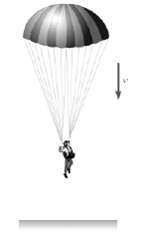
A parachutist is in free fall at a rate of 180 ft/s when he opens his parachute at an altitude of 1900 ft. Following a rapid and constant deceleration, he then descends at a constant rate of 44 ft/s from 1800 ft to 100 ft, where he maneuvers the parachute into the wind to further slow his descent.
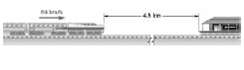
A commuter train traveling at 64 km/h is 4.8 km from a station. The train then decelerates so that its speed is 32 km/h when it is 800 m from the station. Knowing that the train arrives at the station 7.5 min after beginning to decelerate and assuming constant decelerations, determine (a) The time
Two road rally checkpoints A and B are located on the same highway and are 8 mi apart. The speed limits for the first 5 mi and the last 3 mi are 60 mi/h and 35 mi/h, respectively. Drivers must stop at each checkpoint, and the specified time between points A and B is 10 min 20 s. Knowing that a
In a water-tank test involving the launching of a small model boat, the model’s initial horizontal velocity is 20 ft/s and its horizontal acceleration varies linearly from − 40 ft/s2 at t = 0 to − 6 ft/s2 at t = t1 and then remains equal to −6 ft/s2 until t = 1.4 s. Knowing that
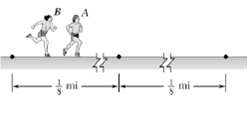
In a 1/4- mile race, runner A reaches her maximum velocity Av in 4 s with constant acceleration and maintains that velocity until she reaches the halfway point with a split time of 25 s. Runner B reaches her maximum velocity vB in 5 s with constant acceleration and maintains that velocity until she
A bus is parked along the side of a highway when it is passed by a truck traveling at a constant speed of 70 km/h. Two minutes later, the bus starts and accelerates until it reaches a speed of 100 km/h, which it then maintains. Knowing that 12 min after the truck passed the bus, the bus is 1.2 km
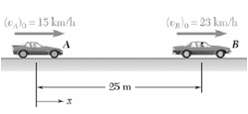
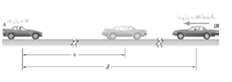
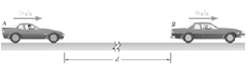
Cars A and B are d = 60 m apart and are traveling respectively at the constant speeds of (vA)0 = 32 km/h and (vB)0 = 24 km/h on an icecovered road. Knowing that 45 s after driver A applies his brakes to avoid overtaking car B the two cars collide, determine (a) The uniform deceleration of car
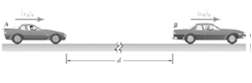
Cars A and B are traveling respectively at the constant speeds of (vA)0 = 22 mi/h and (vB)0 = 13 mi/h on an ice-covered road. To avoid overtaking car B, the driver of car A applies his brakes so that his car decelerates at a constant rate of 0.14 ft/s2. Determine the distance d between the cars at
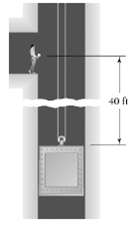
An elevator starts from rest and moves upward, accelerating at a rate of 4 ft/s2 until it reaches a speed of 24 ft/s, which it then maintains. Two seconds after the elevator begins to move, a man standing 40 ft above the initial position of the top of the elevator throws a ball upward with an
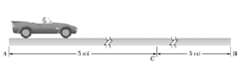
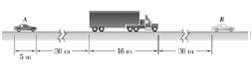
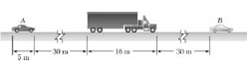
A car and a truck are both traveling at the constant speed of 54 km/h; the car is 30 m behind the truck. The driver of the car wants to pass the truck, that is, he wishes to place his car at B, 30 m in front of the truck, and then resume the speed of 54 km/h. The maximum acceleration of the car is
Solve Prob. 11.77, assuming that the driver of the car does not pay any attention to the speed limit while passing and concentrates on reaching position B and resuming a speed of 54 km/h in the shortest possible time. What is the maximum speed reached? Draw the v??tcurve.
During a manufacturing process, a conveyor belt starts from rest and travels a total of 0.36 m before temporarily coming to rest. Knowing that the jerk, or rate of change of acceleration, is limited to ±1.5 m/s2 per second, determine(a) The shortest time required for the belt to move 0.36 m,(b)
An airport shuttle train travels between two terminals that are 5 km apart. To maintain passenger comfort, the acceleration of the train is limited to ± 1.25 m/s2, and the jerk, or rate of change of acceleration, is limited to ± 0.25 m/s2 per second. If the shuttle has a maximum speed of 32 km/h,
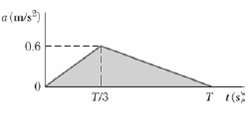
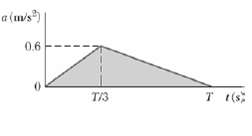
An elevator starts from rest and rises 40 m to its maximum velocity in T s with the acceleration record shown in the figure. Determine(a) The required time T,(b) The maximum velocity,(c) The velocity and position of the elevator at t =T/2.
An elevator starts from rest and rises 40 m to its maximum velocity in T s with the acceleration record shown in the figure. Determine(a) The required time T,(b) The maximum velocity,(c) The velocity and position of the elevator at t =T/2.
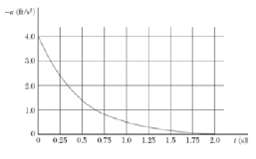
Two seconds are required to bring the piston rod of an air cylinder to rest; the acceleration record of the piston rod during the 2 s is as shown. Determine by approximate means (a) The initial velocity of the piston rod, (b) The distance traveled by the piston rod as it is brought torest.
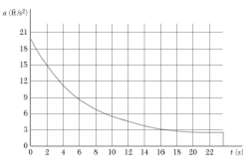
The acceleration record shown was obtained during the speed trials of a sports car. Knowing that the car starts from rest, determine by approximate means(a) The velocity of the car at t = 8 s,(b) The distance the car traveled at t = 20s.
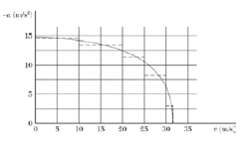
A training airplane has a velocity of 32 m/s when it lands on an aircraft carrier. As the arresting gear of the carrier brings the airplane to rest, the velocity and the acceleration of the airplane are recorded; the results are shown (solid curve) in the figure. Determine by approximate means(a)
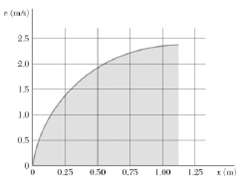
Shown in the figure is a portion of the experimentally determined v ?? x curve for a shuttle cart. Determine by approximate means the acceleration of the cart (a) When x = 0.25 m, (b) When v = 2 m/s.
Using the method of Sec. 11.8, derive the formula x = x0 + v0t + ½ at2 for the position coordinate of a particle in uniformly accelerated rectilinear motion.
Using the method of Sec. 11.8, determine the position of the particle of Prob. 11.63 when t = 12 s.
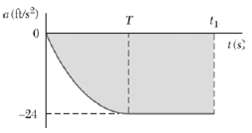
An automobile begins a braking test with a velocity of 90 ft/s at t = 0 and comes to a stop at t = t1 with the acceleration record shown. Knowing that the area under the a??tcurve from t = 0 to t = T is a semiparabolic area, use the method of Sec. 11.8 to determine the distance traveled by the
For the particle of Prob. 11.65, draw the a??t curve and, using the method of Sec. 11.8, determine(a) The position of the particle when t = 20 s,(b) The maximum value of its positioncoordinate.
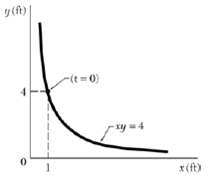
The motion of a particle is defined by the equations x = (t + 1)2 and y = 4(t + 1)?2, where x and y are expressed in meters and t in seconds. Show that the path of the particle is part of the rectangular hyperbola shown and determine the velocity and acceleration when(a) t = 0,(b) t = ? s.
The motion of a particle is defined by the equations s x = 6 − 0.8t (t2 − 9t +18) and y = − 4 + 0.6t (t2 − 9t + 18), where x and y are expressed in meters and t is expressed in seconds. Show that the path of the particle is a portion of a straight line, and determine the
For the particle of Prob. 11.65, draw the a??t curve and, using the method of Sec. 11.8, determine(a) The position of the particle when t = 20 s,(b) The maximum value of its positioncoordinate.
The motion of a particle is defined by the equations x = 6t − 3 sin t and y = 6 – 3 cos t, where x and y are expressed in meters and t is expressed in seconds. Sketch the path of the particle for the time interval 0 ≤ t ≤ 2π, and determine(a) The magnitudes of the smallest and largest
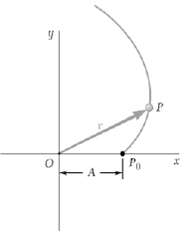
The motion of a particle is defined by the position vector r = A (cos t + t sin t)i + A(sin t ?? t cos t) j, where t is expressed in seconds. Determine the values of t for which the position vector and the acceleration vector are (a) Perpendicular, (b)Parallel.
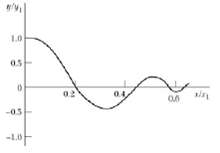
The damped motion of a vibrating particle is defined by the position vector r = x1 [1??1/(t+1)]I + (y1e??πt/2 cos2πt)j, where t is expressed in seconds. For x1 = 30 in. and y1 = 20 in., determine the position, the velocity, and the acceleration of the particle when (a) t = 0, (b) t = 1.5 s.
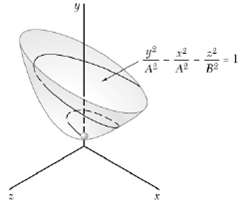
The three-dimensional motion of a particle is defined by the position vector r = (Rt cos ωnt)i + ct j + (Rt sin ωnt)k. Determine the magnitudes of the velocity and acceleration of the particle. (The space curve described by the particle is a conic helix).
(a) The magnitudes of the velocity and acceleration when t = 0,(b) The smallest nonzero value of t for which the position vector and the velocity vector are perpendicular to eachother.
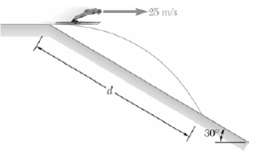
A ski jumper starts with a horizontal take-off velocity of 25 m/s and lands on a straight landing hill inclined at 30o. Determine(a) The time between take-off and landing,(b) The length d of the jump,(c) The maximum vertical distance between the jumper and the landinghill.
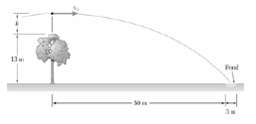
A golfer aims his shot to clear the top of a tree by a distance h at the peak of the trajectory and to miss the pond on the opposite side. Knowing that the magnitude of v0 is 30 m/s, determine the range of values of h which must beavoided.
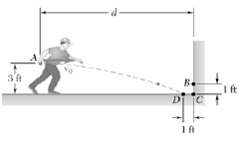
A handball player throws a ball from A with a horizontal velocity v0. Knowing that d = 15 ft, determine(a) The value of v0 for which the ball will strike the corner C,(b) The range of values of v0 for which the ball will strike the corner regionBCD.
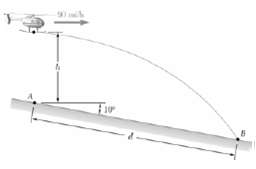
A helicopter is flying with a constant horizontal velocity of 90 mi/h and is directly above point A when a loose part begins to fall. The part lands 6.5 s later at point B on an inclined surface. Determine(a) The distance d between points A and B,(b) The initial heighth.
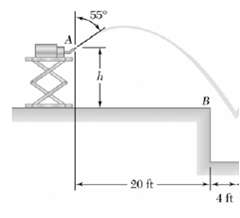
A pump is located near the edge of the horizontal platform shown. The nozzle at A discharges water with an initial velocity of 25 ft/s at an angle of 55? with the vertical. Determine the range of values of the height h for which the water enters the openingBC.
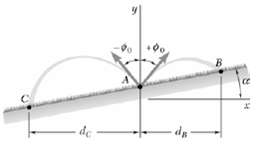
An oscillating water sprinkler is operated at point A on an incline that forms an angle ? with the horizontal. The sprinkler discharges water with an initial velocity v0 at an angle ? with the vertical which varies from ?? ?0 to + ?0. Knowing that v0 = 24 ft/s, ?0 = 40?, ? = 10?, determine the
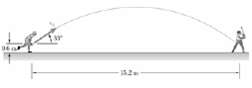
In slow pitch softball the underhand pitch must reach a maximum height of between 1.8 m and 3.7 m above the ground. A pitch is made with an initial velocity v0 of magnitude 13 m/s at an angle of 33? with the horizontal. Determine(a) If the pitch meets the maximum height requirement,(b) The height
Showing 10500 - 10600
of 18200
First
99
100
101
102
103
104
105
106
107
108
109
110
111
112
113
Last
Step by Step Answers

 Get 50% OFF
Claim Now
Get 50% OFF
Claim Now