New Semester
Started
Get
50% OFF
Study Help!
--h --m --s
Claim Now
Question Answers
Textbooks
Find textbooks, questions and answers
Oops, something went wrong!
Change your search query and then try again
S
Books
FREE
Study Help
Expert Questions
Accounting
General Management
Mathematics
Finance
Organizational Behaviour
Law
Physics
Operating System
Management Leadership
Sociology
Programming
Marketing
Database
Computer Network
Economics
Textbooks Solutions
Accounting
Managerial Accounting
Management Leadership
Cost Accounting
Statistics
Business Law
Corporate Finance
Finance
Economics
Auditing
Tutors
Online Tutors
Find a Tutor
Hire a Tutor
Become a Tutor
AI Tutor
AI Study Planner
NEW
Sell Books
Search
Search
Sign In
Register
study help
mathematics
numerical analysis
Numerical Analysis 9th edition Richard L. Burden, J. Douglas Faires - Solutions
Suppose that N (h) is an approximation to M for every h > 0 and that M = N(h) + K1h + K2h2 + K3h3 +· · · , For some constants K1, K2, K3 . . . Use the values N (h), N (h/3) and N (h/9) to produce an O (h3) approximation to M.
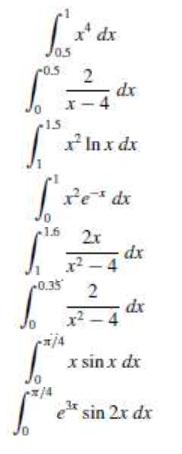
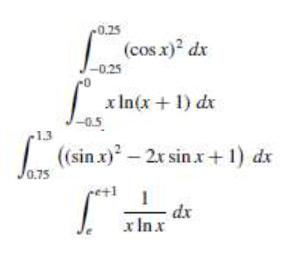
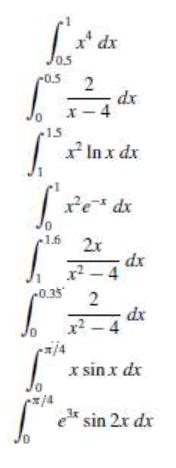
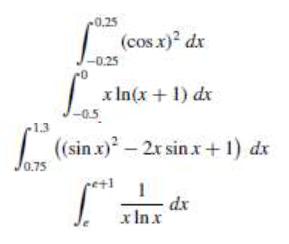
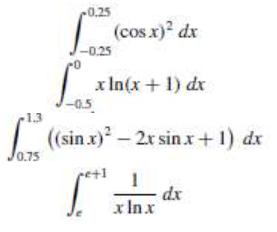
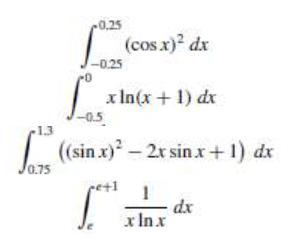
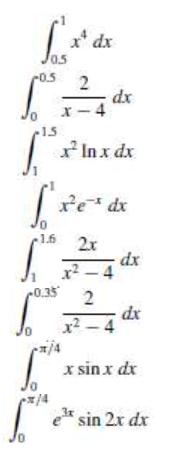
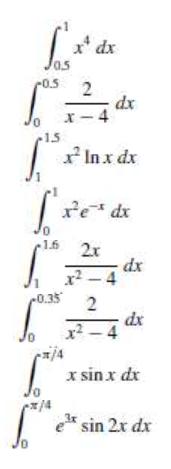
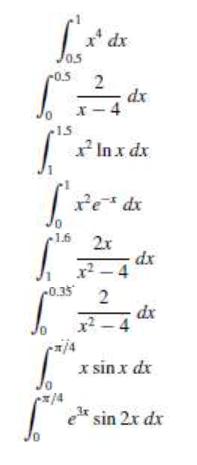
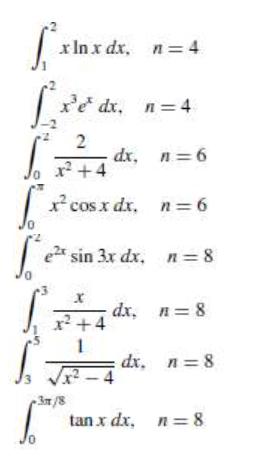
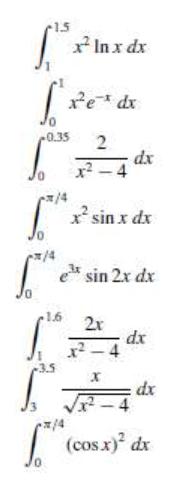
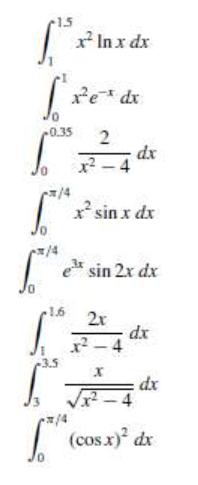
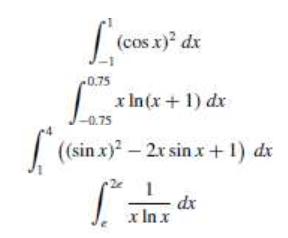
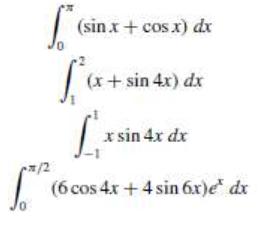
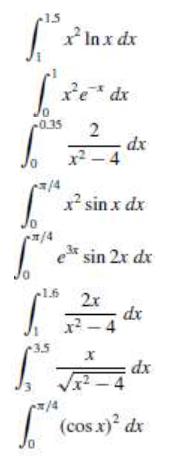
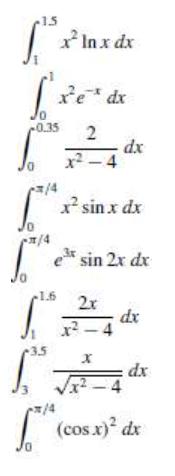
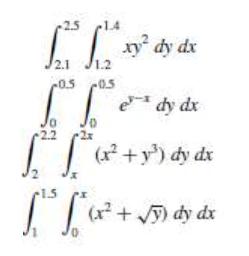
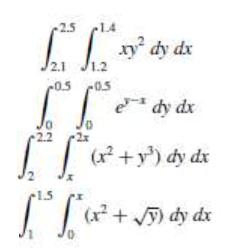
Approximate the following integrals using the Trapezoidal rule.
Repeat Exercise 2 using the Midpoint rule.In Exercise 2
Repeat Exercise 3 using the Midpoint rule and the results of Exercise 9.In Exercise 1
Repeat Exercise 4 using the Midpoint rule and the results of Exercise 10.In Exercise 2
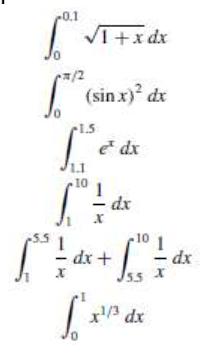
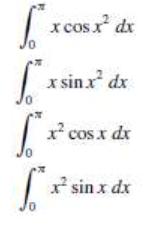
Approximate the following integrals using the Trapezoidal rule.
Approximate the following integrals using formulas (4.25) through (4.32). Are the accuracies of the approximations consistent with the error formulas? Which of parts (d) and (e) give the better approximation?
Given the function f at the following values,ApproximateUsing all the appropriate quadrature formulas of this section
Suppose that the data of Exercise 22 have round-off errors given by the following table.Calculate the errors due to round-off in Exercise 22.
Derive Simpson's rule with error term by usingFind a0, a1, and a2 from the fact that Simpson's rule is exact for f (x) = xn when n = 1, 2, and 3. Then find k by applying the integration formula with f (x) = x4.
Prove the statement following Definition 4.1; that is, show that a quadrature formula has degree of precision n if and only if the error E(P(x)) = 0 for all polynomials P(x) of degree k = 0, 1, . . . , n, but E(P(x)) ≠ 0 for some polynomial P(x) of degree n + 1.
Derive Simpson's three-eighths rule (the closed rule with n = 3) with error term by using Theorem 4.2.
Find a bound for the error in Exercise 1 using the error formula, and compare this to the actual error.In Exercise 1
Find a bound for the error in Exercise 2 using the error formula, and compare this to the actual error.In Exercise 2
Repeat Exercise 1 using Simpson's rule.In Exercise 1
Repeat Exercise 2 using Simpson's rule.In Exercise 2
Repeat Exercise 3 using Simpson's rule and the results of Exercise 5.In Exercise 3
Repeat Exercise 4 using Simpson's rule and the results of Exercise 6.In Exercise 4
Repeat Exercise 1 using the Midpoint rule.In Exercise 1
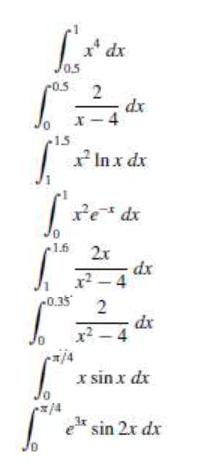
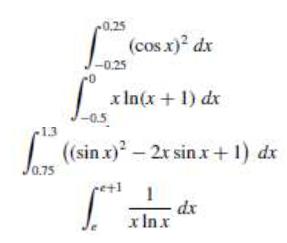
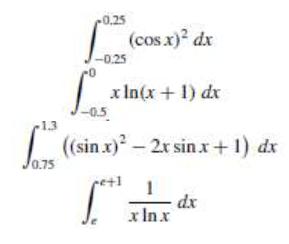
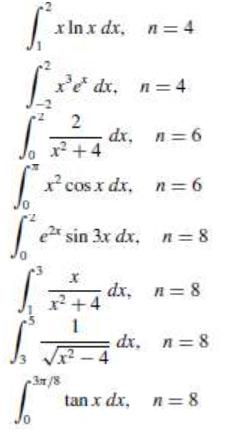
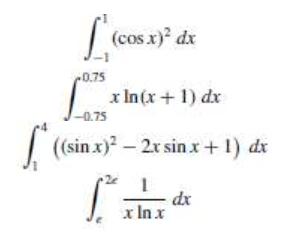
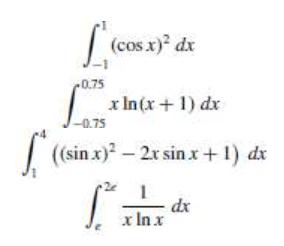
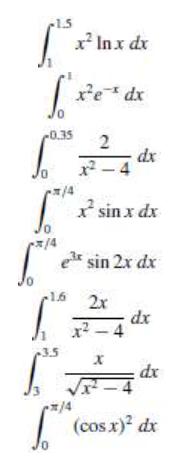
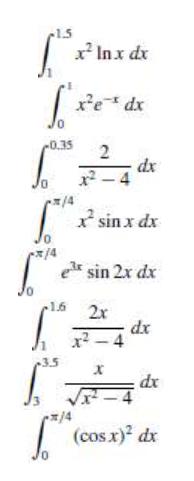
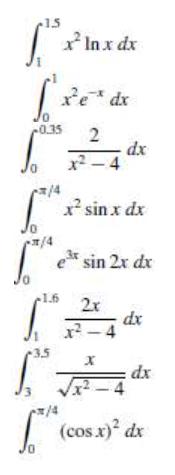
Use the Composite Trapezoidal rule with the indicated values of n to approximate the following integrals.
Determine the values of n and h required to approximateTo within 10ˆ’4 Usea. Composite Trapezoidal rule.b. Composite Simpson's rule.c. Composite Midpoint rule.
Repeat Exercise 11 for the integralIn Exercise 11Determine the values of n and h required to approximateTo within 10ˆ’4 Usea. Composite Trapezoidal rule.b. Composite Simpson's rule.c. Composite Midpoint rule.
Determine the values of n and h required to approximateTo within 10ˆ’5 and compute the approximation. Usea. Composite Trapezoidal rule.b. Composite Simpson's rule.c. Composite Midpoint rule.
Repeat Exercise 13 for the integralIn Exercise 13Determine the values of n and h required to approximateTo within 10ˆ’5 and compute the approximation. Usea. Composite Trapezoidal rule.b. Composite Simpson's rule.c. Composite Midpoint rule.
Let f be defined bya. Investigate the continuity of the derivatives of f .b. Use the Composite Trapezoidal rule with n = 6 to approximateand estimate the error using the error bound.c. Use the Composite Simpson's rule with n = 6 to approximateAre the results more accurate than in part (b)?
Show that the error E(f ) for Composite Simpson's rule can be approximated by − h4/180 [f''' (b) − f'''(a)].
a. Derive an estimate for E(f ) in the Composite Trapezoidal rule using the method in Exercise 16. b. Repeat part (a) for the Composite Midpoint rule.
Use the error estimates of Exercises 16 and 17 to estimate the errors in Exercise 12.
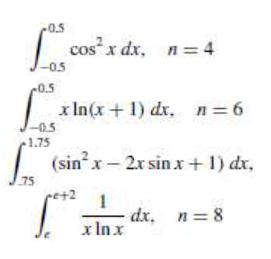
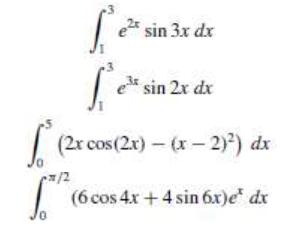
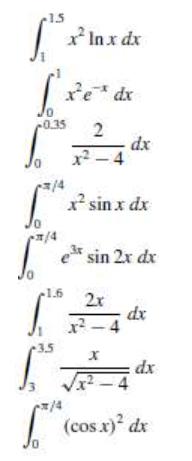
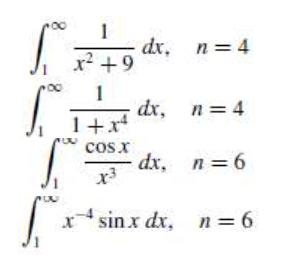
Use the Composite Trapezoidal rule with the indicated values of n to approximate the following integrals.
The equationCan be solved for x by using Newton's method withAndTo evaluate f at the approximation pk , we need a quadrature formula to approximate
Use the Composite Simpson's rule to approximate the integrals in Exercise 2.In Exercise 2
Use the Composite Midpoint rule with n + 2 subintervals to approximate the integrals.In Exercise 1
Use the Composite Midpoint rule with n + 2 subintervals to approximate the integralsIn Exercise 2
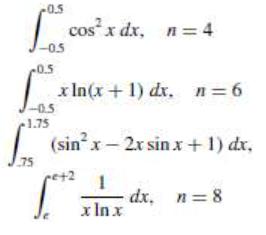
ApproximateUsing h = 0.25. Usea. Composite Trapezoidal rule.b. Composite Simpson's rule.c. Composite Midpoint rule.
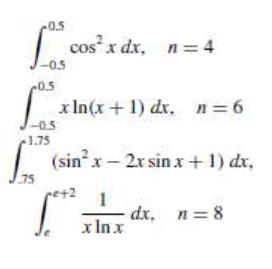
ApproximateUsing h = 0.25. Usea. Composite Trapezoidal rule.b. Composite Simpson's rule.c. Composite Midpoint rule.
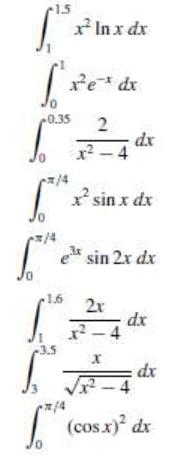
Use Romberg integration to compute R3,3 for the following integrals.
Use Romberg integration to compute the following approximations toa. Determine R1,1, R2,1, R3,1, R4,1, and R5,1, and use these approximations to predict the value of the integral.b. Determine R2,2, R3,3, R4,4, and R5,5, and modify your prediction.c. Determine R6,1, R6,2, R6,3, R6,4, R6,5, and R6,6,
Show that the approximation obtained from Rk,2 is the same as that given by the Composite Simpson's rule described in Theorem 4.4 with h = hk .
Show that, for any k,
Use the result of Exercise 14 to verify Eq. (4.34); that is, show that for all k,
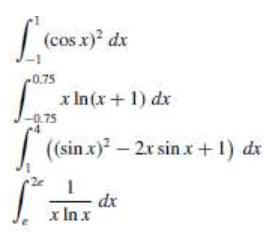
Use Romberg integration to compute R3,3 for the following integrals.
Calculate R4,4 for the integrals in Exercise 1.In Exercise 1
Calculate R4,4 for the integrals in Exercise 2.In Exercise 2
Calculate R4,4 for the integrals in Exercise 2.In Exercise 2Discuss.
Use Romberg integration to approximate the integrals in Exercise 1 to within 10ˆ’6. Compute the Romberg table until either |Rnˆ’1,nˆ’1 ˆ’ Rn,n| In Exercise 1
Use Romberg integration to approximate the integrals in Exercise 2 to within 10ˆ’6. Compute the Romberg table until either |Rnˆ’1,nˆ’1 ˆ’ Rn,n| In Exercise 2
Compute the Simpson's rule approximations S(a, b), S(a, (a + b)/2), and S((a + b)/2, b) for the following integrals, and verify the estimate given in the approximation formula.
The study of light diffraction at a rectangular aperture involves the Fresnel integralsConstruct a table of values for c (t) and s(t) that is accurate to within 10ˆ’4 for values of t = 0.1, 0.2 . . . . 1.0.
Use Adaptive quadrature to find approximations to within 10ˆ’3 for the integrals in Exercise 1. Do not use a computer program to generate these results.
Use Adaptive quadrature to approximate the following integrals to within 10ˆ’5.
Use Adaptive quadrature to approximate the following integrals to within 10ˆ’5.
Use Simpson's Composite rule with n = 4, 6, 8. . . until successive approximations to the following integrals agree to within 10ˆ’6. Determine the number of nodes required. Use the Adaptive Quadrature Algorithm to approximate the integral to within 10ˆ’6, and count the number of nodes. Did
Sketch the graphs of sin(1/x) and cos(1/x) on [0.1, 2]. Use Adaptive quadrature to approximate the following integrals to within 10ˆ’3.and
Let T(a, b) and T(a, a+b/2 ) + T( a+b/2 , b) be the single and double applications of the Trapezoidal rule toDerive the relationship betweenAnd
Approximate the following integrals using Gaussian quadrature with n = 2, and compare your results to the exact values of the integrals.
Approximate the following integrals using Gaussian quadrature with n = 3, and compare your results to the exact values of the integrals.
Approximate the following integrals using Gaussian quadrature with n = 4, and compare your results to the exact values of the integrals.
Approximate the following integrals using Gaussian quadrature with n = 5, and compare your results to the exact values of the integrals.
Verify the entries for the values of n = 2 and 3 in Table 4.12 on page 232 by finding the roots of the respective Legendre polynomials, and use the equations preceding this table to find the coefficients associated with the values.In Table 4.12
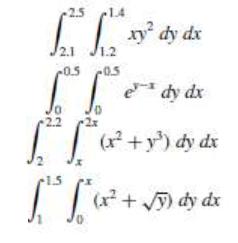
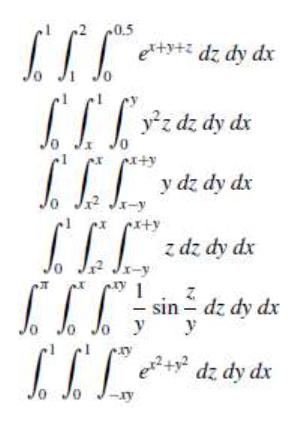
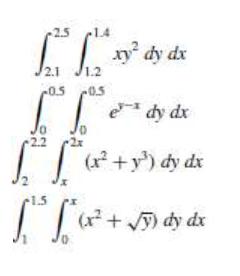
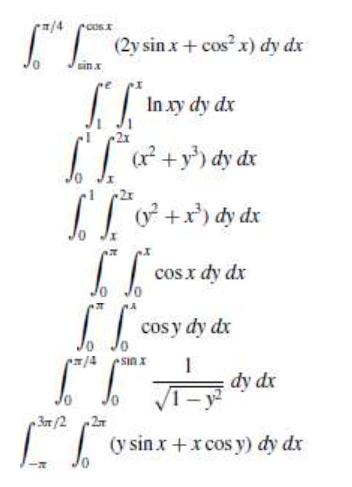
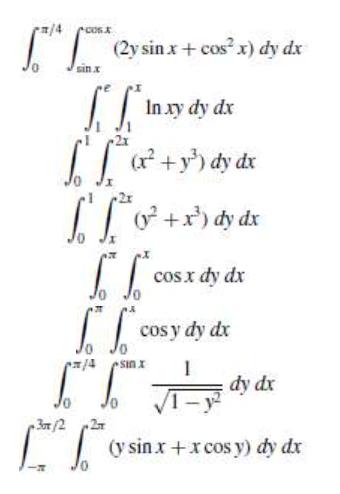
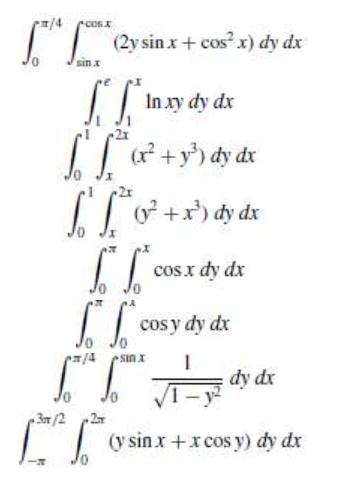
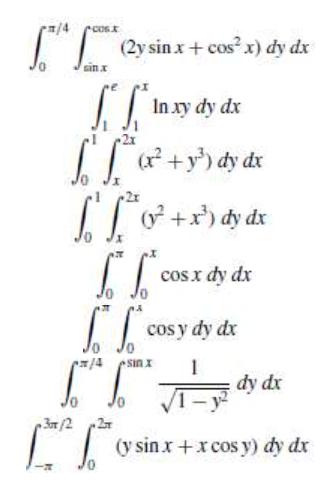
Use Algorithm 4.4 with n = m = 4 to approximate the following double integrals, and compare the results to the exact answers.
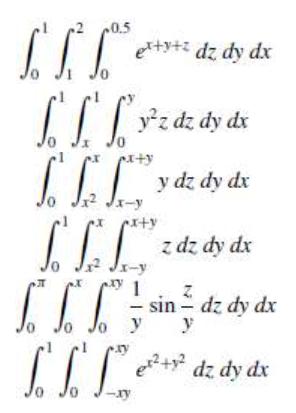
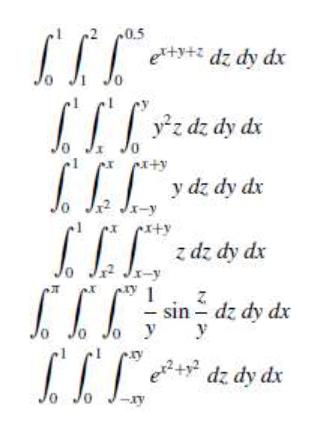
Use Algorithm 4.6 with n = m = p = 2 to approximate the following triple integrals, and compare the results to the exact answers.
Repeat Exercise 15 using n = m = p = 3.In Exercise 15
Repeat Exercise 15 using n = m = p = 4 and n = m = p = 5.In Exercise 15
Find the smallest values for n = m so that Algorithm 4.4 can be used to approximate the integrals in Exercise 1 to within 10ˆ’6 of the actual value.In Exercise 1
Use Algorithm 4.4 with (i) n = 4, m = 8, (ii) n = 8, m = 4, and (iii) n = m = 6 to approximate the following double integrals, and compare the results to the exact answers.
Find the smallest values for n = m so that Algorithm 4.4 can be used to approximate the integrals in Exercise 3 to within 10ˆ’6 of the actual value.In Exercise 3
Use Algorithm 4.5 with n = m = 2 to approximate the integrals in Exercise 1, and compare the results to those obtained in Exercise 1.In Exercise 1
Find the smallest values of n = m so that Algorithm 4.5 can be used to approximate the integrals in Exercise 1 to within 10ˆ’6. Do not continue beyond n = m = 5. Compare the number of functional evaluations required to the number required in Exercise 2.In Exercise 2
Use Algorithm 4.5 with (i) n = m = 3, (ii) n = 3, m = 4, (iii) n = 4, m = 3, and (iv) n = m = 4 to approximate the integrals in Exercise 3.In Exercise 3
Use Algorithm 4.5 with n = m = 5 to approximate the integrals in Exercise 3. Compare the number of functional evaluations required to the number required in Exercise 4.In Exercise 3
Use the transformation t = xˆ’1 and then the Composite Simpson's rule and the given values of n to approximate the following improper integrals.
The Laguerre polynomials {L0(x), L1(x) . . .} form an orthogonal set on [0,ˆž) and satisfyFor i ‰ j. The polynomial Ln(x) has n distinct zeros x1, x2, . . . , xn in [0,ˆž). LetShow that the quadrature formula
The Laguerre polynomials L0(x) = 1, L1(x) = 1 ˆ’ x, L2(x) = x2 ˆ’ 4x + 2, and L3(x) = ˆ’x3 + 9x2 ˆ’ 18x + 6 are derived in Exercise 11 of Section 8.2. As shown in Exercise 6, these polynomials are useful in approximating integrals of the forma. Derive the quadrature formula using n = 2
Use Theorem 5.4 to show that each of the following initial-value problems has a unique solution, and find the solution.a. y' = y cos t, 0≤ t ≤ 1, y(0) = 1.b. y' = 2/t y + t2et, 1≤ t ≤ 2, y(1) = 0.c. y' = −2/t y + t2et, 1≤ t ≤ 2, y(1) =√2e.d. y' = (4t3y)/(1 + t4), 0≤ t ≤ 1, y(0)
Show that each of the following initial-value problems has a unique solution and find the solution. Can Theorem 5.4 be applied in each case?a. y' = et−y, 0≤ t ≤ 1, y(0) = 1.b. y' = t−2(sin 2t − 2ty), 1≤ t ≤ 2, y(1) = 2.c. y' = −y + ty1/2, 2≤ t ≤ 3, y(2) = 2.d. y' = (ty + y)/(ty
For each choice of f (t, y) given in parts (a)-(d): i. Does f satisfy a Lipschitz condition on D = {(t, y) | 0 ≤ t ≤ 1, −∞ < y < ∞}? ii. Can Theorem 5.6 be used to show that the initial-value problem y' = f (t, y), 0≤ t ≤ 1, y(0) = 1, is well-posed? a. f (t, y) = t2y + 1 b. f (t, y)
For each choice of f (t, y) given in parts (a)-(d): i. Does f satisfy a Lipschitz condition on D = {(t, y) | 0 ≤ t ≤ 1, −∞ < y < ∞}? ii. Can Theorem 5.6 be used to show that the initial-value problem y' = f (t, y), 0≤ t ≤ 1, y(0) = 1, is well-posed? a. f (t, y) = et−y b. f (t, y) =
For the following initial-value problems, show that the given equation implicitly defines a solution. Approximate y(2) using Newton's method. a. y' = − y3 + y/((3y2 + 1)t) , 1≤ t ≤ 2, y(1) = 1; y3t + yt = 2 b. y' = − (y cos t + 2tey)/(sin t + t2ey + 2) , 1≤ t ≤ 2, y(1) = 0; y sin t +
Prove Theorem 5.3 by applying the Mean Value Theorem 1,8 to f (t, y), holding t fixed.
Show that, for any constants a and b, the set D = {(t, y) | a ≤ t ≤ b, −∞ < y < ∞} is convex.
Suppose the perturbation δ(t) is proportional to t, that is, δ(t) = δt for some constant δ. Show directly that the following initial-value problems are well-posed. a. y' = 1 − y, 0≤ t ≤ 2, y(0) = 0 b. y' = t + y, 0≤ t ≤ 2, y(0) = −1 c. y' = 2/t y + t2et, 1≤ t ≤ 2, y(1) = 0 d. y'
Picard's method for solving the initial-value problemy' = f (t, y), a ‰¤ t ‰¤ b, y(a) = α,is described as follows: Let y0(t) = α for each t in [a, b]. Define a sequence {yk(t)} of functionsa. Integrate y' = f (t, y(t)), and use the initial condition to derive Picard's method.b. Generate
To prove Theorem 5.20, part (i), show that the hypotheses imply that there exists a constant K > 0 such that |ui − vi| ≤ K|u0 − v0|, for each 1 ≤ i ≤ N, whenever {ui}Ni =1 and {vi}Ni=1 satisfy the difference equation wi+1 = wi + h((ti ,wi , h).
For the Adams-Bashforth and Adams-Moulton methods of order four,a. Show that if f = 0, thenF(ti , h,wi+1, . . . ,wi+1ˆ’m) = 0.b. Show that if f satisfies a Lipschitz condition with constant L, then a constant C exists with
Use the results of Exercise 32 in Section 5.4 to show that the Runge-Kutta method of order four is consistent. In Exercise 32 The Runge-Kutta method of order four can be written in the form w0 = α, wi+1 = wi + h/6 f (ti ,wi) + h/3 f (ti + α1h,wi + δ1hf (ti ,wi)) + h/3 f (ti + α2h,wi + δ2hf (ti
Consider the differential equationy' = f (t, y), a ‰¤ t ‰¤ b, y(a) = α.a. Show thatfor some ξ , where ti b. Part (a) suggests the difference methodwi+2 = 4wi+1 ˆ’ 3wi ˆ’ 2hf (ti ,wi), for i = 0, 1, . . . , N ˆ’ 2.Use this method to solvey' = 1 ˆ’ y, 0‰¤ t ‰¤ 1, y(0) =
Given the multistep methodwi+1 = −3/2 wi + 3wi−1 - 1/2 wi−2 + 3hf (ti ,wi), for i = 2, . . . , N − 1,with starting values w0, w1, w2:a. Find the local truncation error.b. Comment on consistency, stability, and convergence.
Solve the following stiff initial-value problems using Euler's method, and compare the results with the actual solution. a. y' = −9y, 0≤ t ≤ 1, y(0) = e, with h = 0.1; actual solution y(t) = e1−9t . b. y' = −20(y−t2)+2t, 0≤ t ≤ 1, y(0) = 1/3 , with h = 0.1; actual solution y(t) =
Show that the fourth-order Runge-Kutta method, k1 = hf (ti ,wi), k2 = hf (ti + h/2,wi + k1/2), k3 = hf (ti + h/2,wi + k2/2), k4 = hf (ti + h,wi + k3), wi+1 = wi + 1/6 (k1 + 2k2 + 2k3 + k4), when applied to the differential equation y' = λy, can be written in the form wi+1 = (1 + hλ + 1/2 (hλ)2 +
Discuss consistency, stability, and convergence for the Implicit Trapezoidal method wi+1 = wi + h/2 (f (ti+1,wi+1) + f (ti ,wi)) , for i = 0, 1, . . . , N − 1, With w0 = α applied to the differential equation y' = f (t, y), a ≤ t ≤ b, y(a) = α.
The Backward Euler one-step method is defined by wi+1 = wi + hf (ti+1,wi+1), for i = 0, . . . , N − 1. Show that Q(hλ) = 1/(1 − hλ) for the Backward Euler method.
Apply the Backward Euler method to the differential equations given in Exercise 1. Use Newton’s method to solve for wi+1.In Exercise 1a. y' = −9y, 0≤ t ≤ 1, y(0) = e, with h = 0.1; actual solution y(t) = e1−9t .b. y' = −20(y−t2)+2t, 0≤ t ≤ 1, y(0) = 1/3 , with h = 0.1; actual
Apply the Backward Euler method to the differential equations given in Exercise 2. Use Newton’s method to solve for wi+1.In Exercise 2a. y' = −5y + 6et, 0≤ t ≤ 1, y(0) = 2, with h = 0.1; actual solution y(t) = e−5t + et .b. y' = −10y+10t+1, 0 ≤ t ≤ 1, y(0) = e, with h = 0.1; actual
a. Show that the Implicit Trapezoidal method is A-stable. b. Show that the Backward Euler method described in Exercise 12 is A-stable.
Solve the following stiff initial-value problems using Euler's method, and compare the results with the actual solution. a. y' = −5y + 6et, 0≤ t ≤ 1, y(0) = 2, with h = 0.1; actual solution y(t) = e−5t + et . b. y' = −10y+10t+1, 0 ≤ t ≤ 1, y(0) = e, with h = 0.1; actual solution y(t)
Repeat Exercise 1 using the Runge-Kutta fourth-order method.In Exercise 1a. y' = −9y, 0≤ t ≤ 1, y(0) = e, with h = 0.1; actual solution y(t) = e1−9t .b. y' = −20(y−t2)+2t, 0≤ t ≤ 1, y(0) = 1/3 , with h = 0.1; actual solution y(t) = t2+1/3 e−20t .c. y' = −20y + 20 sin t + cos t,
Repeat Exercise 2 using the Runge-Kutta fourth-order method.In Exercise 2a. y' = −5y + 6et, 0≤ t ≤ 1, y(0) = 2, with h = 0.1; actual solution y(t) = e−5t + et .b. y' = −10y+10t+1, 0 ≤ t ≤ 1, y(0) = e, with h = 0.1; actual solution y(t) = e−10t+1+t.c. y' = −15(y − t−3) −
Repeat Exercise 1 using the Adams fourth-order predictor-corrector method.In Exercise 1a. y' = −9y, 0≤ t ≤ 1, y(0) = e, with h = 0.1; actual solution y(t) = e1−9t .b. y' = −20(y−t2)+2t, 0≤ t ≤ 1, y(0) = 1/3 , with h = 0.1; actual solution y(t) = t2+1/3 e−20t .c. y' = −20y + 20
Repeat Exercise 2 using the Adams fourth-order predictor-corrector method.In Exercise 2a. y' = −5y + 6et, 0≤ t ≤ 1, y(0) = 2, with h = 0.1; actual solution y(t) = e−5t + et .b. y' = −10y+10t+1, 0 ≤ t ≤ 1, y(0) = e, with h = 0.1; actual solution y(t) = e−10t+1+t.c. y' = −15(y −
Repeat Exercise 1 using the Trapezoidal Algorithm with TOL = 10−5.In Exercise 1a. y' = −9y, 0≤ t ≤ 1, y(0) = e, with h = 0.1; actual solution y(t) = e1−9t .b. y' = −20(y−t2)+2t, 0≤ t ≤ 1, y(0) = 1/3 , with h = 0.1; actual solution y(t) = t2+1/3 e−20t .c. y' = −20y + 20 sin t +
Showing 1100 - 1200
of 3402
First
5
6
7
8
9
10
11
12
13
14
15
16
17
18
19
Last
Step by Step Answers

 Get 50% OFF
Claim Now
Get 50% OFF
Claim Now


-1.png)
-2.png)
.png)
.png)
.png)
-1.png)
-2.png)
.png)
-1.png)
-2.png)
-1.png)
-2.png)
-3.png)
-1.png)
-2.png)
-3.png)
.png)
.png)
.png)
.png)
.png)
.png)
![Sketch the graphs of sin(1/x) and cos(1/x) on [0.1, 2].](https://dsd5zvtm8ll6.cloudfront.net/si.question.images/image/images10/731-M-N-A-N-L-A(446)-1.png)
![Sketch the graphs of sin(1/x) and cos(1/x) on [0.1, 2].](https://dsd5zvtm8ll6.cloudfront.net/si.question.images/image/images10/731-M-N-A-N-L-A(446)-2.png)
-1.png)
-2.png)
-3.png)
.png)
-1.png)
-2.png)
-3.png)
.png)
.png)
.png)
.png)


