New Semester
Started
Get
50% OFF
Study Help!
--h --m --s
Claim Now
Question Answers
Textbooks
Find textbooks, questions and answers
Oops, something went wrong!
Change your search query and then try again
S
Books
FREE
Study Help
Expert Questions
Accounting
General Management
Mathematics
Finance
Organizational Behaviour
Law
Physics
Operating System
Management Leadership
Sociology
Programming
Marketing
Database
Computer Network
Economics
Textbooks Solutions
Accounting
Managerial Accounting
Management Leadership
Cost Accounting
Statistics
Business Law
Corporate Finance
Finance
Economics
Auditing
Tutors
Online Tutors
Find a Tutor
Hire a Tutor
Become a Tutor
AI Tutor
AI Study Planner
NEW
Sell Books
Search
Search
Sign In
Register
study help
mathematics
numerical analysis
Numerical Analysis 9th edition Richard L. Burden, J. Douglas Faires - Solutions
Use the Gauss-Jordan method and two-digit rounding arithmetic to solve the systems in Exercise 3. In Exercise 3 a. 4x1 − x2 + x3 = 8, 2x1 + 5x2 + 2x3 = 3, x1 + 2x2 + 4x3 = 11. b. 4x1 + x2 + 2x3 = 9, 2x1 + 4x2 − x3 = −5, x1 + x2 − 3x3 = −9.
Repeat Exercise 7 using the Gauss-Jordan method. In Exercise 7 a. 1/4 x1 + 1/5 x2 + 1/6 x3 = 9, 1/3 x1 + 1/4 x2 + 1/5 x3 = 8, 1/2 x1 + x2 + 2x3 = 8 b. 3.333x1 + 15920x2 − 10.333x3 = 15913, 2.222x1 + 16.71x2 + 9.612x3 = 28.544, 1.5611x1 + 5.1791x2 + 1.6852x3 = 8.4254. c. x1 + 1/2 x2 + 1/3 x3 + 1/4
a. Show that the Gauss-Jordan method requires n3/2 + n2 - n/2 multiplications/divisions and n3/2 - n/2 additions/subtractions. b. Make a table comparing the required operations for the Gauss-Jordan and Gaussian elimination
Consider the following Gaussian-elimination-Gauss-Jordan hybrid method for solving the system (6.4). First, apply the Gaussian-elimination technique to reduce the system to triangular form. Then use the nth equation to eliminate the coefficients of xn in each of the first n − 1 rows. After this
Use the hybrid method described in Exercise 16 and two-digit rounding arithmetic to solve the systems in Exercise 3. In Exercise 3 a. 4x1 − x2 + x3 = 8, 2x1 + 5x2 + 2x3 = 3, x1 + 2x2 + 4x3 = 11. b. 4x1 + x2 + 2x3 = 9, 2x1 + 4x2 − x3 = −5, x1 + x2 − 3x3 = −9.
Repeat Exercise 7 using the method described in Exercise 16. In Exercise 7 a. 1/4 x1 + 1/5 x2 + 1/6 x3 = 9, 1/3 x1 + 1/4 x2 + 1/5 x3 = 8, 1/2 x1 + x2 + 2x3 = 8 b. 3.333x1 + 15920x2 − 10.333x3 = 15913, 2.222x1 + 16.71x2 + 9.612x3 = 28.544, 1.5611x1 + 5.1791x2 + 1.6852x3 = 8.4254. c. x1 + 1/2 x2 +
Suppose that in a biological system there are n species of animals and m sources of food. Let xj represent the population of the jth species, for each j = 1, · · · , n; bi represent the available daily supply of the ith food; and aij represent the amount of the ith food consumed on the average
For each of the following linear systems, obtain a solution by graphical methods, if possible. Explain the results from a geometrical standpoint. a. x1 + 2x2 = 0, x1 − x2 = 0. b. x1 + 2x2 = 3, −2x1 − 4x2 = 6 c. 2x1 + x2 = −1, x1 + x2 = 2, x1 − 3x2 = 5. d. 2x1 + x2 + x3 = 1, 2x1 + 4x2 −
A Fredholm integral equation of the second kind is an equation of the formWhere a and b and the functions f and K are given. To approximate the function u on the interval [a, b], a partition x0 = a Are solved for u(x0), u(x1), · · · , u(xm). The integrals are approximated using quadrature
Use Gaussian elimination with backward substitution and two-digit rounding arithmetic to solve the following linear systems. Do not reorder the equations. (The exact solution to each system is x1 = 1, x2 = −1, x3 = 3.) a. 4x1 − x2 + x3 = 8, 2x1 + 5x2 + 2x3 = 3, x1 + 2x2 + 4x3 = 11. b. 4x1 + x2
Use Gaussian elimination with backward substitution and two-digit rounding arithmetic to solve the following linear systems. Do not reorder the equations. (The exact solution to each system is x1 = −1, x2 = 1, x3 = 3.) a. −x1 + 4x2 + x3 = 8, 5/3 x1 + 2/3 x2 + 2/3 x3 = 1, 2x1 + x2 + 4x3 = 11 b.
Use the Gaussian Elimination Algorithm to solve the following linear systems, if possible, and determine whether row interchanges are necessary: a. x1 − x2 + 3x3 = 2, 3x1 − 3x2 + x3 = −1, x1 + x2 = 3. b. 2x1 − 1.5x2 + 3x3 = 1, −x1 + 2x3 = 3, 4x1 − 4.5x2 + 5x3 = 1 c. 2x1 = 3, x1 + 1.5x2
Use the Gaussian Elimination Algorithm to solve the following linear systems, if possible, and determine whether row interchanges are necessary: a. x2 − 2x3 = 4, x1−x2 + x3 = 6, x1 − x3 = 2. b. x1 − 1 2 x2 + x3 = 4, 2x1 − x2 − x3 + x4 = 5, x1 + x2 + 1 2 x3 = 2, x1 − 1 2 x2 + x3 + x4 =
Use Algorithm 6.1 and Maple with Digits:= 10 to solve the following linear systems. a. 1/4 x1 + 1/5 x2 + 1/6 x3 = 9, 1/3 x1 + 1/4 x2 + 1/5 x3 = 8, 1/2 x1 + x2 + 2x3 = 8 b. 3.333x1 + 15920x2 − 10.333x3 = 15913, 2.222x1 + 16.71x2 + 9.612x3 = 28.544, 1.5611x1 + 5.1791x2 + 1.6852x3 = 8.4254. c. x1 +
Use Algorithm 6.1 and Maple with Digits: = 10 to solve the following linear systems.a. 12 x1 + 1/4 x2 - 1/8 x3 = 0,1/3 x1 - 1/6 x2 + 1/9 x3 = 1,1/7 x1 + 1/7 x2 + 1/10 x3 = 2b. 2.71x1 + x2 + 1032x3 = 12,4.12x1 − x2 + 500x3 = 11.49,3.33x1 + 2x2 − 200x3 = 41c. πx1 +√2x2 − x3 + x4= 0,ex1 −
Given the linear system2x1 − 6αx2 = 3,3αx1 − x2 = 3/2a. Find value(s) of α for which the system has no solutions.b. Find value(s) of α for which the system has an infinite number of solutions.c. Assuming a unique solution exists for a given α, find the solution.
Find the row interchanges that are required to solve the following linear systems using Algorithm 6.1.a. x1 − 5x2 + x3 = 7,10x1 + 20x3 = 6,5x1 − x3 = 4b. x1 + x2 − x3 = 1,x1 + x2 + 4x3 = 2,2x1 − x2 + 2x3 = 3c. 2x1 − 3x2 + 2x3 = 5,−4x1 + 2x2 − 6x3 = 14,2x1 + 2x2 + 4x3 = 8.d. x2 + x3 =
Use Gaussian elimination and three-digit chopping arithmetic to solve the following linear systems, and compare the approximations to the actual solution. a. 58.9x1 + 0.03x2 = 59.2, −6.10x1 + 5.31x2 = 47.0 Actual solution [1, 10] b. 3.3330x1 + 15920x2 + 10.333x3 = 7953, 2.2220x1 + 16.710x2 +
Repeat Exercise 9 using three-digit rounding arithmetic.In Exercise 9a. 0.03x1 + 58.9x2 = 59.2,5.31x1 − 6.10x2 = 47.0Actual solution [10, 1]b. 3.03x1 − 12.1x2 + 14x3 = −119,−3.03x1 + 12.1x2 − 7x3 = 120,6.11x1 − 14.2x2 + 21x3 = −139.Actual solution [0, 10, 1/7]c. 1.19x1 + 2.11x2 −
Repeat Exercise 10 using three-digit rounding arithmetic.In Exercise 10a. 58.9x1 + 0.03x2 = 59.2,−6.10x1 + 5.31x2 = 47.0Actual solution [1, 10]b. 3.3330x1 + 15920x2 + 10.333x3 = 7953,2.2220x1 + 16.710x2 + 9.6120x3 = 0.965,−1.5611x1 + 5.1792x2 − 1.6855x3 = 2.714Actual solution [1, 0.5,−1].c.
Repeat Exercise 9 using Gaussian elimination with partial pivoting.In Exercise 9a. 0.03x1 + 58.9x2 = 59.2,5.31x1 − 6.10x2 = 47.0Actual solution [10, 1]b. 3.03x1 − 12.1x2 + 14x3 = −119,−3.03x1 + 12.1x2 − 7x3 = 120,6.11x1 − 14.2x2 + 21x3 = −139.Actual solution [0, 10, 1/7]c. 1.19x1 +
Repeat Exercise 10 using Gaussian elimination with partial pivoting.In Exercise 10a. 58.9x1 + 0.03x2 = 59.2,−6.10x1 + 5.31x2 = 47.0Actual solution [1, 10]b. 3.3330x1 + 15920x2 + 10.333x3 = 7953,2.2220x1 + 16.710x2 + 9.6120x3 = 0.965,−1.5611x1 + 5.1792x2 − 1.6855x3 = 2.714Actual solution [1,
Repeat Exercise 9 using Gaussian elimination with partial pivoting and three-digit rounding arithmetic.In Exercise 9a. 0.03x1 + 58.9x2 = 59.2,5.31x1 − 6.10x2 = 47.0Actual solution [10, 1]b. 3.03x1 − 12.1x2 + 14x3 = −119,−3.03x1 + 12.1x2 − 7x3 = 120,6.11x1 − 14.2x2 + 21x3 = −139.Actual
Repeat Exercise 10 using Gaussian elimination with partial pivoting and three-digit rounding arithmetic.In Exercise 10a. 58.9x1 + 0.03x2 = 59.2, −6.10x1 + 5.31x2 = 47.0 Actual solution [1, 10]b. 3.3330x1 + 15920x2 + 10.333x3 = 7953, 2.2220x1 + 16.710x2 + 9.6120x3 = 0.965, −1.5611x1 + 5.1792x2
Repeat Exercise 9 using Gaussian elimination with scaled partial pivoting.In Exercise 9a. 0.03x1 + 58.9x2 = 59.2, 5.31x1 − 6.10x2 = 47.0 Actual solution [10, 1]b. 3.03x1 − 12.1x2 + 14x3 = −119, −3.03x1 + 12.1x2 − 7x3 = 120, 6.11x1 − 14.2x2 + 21x3 = −139. Actual solution [0, 10, 1/7]c.
Repeat Exercise 10 using Gaussian elimination with scaled partial pivoting.In Exercise 10a. 58.9x1 + 0.03x2 = 59.2, −6.10x1 + 5.31x2 = 47.0 Actual solution [1, 10]b. 3.3330x1 + 15920x2 + 10.333x3 = 7953, 2.2220x1 + 16.710x2 + 9.6120x3 = 0.965, −1.5611x1 + 5.1792x2 − 1.6855x3 = 2.714 Actual
Repeat Exercise 9 using Gaussian elimination with scaled partial pivoting and three-digit rounding arithmetic.In Exercise 9a. 0.03x1 + 58.9x2 = 59.2, 5.31x1 − 6.10x2 = 47.0 Actual solution [10, 1] b. 3.03x1 − 12.1x2 + 14x3 = −119, −3.03x1 + 12.1x2 − 7x3 = 120, 6.11x1 − 14.2x2 +
Repeat Exercise 10 using Gaussian elimination with scaled partial pivoting and three-digit rounding arithmetic.In Exercise 10a. 58.9x1 + 0.03x2 = 59.2, −6.10x1 + 5.31x2 = 47.0. Actual solution [1, 10]b. 3.3330x1 + 15920x2 + 10.333x3 = 7953, 2.2220x1 + 16.710x2 + 9.6120x3 = 0.965, −1.5611x1 +
Repeat Exercise 9 using Algorithm 6.1 in Maple with Digits:= 10.In Exercise 9a. 0.03x1 + 58.9x2 = 59.2, 5.31x1 − 6.10x2 = 47.0. Actual solution [10, 1] b. 3.03x1 − 12.1x2 + 14x3 = −119, −3.03x1 + 12.1x2 − 7x3 = 120, 6.11x1 − 14.2x2 + 21x3 = −139. Actual solution [0, 10, 1/7]c.
Repeat Exercise 10 using Algorithm 6.1 in Maple with Digits:= 10.In Exercise 10a. 58.9x1 + 0.03x2 = 59.2, −6.10x1 + 5.31x2 = 47.0. Actual solution [1, 10]b. 3.3330x1 + 15920x2 + 10.333x3 = 7953, 2.2220x1 + 16.710x2 + 9.6120x3 = 0.965, −1.5611x1 + 5.1792x2 − 1.6855x3 = 2.714. Actual solution
Repeat Exercise 9 using Algorithm 6.2 in Maple with Digits:= 10.In Exercise 9a. 0.03x1 + 58.9x2 = 59.2, 5.31x1 − 6.10x2 = 47.0. Actual solution [10, 1]b. 3.03x1 − 12.1x2 + 14x3 = −119, −3.03x1 + 12.1x2 − 7x3 = 120, 6.11x1 − 14.2x2 + 21x3 = −139. Actual solution [0, 10, 1/7]c. 1.19x1 +
Repeat Exercise 10 using Algorithm 6.2 in Maple with Digits:= 10.In Exercise 10a. 58.9x1 + 0.03x2 = 59.2, −6.10x1 + 5.31x2 = 47.0. Actual solution [1, 10]b. 3.3330x1 + 15920x2 + 10.333x3 = 7953, 2.2220x1 + 16.710x2 + 9.6120x3 = 0.965, −1.5611x1 + 5.1792x2 − 1.6855x3 = 2.714. Actual solution
Repeat Exercise 9 using Algorithm 6.3 in Maple with Digits:= 10.In Exercise 9a. 0.03x1 + 58.9x2 = 59.2, 5.31x1 − 6.10x2 = 47.0. Actual solution [10, 1]b. 3.03x1 − 12.1x2 + 14x3 = −119, −3.03x1 + 12.1x2 − 7x3 = 120, 6.11x1 − 14.2x2 + 21x3 = −139. Actual solution [0, 10, 1/7]c. 1.19x1 +
Repeat Exercise 10 using Algorithm 6.3 in Maple with Digits:= 10.In Exercise 10a. 58.9x1 + 0.03x2 = 59.2, −6.10x1 + 5.31x2 = 47.0. Actual solution [1, 10]b. 3.3330x1 + 15920x2 + 10.333x3 = 7953, 2.2220x1 + 16.710x2 + 9.6120x3 = 0.965, −1.5611x1 + 5.1792x2 − 1.6855x3 = 2.714. Actual solution
Repeat Exercise 9 using Gaussian elimination with complete pivoting.In Exercise 9a. 0.03x1 + 58.9x2 = 59.2, 5.31x1 − 6.10x2 = 47.0. Actual solution [10, 1]b. 3.03x1 − 12.1x2 + 14x3 = −119, −3.03x1 + 12.1x2 − 7x3 = 120, 6.11x1 − 14.2x2 + 21x3 = −139. Actual solution [0, 10, 1/7]c.
In Exercise 10a. 58.9x1 + 0.03x2 = 59.2, −6.10x1 + 5.31x2 = 47.0. Actual solution [1, 10]b. 3.3330x1 + 15920x2 + 10.333x3 = 7953, 2.2220x1 + 16.710x2 + 9.6120x3 = 0.965, −1.5611x1 + 5.1792x2 − 1.6855x3 = 2.714. Actual solution [1, 0.5,−1].c. 2.12x1 − 2.12x2 + 51.3x3 + 100x4 = π, 0.333x1
Repeat Exercise 9 using Gaussian elimination with complete pivoting and three-digit rounding arithmetic.In Exercise 9a. 0.03x1 + 58.9x2 = 59.2, 5.31x1 − 6.10x2 = 47.0. Actual solution [10, 1]b. 3.03x1 − 12.1x2 + 14x3 = −119, −3.03x1 + 12.1x2 − 7x3 = 120, 6.11x1 − 14.2x2 + 21x3 = −139.
Repeat Exercise 1 using Algorithm 6.2. In Exercise 1 a. x1 − 5x2 + x3 = 7, 10x1 + 20x3 = 6, 5x1 − x3 = 4 b. x1 + x2 − x3 = 1, x1 + x2 + 4x3 = 2, 2x1 − x2 + 2x3 = 3 c. 2x1 − 3x2 + 2x3 = 5, −4x1 + 2x2 − 6x3 = 14, 2x1 + 2x2 + 4x3 = 8. d. x2 + x3 = 6, x1 − 2x2 − x3 = 4, x1 − x2 + x3
Repeat Exercise 10 using Gaussian elimination with complete pivoting and three-digit rounding arithmetic.In Exercise 10a. 58.9x1 + 0.03x2 = 59.2, −6.10x1 + 5.31x2 = 47.0. Actual solution [1, 10]b. 3.3330x1 + 15920x2 + 10.333x3 = 7953, 2.2220x1 + 16.710x2 + 9.6120x3 = 0.965, −1.5611x1 + 5.1792x2
Construct an algorithm for the complete pivoting procedure discussed in the text.
Use the complete pivoting algorithm to repeat Exercise 9 Maple with Digits:= 10.In Exercise 9a. 0.03x1 + 58.9x2 = 59.2, 5.31x1 − 6.10x2 = 47.0. Actual solution [10, 1]b. 3.03x1 − 12.1x2 + 14x3 = −119, −3.03x1 + 12.1x2 − 7x3 = 120, 6.11x1 − 14.2x2 + 21x3 = −139. Actual solution [0, 10,
Use the complete pivoting algorithm to repeat Exercise 10 Maple with Digits:= 10.In Exercise 10a. 58.9x1 + 0.03x2 = 59.2, −6.10x1 + 5.31x2 = 47.0. Actual solution [1, 10]b. 3.3330x1 + 15920x2 + 10.333x3 = 7953, 2.2220x1 + 16.710x2 + 9.6120x3 = 0.965, −1.5611x1 + 5.1792x2 − 1.6855x3 = 2.714.
Repeat Exercise 2 using Algorithm 6.2. In Exercise 2 a. 13x1 + 17x2 + x3 = 5, x2 + 19x3 = 1, 12x2 − x3 = 0 b. x1 + x2 − x3 = 0, 12x2 − x3 = 4, 2x1 + x2 + x3 = 5 c. 5x1 + x2 − 6x3 = 7, 2x1 + x2 − x3 = 8, 6x1 + 12x2 + x3 = 9 d. x1 − x2 + x3 = 5, 7x1 + 5x2 − x3 = 8, 2x1 + x2 + x3 = 7
Repeat Exercise 1 using Algorithm 6.3. In Exercise 1 a. x1 − 5x2 + x3 = 7, 10x1 + 20x3 = 6, 5x1 − x3 = 4 b. x1 + x2 − x3 = 1, x1 + x2 + 4x3 = 2, 2x1 − x2 + 2x3 = 3 c. 2x1 − 3x2 + 2x3 = 5, −4x1 + 2x2 − 6x3 = 14, 2x1 + 2x2 + 4x3 = 8. d. x2 + x3 = 6, x1 − 2x2 − x3 = 4, x1 − x2 + x3
Repeat Exercise 1 using complete pivoting. In Exercise 1 a. x1 − 5x2 + x3 = 7, 10x1 + 20x3 = 6, 5x1 − x3 = 4 b. x1 + x2 − x3 = 1, x1 + x2 + 4x3 = 2, 2x1 − x2 + 2x3 = 3 c. 2x1 − 3x2 + 2x3 = 5, −4x1 + 2x2 − 6x3 = 14, 2x1 + 2x2 + 4x3 = 8. d. x2 + x3 = 6, x1 − 2x2 − x3 = 4, x1 − x2
Repeat Exercise 2 using complete pivoting. In Exercise 2 a. 13x1 + 17x2 + x3 = 5, x2 + 19x3 = 1, 12x2 − x3 = 0 b. x1 + x2 − x3 = 0, 12x2 − x3 = 4, 2x1 + x2 + x3 = 5 c. 5x1 + x2 − 6x3 = 7, 2x1 + x2 − x3 = 8, 6x1 + 12x2 + x3 = 9 d. x1 − x2 + x3 = 5, 7x1 + 5x2 − x3 = 8, 2x1 + x2 + x3 = 7
Use Gaussian elimination and three-digit chopping arithmetic to solve the following linear systems, and compare the approximations to the actual solution. a. 0.03x1 + 58.9x2 = 59.2, 5.31x1 − 6.10x2 = 47.0 Actual solution [10, 1] b. 3.03x1 − 12.1x2 + 14x3 = −119, −3.03x1 + 12.1x2 − 7x3 =
Perform the following matrix-vector multiplications:a.b.c.d.
Prove the following statements or provide counterexamples to show they are not true. a. The product of two symmetric matrices is symmetric. b. The inverse of a nonsingular symmetric matrix is a nonsingular symmetric matrix. c. If A and B are n × n matrices, then (AB)t = AtBt .
a. Show that the product of two n × n lower triangular matrices is lowers triangular. b. Show that the product of two n × n upper triangular matrices is upper triangular. c. Show that the inverse of a nonsingular n × n lower triangular matrix is lowers triangular.
Suppose m linear systems Ax(p) = b(p), p = 1, 2, . . . ,m, Are to be solved, each with the n × n coefficient matrix Aa. Show that Gaussian elimination with backward substitution applied to the augmented matrix [A : b(1)b(2) · · · b(m)]Requires1/3 n3 + mn2 – 1/3 n multiplications/ divisions
In a paper entitled "Population Waves," Bernadelli [Ber] (see also [Se]) hypothesizes a type of simplified beetle that has a natural life span of 3 years. The female of this species has a survival rate of 1/2 in the first year of life, has a survival rate of 1/3 from the second to third years, and
The study of food chains is an important topic in the determination of the spread and accumulation of environmental pollutants in living matter. Suppose that a food chain has three links. The first link consists of vegetation of types v1, v2. . . vn, which provide all the food requirements for
In Section 3.6 we found that the parametric form (x(t), y(t)) of the cubic Hermite polynomials through (x(0), y(0)) = (x0, y0) and (x(1), y(1)) = (x1, y1) with guide points (x0+α0, y0+β0) and (x1−α1, y1−β1), respectively, are given by x(t) = (2(x0 − x1) + (α0 + α1))t3 + (3(x1 − x0)
Consider the 2×2 linear system (A+iB)(x +iy) = c+id with complex entries in component form: (a11 + ib11)(x1 + iy1) + (a12 + ib12)(x2 + iy2) = c1 + id1, (a11 + ib21)(x1 + iy1) + (a22 + ib22)(x2 + iy2) = c2 + id2. a. Use the properties of complex numbers to convert this system to the equivalent 4×4
Perform the following matrix-vector multiplications:a.b. c. d.
Perform the following matrix-matrix multiplications:a.b. c. d.
Perform the following matrix-matrix multiplications:a.b. c. d.
Determine which of the following matrices are nonsingular, and compute the inverse of these matrices:
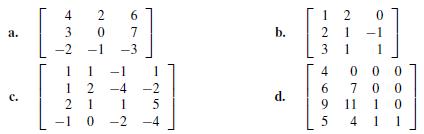
Determine which of the following matrices are nonsingular, and compute the inverse of these matrices:a.b. c. d.
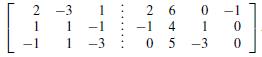
Consider the four 3 × 3 linear systems having the same coefficient matrix:2x1 − 3x2 + x3 = 2, 2x1 − 3x2 + x3 = 6,x1 + x2 − x3 = −1, x1 + x2 − x3 = 4,−x1 + x2 − 3x3 = 0; −x1 + x2 − 3x3 = 5;2x1 − 3x2 + x3 = 0, 2x1 − 3x2 + x3 = −1,x1 + x2 − x3 = 1, x1 + x2 − x3 = 0,−x1 +
The following statements are needed to prove Theorem 6.12. a. Show that if A−1 exists, it is unique. b. Show that if A is nonsingular, then (A−1)−1 = A. c. Show that if A and B are nonsingular n×n matrices, then (AB)−1 = B−1A−1.
Let A be a 3 × 3 matrix. Show that if A̅ is the matrix obtained from A using any of the operations (E1) ↔ (E2), (E1) ↔ (E3), or (E2) ↔ (E3), then det A̅ = −det A.
The solution by Cramer’s rule to the linear system a11x1 + a12x2 + a13x3 = b1, a21x1 + a22x2 + a23x3 = b2, a31x1 + a32x2 + a33x3 = b3, hasAnda. Find the solution to the linear system 2x1 + 3x2 − x3 = 4, x1 − 2x2 + x3 = 6, x1 − 12x2 + 5x3 = 10, by Cramer’s rule.b. Show that the linear
a. Generalize Cramer's rule to an n × n linear system. b. Use the result in Exercise 9 to determine the number of multiplications/divisions and additions/subtractions required for Cramer's rule on an n × n system.
Use mathematical induction to show that when n > 1, the evaluation of the determinant of an n × n matrix using the definition requires
Suppose A = PtLU, where P is a permutation matrix, L is a lower-triangular matrix with ones on the diagonal, and U is an upper-triangular matrix.a. Count the number of operations needed to compute PtLU for a given matrix A.b. Show that if P contains k row interchanges, thendet P = det Pt =
a. Show that the LU Factorization Algorithm requires 1/3 n3 - 1/3 n multiplications/divisions and 1/3 n3 - 1/2 n2 + 1/6 n additions/subtractions b. Show that solving Ly = b, where L is a lower-triangular matrix with lii = 1 for all i, requires 1/2 n2 - 1/2 n multiplications/divisions and 1/2 n2 -
Consider the following matrices. Find the permutation matrix P so that PA can be factored into the product LU, where L is lower triangular with 1s on its diagonal and U is upper triangular for these matrices.a.b. c. d.
Consider the following matrices. Find the permutation matrix P so that PA can be factored into the product LU, where L is lower triangular with 1s on its diagonal and U is upper triangular for these matrices.a.b. c. d.
Factor the following matrices into the LU decomposition using the LU Factorization Algorithm with lii = 1 for all i.a.b. c. d.
Factor the following matrices into the LU decomposition using the LU Factorization Algorithm with lii = 1 for all i.a.b. c. d.
Modify the LU Factorization Algorithm so that it can be used to solve a linear system, and then solve the following linear systems. a. 2x1− x2+ x3 = −1, 3x1+3x2+9x3 = 0, 3x1+3x2+5x3 = 4. b. 1.012x1 − 2.132x2 + 3.104x3 = 1.984, −2.132x1 + 4.096x2 − 7.013x3 = −5.049, 3.104x1 − 7.013x2 +
Modify the LU Factorization Algorithm so that it can be used to solve a linear system, and then solve the following linear systems. a. x1 − x2 = 2, 2x1 + 2x2 + 3x3 = −1, −x1 + 3x2 + 2x3 = 4 b. 1/3 x1 + 1/2 x2 - 1/4 x3 = 1, 1/5 x1 + 2/3 x2 + 3/8 x3 = 2, 2/5 x1 - 2/3 x2 + 5/8 x3 = −3. b. 2x1
Obtain factorizations of the form A = PtLU for the following matrices.a.b. c. d.
Determine which of the following matrices are (i) symmetric, (ii) singular, (iii) strictly diagonally dominant, (iv) positive definite.a.b. c. d.
Use the modified algorithm developed in Exercise 9 to solve the linear systems in Exercise 8. In Exercise 7 a. 2x1 − x2 = 3, −x1 + 2x2 − x3 = −3, − x2 + 2x3 = 1. b. 4x1 + x2 + x3 + x4 = 0.65, x1 + 3x2 − x3 + x4 = 0.05, x1 − x2 + 2x3 = 0, x1 + x2 + 2x4 = 0.5. c. 4x1 + x2 − x3 = 7, x1
Use Crout factorization for tridiagonal systems to solve the following linear systems. a. x1 − x2 = 0, −2x1 + 4x2 − 2x3 = −1, − x2 + 2x3 = 1.5. b. 3x1 + x2 = −1, 2x1 + 4x2 + x3 = 7, 2x2 + 5x3 = 9. c. 2x1 − x2 = 3, −x1 + 2x2 − x3 = −3, − x2 + 2x3 = 1. d. 0.5x1 + 0.25x2 =
Use Crout factorization for tri diagonal systems to solve the following linear systems.a. 2x1 + x2 = 3,x1 + 2x2+ x3 = −2,2x2+3x3 = 0.b. 2x1 − x2 = 5,−x1 + 3x2 + x3 = 4,x2 + 4x3 = 0.c. 2x1 − x2 = 3,x1 + 2x2 − x3 = 4,x2 − 2x3+ x4 = 0,x3+2x4 = 6.d. 2x1 − x2 = 1,x1 + 2x2 − x3 = 2,2x2 +
Modify the LDLt factorization to factor a symmetric matrix A. Apply the new algorithm to the following matrices:a.b. c. d.
Determine which of the following matrices are (i) symmetric, (ii) singular, (iii) strictly diagonally dominant, (iv) positive definite.a.b. c. d.
Suppose that A and B are strictly diagonally dominant n × n matrices. Which of the following must be strictly diagonally dominant? a. −A b. At c. A + B d. A2 e. A − B
Suppose that A and B are positive definite n × n matrices. Which of the following must be positive definite? a. −A b. At c. A + B d. A2 e. A − B
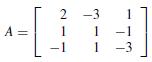
LetFind all values of α for whicha. A is singular. b. A is strictly diagonally dominant.c. A is symmetric.d. A is positive definite.
LetFind all values of α and β for whicha. A is singular. b. A is strictly diagonally dominant.c. A is symmetric. d. A is positive definite.
Show that Gaussian elimination can be performed on A without row interchanges if and only if all leading principal sub matrices of A are nonsingular. [Hint: Partition each matrix in the equationA(k) = M(k−1)M(k−2) · · ·M(1)AVertically between the kth and (k+1)st columns and horizontally
Tri diagonal matrices are usually labeled by using the notationTo emphasize that it is not necessary to consider all the matrix entries. Rewrite the Crout Factorization Algorithm using this notation, and change the notation of the li j and ui j in a similar manner.
Prove Theorem 6.31. [Show that [ui,i+1] < 1, for each i = 1, 2, . . . , n − 1, and that |lii| > 0, for each i = 1, 2, . . . , n. Deduce that det A = det L · det U ≠ 0.]
Use the LDLt Factorization Algorithm to find a factorization of the form A = LDLt for the following matrices:a.b. c. d.
Suppose that the positive definite matrix A has the Cholesky factorization A = LLt and also the factorization A = LDLt, where D is the diagonal matrix with positive diagonal entries d11, d22, . . ., dnn. Let D1/2 be the diagonal matrix with diagonal entries√d11, √d22, . . . ,√dnn. a. Show
Use the LDLt Factorization Algorithm to find a factorization of the form A = LDLt for the following matrices:a.b. c. d.
Use the Cholesky Algorithm to find a factorization of the form A = LLt for the matrices in Exercise 3.In Exercise 3a.b. c. d.
Use the Cholesky Algorithm to find a factorization of the form A = LLt for the matrices in Exercise 4.In Exercise 4a.b. c. d.
Modify the LDLt Factorization Algorithm as suggested in the text so that it can be used to solve linear systems. Use the modified algorithm to solve the following linear systems. a. 2x1 − x2 = 3, −x1 + 2x2 − x3 = −3, − x2 + 2x3 = 1. b. 4x1 + x2 + x3 + x4 = 0.65, x1 + 3x2 − x3 + x4 =
Use the modified algorithm from Exercise 7 to solve the following linear systems. a. 4x1 − x2+ x3 = −1, −x1 + 3x2 = 4, x1 +2x3 = 5. b. 4x1 + 2x2+2x3 = 0, 2x1 + 6x2+2x3 = 1, 2x1 + 2x2+5x3 = 0. c. 4x1 + 2x3 + x4 = −2, 3x2 − x3 + x4 = 0, 2x1 − x2 + 6x3 + 3x4 = 7, x1 + x2 + 3x3 + 8x4 =
Modify the Cholesky Algorithm as suggested in the text so that it can be used to solve linear systems, and use the modified algorithm to solve the linear systems in Exercise 7. In Exercise 7 a. 2x1 − x2 = 3, −x1 + 2x2 − x3 = −3, − x2 + 2x3 = 1. b. 4x1 + x2 + x3 + x4 = 0.65, x1 + 3x2 −
Find l∞ and l2 norms of the vectors. a. x = (3,−4, 0, 3/2 )t b. x = (2, 1,−3, 4)t c. x = (sin k, cos k, 2k)t for a fixed positive integer k d. x = (4/(k + 1), 2/k2, k2e−k)t for a fixed positive integer k
In Exercise 9 the Frobenius norm of a matrix was defined. Show that for any n×n matrix A and vector x in Rn, ||Ax||2 ≤ ||A||F ||x||2.
Let S be a positive definite n × n matrix. For any x in Rn define ||x|| = (xtSx)1/2. Show that this defines a norm on Rn. [Use the Cholesky factorization of S to show that xtSy = ytSx ≤ (xtSx)1/2(ytSy)1/2.]
Let S be a real and nonsingular matrix, and let ||·||' be any norm on Rn. Define ||·||' by ||x|| = ||Sx||.Show that || · ||' is also a norm on Rn.
Showing 1300 - 1400
of 3402
First
7
8
9
10
11
12
13
14
15
16
17
18
19
20
21
Last
Step by Step Answers

 Get 50% OFF
Claim Now
Get 50% OFF
Claim Now


-1.png)
-2.png)
-1.png)
-2.png)
-1.png)
-2.png)
-3.png)
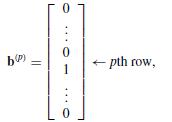
.png)
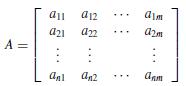
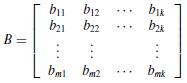
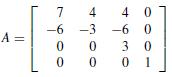
-1.png)
-2.png)
-3.png)
-1.png)
-2.png)
-3.png)
-1.png)
-2.png)
-3.png)
-1.png)
-2.png)
-3.png)


.png)
.png)
-1.png)
-2.png)
-3.png)
-1.png)
-2.png)
-3.png)
-1.png)
-2.png)
-3.png)
-1.png)
-2.png)
-3.png)
-1.png)
-2.png)
-3.png)
-1.png)
-2.png)
-3.png)
-1.png)
-2.png)
-3.png)
-1.png)
-2.png)
-3.png)
.png)
.png)
.png)
-1.png)
-2.png)
-3.png)
-1.png)
-2.png)
-3.png)
-1.png)
-2.png)
-3.png)
-1.png)
-2.png)
-3.png)


