New Semester
Started
Get
50% OFF
Study Help!
--h --m --s
Claim Now
Question Answers
Textbooks
Find textbooks, questions and answers
Oops, something went wrong!
Change your search query and then try again
S
Books
FREE
Study Help
Expert Questions
Accounting
General Management
Mathematics
Finance
Organizational Behaviour
Law
Physics
Operating System
Management Leadership
Sociology
Programming
Marketing
Database
Computer Network
Economics
Textbooks Solutions
Accounting
Managerial Accounting
Management Leadership
Cost Accounting
Statistics
Business Law
Corporate Finance
Finance
Economics
Auditing
Tutors
Online Tutors
Find a Tutor
Hire a Tutor
Become a Tutor
AI Tutor
AI Study Planner
NEW
Sell Books
Search
Search
Sign In
Register
study help
mathematics
numerical analysis
Numerical Methods For Engineers 5th Edition Steven C. Chapra, Raymond P. Canale - Solutions
Differential equations like the one solved in Prob. 27.6 can often be simplified by linearizing their nonlinear terms. For example, a first-order Taylor series expansion can be used to linearize the quartic term in Eq. (P27.6) as1 x 10-7 (T + 273)4 = 1 x 10⁻⁷ (Tb + 273)4 + 4x 10⁻⁷ (Tb + 273)3 (T -
Repeat Example 27.4 but for three masses. Produce a plot like Figure to identify the principle modes of vibration. Change all the k’s to 240.
Repeat Example 27.6, but for five interior points (h = 3/6).
Use minors to expand the determinedof
Use the power method to determine the highest eigenvalue and corresponding eigenvector for Prob. 27.10.
Use the power method to determine the lowest eigenvalue and corresponding eigenvector for Prob. 27.10.
Develop a user-friendly computer program to implement the shooting method for a linear second-order ODE. Test the program by duplicating Example 27.1.
Use the program developed in Prob. 27.13 to solve Probs. 27.2 and 27.4.
Develop a user-friendly computer program to implement the finite-difference approach for solving a linear second-order ODE. Test it by duplicating Example 27.3.
Use the program developed in Prob. 27.l5 to solve Probs. 27.3 and 27.5.
Develop a user-friendly program to solve for the largest eigenvalue with the power method. Test it by duplicating Example 27.7.
Develop a user-friendly program to solve for tie smallest eigenvalue with the power method. Test it by duplicating Example 27.8.
Use the Excel Solver to directly solve (that is, without linearization) Prob. 27.6 using the finite-difference approach. Employ ∆x = 0.1 to obtain your solution.
Use MATLAB to integrate the following pair of ODEs from t = 0 to 100:dy1/dt = 0.35y1 – 1.6y1y2dy2/dt = 0.04 y1y2 – 0.15y2Where y1= 1 and y2 = 0.05 at t = 0. Develop a state- space, plot (y1 versus y2) of your results.
The following differential equation was used in Sec. 8.4 to analyze the vibrations of an automobile shock absorber:1.25 x 10⁶ d2x/dt2 + 1 x 10⁷ dx/dt + 1.5 x 10⁹x = 0Transform this equation into a pair of ODEs.(a) Use MATLAB to solve these equations from t = 0 to 0.4 for the case where x = 0.5, and
Use IMSL to integrate(a) dx/dt = αx - bxydy/dt = -cy + dxyWhere α = 1.5, b = 0.7, c = 0.9, and d = 0.4. Employ initial conditions of x = 2 and y = 1 and integrate from t = 0 to 30.(b) dx/dt = -σx + σydy/dt = rx - y - xzdz/dt = -bz + xyWhere σ = 10, b = 2.666667, and r = 28. Employ initial
Use finite differences to solve the boundary-value ordinary differential equationd2u/dx2 + 6du/dx – u = 2With boundary conditions u(0) = 10 and u(2) = 1. Plot the results of u versus x. Use ∆x = 0.1.
Solve the nondimensionalized ODE using finite difference methods that describe the temperature distribution in a circular rod with internal heat source SOver the range 0 ≤ r ≤ 1, with the boundary conditionsFor S = 1, 10, and 20 K/m2. Plot the temperature versus radius.
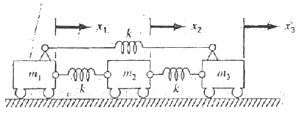
Derive the set of differential equations for a three mass-four spring system (Figure) that describes their time motion. Write the three differential equations in matrix from,[Acceleration vector] + [k/m matrix][displacement vector x] = 0Note each equation has been divided by the mass. Solve for the
Consider the mass-spring system in Figure. The frequencies for the mass vibrations can be determined by solving for the eigenvalues and by applying Mx + kx = 0, which yieldsApplying the guess x = x0eiωl as a solution, we get the following matrix:Use MATLAB’s eig command to solve for the
The following nonlinear, parasitic ODE was suggested by Hornbeck (1975):dy1/dt = 5(yl – t2)If the initial condition is y1(0) = 0.08, obtain a solution from τ = 0 to 5:(a) Analytically.(b) Using the fourth-order RK method with a constant step size of 0.03125.(c) Using the MATLAB function
A heated rod with a uniform heat source can be modeled with the Poisson equation,d2T/dx2 = – ƒ(x)Given a heat source ƒ(x) = 25 and the boundary conditions, T(x = 0) = 40 and T(x = 10) = 200, solve for the temperature distribution with(a) The shooting method and(b) The finite-difference method
Repeat Prob. 27.28, but for the following heat source: ƒ(x) = 0.12x3- 2.4x2 + l2x.
Perform the first computation in Sec. 28.1, but for the case where h = 10. Use the Heun (without iteration) and the fourth-order RK method to obtain solution.
Perform the second computation in Sec. 28.1, but for the system described in Prob. 12.4.
A mass balance for a chemical in a completely mixed reactor can be written asVdc/dt = F – Qc – kVc2where V = volume (12 m3), c = concentration (g/m3), F = feed rate (175 g/min), Q = flow rate (1 m3/min), and k = a second-order reaction rate (0.15 m3/g/min). If c(0) = 0, solve the ODE until the
If cin = cb (1 – e-0.12t), calculate the outflow concentration of a conservative substance (no reaction) for a single, completely mixed reactor as a function of time. Use Heun’s method (without iteration) to perform the computation. Employ values of cb = 40 mg/m3, Q = 6 m3/min, V = 100 m3, and
Seawater with a concentration of 8000 g/m3 is pumped into a well-mixed tank at a rate of 0.6 m3/hr. Because of faulty design work, water is evaporating from the tank at a rate of 0.025 m3/hr. The salt solution leave the tank at a rate of 0.6 m3/hr.(a) If the tank originally contains 1 m3 of the
A spherical ice cube (an ice sphere) that is 6 cm in diameter is removed from a 0°C freezer and placed on a mesh screen at room temperature Tα = 20°C. What will be the diameter of the ice cube as a function of time out of the freezer (assuming that all the water that has melted immediately drips
The following equations define the concentrations of three reactants:dcα/dt = - 10cαcc + cbdcb/dt = 10cαcc - cbdcc/dt = - 10cαcc + cb – 2ccIf the initial conditions are cα = 50, cb = 0, and cc = 40, find the concentrations for the times from 0 to 3 s.
Compound A diffuses through a 4-cm-long tube and reacts as it diffuses. The equation governing diffusion with reaction isDd2A/dx2 – kA = 0At one end of the tube, there is a large source of A at a concentration of 0.l M. At the other end of the tube these is an adsorbent material that quickly
In the investigation of a homicide or accidental death, it is often important to estimate the time of death. From the experimental observations, it is known that the surface temperature of an object changes at a rate proportional to the difference between the temperature of the object and that of
The reaction A → B takes place in two reactors in series.The reactors are well mixed but are not at steady state. The unsteady-state mass balance for each tank reactor is shown below:dCAl/dt = 1/τ(CA0 - CAl) - kCAldCBl/dt = - 1/τ CBl + kCAldCA2/dt = 1/τ(CAl – CA2) – kCA2dCB2/dt = 1/τ(CBl
A nonisothermal batch reactor can be described by the following equationsdC/dt = - e(- 10/T + 273))CdT/dt = 1000e(- 10/T + 273))C – 10(T - 20)where C is the concentration of the reactant and T in the temperature of the reactor. Initially the reactor is at 15°C and has a concentration of reactor
The following system is a classic example of stiff ODEs that can occur in the solution of chemical reaction kinetics:dc1/dt = – 0.013c1 – 1000c1c3dc2/dt = –2500c2c3dc3/dt = –0.013c1 – 1000c1c3 – 2500c2c3Solve these equations from t = 0 to 50 with initial conditions c1(0) = c2(0) = 1 and
Perform the same computation for the Lotka-Volterra system in Sec. 28.2, but use(a) Euler’s method,(b) Heun’s method (without iterating the corrector),(c) The fourth-order RK method, and(d) The MATLAB ode45 function. In all cases use single-precision variables, a step size of 0.1, and simulate
Perform the same computation for the Lorenz equations in Sec. 28.2, but use(a) Euler’s method,(b) Heun’s method (without iterating the corrector),(c) The fourth-order RK method, and(d) The MATLAB ode45 function. In all cases use single-precision variables and a step size of 0.1 and simulate
The following equation can be used to model the deflection of a sailboat must subject to a wind force:d2y/dz2 = ƒ/2El(L - z)2where ƒ = wind force, E = modulus of elasticity, L = mast length, and l = moment of inertia. Calculate the deflection if y = 0 and dy/dz = 0 at z = 0. Use parameter values
Perform the same computation as in Prob. 28.15, but rather than using a constant wind force, employ a force that varies with height according to (recall Sec. 24.2)ƒ(z) = 200z/5 + z e-2z/30
An environmental engineer is interested in estimating the mixing that occurs between a stratified lake and an adjacent embayment (Figure). A conservative tracer is instantaneously mixed with the bay water, and then the tracer concentration is monitored over the ensuing period in all three segments.
Population-growth dynamics are important in a variety of planning studies for areas such as transportation and water resource engineering. One of the simplest models of such growth incorporates the assumption that the rate of change of the population p is proportional to the existing population at
Although the model in Prob. 28.18 works adequately when population growth is unlimited, it breaks down when factors such as food shortages, pollution, and lack of space inhibit growth. In such cases, the growth rate itself can be thought of as being inversely proportional to population. One model
Isle Royale National Park is a 210-square-mile archipelago composed of a single large island and many small islands in Lake Superior. Moose, arrived around 1900 and by 1930, their population approached 3000, ravaging vegetation. In 1949, wolves crossed an ice bridge from Ontario. Since the late
A cable is hanging from two supports at A and B (Figure). The cable is loaded with a distributed load whose magnitude varies with x asWhere wo = 1000 lbs/ft. The slope of the cable (dy/dx) = 0 at x = 0, which is the lowest point for the cable. It is also the point where the tension in the cable is
The basic differential equation of the elastic curve for a cantilever beam (Figure) is given asEl d2y/dx2 = -P(L - x)where E = the modulus of elasticity and l = the moment of inertia. Solve for the deflection of the beam using a numerical method. The following parameter values apply: E = 30,000
The basic differential equation of the elastic curve for a uniformly loaded beam (Figure) is given asEl d2y/dx2 = wLx/2 – wx2/2where E = the modulus of elasticity and l = the moment of inertia. Solve for the deflection of the beam using(a) The finite-difference approach (Δx = 2 ft) and(b) The
A pond drains through a pipe as shown in Figure. Under a number of simplifying assumptions, the following differential equation describes how depth changes with time:dh/dt = πd2/4A(h) √2g(h + e)where h = depth (m), t = time (s), d = pipe diameter (m), A(h) = pond surface area as a function of
Engineers and scientists use mass-spring models to gain insight into the dynamics of structures under the influence of disturbances such as earthquakes. Figure shows such a representation for a three-story building. For this case, the analysis is limited to horizontal motion of the structure; Force
Perform the same computation as in the first part of Sec. 28.3, but with R = 0.025 Ω.
Solve the ODE in the first part of Sec. 8.3 from t = 0 to 0.5 using numerical techniques if q = 0.1 and i = -3.281515 at t = 0. Use an R = 50 along with the other parameters from Sec. 8.3.
For a simple RL circuit, Kirchhoff’s voltage law requires that (if Ohm’s law holds)Ldi/dt + Ri = 0where i = current, L = inductance, and R = resistance. Solve for i, if L = l, R = l.5, and i(0) = 0.5. Solve this problem analytically and with a numerical method. Present your results graphically.
In contrast to Prob. 28.28, real resistors may not always obey Ohm’s law. For example, the voltage drop may be nonlinear and the circuit dynamics is described by a relationship such asWhere all other parameters are as defined in Prob. 28.28 and l is a known reference current equal to 1. Solve for
Develop an eigenvalue problem for an LC network similar to the one in Figure, but with only two loops. That is, omit the i3 loop. Draw the network, illustrating how the currents oscillate in their primary nodes.
Perform the same computation as in Sec. 28.4 but for a l-m-long pendulum.
Section 8.4 presents a second-order differential equation that can be used to analyze the unforced oscillations of an automobile shock absorber. Given m = 1.2 x 10⁶ g, c = l x 107 g/s, and k =l.25 x l09 g/s2, use a numerical method to solve for the case where x(0) = 0.4 and dx(0) dt = 0.0. Solve
The rate of cooling a body can be expressed asdT/dt = -k(T - Tα)where T = temperature of the body (°C), Tα = temperature of the surrounding medium (°C), and k = the proportionality constant (min-1). Thus, this equation specifies that the rate of cooling is proportional to the difference in
The rate of heat flow (conduction) between two points on a cylinder heated at one end is given bydQ/dt = λAdT/dxwhere λ = a constant, A = the cylinder’s cross-sectional area, Q = heat flow, T = temperature, t = time, and x = distance from the heated end. Because the equation involves two
Repeat the falling parachutist problem (Example 1.2), but with the upward force due to drag as a second-order rate:Fα = -cυ2where c = 0.225 kg/m. Solve for t = 0 to 30, plot your results, and compare with those of Example 1.2.
Suppose that, after falling for 13 s, the parachutist from Examples 1.1 and 1.2 pulls the rip cord. At this point, assume that the drag coefficient is instantaneously increased to a constant value of 55 kg/s. Compute the parachutist’s velocity from t = 0 to 30 s with Heun’s method (without
The following ordinary differential equation describes the motion of a damped spring-mess system (Figure):where x = displacement from the equilibrium position, t = time, m = 1 kg mass, and α = 5 N/(m/s)2. The damping term is nonlinear and represents air damping.The spring is a cubic spring and is
A forced damped spring-mass system (Figure) has the following ordinary differential equation of motion:Where x = displacement from the equilibrium position, t = time, m = 2 kg mass, α = 5 N/(m/s)2, and k 6 N/(m/s)2. The damping term is nonlinear and represents air damping. The forcing function
The temperature distribution in a tapered conical cooling fin (Figure) is described by the following differential equation, which has been nondimensionalizedWhere u = temperature (0 ≤ u ≤ l).x = axial distance (0 ≤ x ≤ 1), and p is a nondimensional parameter that describes the heat transfer
The dynamics of a forced spring-mass-damper system can be represented by the following second-order ODE:md2x/dt2 + cdx/dt + k1x + k3x3 = P cos(ωt)where in m = 1 kg, c = 0.4 N · s/m, P = 0.5 N, and ω = 0.5/s. Use a numerical method to solve for displacement (x) and velocity (υ = dx/dt) as a
The differential equation for the velocity of a bungee of a jumper is different depending on whether the jumper has fallen to a distance where the cord is fully extended and begins to stretch. Thus, if the distance fallen is less than the cord length, the jumper is only subject to gravitational and
Use Liebmann’s method to solve for the temperature of the square heated plate in Figure, but with the upper boundary condition increased to 120°C and the left boundary decreased to 60°C. Use a relaxation factor of 1.2 and iterate to εs = 1%.
Compute the fluxes for Prob. 29.1 using the parameters from Example 29.3.
Repeat Example 29.1, but use 49 interior nodes (that is, Δx = Δy = 5 cm).
Repeat Prob. 29.3, but for the case where the lower edge is insulated.
Repeat Examples 29.1 and 29.3, but for the case where the flux at the lower edge is directed downward with a value of 1 cal/cm2 · s.
Repeat Example 29.4 for the case where both the lower left and the upper right corners are rounded in the same fashion as the lower left corner of Figure. Note that all boundary temperatures on the upper and right sides are fixed at 100°C and all on the lower and left sides are fixed at 50°C.
With the exception of the boundary conditions, the plate in Figure has the exact same characteristics as the plate used in Examples 23.1 through 23.4. Simulate both the temperatures and fluxes for theplate.
Write equations for the darkened nodes in the grid in Figure. Note that all units are cgs. The coefficient of thermal conductivity for the plate is 0.75 cal/(s · cm · °C), the convection coefficient is hc = 0.015 cal/(cm2 · C · s), and the thickness of the plate is 0.5 cm.
Write equations for the darkened nodes in the grid in Figure. Note that all units are cgs. The convection coefficient is hc = 0.015 cal/(cm2 · C · s) and the thickness of the plate is 1.5 cm.
Apply the control volume approach to develop the equation for node (0, j) in Figure.
Derive an equation like Eq. (29.26) for the case where θ is greater than 45° for Figure.
Develop a user-friendly computer program to implement Liebmann’s method for a rectangular plate with Dirichlet boundary conditions. Design the program so that it can compute both temperature and flux. Test the program by duplicating the results of Examples 29.1 and 29.2.
Employ the program from Prob. 29.12 to solve Probs. 29.1 and 29.2.
Employ the program from Prob 29.12 to solve Prob. 29.3.
Use the control-volume approach and derive the node equation for node (2, 2) in Figure and include a heat source at this point. Use the following values for the constants: Δz = 0.2.5 cm, h = 10 cm, kA = 0.25 W/cm · C, and kB = 0.45 W/cm · C. The heat source comes only from material A at the rate
Calculate heat flux (W/cm2) for node (2, 2) in Figure using finite-difference approximations for the temperature gradients at this node. Calculate the flux in the horizontal direction in materials A and B, and determine if these two fluxes should be equal. Also, calculate the vertical flux in
Repeat Example 30.1, but use the midpoint method to generate your solution.
Repeat Example 30.1, but for the case where the rod is initially at 25°C and the derivative at x = 0 is equal to 1 and at x = 10 is equal to 0. Interpret your results.
(a) Repeat Example 30.1, but for a time step of Δt = 0.05 s. Compute results to t = 0.2.(b) In addition, perform the same computation with the Heun method (without iteration of the corrector) with a much smaller step size of Δt = 0.001 s. Assuming that the results of (b) are a valid approximation
Repeat Example 30.2, but for the case where the derivative at x = 10 is equal to zero.
Repeat Example 30.3, but for Δx = 1 cm.
Repeat Example 30.5, but for the plate described in Prob. 29.1.
The advection-diffusion equation is used to compute the distribution of concentration along the length of a rectangular chemical reactor (see Sec. 32.1).∂c/∂t = D∂2c/∂x2 – U ∂c/∂x – kcwhere c = concentration (mg/m3), t = time (min), D = a diffusion coefficient (m2/min), x = distance
Develop a user-friendly computer program for the simple explicit method from Sec. 30.2. Test it by duplicating Example 30.1.
Modify the program in Prob. 30.8 so that it employs either Dirichlet or derivative boundary conditions. Test it by solving Prob. 30.2.
Develop a user-friendly computer program to implement the simple implicit scheme from Sec. 30.3. Test it by duplicating Example 30.2.
Develop a user-friendly computer program to implement the Crank-Nicolson method from Sec. 30.4. Test it by duplicating. Example 30.3
Develop a user-friendly computer program for the ADI method described in Sec. 30.5. Test it by duplicating Example 30.5.
The nondimensional form for the transient heat conduction in an insulated rod (Eq. 30.1) can be written as∂2u/∂x2 = ∂u/∂twhere nondimensional space, time, and temperature are defined asx = x/L l = T/(pCL2/k)
The problem of transient radial heat flow in a circular rod in nondimensional form is described by∂2u/∂r2 + 1/r ∂u/∂r = ∂u/∂tBoundary conditionsu(1, l) = 1∂u/∂t(0, l) = 0Initial conditionsu(x, 0) = 00 ≤ x ≤ 1Solve the nondimensional transient radial heat conduction equation in a
Solve the following PDE:∂2u/∂x2 + b∂u/∂x = ∂u/∂tBoundary conditions u(0, l) = 0 u(1, l) = 0Initial conditions u(x, 0) =
Determine the temperatures along a 1-m horizontal rod described by the heat conduction equation (Eq. 30.1). Assume that the right boundary is insulated and that the left boundary (x = 0) is represented bywhere k’ = coefficient of thermal conductivity (W/m · °C), h = convective heat transfer
Repeat Example 31.1, but for T(0, t) = 75 and T(10, t) = 150 and a uniform heat source of 15.
Repeat Example 31.2, but for boundary conditions of T(0, t) = 75 and T(10, t) = 150 and a heat source of 15.
Apply the results of Prob. 31.2 to compute the temperature distribution for the entire rod using the finite-element approach.
Use Galerkin’s method to develop an element equation for a steady-state version of the advection-diffusion equation described in Prob. 30.7. Express the final result in the format of Eq. (31.26) so that each term has a physical interpretation.
Showing 600 - 700
of 3402
1
2
3
4
5
6
7
8
9
10
11
12
13
14
15
Last
Step by Step Answers

 Get 50% OFF
Claim Now
Get 50% OFF
Claim Now


.png)
-1.png)
-2.png)
.png)
-1.png)
-2.png)
-1.png)
-2.png)
.png)
-1.png)
-2.png)
.png)
.png)
.png)
-1.png)
-2.png)
![**6 -(4)]- di dt](https://dsd5zvtm8ll6.cloudfront.net/si.question.images/image/images4/45-M-N-A-O-A-P(123).png)
-1.png)
-2.png)
-3.png)
-1.png)
-2.png)
-1.png)
-2.png)
-3.png)
.png)
.png)
.png)
.png)


