New Semester
Started
Get
50% OFF
Study Help!
--h --m --s
Claim Now
Question Answers
Textbooks
Find textbooks, questions and answers
Oops, something went wrong!
Change your search query and then try again
S
Books
FREE
Study Help
Expert Questions
Accounting
General Management
Mathematics
Finance
Organizational Behaviour
Law
Physics
Operating System
Management Leadership
Sociology
Programming
Marketing
Database
Computer Network
Economics
Textbooks Solutions
Accounting
Managerial Accounting
Management Leadership
Cost Accounting
Statistics
Business Law
Corporate Finance
Finance
Economics
Auditing
Tutors
Online Tutors
Find a Tutor
Hire a Tutor
Become a Tutor
AI Tutor
AI Study Planner
NEW
Sell Books
Search
Search
Sign In
Register
study help
mathematics
numerical analysis
Numerical Methods For Engineers 5th Edition Steven C. Chapra, Raymond P. Canale - Solutions
It is known that the tensile strength of a plastic increases as a function of the time it is heat-treated. The following data is collected:(a) Fit a straight line to this data and use the equation to determine the tensile strength at a time of 32 min.(b) Repeat the analysis but for a straight line
The following data was gathered to determine the relationship between pressure and temperature of a fixed volume of 1 kg nitrogen. The volume is 10 m3.Employ the ideal gas law pV = nRT to determine R on the basis of this data. Note that for the law, T must be expressed inkelvins.
The specific volume of a superheated steam is listed in steam tables for various temperatures. For example, at a pressure of 3000 lb/in2, absolute:Determine υ at T = 750°F.
A reactor is thermally stratified as in the following table:As depicted in Figure, the tank can be idealized as two zones separated by a strong temperature gradient or thermocline. The depth of this gradient can be defined as the inflection point of the temperature-depth curve—that is, the point
In Alzheimer’s disease, the number of neurons in the cortex decreases as the disease progresses. The following data was taken to determine the number of neurotransmitter receptors left in a diseased brain. Free neurotransmitter ([F]) was incubated with tissue and the concentration that bound
The following data was taken from a stirred tank reactor for the reaction A → B. Use the data to determine the best estimates for k01 and E1 for the following kinetic model,Where R is the gas constant and equals 0.00198Kcal/mol/K
Use the following set of pressure-volume data to find the best possible virial constants (A1 and A2) for the equation of state shown below. R = 82.05 ml atm/gmol K and T = 303K.
Concentration data was taken at 15 time points for the polymerization reactionxA + yB → AxByWe assume the reaction occurs via a complex mechanism consisting of many steps. Several models have been hypothesized and the sum of the squares of the residuals had been calculated for the fits of the
Below is data taken from a batch reactor of bacterial growth (after lag phase was over). The bacteria are allowed to grow as fast as possible for the first 2.5 hours, and then they are induced to produce a recombinant protein, the production of which slows the bacterial growth significantly. The
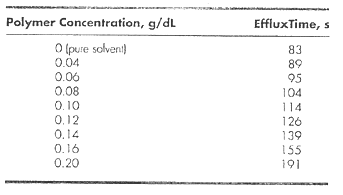
The molecular weight of a polymer can be determined from its viscosity by the following relationship:Where [η] is the intrinsic viscosity of the polymer Mυ is the viscosity averaged molecular weight, and K and α are constants specific for the polymer. The intrinsic viscosity is determined
On average, the surface area A of human beings is related to weight W and height H. Measurements on a number of individuals give values of A in the following table:Develop an equation to predict area as a function of height and weight. Use it to estimate the surface area for a 187-cm, 78-kgperson.
Determine an equation to predict metabolism rate as a function of mass based on the followingdata:
Human blood behaves as a Newtonian fluid (see Prob. 20.51) in the high shear rate region where γ > 100. In the low shear rate region where γ < 50, the red cells lend to aggregate into what are called rouleaux, which make the fluid behavior depart from Newtonian. This low shear rate region is
Soft tissue follows an exponential deformation behavior in uniaxial tension while it is in the physiologic or normal range elongation. This can be expressed as
The thickness of the retina changes during certain eye diseases. One way to measure retinal thickness is to shine a low-energy laser at the retina and record the reflections on film. Because of the optical properties of the eye, the reflections from the front surface of the retina and the back
The shear stresses, in kilopascals (kPa), of nine specimens taken at various depths in a clay stratum are listed below. Estimate the shear stress at a depth of 4.5m.
A transportation engineering study was conducted to determine the proper design of bike lanes. Data was gathered on bike- lane widths and average distance between bikes and passing cars. The data from 9 streets is(a) Plot the data.(b) Fit a straight line to the data with linear regression. Add this
In water-resources engineering, the sizing or reservoirs depends on accurate estimates of water flow in the river that is being impounded. For some rivers, long-term historical records of such flow data are difficult to obtain. In contrast, meteorological data on precipitation is often available
Environmental engineers dealing with the impacts of acid rain must determine the valise of the product of water Kw as a function of temperature. Scientists have suggested the following equation to model this relationship:Where Tα = absolute temperature (K), and a, b, c, and d are parameters.
Perform the same computations as in Sec. 20.3, but analyze data generated with ƒ(t) = 4 cos(5t) - 7 sin(3t) + 6.
You measure the voltage drop V across a resistor for a number of different values of current i. The results areUse first-through fourth-order polynomial interpolation to estimate the voltage drop for i = 1.15. Interpret yourresults.
Duplicate the computation for Prob. 20.32, but use polynomial regression to derive best fit equations of order 1 through 4 using all the data. Plot and evaluate your results.
The current in a wire is measured with great precision as a function of time:Determine i at t =0.23.
The following data was taken from an experiment that measured the current in a wire for various imposed voltages:(a) On the basis of a linear regression of this data, determine current for a voltage of 3.5 V. Plot the line and the data and evaluate the fit.(b) Redo the regression and force the
It is known that the voltage drop across an inductor follows Faraday’s law:VL = L di/dtWhere VL is the voltage drop (in volts), L is inductance (in henrys; 1 H = I V∙ s/A), and i is current (in amperes). Employ the following data to estimate L:What is the meaning, if any, of the intercept of
Ohm’s law stares that the voltage drop V across an ideal resistor is linearly proportional to the current i flowing through the as in V = iR, where R is the resistance. However, real resistor may not always obey Ohm’s law. Suppose that you performed some very precise experiments to measure the
Repeat Prob. 20.37 but determine the coefficients of the polynomial (Sec. 18.4) that fit the data in Table P20.37.
An experiment is performed to determine the percent elongation of electrical conducting material as a function of temperature. The resulting data is listed below. Predict the percent elongation for a temperature of400°C.
Bessel functions often arise in advanced engineering analyses such as the study of electric fields. These functions are usually not amenable to straight forward evaluation and, therefore, are often compiled in standard mathematical tables. For example,Estimate J1(2.1).(a) Using an interpolating
The population (p) of a small community on the outskirts of a city grows rapidly over a 20-year period:As an engineer working for a utility company, you must forecast the population 5 years into the future in order to anticipate the demand for power. Employ an exponential model and linear
Based on Table 20.4, use linear and quadratic interpolation to compute Q for D = l.23 ft and S = 0.001 ft/ft. Compare your results with the same value computed with the formula derived in Sec. 20.4.
Reproduce Sec. 20.4, but develop an equation to predict slope as a function of diameter and flow. Compare your results with the formula from Sec. 20.4 and discuss your results.
Dynamic viscosity of water μ(l0-3 N · s/m2) is related to temperature T (°C) in the following manner:(a) Plot this data.(b) Use interpolation to predict μ at T = 7.5°C.(c) Use Polynomial regression to fit a parabola to the data in order to make the same prediction.
Hooke’s 1aw, which holds when a spring is not stretched too far, signifies that the extension of the spring and the applied force are linearly related. The proportionality is parameterized by the spring constant k. A value for this parameter can be established experimentally by placing known
Repeat Prob. 20.45 but fit a power curve to all the data in Table P20.45. Comment on your results.
The distance required to stop an automobile consists of both thinking and braking components each at which is a function of its speed. The following experimental data was collected to quantify this relationship. Develop a best-fit equation for both the thinking and braking components. Use these
An experiment is performed to define the relationship between applied stress and the time to fracture for a type of stainless steel. Eight different values of stress are applied, and the resulting data isPlot the data and then develop a best-fit equation to predict the fracture time for an applied
The acceleration due to gravity at an altitude y above the surface of the earth is given byCompute g at y = 55,000m.
The creep rate ε the time rate at which strain increases, and stress data below were obtained from a testing procedure. Using power law curve fit,ε = BσmFind the value of B and m. Plot your results using a log-log scale.
It is a common practice when examining a fluid’s viscous behavior to plot the shear rule (velocity gradient)dυ/dy = γon the abscissa versus shear sires (τ) on the ordinate. When a fluid has a straight-line behavior between these two variables it is called a Newtonian fluid, and the resulting
The relationship between stress τ and the shear strain rate γ for a pseudoplastic fluid (see Prob. 20.51) can be expressed by the equation τ = μγn. The following data comes from a 0.5% hydroxethylcellulose in water solution. Using a power-law fit, find the values of μ and n.
The velocity u of air flowing past a flat surface is measured at several distances y away from the surface. Fit a curve to this data assuming that the velocity is zero at the surface (y = 0). Use your result to determine the shear stress (μ du/dy) at the surface. (μ = 1.8 x 10→5 N · s/m2)
Andrade’s equation has been proposed as a model of the effect of temperature on viscosity,μ = DeB/T0Where μ = dynamic viscosity of water (10-3 N ∙ s/m2), Tα = absolute temperature (K), and D and B are parameters. Fit this model to the data for water front Prob. 20.44.
Develop equations to fit the ideal specific heats cp (kJ/kg · K), as a function of temperature T (K), for several gases as listed in Table P20.55.
Temperatures are measured at various points on a heated plate (Table P20.56). Estimate the temperature at(a) x = 4, y = 3.2, and(b) x = 4.3, y =2.7.
The data below was obtained from a creep test performed at room temperature on a wire composed of 40% tin, 60% lead, and solid core solder. This was done by measuring the increase in strain over time while a constant load was applied to a test specimen.Using a linear regression method, find (a) The
The concentration of total phosphorus (p in mg/m3) and chlorophyll α (c in mg/m3) for each of the Great Lakes in 1970 wasThe concentration of chlorophyll α indicates how much plant life is suspended in the water. As such, it indicates how unclear and unsightly the water appears. Use the above
The vertical stress σz under the corner of a rectangular area subjected to a uniform load of intensity q is given by the solution of Boussinesq’s equation:Because this equation is inconvenient to solve manually, it has been reformulated asΣz = qfz (m, n)Where ƒz(m, n) is called the influence
Three disease-carrying organisms decay exponentially in lake water according to the following model:Estimate the initial population of each organism (A, B, and C) given the followingmeasurements:
The mast of a sailboat has a cross-sectional area of 10.65 cm2 and is constructed of an experimental aluminum alloy. Tests were performed to define the relationship between stress and strain. The test results areThe stress caused by wind can be computed as F/Ac; where F = force in the mast and Ac
Enzymatic reactions are used extensively to characterize biologically mediated reactions in environmental engineering. Proposed rate expressions for en enzymatic reaction are given below where [S] is the substrate concentration and v0 is the initial rate of reaction. Which formula best fits the
Solve the following initial-value problem analytically over the interval from x = 0 to 2:dy/dx = yx2 – 1.1yWhere y(0) = l. Plot the solution.
Use Euler’s method with h = 0.5 and 0.25 to solve Prob. 25.1. Plot the results on the same graph to visually compare the accuracy for the two step sizes.
Use Heun’s method with h = 0.5 to solve Prob. 25.1. Iterate the corrector to εs = 1%.
Use the midpoint method with h = 0.5 and 0.25 to solve Prod. 25.1.
Use the classical fourth-order RK method with h = 0.5 to solve Prob. 25.1.
Repeat Probs. 25.1 through 25.5 but for the following initial-value problem over the interval from x = 0 to 1:dy/dx = (1 + 2x)√yy(0) = 1
Use the(a) Euler and(b) Heun (without iteration) methods to solved2y/dt2 – 0.5t + y = 0where y(0) = 2 and y’(0) = 0. Solve from x = 0 to 4 using h = 0.1. Compare the methods by plotting the solutions.
Solve the following problem with the fourth-order RK method:d2y/dx2 + 0.6 dy/dx + 8y = 0where y(0) = 4 and y’(0)= 0. Solve from x = 0 to 5 with h = 0.5. Plot your results.
Solve from t = 0 to 3 with h = 0.1 using(a) Heun (without corrector) and(b) Ralston’s 2nd-order RK method:dy/dt = y sin3(t)y(0) = 1
Solve the following problem numerically from t = 0 to 3:dy/dx = - y + t2 y(0) = 1Use the third-order RK method with a step size of 0.5.
Use(a) Euler’s and(b) The fourth-order RK method to solvedy/dx = -2y + 4e-xdz/dx = -yz2/3Over the range x = 0 to 1 using a step size of 0.2 with y(0) = 2 and z(0) = 4.
Compute the first step of Example 25.14 using the adaptive fourth-order RK method with h = 0.5. Verify whether step-size adjustment is in order.
If ε = 0.001, determine whether step size adjustment is required for Example 25.12.
Use the RK-Fehlberg approach to perform the same calculation as in Example 25.l2 from x = 0 to 1 with h= 1.
Write a computer program based on Figure. Among other things, place documentation statements throughout the program to identify what each section is intended to accomplish.
Test the program you developed in Prob. 25.15 by duplicating the computations from Examples 25.1 and 25.4.
Develop a user-friendly program for the Heun method with iterative corrector. Test the program by duplicating the results in Table 25.2.
Develop a user-friendly computer program for the classical fourth-order RK method. Test the program by duplicating Example 25.7.
Develop a user-friendly computer program for systems of equations using the fourth-order RK method. Use this program to duplicate the computation In Example 25.10.
The motion of a damped spring-mass system (Figure) is described by the following ordinary differential equation:where x = displacement from equilibrium position (m), t = time (s), m = 20-kg mass, and c = the damping coefficient (N ∙ s/m). The damping coefficient c takes on three values of 5
If water is drained from a vertical cylindrical tank by opening a valve at the base, the water will flow fast when the tank is full and slow down as it continues to drain. As it turns out, the rate at which the water level drops is:dy/dt = -k√ywhere k is a constant depending on the shape of the
The following is an initial value, second-order differentialEquation:d2x/dt2 + (5x) dx/dt + (x + 7) sin(ωt) = 0Wheredx/dt (0) = 1.5 and x (0) = 6Note that ω = 1. Decompose the equation into two first-order differential equations. After the decomposition, solve the system from t = 0 to 15 and plot
Assuming that drag is proportional to the square of velocity, we can model the velocity of a falling object like a parachutist with the following differential equation:dυ/dt = g – cd/m υ2Where υ is velocity (m/s), t = time (s), g is the acceleration due to gravity (9.81 m/s2), cd = a
A spherical tank has a circular orifice in its bottom through witch the liquid flows out (Figure). The flow rate through the hole can he estimated asQout = CA√2ghWhere Qout = outflow (m3/s), C = an empirically-derived coefficient, A = the area of the orifice (m2), g = the gravitational constant
The logistic model is used to simulate population as indp/dt = kgm(1 – p/pmax)pWhere p = population, kgm = the maximum growth rate under unlimited conditions, and pmax = the carrying capacity. Simulate the world’s population from 1950 to 2002 using case of the numerical methods described in
Suppose that a projectile is launched upward from the earth’s surface. Assume that the only force acting on the object is the downward force of gravity. Under these conditions, a force balance can be used to derive,dυ/dt = -g(0) R2/(R + x)2where υ = upward velocity (m/s), t = time (s), x =
The following function exhibits both flat and steep regions over a relatively than x regionƒ(x) = 1/(x – 0.3)2 + 0.01 + 1/(x – 0.9)2 + 0.04 - 6Determine the value of the definite integral of this function between x = 0 and 1 using an adaptive RK method.
Givendy/dx = – 200,000y + 200,000e–x – e–x(a) Estimate the step-size required to maintain stability using the explicit Euler method.(b) If y(0) = 0, use the implicit Euler to obtain a solution from x =0 to 2 using a step size of 0.1.
Givendy/dt = 30(cos t – y) + 3 sin tIf y(0) = 1, use the implicit Euler to obtain a solution from t = 0 to 4 using a step size of 0.4.
Givendxl/dt = 1999x1 + 2999x2dx2/dt = –2000xl – 3000x2If x1(0) x2(0) = 1, obtain a solution from t = 0 to 0.2 using a step size of 0.05 with the(a) Explicit and(b) Implicit Euler methods.
Solve the following initial-value problem over the interval from t = 2 to t = 3:dy/dt = –0.4y + e-2tUse the non-self-starting Heun method with a step size of 0.5 and initial conditions of y(1.5) = 5.800007 and y(2.0) = 4.762673. Iterate the corrector to εs = 0.1%. Compute the true percent
Repeat Prob. 26.4, but use the fourth-order Adams method. [Note: y(0.5) = 8.46909 and y(l.0) = 7.037566.] Iterate the corrector to εs = 0.01%.
Solve the following initial-value problem from t = 4 to 5:dy/dt = – 2y/tUse a step size of 0.5 and initial values of y(2.5) = 0.48, y(3) = 0.333333, y(3.5) = 0.244898, and y(4) = 0.1875. Obtain your solutions using the following techniques:(a) The non-self-starting Heun method (εs = 1%), and(b)
Solve the following initial-value problem from x = 0 to x = 0.75:dy/dx = yx2 – yUse the non-self-starting Heun method with a step size of 0.25. If y(0) = 1, employ the fourth-order RK method with a step size of 0.25 to predict the starting value at y(0.25).
Solve the following initial-value problem from t = 1.5 to t = 2.5dy/dt = -2y/1 + tUse the fourth-order Adams method. Employ a step size of 0.5 and the fourth-order RK method to predict the start -up values if y(0) = 2.
Develop a program for the implicit Euler method for a single linear ODE. Test it by duplicating Prob. 26.1b.
Develop a program for the implicit Euler method for a pair of linear ODEs. Test it by solving Eq. (26.6).
Develop a user-friendly program for the non-self-starting Heun method with a predictor modifier. Employ a fourth-order RK method to compute starter values. Test the program by duplicating Example 26.4.
Use the program developed in Prob. 26.11 to solve Prob. 26.7.
Consider the thin rod of length l moving in the x-y plane as shown in Figure. The rod is fixed with a pin on one end and a mass at the other. Note that g = 9.8l m/s2 and l = 0.5 m. This system can be solved usingθ – g/lθ = 0Let θ(0) = 0 and θ(0) = 0.25 rad/s. Solve using any method
Given the first-order ODEdx/dt= -700x - 1000e-1x(t = 0) = 4Solve this stiff differential equation using a numerical method over the time period 0 ≤ t ≤ 5. Also solve analytically and plot the analytic and numerical solution for both the fast transient and slow transition phase of the timescale.
The following second-order ODE is considered to be stiffd2y/dx2= -l00l dy/dx - l000ySolve this differential equation(a) Analytically and(b) Numerically for x = 0 to 5. For (b) use an implicit approach with h = 0.5. Note that the initial conditions are y(0) = 1 and y’(0) = 0. Display both results
Solve the following differential equation from t = 0 to 1dy/dt = –10yWith the initial condition y(0) = 1. Use the following techniques to obtain your solutions:(a) Analytically,(b) The explicit Euler method, and(c) The implicit Euler method. For (b) and (c) use h = 0.1 and 0.2. Plot your results.
A steady-state heat balance for a rod can be represented asd2T/dx2 – 0.15T = 0Obtain an analytical solution for a 10-m rod with T(0) = 240 and T(10) = 150.
Use the shooting method to solve Prob. 27.1.
Use the finite-difference approach with ∆x = 1 to solve Prob. 27.1.
Use the shooting method to solve7d2y/dx2 -2dy/dx - y + x = 0With the boundary conditions y(0) = 5 and y(20) = 8.
Solve Prob. 27.4 with the finite-difference approach using ∆x = 2.
Use the shooting method to solved2T/dx2 – 1x l0-7(T + 273)4 + 4(l50 – T) = 0Obtain a solution for boundary conditions: T(0) = 200 and T(0.5)= 100.
Showing 500 - 600
of 3402
1
2
3
4
5
6
7
8
9
10
11
12
13
14
15
Last
Step by Step Answers

 Get 50% OFF
Claim Now
Get 50% OFF
Claim Now


.png)
.png)
.png)
.png)
![Bmax(F] K +[F] [B] =](https://dsd5zvtm8ll6.cloudfront.net/si.question.images/image/images4/45-M-N-A-C-F(86)-1.png)
-2.png)
-1.png)
-2.png)
.png)
.png)
.png)
![(n] = KM](/image/images4/45-M-N-A-C-F(91)-1.png)
-2.png)
.png)
.png)
.png)
-1.png)
-2.png)
-3.png)
.png)
.png)
.png)
.png)
-1.png)
-2.png)
.png)
.png)
.png)
.png)
.png)
.png)
.png)
.png)
.png)
.png)
.png)
.png)
.png)
.png)
-1.png)
-2.png)
.png)
.png)
.png)
.png)
.png)
.png)
-1.png)
-2.png)
-1.png)
-2.png)
.png)
![k[S] k[S]? K + [S]? k[S] = 01 K + [SP Vo = k[S] vo = K + [S] Initial Rate, 10-6 M/s (1, M 6.3636 x 10⁻⁵ 7.9520 x 10⁻³ 6.](https://dsd5zvtm8ll6.cloudfront.net/si.question.images/image/images4/45-M-N-A-C-F(104).png)
-1.png)
-2.png)
.png)
.png)
.png)


