New Semester
Started
Get
50% OFF
Study Help!
--h --m --s
Claim Now
Question Answers
Textbooks
Find textbooks, questions and answers
Oops, something went wrong!
Change your search query and then try again
S
Books
FREE
Study Help
Expert Questions
Accounting
General Management
Mathematics
Finance
Organizational Behaviour
Law
Physics
Operating System
Management Leadership
Sociology
Programming
Marketing
Database
Computer Network
Economics
Textbooks Solutions
Accounting
Managerial Accounting
Management Leadership
Cost Accounting
Statistics
Business Law
Corporate Finance
Finance
Economics
Auditing
Tutors
Online Tutors
Find a Tutor
Hire a Tutor
Become a Tutor
AI Tutor
AI Study Planner
NEW
Sell Books
Search
Search
Sign In
Register
study help
mathematics
numerical analysis
Numerical Methods For Engineers 5th Edition Steven C. Chapra, Raymond P. Canale - Solutions
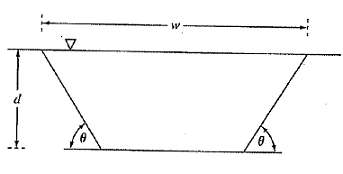
As an agricultural engineer, you must design a trapezoidal open channel to carry irrigation water (Figure). Determine the optimal dimensions to minimize the wetted perimeter for a cross-sectional area of 50 m2. Are the relative dimensions universal?
Find the optimal dimensions for a heated cylindrical tank designed to hold 10 m3 of fluid. The ends and sides cost $200/m2 and $100/m2, respectively. In addition, a coating is applied to the entire tank area at a cost of $50/m2.
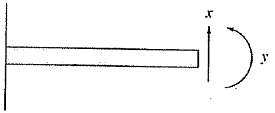
A finite-element model of a cantilever beam subject to loading and moments (Figure) is given by optimizing ?(x, y) = 5x2 ? 5xy + 2.5y2 ? x ? 1.5y Where x = end displacement and y = end moment. Find the values of x and y that minimize ?(x, y).
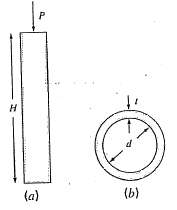
Suppose that you are asked to design a column to support a compressive load P as shown in Figure. The column has a cross-section shaped as a thin-walled pipe as shown in Figure. The design variables are the mean pipe diameter d and the wall thickness t. The cost of the pipe is computed by Cost =
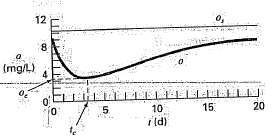
The Streeter-Phelps model can be used to compute the dissolved oxygen concentration in a river below a point discharge of sewage (Figure), o = os?? kdLo/kd + ks ? ka (e?kat?? e?(kd + ks)t) ? Sb/ka?(1 ? e?kat) where o = dissolved oxygen concentration [mg/L], os = oxygen saturation concentration
The two-dimensional distribution of pollutant concentration in a channel can be described byc(x, y) = 7.7 + 0.15x + 0.22y – 0.05x2–0.016y2 – 0.007xyDetermine the exact location of the peak concentration given the function and the knowledge that the peak lies within the bounds – 10 ≤ x ≤
The flow Q [m3/s] in an open channel can be predicted with the Manning equation (recall Sec. 8.2)Q = 1/n AcR2/3 S1/2Where n = Manning roughness coefficient (a dimensionless number used to parameterize the channel friction), Ac = cross-sectional area of the channel (m2), S = channel slope
A cylindrical beam carries a compression load P = 3000 kN. To prevent the beam from buckling, this load must be less than a critical load,Pc = π2El/L2Where E = Young’s modulus = 200 x 109 N/m2, I = πr4/4 (the area moment of inertia for a cylindrical beam of radius r), and L is the beam length.
The Splash River has a flow rate of 2 x 10⁶ m3/d, of which up to 70% can be diverted into two channels where it flows through Splish County. These channels are used for transportation, irrigation, and electric power generation, with the latter two being sources of revenue. The transportation use
Determine the beam cross-sectional areas that result in the minimum weight for the truss we studied in Sec. 12.2 (Figure). The critical buckling and maximum tensile strengths of compression and tension members are 10 and 20 ksi, respectively. The truss is to be constructed of steel (density = 3.5
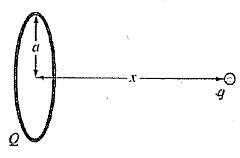
A total charge Q is uniformly distributed around a ring-shaped conductor with radius ?. A charge q is located at a distance x from the center of the ring (Figure). The force exerted on the charge by the ring is given by F = 1/4?e0 qQx/(x2 + ?2)3/2 Where e0 = 8.85 x 10⁻¹² C2/(N m2), q = Q = 2 x 10⁻⁵
A system consists of two power plants that must deliver loads over a transmission network. The costs of generating power at plants 1 and 2 are given byF1 = 2p1 + 2F2 = 10p2Where p1 and p2 = power produced by each plant. The losses of power due to transmission L are given byL1 = 0.2p1 + 0.1p2L2 =
The torque transmitted to an induction motor is a function of the slip between the rotation of the stator field and the rotor speed s where slip is defined as s = n ? nR/n Where n = revolutions per second of rotating stator speed and nR = rotor speed. Kirchhoff?s laws can be used to show that the
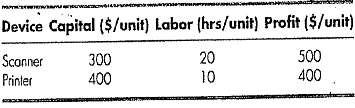
(a) A computer equipment manufacturer produces scanners and printers. The resources needed for producing these devices and the corresponding profits are If there are $127,000 worth of capital and 4270 hours of labor available each day, how many of each device should be produced per day to
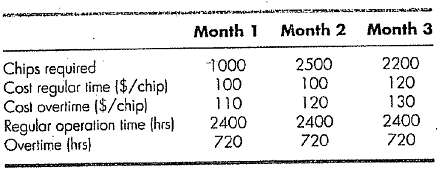
A manufacturer provides specialized microchips. During the next 3 months its sales, costs, and available time are There are no chips in stock at the beginning of the first month. It takes 1.5 hrs of production time to produce a chip and costs $5 to store a chip from one month to next. Determine a
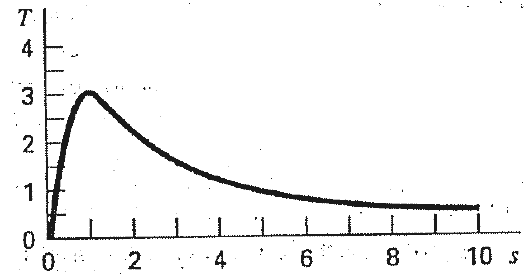
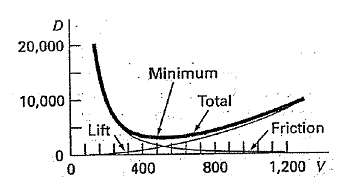
The total drag on an airfoil can be estimated by D = 0.01?V2 + 0.95/? (W/V)2 Friction ? ? ? ? ? ? ? ? ? ? ? ?lift Where D = drag, ? = ratio of air density between the flight altitude and sea level, W = weight, and V = velocity. As seen in Figure. The two factors contributing to drag are affected
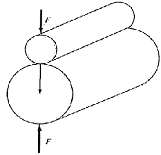
Roller bearings are subject to fatigue failure caused by large contacts loads F (Figure). The problem of finding the location of the maximum stress along the x axis can be shown to be equivalent to maximizing the function ?(x) = 0.4/?1 + x2 ? ?1 + x2 (1 ? 0.4/1 + x2) + x Find the x that maximizes
An aerospace company is developing a new fuel additive for commercial airliners. The additive is composed of three ingredients: X, Y, and Z. For peak performance, the total amount of additive must be at least 6 mL/L of fuel. For safety reasons, the sum of the highly flammable X and Y ingredients
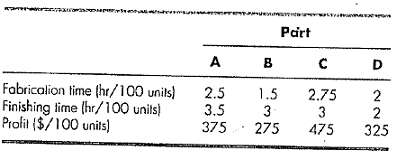
A manufacturing firm produces five types of automobile parts. Each is first fabricated and then finished. The required worker hours and profit for each part are The capacities of the fabrication and finishing shops over the next month are 640 and 960 hours, respectively. Determine how many of
Given the data8.8 9.59.8 9.410.09.410.19.211.3 9.410.010.47.910.4 9.89.8 9.58.9 8.810.610.1 9.59.610.2 8.9Determine(a) The mean,(b) The standard deviation,(c) The variance,(d) The coefficient of variation, and(e) The 95% confidence interval for the mean.
Construct a histogram from the data from Prob. 17.1. Use a range from 7.5 to 11.5 with intervals of 0.5.
Given the data28.6526.5526.6527.6527.3528.3526.8528.6529.6527.8527.0528.2528.8526.7527.6528.4528.6528.4531.6526.3527.7529.2527.6528.6527.6528.5527.6527.25Determine(a) The mean,(b) The standard deviation,(c) The variance,(d) The coefficient of variation, and(e) The 90% confidence interval for the
Use least-squares regression to fit a straight toAlong with the slope and intercept, compute the standard error of the estimate and the correlation coefficient. Plot the data and the regression line. Then repeat the problem, but regress x versus y – that is, switch the variables. Interpret your
Use least-squares regression to fit a straight toAlong with the slope and the intercept, compute the standard error of the estimate and the correlation coefficient. Plot the data and the regression line. If someone made an additional measurement of x = 10, y = 10, would you suspect, based on visual
Using the same approach as was employed to derive Eqs. (17.15) and (17.16), derive the least-squares fit of the following model:y = α1 x + eThat is, determine the slope that results in the least-squares fit for a straight line with a zero intercept. Fit the following data with this model and
Use least-squares regression to fit a straight to(a) Along with the slope and intercept, compute the standard error of the estimate and the correlation coefficient. Plot the data and the straight line. Assess the fit.(b) Recompute (a), but use polynomial regression to fit a parabola to the data.
Fit the following data with(a) A saturation-growth-rate model,(b) A power equation, and(c) A parabola. In each case, Plot the data and theequation.
Fit the following data with the power model (y = αx-b). Use the resulting power equation to predict y at x = 9:
Fit an exponential model toPlot the data and the equation on both standard and semi-logarithmic graphpaper.
Rather than using the base-e exponential model (Eq. 17.22), a common alternative is to use a base-10 model,y = α5 10βsxWhen used for curve fitting, this equation yields identical results to the base-e version, but the value of the exponent parameter (β5) will differ from that estimated with Eq.
Beyond the examples in Figure, there are other models that can be linearized using transformations. For example,y = α4xeβ4xLinearize this model and use it to estimate α4 and β4 based on the following data. Develop a plot of your fit along with the data.
An investigator has reported the data tabulated below for an experiment to determine the growth rate of bacteria k (per d), as a function of oxygen concentration c (mg/L). It is known that such data can be modeled by the following equation:k = kmaxc2/c5 + c2where c5 and kmax are parameters. Use a
Given the dataUse least-squares regression to fit(a) A straight line,(b) A power equation,(c) A saturation-growth-rate equation, and(d) A parabola. Plot the data along with all the curves. Is any one of the curves superior? If so,justify.
Fit a cubic equation to the following data:Along with the coefficients, determine r2 andsy/x.
Use multiple linear regression to fitCompute the coefficients, the standard error of the estimate, and the correlationcoefficient.
Use multiple linear regression to fitCompute the coefficients, the standard error of the estimate, and the correlationcoefficient.
Use nonlinear regression to fit a parabola to the followingdata:
Use nonlinear regression to fit a saturation-growth-rate equation to the data in Prob. 17. 14.
Recompute the regression fits from Probs.(a) 17.4, and(b) 17.15, using the matrix approach. Estimate the standard errors and develop 90% confidence intervals for the coefficients.
Develop, debug, and test a program in either a high-level language or macro language of your choice to implement linear regression. Among other things:(a) Include statements to document the code, and(b) Determine the standard error and the coefficient of determination.
A material is tested for cyclic fatigue failure whereby a stress, in MPa, is applied to the material and the number of cycles needed to cause failure is measured. The results are in the table below. When a log-log plot of stress versus cycles is generated, the data trend shows a linear
The following data shows the relationship between the viscosity of SAE 70 oil and temperature. After taking the log of the data, use linear regression to find the equation of the line that best fits the data and the r2value.
The data below represents the bacterial growth in a liquid culture over a number of days.Find a best-fit equation to the data trend. Try several possibilities-linear, parabolic, and exponential. Use the software package of your choice to find the best equation to predict the amount of bacteria
The concentration of E. coli bacteria in a swimming area is monitored after a storm:The time is measured in hours following the end of the storm and the unit CFU is a "colony forming unit" Use this data to estimate.(a) The concentration at the end of the storm (t = 0) and(b) The time at which the
An object is suspended in a wind tunnel and the force measured for various levels of wind velocity. The results are tabulated below. Use least-squares regression to fit a straight line to this data.Use least-squares regression to fit this data with(a) A straight line,(b) A power equation based on
Fit a power model to the data from Prob. 17.26, but use natural logarithms to perform the transformations.
Using the same approach as was employed to derive Eqs. (17.15) and (17.16), derive the least-squares fit of the following model:y = α1x + α2x2 + eThat is, determine the coefficients that results in the least-squares fit for a second-order polynomial with a zero intercept. Test the approach by
In Prob. 17.12 we used transformations to linearize and fit the following model:y = α4xeβ4xUse nonlinear regression to estimate α4 and β4 based on the following data. Develop a Plot of your fit along with the data.
Estimate the common logarithm of 10 using-linear interpolation.(a) Interpolate between log 8 = 0.903900 and log 12 = 1.0791812.(b) Interpolate between log 9 = 0.9542425 and log 11 = 1.0413927. For each of the interpolations, compute the percent relative error based on the true value.
Fit a second-order Newton’s interpolating polynomial to estimate log 10 using the data from Prob. 18.1 at x = 8, 9, and 11. Compute the true percent relative error.
Fit a third-order Newton’s interpolating polynomial to estimate log 10 using the data from Prob. 18.1.
Given the data(a) Calculate ƒ(2.8) using Newton’s interpolating polynomials of order 1 through 3. Choose the sequence of the points for your estimates to attain the best possible accuracy.(b) Utilize Eq. (18.18) to estimate the error for each prediction.
Given the data Calculate ƒ(4) using Newton’s interpolating polynomials of order 1 through 4. Choose your base points to attain good accuracy. What do your results indicate regarding the order of the polynomial used to generate the data in the table?
Repeat Probs. 18.1 through 18.3 using the Lagrange polynomial.
Repeat Prob. 18.5 using Lagrange polynomials of order 1 through 3.
Employ inverse interpolation using a cubic interpolating polynomial and bisection to determine the value of x that corresponds to Æ’(x) = 0.23 for the following tabulateddata:
Employ inverse interpolation to determine the value of x that corresponds to Æ’(x) = 0.85 for the following tabulated data:Note that the values in the table ware generated with the functionÆ’(x) = x3/(2 + x3).(a) Determine the correct value analytically.(b) Use cubic interpolation of x versus
Develop quadratic splines for the first 5 data points in Prob. 18.4 and predict ƒ(3.4) and ƒ(2.2).
Develop cubic splines for the data in Prob. 18.5 and(a) Predict ƒ(4) and ƒ(2.5) and(b) Verify that ƒ2(3) and ƒ3(3) = 19.
Determine the coefficients of the parabola that passes through the last three points in Prob. 18.4.
Determine the coefficients of the cubic equation that passes through the first four points in Prob. 18.5.
Develop, debug, and test a program in either a high-level language or macro language of your choice to implement Newton’s interpolating polynomial based on Figure.
Test the program you developed in Prob. 18.14 by duplicating the computation from Example 18.5.
Use the program you developed in Prob. 18.14 to solve Probs. 18.1 through 18.3.
Use the program you developed in Prob. 18.14 to solve Probs. 18.4 and 18.5. In Problem 18.4, utilized all data to develop first- through fifth-order polynomials. For both problems, plot the estimated error versus order.
Develop, debug, and test a program in either a high-level language or macro language of your choice to implement Lagrange interpolation. Base it on the pseudocode from Figure. Test it by duplicating Example 18.7.
A useful application of Lagrange interpolation is called a table look-up. As the name implies, this involves “looking-up” an intermediate value from a table. To develop such an algorithm, the table of x and ƒ(x) values are first stored in a pair of one-dimensional arrays. These values are then
Develop, debug, and test a program in either a high-level language or macro language of your choice to implement cubic spline interpolation based on Figure. Test the program by duplicating Example 18.10.
Use the software developed in Prob. 18.20 to fit cubic splines through the data in Probs. 18.4 and 18.5. For both cases, predict ƒ(2.25).
Use the portion of the given steam table for superheated H2O at 200 MPa to(a) Find the corresponding entropy s for a specific volume v of 0.108 m3/kg with linear interpolation,(b) Find the same corresponding entropy using quadratic interpolation, and(c) Find the volume corresponding to an entropy
The pH in a reactor varies sinusoidally over the course of a day. Use least-squares regression to fit Eq. (19.11) to the following data. Use your fit to determine the mean, amplitude, and time of maximumpH.
The solar radiation for Tucson, Arizona, has been tabulated asAssuming each month is 30 days long, fit a sinusoid to this data. Use the resulting equation to predict the radiation inmid-August.
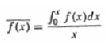
The average values of a function can be determined byUse this relationship to verify the results of Eq.(19.13).
Use a continuous Fourier series to approximate the sawtooth wave in Figure. Plot the first three terms along with thesummation.
Use a continuous Fourier series to approximate the wave from in Figure. Plot the first three terms along with thesummation.
Construct amplitude and phase line spectra for Prob. 19.4.
Construct amplitude and phase line spectra for Prob. 19.5.
A half-wave rectifier can be characterized bywhere C1 is the amplitude of the wave. Plot the first four terms along with thesummation.
Construct amplitude and phase line spectra for Prob. 19.8.
Develop a user-friendly program for the DFT based on the algorithm from Figure. Test it by duplicatingFigure.
Use the program from Prob. 19.10 to compute a DFT for the triangular wave from Prob. 19.8. Sample the wave from t = 0 to 4T. Use 32, 64, and 128 sample points. Time each run and plot execution versus N to verifyFigure.
Develop a user-friendly program for the FFT based on the algorithm from Figure. Test it by duplicating Figure.
Repeat Prob. 19.11 using the software you developed in Prob. 19.12.
An object is suspended in a wind tunnel and the force measured for various levels of wind velocity. The results are tabulated below. Use Excel’s Trendline command to fit a power equation to this data. Plot F versus υ along with the power equation and r2.
Use the Excel Data Analysis Toolpack to develop a regression polynomial to the following data for the dissolved oxygen concentration of fresh water versus temperature at sea level. Determine the order of polynomial necessary to match the precision of thedata.
Use the Excel Data Analysis Toolpack to fit a straight line to the following data. Determine the 90% confidence interval for the intercept. If it encompasses zero, redo the regression, but with the intercept forced to be zero (this is an option on the Regression dialoguebox).
(a) Use MATLAB to fit a cubic spline to the following data:Determine the value of y at x = 1.5.(b) Repeat (a), but with zero first derivatives at the end knots. Note that the MATLAB help facility describes how to prescribe endderivatives.
Use MATLAB to generate 64 points from the functionƒ(t) = cos(10t) + sin(3t)from t = 0 to 2π. Add a random component to the signal with the function randn. Take an FFT of these values and plot the results.
In a fashion similar to Sec. 19.8.2, use MATLAB to fit the data from Prob. 19.15 using(a) Linear interpolation,(b) A third-order regression polynomial, and(c) A spline. Use each approach to predict oxygen concentration at T = 10.
Runge’s function is written asƒ(x) = 1/1 + 25x2Generate 9 equidistantly spaced values of this function over the interval: [-1, 1]. Fit this data with(a) An eighth-order polynomial,(b) A linear spline, and(c) A cubic spline. Present your results graphically.
Repeat Prob. 19.15, but use the IMSL routine, RCURV.
A dye is injected into the circulating blood volume to measure a patient’s cardiac output, which is the volume flow rate of blood out of the left ventricle of the heart. In other words, cardiac output is the number of liters of blood your heart pumps in a minute. For a person at rest, the rate
In electric circuits, it is common to see current behavior in the form of a square ware as shown in Figure. Solving for the Fourier series fromWe get the Fourier seriesLet A0 = 1 and T = 0.25 s. Plot the first six terms of the Fourier series individually, as well as the sum of these six terms. Use
Develop a plot of the following data with(a) Sixth-order interpolating polynomial,(b) A cubic spline, and(c) A cubic spline with zero end derivatives.In each case, compare your plot with the following equation, which was used to generate the data.
Perform the same computation as in Sec. 20.1, but use linear regression and transformations to fit the data with a power equation. Assess the result.
You perform experiments and determine the following values of heat capacity c at various temperatures T for a gas:Use regression to determine a model to predict c as a function ofT.
The saturation concentration of dissolved oxygen in water as a function of temperature and chloride concentration is listed Table P20.3. Use interpolation to estimate the dissolved oxygen level for T= 18°C with chloride = 10 g/L.
For the data in Table P20.3, use polynomial regression to derive a third-order predictive equation for dissolved oxygen concentration as a function of temperature for the case where chloride concentration is equal to 10 g/L. Use the equation to estimate the dissolved oxygen concentration for T =
Use multiple linear regression to derive a predictive equation for dissolved oxygen concentration as a function of temperature and chloride based on the data from Table P20.3. Use the equation to estimate the concentration of dissolved oxygen for a chloride concentration of 5 g/L at T = l7°C.
As compared to the models from Probs. 20.4 and 20.5, a somewhat more sophisticated model that accounts for the effect of both temperature and chloride on dissolved oxygen saturation can be hypothesized as being of the form,os = α0 + ƒ3(T) + ƒ1(c)That is, a constant plus a third-order polynomial
Showing 400 - 500
of 3402
1
2
3
4
5
6
7
8
9
10
11
12
13
14
15
Last
Step by Step Answers

 Get 50% OFF
Claim Now
Get 50% OFF
Claim Now


.png)
.png)
.png)
.png)
.png)
.png)
.png)
.png)
.png)
.png)
.png)
.png)
.png)
.png)
.png)
.png)
.png)
.png)
.png)
.png)
.png)
.png)
.png)
.png)
.png)
.png)
.png)
.png)
.png)
.png)
.png)
.png)
.png)
.png)
.png)
.png)
-1.png)
-2.png)
-1.png)
-2.png)
-3.png)
-1.png)
-2.png)
.png)
.png)


