New Semester
Started
Get
50% OFF
Study Help!
--h --m --s
Claim Now
Question Answers
Textbooks
Find textbooks, questions and answers
Oops, something went wrong!
Change your search query and then try again
S
Books
FREE
Study Help
Expert Questions
Accounting
General Management
Mathematics
Finance
Organizational Behaviour
Law
Physics
Operating System
Management Leadership
Sociology
Programming
Marketing
Database
Computer Network
Economics
Textbooks Solutions
Accounting
Managerial Accounting
Management Leadership
Cost Accounting
Statistics
Business Law
Corporate Finance
Finance
Economics
Auditing
Tutors
Online Tutors
Find a Tutor
Hire a Tutor
Become a Tutor
AI Tutor
AI Study Planner
NEW
Sell Books
Search
Search
Sign In
Register
study help
physics
mechanics
Vector Mechanics for Engineers Statics and Dynamics 11th edition Ferdinand Beer, E. Russell Johnston Jr., David Mazurek, Phillip Cornwell, Brian Self - Solutions
A half section of pipe rests on a frictionless horizontal surface as shown. If the half section of pipe has a mass of 9 kg and a diameter of 300 mm, determine the bending moment at Point J when θ= 90°.
A half section of pipe rests on a frictionless horizontal surface as shown. If the half section of pipe has a mass of 9 kg and a diameter of 300 mm, determine the bending moment at point J when θ = 90°.
Determine the internal forces at Point J when α= 90°.
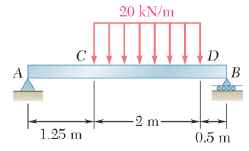
For the beam and loading shown,(a) Draw the shear and bending-moment diagrams,(b) Determine the maximum absolute values of the shear and bending moment.
Determine the internal forces at Point J when α= 0.
For the frame and loading shown, determine the internal forces at the point indicated:Point J.
Determine(a) The distance a for which the maximum absolute value of the bending moment in beam AB is as small as possible,(b) The corresponding value of |M|max.
For the beam and loading shown, determine (a) the distance a for which the maximum absolute value of the bending moment in the beam is as small as possible, (b) the corresponding value of |M|max.
A uniform beam is to be picked up by crane cables attached at A and B. Determine the distance a from the ends of the beam to the points where the cables should be attached if the maximum absolute value of the bending moment in the beam is to be as small as possible.
For the frame and loading shown, determine the internal forces at the point indicated:Point K.
Knowing that P = Q = 150 lb, determine(a) The distance a for which the maximum absolute value of the bending moment in beam AB is as small as possible,(b) The corresponding value of max||.M (See hint for Problem 7.55.)
Solve Problem 7.60 assuming that P = 300 lb and Q= 150 lb.PROBLEM 7.60 Knowing that P =Q= 150 lb, determine(a) The distance a for which the maximum absolute value of the bending moment in beam AB is as small as possible,(b) The corresponding value of max||.M (See hint for Problem 7.55.)
For the beam and loading shown,(a) Draw the shear and bending-moment diagrams,(b) Determine the maximum absolute values of the shear and bending moment.
An archer aiming at a target is pulling with a 45-lb force on the bowstring. Assuming that the shape of the bow can be approximated by a parabola, determine the internal forces at Point J.
For the beam and loading shown,(a) Draw the shear and bending-moment diagrams,(b) Determine the maximum absolute values of the shear and bending moment.
For the beam and loading shown,(a) Draw the shear and bending-moment diagrams,(b) Determine the maximum absolute values of the shear and bending moment.
For the beam and loading shown,(a) Draw the shear and bending-moment diagrams,(b) Determine the maximum absolute values of the shear and bending moment.
For the beam and loading shown,(a) Draw the shear and bending-moment diagrams,(b) Determine the magnitude and location of the maximum absolute value of the bending moment.
For the beam and loading shown,(a) Draw the shear and bending-moment diagrams,(b) Determine the magnitude and location of the maximum absolute value of the bending moment.
For the beam and loading shown,(a) Draw the shear and bending-moment diagrams,(b) Determine the magnitude and location of the maximum bending moment.
For the bow of Problem 7.7, determine the magnitude and location of the maximum(a) Axial force,(b) Shearing force,(c) Bending moment.PROBLEM 7.7 An archer aiming at a target is pulling with a 45-lb force on the bowstring. Assuming that the shape of the bow can be approximated by a parabola,
For the beam and loading shown,(a) Draw the shear and bending-moment diagrams,(b) Determine the magnitude and location of the maximum bending moment.
For the beam and loading shown,(a) Draw the shear and bending-moment diagrams,(b) Determine the magnitude and location of the maximum absolute value of the bending moment.
For the beam and loading shown,(a) Draw the shear and bending-moment diagrams,(b) Determine the magnitude and location of the maximum absolute value of the bending moment.
(a) Draw the shear and bending-moment diagrams for beam AB,(b) Determine the magnitude and location of the maximum absolute value of the bending moment.
Solve Problem 7.83 assuming that the 300-lb force applied at D is directed upward.PROBLEM 7.83 (a) Draw the shear and bending-moment diagrams for beam AB, (b) determine the magnitude and location of the maximum absolute value of the bending moment.
For the beam and loading shown,(a) Write the equations of the shear and bending-moment curves,(b) Determine the magnitude and location of the maximum bending moment.
For the beam and loading shown,(a) Write the equations of the shear and bending-moment curves,(b) Determine the magnitude and location of the maximum bending moment.
Knowing that the maximum tension in cable ABCDE is 25 kN, determine the distance dC.
If dc = 8 ft, determine(a) The reaction at A,(b) The reaction at E.
Knowing that dC = 3m, determine(a) The distances Bd and Dd(b) The reaction at E.
Determine(a) Distance dC for which portion DE of the cable is horizontal,(b) The corresponding reactions at A and E.
If dC = 15 ft, determine(a) The distances dB and dD,(b) The maximum tension in the cable.
Determine whether the block shown is in equilibrium and find the magnitude and direction of the friction force when P = 150 N.
Knowing that P = 100 N, determine the range of values of θ for which equilibrium of the 7.5-kg block is maintained.
A 900-kg machine base is rolled along a concrete floor using a series of steel pipes with outside diameters of 100 mm. Knowing that the coefficient of rolling resistance is 0.5 mm between the pipes and the base and 1.25 mm between the pipes and the concrete floor, determine the magnitude of the
A rope having a weight per unit length of 0.4 lb/ft is wound 2 1/2 times around a horizontal rod. Knowing that the coefficient of static friction between the rope and the rod is 0.30, determine the minimum length x of rope that should be left hanging if a 100-lb load is to be supported.
A hawser is wrapped two full turns around a bollard. By exerting an 80-lb force on the free end of the hawser, a dockworker can resist a force of 5000 lb on the other end of the hawser. Determine (a) The coefficient of static friction between the hawser and the bollard, (b) The number of times the
The 50-lb block A and the 25-lb block B are supported by an incline that is held in the position shown. Knowing that the coefficient of static friction is 0.15 between the two blocks and zero between block B and the incline, determine the value of θ for which motion is impending.
A flat belt is used to transmit a couple from pulley A to pulley B. The radius of each pulley is 60 mm, and a force of magnitude P = 900 N is applied as shown to the axle of pulley A. Knowing that the coefficient of static friction is 0.35, determine(a) The largest couple that can be
Solve Problem 8.113 assuming that the belt is looped around the pulleys in a figure eight. PROBLEM 8.113 A flat belt is used to transmit a couple from pulley A to pulley B. The radius of each pulley is 60 mm, and a force of magnitude P = 900 N is applied as shown to the axle of pulley A. Knowing
The speed of the brake drum shown is controlled by a belt attached to the control bar AD. A force P of magnitude 25 lb is applied to the control bar at A. Determine the magnitude of the couple being applied to the drum, knowing that the coefficient of kinetic friction between the belt and the drum
The speed of the brake drum shown is controlled by a belt attached to the control bar AD. Knowing that a = 4 in., determine the maximum value of the coefficient of static friction for which the brake is not self-locking when the drum rotates counterclockwise.
The speed of the brake drum shown is controlled by a belt attached to the control bar AD. Knowing that the coefficient of static friction is 0.30 and that the brake drum is rotating counterclockwise, determine the minimum value of a for which the brake is not self-locking.
The 50-lb block A and the 25-lb block B are supported by an incline that is held in the position shown. Knowing that the coefficient of static friction is 0.15 between all surfaces of contact, determine the value of θ for which motion is impending.
A cable is placed around three parallel pipes. Knowing that the coefficients of friction are μs = 0.25 and μk = 0.20, determine(a) The smallest weight W for which equilibrium is maintained,(b) The largest weight W that can be raised if pipe B is slowly rotated
A cable is placed around three parallel pipes. Two of the pipes are fixed and do not rotate; the third pipe is slowly rotated. Knowing that the coefficients of friction are μs = 0.25 and μk = 0.20, determine the largest weight W that can be raised(a) If only pipe A is
A cable is placed around three parallel pipes. Knowing that the coefficients of friction are μs = 0.25 and μk = 0.20, determine(a) The smallest weight W for which equilibrium is maintained,(b) The largest weight W that can be raised if pipe B is slowly rotated
A cable is placed around three parallel pipes. Two of the pipes are fixed and do not rotate; the third pipe is slowly rotated. Knowing that the coefficients of friction are μs = 0.25 and μk = 0.20, determine the largest weight W that can be raised(a) If only pipe A is rotated
The 10-lb bar AE is suspended by a cable that passes over a 5-in.-radius drum. Vertical motion of end E of the bar is prevented by the two stops shown. Knowing that μs = 0.30 between the cable and the drum, determine(a) The largest counterclockwise couple M0 that can be applied to the
Solve Problem 8.128 assuming that a clockwise couple M0 is applied to the drum.PROBLEM 8.128The 10-lb bar AE is suspended by a cable that passes over a 5-in.-radius drum. Vertical motion of end E of the bar is prevented by the two stops shown. Knowing that μs = 0.30 between the cable
Three 4-kg packages A, B, and C are placed on a conveyor belt that is at rest. Between the belt and both packages A and C the coefficients of friction are μs = 0.30 and μk = 0.20; between package B and the belt the coefficients are μs = 0.10 and μk = 0.08. The packages are placed on the belt so
The hydraulic cylinder shown exerts a force of 3 kN directed to the right on Point B and to the left on Point E. Determine the magnitude of the couple M required to rotate the drum clockwise at a constant speed.
A rod DE and a small cylinder are placed between two guides as shown. The rod is not to slip downward, however large the force P may be; i.e., the arrangement is said to be self-locking. Neglecting the weight of the cylinder, determine the minimum allowable coefficients of static friction at A, B,
Solve Problem 8.13 assuming that package B is placed to the right of both packages A and C.PROBLEM 8.13Three 4-kg packages A, B, and C are placed on a conveyor belt that is at rest. Between the belt and both packages A and C the coefficients of friction are μs = 0.30 and
Two 10° wedges of negligible weight are used to move and position the 400- lb block. Knowing that the coefficient of static friction is 0.25 at all surfaces of contact, determine the smallest force P that should be applied as shown to one of the wedges.
A 10° wedge is used to split a section of a log. The coefficient of static friction between the wedge and the log is 0.35. Knowing that a force P of magnitude 600 lb was required to insert the wedge, determine the magnitude of the forces exerted on the wood by the wedge after insertion.
In the gear-pulling assembly shown the square-threaded screw AB has a mean radius of 15 mm and a lead of 4 mm. Knowing that the coefficient of static friction is 0.10, determine the couple that must be applied to the screw in order to produce a force of 3 kN on the gear. Neglect friction at end A
A lever of negligible weight is loosely fitted onto a 30-mmradius fixed shaft as shown. Knowing that a force P of magnitude 275 N will just start the lever rotating clockwise, determine(a) The coefficient of static friction between the shaft and the lever,(b) The smallest force P for which the
A uniform crate with a mass of 30 kg must be moved up along the 15° incline without tipping. Knowing that force P is horizontal, determine(a) The largest allowable coefficient of static friction between the crate and the incline,(b) The corresponding magnitude of force P.
A worker slowly moves a 50-kg crate to the left along a loading dock by applying a force P at corner B as shown. Knowing that the crate starts to tip about the edge E of the loading dock when a = 200 mm, determine(a) The coefficient of kinetic friction between the crate and the loading dock,(b) The
A half-section of pipe weighing 200 lb is pulled by a cable as shown. The coefficient of static friction between the pipe and the floor is 0.40. If α = 30°, determine(a) The tension T required to move the pipe,(b) Whether the pipe will slide or tip.
A 120-lb cabinet is mounted on casters that can be locked to prevent their rotation. The coefficient of static friction between the floor and each caster is 0.30. Assuming that the casters at both A and B are locked, determine(a) The force P required to move the cabinet to the right,(b) The largest
Wire is being drawn at a constant rate from a spool by applying a vertical force P to the wire as shown. The spool and the wire wrapped on the spool have a combined weight of 20 lb. Knowing that the coefficients of friction at both A and B are μs = 0.40 and μk = 0.30,
Determine whether the block shown is in equilibrium and find the magnitude and direction of the friction force when P = 400 N.
Solve Problem 8.19 assuming that the coefficients of friction at B are zero.PROBLEM 8.19Wire is being drawn at a constant rate from a spool by applying a vertical force P to the wire as shown. The spool and the wire wrapped on the spool have a combined weight of 20 lb. Knowing that the coefficients
End A of a slender, uniform rod of length L and weight W bears on a surface as shown, while end B is supported by a cord BC. Knowing that the coefficients of friction are μs = 0.40 and μk = 0.30, determine(a) The largest value of θ for which motion is
The press shown is used to emboss a small seal at E. Knowing that the coefficient of static friction between the vertical guide and the embossing die D is 0.30, determine the force exerted by the die on the seal.
The 50-lb plate ABCD is attached at A and D to collars that can slide on the vertical rod. Knowing that the coefficient of static friction is 0.40 between both collars and the rod, determine whether the plate is in equilibrium in the position shown when the magnitude of the vertical force applied
Determine whether the block shown is in equilibrium and find the magnitude and direction of the friction force when P = 120 lb.
In Problem 8.29, determine the range of values of the magnitude P of the vertical force applied at E for which the plate will move downward.PROBLEM 8.29The 50-lb plate ABCD is attached at A and D to collars that can slide on the vertical rod. Knowing that the coefficient of static friction is 0.40
A window sash weighing 10 lb is normally supported by two 5-lb sash weights. Knowing that the window remains open after one sash cord has broken, determine the smallest possible value of the coefficient of static friction. (Assume that the sash is slightly smaller than the frame and will bind only
A 500-N concrete block is to be lifted by the pair of tongs shown. Determine the smallest allowable value of the coefficient of static friction between the block and the tongs at F and G.
A safety device used by workers climbing ladders fixed to high structures consists of a rail attached to the ladder and a sleeve that can slide on the flange of the rail. A chain connects the worker's belt to the end of an eccentric cam that can be rotated about an axle attached to the sleeve at C.
To be of practical use, the safety sleeve described in Problem 8.34 must be free to slide along the rail when pulled upward. Determine the largest allowable value of the coefficient of static friction between the flange of the rail and the pins at A and B if the sleeve is to be free to slide when
A 1.2-m plank with a mass of 3 kg rests on two joists. Knowing that the coefficient of static friction between the plank and the joists is 0.30, determine the magnitude of the horizontal force required to move the plank when(a) A = 750 mm,(b) A = 900 mm.
Two rods are connected by a collar at B. A couple MA with a magnitude of 15 N·m is applied to rod AB. Knowing that the coefficient of static friction between the collar and the rod is 0.30, determine the largest couple MC for which equilibrium will be maintained.
Determine whether the block shown is in equilibrium and find the magnitude and direction of the friction force when P = 80 lb.
In Prob. 8.39, determine the smallest couple MC for which equilibrium will be maintained.PROBLEM 8.39Two rods are connected by a collar at B. A couple MA with a magnitude of 15 N·m is applied to rod AB. Knowing that the coefficient of static friction between the collar and the rod is 0.30,
A 10-ft beam, weighing 1200 lb, is to be moved to the left onto the platform. A horizontal force P is applied to the dolly, which is mounted on frictionless wheels. The coefficients of friction between all surfaces are μs = 0.30 and μk = 0.25, and initially x = 2 ft. Knowing that the top
(a) Show that the beam of Problem 8.41 cannot be moved if the top surface of the dolly is slightly lower than the platform.(b) Show that the beam can be moved if two 175-lb workers stand on the beam at B and determine how far to the left the beam can be moved.PROBLEM 8.41A 10-ft beam, weighing 1200
Two 8-kg blocks A and B resting on shelves are connected by a rod of negligible mass. Knowing that the magnitude of a horizontal force P applied at C is slowly increased from zero, determine the value of P for which motion occurs, and what that motion is, when the coefficient of static friction
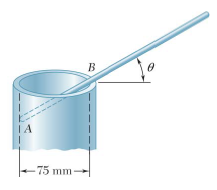
A slender steel rod of length 225 mm is placed inside a pipe as shown. Knowing that the coefficient of static friction between the rod and the pipe is 0.20, determine the largest value of θ for which the rod will not fall into the pipe.
In Problem 8.44, determine the smallest value of θ for which the rod will not fall out the pipe.PROBLEM 8.44A slender steel rod of length 225 mm is placed inside a pipe as shown. Knowing that the coefficient of static friction between the rod and the pipe is 0.20, determine the largest value of θ
Two slender rods of negligible weight are pin-connected at C and attached to blocks A and B, each of weight W. Knowing that P = 1.260W and that the coefficient of static friction between the blocks and the horizontal surface is 0.30, determine the range of values of θ, between 0 and 180°, for
The machine part ABC is supported by a frictionless hinge at B and a 10° wedge at C. Knowing that the coefficient of static friction is 0.20 at both surfaces of the wedge, determine(a) The force P required to move the wedge to the left,(b) The components of the corresponding reaction at B.
Solve Prob. 8.48 assuming that the wedge is moved to the right.PROBLEM 8.48The machine part ABC is supported by a frictionless hinge at B and a 10° wedge at C. Knowing that the coefficient of static friction is 0.20 at both surfaces of the wedge, determine(a) The force P required to move the
Determine the smallest value of P required to(a) Start the block up the incline,(b) Keep it moving up.
Two 8° wedges of negligible weight are used to move and position the 800-kg block. Knowing that the coefficient of static friction is 0.30 at all surfaces of contact, determine the smallest force P that should be applied as shown to one of the wedges.
Two 8° wedges of negligible weight are used to move and position the 800-kg block. Knowing that the coefficient of static friction is 0.30 at all surfaces of contact, determine the smallest force P that should be applied as shown to one of the wedges.
Block A supports a pipe column and rests as shown on wedge B. Knowing that the coefficient of static friction at all surfaces of contact is 0.25 and that θ = 45°, determine the smallest force P required to raise block A.
Block A supports a pipe column and rests as shown on wedge B. Knowing that the coefficient of static friction at all surfaces of contact is 0.25 and that θ = 45°, determine the smallest force P for which equilibrium is maintained.
Block A supports a pipe column and rests as shown on wedge B. The coefficient of static friction at all surfaces of contact is 0.25. If P = 0, determine(a) The angle θ for which sliding is impending,(b) The corresponding force exerted on the block by the vertical wall.
A wedge A of negligible weight is to be driven between two 100-lb blocks B and C resting on a horizontal surface. Knowing that the coefficient of static friction between all surfaces of contact is 0.35, determine the smallest force P required to start moving the wedge(a) If the blocks are equally
A 15° wedge is forced into a saw cut to prevent binding of the circular saw. The coefficient of static friction between the wedge and the wood is 0.25. Knowing that a horizontal force P with a magnitude of 30 lb was required to insert the wedge, determine the magnitude of the forces exerted on
A 12° wedge is used to spread a split ring. The coefficient of static friction between the wedge and the ring is 0.30. Knowing that a force P with a magnitude of 120 N was required to insert the wedge, determine the magnitude of the forces exerted on the ring by the wedge after insertion.
The spring of the door latch has a constant of 1.8 lb/in. and in the position shown exerts a 0.6-lb force on the bolt. The coefficient of static friction between the bolt and the strike plate is 0.40; all other surfaces are well lubricated and may be assumed frictionless. Determine the magnitude of
In Problem 8.60, determine the angle that the face of the bolt should form with the line BC if the force P required to close the door is to be the same for both the position shown and the position when B is almost at the strike plate.PROBLEM 8.60The spring of the door latch has a constant of 1.8
A 5° wedge is to be forced under a 1400-lb machine base at A. Knowing that the coefficient of static friction at all surfaces is 0.20,(a) Determine the force P required to move the wedge,(b) Indicate whether the machine base will move.
Solve Problem 8.62 assuming that the wedge is to be forced under the machine base at B instead of A.PROBLEM 8.62A 5° wedge is to be forced under a 1400-lb machine base at A. Knowing that the coefficient of static friction at all surfaces is 0.20,(a) Determine the force P required to move the
Showing 16400 - 16500
of 21795
First
158
159
160
161
162
163
164
165
166
167
168
169
170
171
172
Last
Step by Step Answers

 Get 50% OFF
Claim Now
Get 50% OFF
Claim Now


.png)
.png)
.png)
.png)
.png)
.png)
.png)
.png)
.png)
.png)
.png)
.png)
.png)
.png)
.png)
.png)
.png)
.png)
.png)
.png)
.png)
.png)
.png)
.png)
.png)
.png)
.png)
.png)
.png)
.png)
.png)
.png)
.png)
.png)
.png)
.png)
.png)
.png)
.png)
.png)
.png)
.png)
.png)
.png)
.png)
.png)
.png)
.png)
.png)
.png)
.png)
.png)
.png)
.png)
.png)
.png)
.png)
.png)
.png)
.png)
.png)
.png)
.png)
.png)
.png)
.png)
.png)
.png)
.png)
.png)
.png)
.png)
.png)
.png)
.png)
.png)
.png)
.png)
.png)
.png)
.png)
.png)
.png)
.png)
.png)
.png)
.png)
.png)
.png)
.png)
.png)
.png)
.png)
.png)
.png)


