New Semester
Started
Get
50% OFF
Study Help!
--h --m --s
Claim Now
Question Answers
Textbooks
Find textbooks, questions and answers
Oops, something went wrong!
Change your search query and then try again
S
Books
FREE
Study Help
Expert Questions
Accounting
General Management
Mathematics
Finance
Organizational Behaviour
Law
Physics
Operating System
Management Leadership
Sociology
Programming
Marketing
Database
Computer Network
Economics
Textbooks Solutions
Accounting
Managerial Accounting
Management Leadership
Cost Accounting
Statistics
Business Law
Corporate Finance
Finance
Economics
Auditing
Tutors
Online Tutors
Find a Tutor
Hire a Tutor
Become a Tutor
AI Tutor
AI Study Planner
NEW
Sell Books
Search
Search
Sign In
Register
study help
physics
mechanics
Vector Mechanics for Engineers Statics and Dynamics 11th edition Ferdinand Beer, E. Russell Johnston Jr., David Mazurek, Phillip Cornwell, Brian Self - Solutions
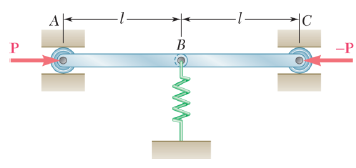
Two bars AB and BC of negligible weight are attached to a single spring of constant k that is unstretched when the bars are horizontal. Determine the range of values of the magnitude P of two equal and opposite forces P and -P for which the equilibrium of the system is stable in the position shown.
Rod AD is acted upon by a vertical force P at end A, and by two equal and opposite horizontal forces of magnitude Q at points B and C. Derive an expression for the magnitude Q of the horizontal forces required for equilibrium.
A vertical bar AD is attached to two springs of constant k and is in equilibrium in the position shown. Determine the range of values of the magnitude P of two equal and opposite vertical forces P and -P for which the equilibrium position is stable if (a) AB = CD, (b) AB = 2CD.
Rod AB is attached to a hinge at A and to two springs, each of constant k. If h = 25 in., d = 12 in., and W = 80 lb, determine the range of values of k for which the equilibrium of the rod is stable in the position shown. Each spring can act in either tension or compression.
Rod AB is attached to a hinge at A and to two springs, each of constant k. If h = 45 in., k = 6 lb/in., and W = 60 lb, determine the smallest distance d for which the equilibrium of the rod is stable in the position shown. Each spring can act in either tension or compression.
The horizontal bar BEH is connected to three vertical bars. The collar at E can slide freely on bar DF. Determine the range of values of Q for which the equilibrium of the system is stable in the position shown when a = 24 in., b = 20 in., and P = 150 lb.
The horizontal bar BEH is connected to three vertical bars. The collar at E can slide freely on bar DF. Determine the range of values of P for which the equilibrium of the system is stable in the position shown when a = 150 mm, b = 200 mm, and Q = 45 N.
Two rods of negligible weight are attached to drums of radius r that are connected by a belt and spring of constant k. Knowing that the spring is undeformed when the rods are vertical, determine the range of values of P for which the equilibrium position θ1 = θ2 = 0 is stable.
A snowboarder starts from rest at the top of a double black diamond hill. As he rides down the slope, GPS coordinates are used to determine his displacement as a function of time: x = 0.5t3 + t2 + 2t where x and t are expressed in ft and seconds, respectively. Determine the position, velocity, and
The acceleration of a particle is defined by the relation a = kt2.(a) Knowing that v = - 8 m/s when t = 0 and that v = + 8 m/s when t = 2 s, determine the constant k.(b) Write the equations of motion, knowing also that x = 0 when t = 2 s.
A piece of electronic equipment that is surrounded by packing material is dropped so that it hits the ground with a speed of 4 m/s. After contact the equipment experiences an acceleration of a = - kx, where k is a constant and x is the compression of the packing material. If the packing material
The acceleration of a particle is defined by the relation a = - k/x. It has been experimentally determined that v = 15 ft/s when x = 0.6 ft and that v = 9 ft/s when x = 1.2 ft. Determine (a) The velocity of the particle when x = 1.5 ft, (b) The position of the particle at which its velocity is zero.
The motion of a particle is defined by the relation x = 2t3 + 9t2 + 12t + 10, where x and t are expressed in feet and seconds, respectively. Determine the time, the position, and the acceleration of the particle when v = 0.
A spring AB is attached to a support at A and to a collar. The unstretched length of the spring is l. Knowing that the collar is released from rest at x = x0 and has an acceleration defined by the relation a = - 100(x - lx/ √l2 + x2), determine the velocity of the collar as it passes through
The vertical motion of mass A is defined by the relation x = 10 sin 2t + 15cos 2t + 100, where x and t are expressed in mm and seconds, respectively. Determine(a) The position, velocity and acceleration of A when t = 1 s,(b) The maximum velocity and acceleration of A
A loaded railroad car is rolling at a constant velocity when it couples with a spring and dashpot bumper system. After the coupling, the motion of the car is defined by the relation x = 60e-4.8t sin16t where x and t are expressed in mm and seconds, respectively. Determine the position, the velocity
The motion of a particle is defined by the relation x = 6t4 - 2t3 - 12t2 + 3t + 3, where x and t are expressed in meters and seconds, respectively. Determine the time, the position, and the velocity when a = 0.
The motion of a particle is defined by the relation x = t3 - 9t2 + 24t - 8, where x and t are expressed in inches and seconds, respectively. Determine (a) When the velocity is zero, (b) The position and the total distance traveled when the acceleration is zero.
The brakes of a car are applied, causing it to slow down at a rate of 10 ft/s2. Knowing that the car stops in 100 ft, determine(a) How fast the car was traveling immediately before the brakes were applied,(b) The time required for the car to stop.
Astronauts who landed on the moon during the Apollo 15, 16 and 17 missions brought back a large collection of rocks to the earth. Knowing the rocks weighed 139 lb when they were on the moon, determine(a) The weight of the rocks on the earth,(b) The mass of the rocks in slugs. The acceleration due
A mother and her child are skiing together, and the mother is holding the end of a rope tied to the child's waist. They are moving at a speed of 7.2 km/h on a gently sloping portion of the ski slope when the mother observes that they are approaching a steep descent. She pulls on the rope with an
As a space probe approaching the planet Venus on a parabolic trajectory reaches Point A closest to the planet, its velocity is decreased to insert it into a circular orbit. Knowing that the mass and the radius of Venus are 4.87 × 1024 kg and 6052 km, respectively, determine(a) The velocity of
It was observed that as the Voyager I spacecraft reached the point of its trajectory closest to the planet Saturn, it was at a distance of 185 × 103 km from the center of the planet and had a velocity of 21.0 km/s. Knowing that Tethys, one of Saturn's moons, describes a circular orbit of radius
A satellite describes an elliptic orbit about a planet of mass M. Denoting by r0 and r1, respectively, the minimum and maximum values of the distance r from the satellite to the center of the planet, derive the relationWhere h is the angular momentum per unit mass of the satellite.
A space probe is describing a circular orbit about a planet of radius R. The altitude of the probe above the surface of the planet is α R and its speed is v0. To place the probe in an elliptic orbit which will bring it closer to the planet, its speed is reduced from v0 to (v0, where ( < 1, by
A satellite describes a circular orbit at an altitude of 19 110 km above the surface of the earth. Determine(a) The increase in speed required at point A for the satellite to achieve the escape velocity and enter a parabolic orbit,(b) The decrease in speed required at point A for the satellite to
A space probe is to be placed in a circular orbit of 5600 mi radius about the planet Venus in a specified plane. As the probe reaches A, the point of its original trajectory closest to Venus, it is inserted in a first elliptic transfer orbit by reducing its speed by ΔvA. This orbit brings it to
For the space probe of Problem 12.105, it is known that rA = 9.3 × 10³ mi and that the velocity of the probe is reduced to 20,000 ft/s as it passes through A. Determine(a) The distance from the center of Venus to Point B,(b) The amounts by which the velocity of the probe should be reduced at B and
As it describes an elliptic orbit about the sun, a spacecraft reaches a maximum distance of 202 × 106 mi from the center of the sun at Point A (called the aphelion) and a minimum distance of 92 × 106 mi at Point B (called the perihelion). To place the spacecraft in a smaller elliptic orbit
Halley's comet travels in an elongated elliptic orbit for which the minimum distance from the sun is approximately 1/2 rE, where rE = 150 × 106 km is the mean distance from the sun to the earth. Knowing that the periodic time of Halley's comet is about 76 years, determine the maximum distance from
A space probe is to be placed in a circular orbit of radius 4000 km about the planet Mars. As the probe reaches A, the point of its original trajectory closest to Mars, it is inserted into a first elliptic transfer orbit by reducing its speed. This orbit brings it to Point B with a much reduced
A spacecraft and a satellite are at diametrically opposite positions in the same circular orbit of altitude 500 km above the earth. As it passes through point A, the spacecraft fires its engine for a short interval of time to increase its speed and enter an elliptic orbit. Knowing that the
The Clementine spacecraft described an elliptic orbit of minimum altitude hA = 400 km and a maximum altitude of hB = 2940 km above the surface of the moon. Knowing that the radius of the moon is 1737 km and that the mass of the moon is 0.01230 times the mass of the earth, determine the periodic
Determine the time needed for the space probe of Problem 12.100 to travel from B to C?
A long-range ballistic trajectory between Points A and B on the earth's surface consists of a portion of an ellipse with the apogee at Point C. Knowing that Point C is 1500 km above the surface of the earth and the range R ( of the trajectory is 6000 km, determine(a) The velocity of the projectile
As a spacecraft approaches the planet Jupiter, it releases a probe which is to enter the planet's atmosphere at Point B at an altitude of 280 mi above the surface of the planet. The trajectory of the probe is a hyperbola of eccentricity ( = 1.031. Knowing that the radius and the mass of Jupiter are
A light train made up of two cars is traveling at 90 km/h when the brakes are applied to both cars. Knowing that car A has a mass of 25 Mg and car B a mass of 20 Mg, and that the braking force is 30 N on each car, determine(a) The distance traveled by the train before it comes to a stop,(b) The
Derive Kepler's third law of planetary motion from Eqs. (12.37) and (12.43)?
A bucket is attached to a rope of length L = 1.2 m and is made to revolve in a horizontal circle. Drops of water leaking from the bucket fall and strike the floor along the perimeter of a circle of radius a. Determine the radius a when ( = 30o.
A 12-lb block B rests as shown on the upper surface of a 30-lb wedge A. Neglecting friction, determine immediately after the system is released from rest(a) The acceleration of A,(b) The acceleration of B relative to A.
A 500-lb crate B is suspended from a cable attached to a 40-lb trolley A which rides on an inclined I-beam as shown. Knowing that at the instant shown the trolley has an acceleration of 1.2 ft/s2 up and to the right, determine(a) The acceleration of B relative to A,(b) The tension in cable CD.
The roller-coaster track shown is contained in a vertical plane. The portion of track between A and B is straight and horizontal, while the portions to the left of A and to the right of B have radii of curvature as indicated. A car is traveling at a speed of 72 km/h when the brakes are suddenly
The parasailing system shown uses a winch to pull the rider in towards the boat, which is travelling with a constant velocity. During the interval when ( is between 20º and 40º, (where t = 0 at ( = 20º) the angle increases at the constant rate of 2 º/s. During this time, the length of
A small 200-g collar C can slide on a semicircular rod which is made to rotate about the vertical AB at the constant rate of 6 rad/s. Determine the minimum required value of the coefficient of static friction between the collar and the rod if the collar is not to slide when(a) ( = 90o,(b) ( =
Telemetry technology is used to quantify kinematic values of a 200-kg roller coaster cart as it passes overhead. According to the system, r = 25 m, = - 10 m/s, = - 10 m/s, = -2 m/s2, ( = 90o, = -0.4 rad/s, = -0.32 rad/s2. At this instant, determine(a) The normal force between the cart and the
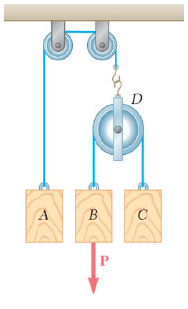
The two blocks shown are originally at rest. Neglecting the masses of the pulleys and the effect of friction in the pulleys and between block A and the incline, determine(a) The acceleration of each block,(b) The tension in the cable.
At engine burnout on a mission, a shuttle had reached Point A at an altitude of 40 mi above the surface of the earth and had a horizontal velocity v0. Knowing that its first orbit was elliptic and that the shuttle was transferred to a circular orbit as it passed through Point B at an altitude of
A space probe in a low earth orbit is inserted into an elliptic transfer orbit to the planet Venus. Knowing that the mass of the sun is 332.8 × 10³ times the mass of the earth and assuming that the probe is subjected only to the gravitational attraction of the sun, determine the value of (,
Disk A rotates in a horizontal plane about a vertical axis at the constant rate (0 = 10 rad/s. Slider B has mass 1 kg and moves in a frictionless slot cut in the disk. The slider is attached to a spring of constant k, which is un-deformed when r = 0. Knowing that the slider is released with no
Solve Problem 12.13, assuming that the coefficients of friction between block A and the incline are (s = 0.25 and (k = 0.20.The two blocks shown are originally at rest. Neglecting the masses of the pulleys and the effect of friction in the pulleys and between block A and the incline, determine(a)
Each of the systems shown is initially at rest. Neglecting axle friction and the masses of the pulleys, determine for each system(a) The acceleration of block A,(b) The velocity of block A after it has moved through 10 ft(c) The time required for block A to reach a velocity of 20 ft/s.
Boxes A and B are at rest on a conveyor belt that is initially at rest. The belt is suddenly started in an upward direction so that slipping occurs between the belt and the boxes. Knowing that the coefficients of kinetic friction between the belt and the boxes are ((k)A = 0.30 and ((k)B = 0.32,
A 5000-lb truck is being used to lift a 1000 lb boulder B that is on a 200 lb pallet A. Knowing the acceleration of the truck is 1 ft / s2, determine(a) The horizontal force between the tires and the ground,(b) The force between the boulder and the pallet?
Block A has a mass of 40 kg, and block B has a mass of 8 kg. The coefficients of friction between all surfaces of contact are (s = 0.20 s and (k = 0.15. If P = 0, determine(a) The acceleration of block B,(b) The tension in the cord.
Block A has a mass of 40 kg, and block B has a mass of 8 kg. The coefficients of friction between all surfaces of contact are (s = 0.20 s and 0.15. k If P = 40 N (, determine(a) The acceleration of block B,(b) The tension in the cord.
The value of g at any latitude ( may be obtained from the formulag = 32.09 (1 + 0.0053 sin2 () ft/s2Which takes into account the effect of the rotation of the earth, as well as the fact that the earth is not truly spherical. Knowing that the weight of a silver bar has been officially designated as
The flat-bed trailer carries two 1500-kg beams with the upper beam secured by a cable. The coefficients of static friction between the two beams and between the lower beam and the bed of the trailer are 0.25 and 0.30, respectively. Knowing that the load does not shift, determine(a) The maximum
A baggage conveyor is used to unload luggage from an airplane. The 10-kg duffel bag A is sitting on top of the 20-kg suitcase B. The conveyor is moving the bags down at a constant speed of 0.5 m/s when the belt suddenly stops. Knowing that the coefficient of friction between the belt and B is 0.3
An airplane has a mass of 25 Mg and its engines develop a total thrust of 40 kN during take-off. If the drag D exerted on the plane has a magnitude D = 2.25v2, where v is expressed in meters per second and D in new-tons, and if the plane becomes airborne at a speed of 240 km/h, determine the length
Block A has a mass of 10 kg, and blocks B and C have masses of 5 kg each. Knowing that the blocks are initially at rest and that B moves through 3 m in 2 s, determine(a) The magnitude of the force P,(b) The tension in the cord AD. Neglect the masses of the pulleys and axle friction.
A 40-lb sliding panel is supported by rollers at B and C. A 25-lb counterweight A is attached to a cable as shown and, in cases a and c, is initially in contact with a vertical edge of the panel. Neglecting friction, determine in each case shown the acceleration of the panel and the tension in the
A 400-kg satellite has been placed in a circular orbit 1500 km above the surface of the earth. The acceleration of gravity at this elevation is 6.43 m / s2. Determine the linear momentum of the satellite, knowing that its orbital speed is 25.6 × 10³ km/h?
An athlete pulls handle A to the left with a constant force of P = 100 N. Knowing that after the handle A has been pulled 30 cm its velocity is 3 m/s, determine the mass of the weight stack B?
A 10-lb block B rests as shown on a 20-lb bracket A. The coefficients of friction are (s 0.30 s and 0.25 (k = 0.25 between block B and bracket A, and there is no friction in the pulley or between the bracket and the horizontal surface.(a) Determine the maximum weight of block C if block B is not to
Knowing that ( = 0.30, determine the acceleration of each block when mA = mB = mC.
Knowing that ( = 0.30, determine the acceleration of each block when mA = 5 kg, mB = 30 kg, and mC = 15 kg.
Block B of mass 10-kg rests as shown on the upper surface of a 22-kg wedge A. Knowing that the system is released from rest and neglecting friction, determine(a) The acceleration of B(b) The velocity of B relative to A at t = 0.5 s?
A 450-g tetherball A is moving along a horizontal circular path at a constant speed of 4 m/s. Determine(a) The angle ( that the cord forms with pole BC,(b) The tension in the cord?
Human centrifuges are often used to simulate different acceleration levels for pilots. When aerospace physiologists say that a pilot is pulling 9g's, they mean that the resultant normal force on the pilot from the bottom of the seat is nine times their weight. Knowing that the centrifuge starts
A spring scale A and a lever scale B having equal lever arms are fastened to the roof of an elevator, and identical packages are attached to the scales as shown. Knowing that when the elevator moves downward with an acceleration of 1 m/s2 the spring scale indicates a load of 60 N, determine(a) The
The 1.2-lb fly-balls of a centrifugal governor revolve at a constant speed v in the horizontal circle of 6-in. radius shown. Neglecting the weights of links AB, BC, AD, and DE and requiring that the links support only tensile forces, determine the range of the allowable values of v so that the
A 130-lb wrecking ball B is attached to a 45-ft-long steel cable AB and swings in the vertical arc shown. Determine the tension in the cable(a) At the top C of the swing,(b) At the bottom D of the swing, where the speed of B is 13.2 ft/s.
During a high-speed chase, a 2400-lb sports car traveling at a speed of 100 mi/h just loses contact with the road as it reaches the crest A of a hill.(a) Determine the radius of curvature ( of the vertical profile of the road at A.(b) Using the value of ( found in part a, determine the force
An airline pilot climbs to a new flight level along the path shown. Knowing that the speed of the airplane decreases at a constant rate from 180 m/s at point A to 160 m/s at point C, determine the magnitude of the abrupt change in the force exerted on a 90-kg passenger as the airplane passes point
The roller-coaster track shown is contained in a vertical plane. The portion of track between A and B is straight and horizontal, while the portions to the left of A and to the right of B have radii of curvature as indicated. A car is traveling at a speed of 72 km/h when the brakes are suddenly
A spherical-cap governor is fixed to a vertical shaft that rotates with angular velocity (. When the string-supported clapper of mass m touches the cap, a cutoff switch is operated electrically to reduce the speed of the shaft. Knowing that the radius of the clapper is small relative to the cap,
A series of small packages, each with a mass of 0.5 kg, are discharged from a conveyor belt as shown. Knowing that the coefficient of static friction between each package and the conveyor belt is 0.4, determine(a) The force exerted by the belt on a package just after it has passed Point A,(b) The
In anticipation of a long 7° upgrade, a bus driver accelerates at a constant rate of 3 ft / s2 while still on a level section of the highway. Knowing that the speed of the bus is 60 mi/h as it begins to climb the grade and that the driver does not change the setting of his throttle or shift gears,
A 54-kg pilot flies a jet trainer in a half vertical loop of 1200-m radius so that the speed of the trainer decreases at a constant rate. Knowing that the pilot's apparent weights at Points A and C are 1680 N and 350 N, respectively, determine the force exerted on her by the seat of the trainer
A carnival ride is designed to allow the general public to experience high acceleration motion. The ride rotates about Point O in a horizontal circle such that the rider has a speed v0. The rider reclines on a platform A which rides on rollers such that friction is negligible. A mechanical stop
A curve in a speed track has a radius of 1000 ft and a rated speed of 120 mi/h. (See Sample Problem 12.7 for the definition of rated speed). Knowing that a racing car starts skidding on the curve when traveling at a speed of 180 mi/h, determine(a) The banking angle (,(b) The coefficient of static
Tilting trains, such as the American Flyer which will run from Washington to New York and Boston, are designed to travel safely at high speeds on curved sections of track which were built for slower, conventional trains. As it enters a curve, each car is tilted by hydraulic actuators mounted on its
Tests carried out with the tilting trains described in Problem 12.53 revealed that passengers feel queasy when they see through the car windows that the train is rounding a curve at high speed, yet do not feel any side force. Designers, therefore, prefer to reduce, but not eliminate, that force.
A 3-kg block is at rest relative to a parabolic dish which rotates at a constant rate about a vertical axis. Knowing that the coefficient of static friction is 0.5 and that r = 2 m, determine the maximum allowable velocity v of the block.
A polisher is started so that the fleece along the circumference undergoes a constant tangential acceleration of 4 m/s2. Three seconds after a polisher is started from rest, small tufts of fleece from along the circumference of the 225-mm-diameter polishing pad are observed to fly free of the pad.
A turntable A is built into a stage for use in a theatrical production. It is observed during a rehearsal that a trunk B starts to slide on the turntable 10 s after the turntable begins to rotate. Knowing that the trunk undergoes a constant tangential acceleration of 0.24 m/s2, determine the
The carnival ride from Prob 12.51 is modified so that the 80 kg riders can move up and down the inclined wall as the speed of the ride increases. Assuming that the friction between the wall and the carriage is negligible, determine the position h of the rider if the speed v0 = 13 m/s.
The carnival ride from Prob 12.51 is modified so that the 80 kg riders can move up and down the inclined wall as the speed of the ride increases. Knowing that the coefficient of static friction between the wall and the platform is 0.2, determine the range of values of the constant speed v0 for
The parallel-link mechanism ABCD is used to transport a component I between manufacturing processes at stations E, F, and G by picking it up at a station when ( = 0 and depositing it at the next station when ( = 180o. Knowing that member BC remains horizontal throughout its motion and that links AB
An advanced spatial disorientation trainer allows the cab to rotate around multiple axes as well as extend inwards and outwards. It can be used to simulate driving, fixed wing aircraft flying, and helicopter maneuvering. In one training scenario, the trainer rotates and translates in the horizontal
An advanced spatial disorientation trainer is programmed to only rotate and translate in the horizontal plane. The pilot's location is defined by the relationships r = 8 (1 - e-1) and ( = 2 / ( (sin ( / 2t), where r, (, and t are expressed in feet, radians, and seconds, respectively. Determine the
The 3-kg collar B slides on the frictionless arm AA’. The arm is attached to drum D and rotates about O in a horizontal plane at the rate = 0.75t, where and t are expressed in rad/s and seconds, respectively. As the arm-drum assembly rotates, a mechanism within the drum releases cord so
A tugboat pulls a small barge through a harbor. The propeller thrust minus the drag produces a net thrust that varies linearly with speed. Knowing that the combined weight of the tug and barge is 3600 kN, determine(a) The time required to increase the speed from an initial value v1 = 1.0 m/s to a
Pin B weighs 4 oz and is free to slide in a horizontal plane along the rotating arm OC and along the circular slot DE of radius b = 20 in. Neglecting friction and assuming that = 15 rad/s and = 250 rad/s2 for the position ( = 20o, determine for that position(a) The radial and transverse components
The two blocks are released from rest when r = 0.8 m and ( = 30o. Neglecting the mass of the pulley and the effect of friction in the pulley and between block A and the horizontal surface, determine(a) The initial tension in the cable,(b) The initial acceleration of block A,(c) The initial
The velocity of block A is 2 m/s to the right at the instant when r = 0.8 m and ( = 30o. Neglecting the mass of the pulley and the effect of friction in the pulley and between block A and the horizontal surface, determine, at this instant(a) The tension in the cable,(b) The acceleration of block
Slider C has a weight of 0.5 lb and may move in a slot cut in arm AB, which rotates at the constant rate 0 = 10 rad/s in a horizontal plane. The slider is attached to a spring of constant k = 2.5 lb/ft, which is un-stretched when r = 0. Knowing that the slider is released from rest with no radial
A particle of mass m is projected from Point A with an initial velocity v0 perpendicular to line OA and moves under a central force F along a semicircular path of diameter OA. Observing that r = r0 cos ( and using Eq. (12.25), show that the speed of the particle is v = v0 / cos2 (?
For the particle of Problem 12.76, determine the tangential component Ft of the central force F along the tangent to the path of the particle for(a) ( = 0,(b) ( = 45o.In Problem 12.76,A particle of mass m is projected from Point A with an initial velocity v0 perpendicular to line OA and moves under
Determine the mass of the earth knowing that the mean radius of the moon's orbit about the earth is 238,910 mi and that the moon requires 27.32 days to complete one full revolution about the earth?
Showing 16600 - 16700
of 21795
First
160
161
162
163
164
165
166
167
168
169
170
171
172
173
174
Last
Step by Step Answers

 Get 50% OFF
Claim Now
Get 50% OFF
Claim Now


.png)
.png)
.png)
.png)
.png)
.png)
.png)
.png)
.png)
.png)
.png)
.png)
.png)
.png)
-1.png)
-2.png)
.png)
.png)
.png)
.png)
.png)
.png)
.png)
.png)
.png)
.png)
.png)
.png)
.png)
.png)
.png)
.png)
.png)
.png)
.png)
.png)
.png)
.png)
.png)
.png)
.png)
.png)
.png)
-1.png)
-2.png)
-3.png)
.png)
.png)
.png)
.png)
.png)
.png)
.png)
.png)
.png)
.png)
.png)
.png)
.png)
.png)
.png)
.png)
.png)
.png)
.png)
.png)
.png)
.png)
.png)
.png)
.png)
-1.png)
-2.png)
-3.png)
.png)
.png)
.png)
.png)
.png)
.png)
.png)
.png)
.png)


