New Semester
Started
Get
50% OFF
Study Help!
--h --m --s
Claim Now
Question Answers
Textbooks
Find textbooks, questions and answers
Oops, something went wrong!
Change your search query and then try again
S
Books
FREE
Study Help
Expert Questions
Accounting
General Management
Mathematics
Finance
Organizational Behaviour
Law
Physics
Operating System
Management Leadership
Sociology
Programming
Marketing
Database
Computer Network
Economics
Textbooks Solutions
Accounting
Managerial Accounting
Management Leadership
Cost Accounting
Statistics
Business Law
Corporate Finance
Finance
Economics
Auditing
Tutors
Online Tutors
Find a Tutor
Hire a Tutor
Become a Tutor
AI Tutor
AI Study Planner
NEW
Sell Books
Search
Search
Sign In
Register
study help
physics
mechanics
Vector Mechanics for Engineers Statics and Dynamics 11th edition Ferdinand Beer, E. Russell Johnston Jr., David Mazurek, Phillip Cornwell, Brian Self - Solutions
A 1-lb stone is dropped down the "bottomless pit" at Carlsbad Caverns and strikes the ground with a speed of 95 ft/s. Neglecting air resistance, determine(a) The kinetic energy of the stone as it strikes the ground and the height h from which it was dropped,(b) Solve Part a assuming that the same
The system shown is at rest when a constant 30 lb force is applied to collar B.(a) If the force acts through the entire motion, determine the speed of collar B as it strikes the support at C.(b) After what distance d should the 30 lb force be removed if the collar is to reach support C with zero
The 2-lb ball at A is suspended by an inextensible cord and given an initial horizontal velocity of v0. If l = 2 ft, xB = 0.3 ft and yB = 0.4 ft determine the initial velocity v so that the ball will enter in the basket. Use a computer to solve the resulting set of equations.
Car B is towing car A at a constant speed of 10 m/s on an uphill grade when the brakes of car A are fully applied causing all four wheels to skid. The driver of car B does not change the throttle setting or change gears. The masses of the cars A and B are 1400 kg and 1200 kg, respectively, and the
The system shown is at rest when a constant 250-N force is applied to block A. Neglecting the masses of the pulleys and the effect of friction in the pulleys and between block A and the horizontal surface,Determine(a) The velocity of block B after block A has moved 2 m,(b) The tension in the cable.
The system shown is at rest when a constant 250-N force is applied to block A. Neglecting the masses of the pulleys and the effect of friction in the pulleys and assuming that the coefficients of friction between block A and the horizontal surface are µs = 0.25 and µk = 0.20Determine(a) The
Two blocks A and B, of mass 4 kg and 5 kg, respectively, are connected by a cord which passes over pulleys as shown. A 3 kg collar C is placed on block A and the system is released from rest. After the blocks have moved 0.9 m, collar C is removed and blocks A and B continue to move. Determine the
A 3-kg block rests on top of a 2-kg block supported by, but not attached to, a spring of constant 40 N/m. The upper block is suddenly removed.Determine(a) The maximum speed reached by the 2-kg block,(b) The maximum height reached by the 2-kg block.
A 3-kg block rests on top of a 2-kg block supported by, but not attached to, a spring of constant 40 N/m. The upper block is suddenly removed.Determine(a) The maximum speed reached by the 2-kg block,(b) The maximum height reached by the 2-kg block.
People with mobility impairments can gain great health and social benefits from participating in different recreational activities. You are tasked with designing an adaptive spring-powered shuffleboard attachment that can be utilized by people who use wheelchairs. Knowing that the coefficient of
A baseball player hits a 5.1-oz baseball with an initial velocity of 140 ft/s at an angle of 40° with the horizontal as shown.Determine(a) The kinetic energy of the ball immediately after it is hit,(b) The kinetic energy of the ball when it reaches its maximum height,(c) The maximum height above
A 5-kg collar A is at rest on top of, but not attached to, a spring with stiffness k1 = 400 N/m; when a constant 150-N force is applied to the cable. Knowing A has a speed of 1 m/s when the upper spring is compressed 75 mm, determine the spring stiffness k2. Ignore friction and the mass of the
An uncontrolled automobile traveling at 65 mph strikes squarely a highway crash cushion of the type shown in which the automobile is brought to rest by successively crushing steel barrels. The magnitude F of the force required to crush the barrels is shown as a function of the distance x the
Two types of energy-absorbing fenders designed to be used on a pier are statically loaded. The force-deflection curve for each type of fender is given in the graph. Determine the maximum deflection of each fender when a 90-ton ship moving at 1 mi/h strikes the fender and is brought to rest.
Nonlinear springs are classified as hard or soft, depending upon the curvature of their force-deflection curve (see figure). If a delicate instrument having a mass of 5 kg is placed on a spring of length l so that its base is just touching the undeformed spring and then inadvertently released from
A golf ball struck on earth rises to a maximum height of 60 m and hits the ground 230 m away. How high will the same golf ball travel on the moon if the magnitude and direction of its velocity are the same as they were on earth immediately after the ball was hit? Assume that the ball is hit and
A roller coaster starts from rest at A, rolls down the track to B, describes a circular loop of 40-ft diameter, and moves up and down past Point E. Knowing that h = 60 ft and assuming no energy loss due to friction,Determine(a) The force exerted by his seat on a 160-lb rider at B and D,(b) The
In Problem 13.42, determine the range of values of h for which the roller coaster will not leave the track at D or E, knowing that the radius of curvature at E is ρ = 75 ft. Assume no energy loss due to friction.A roller coaster starts from rest at A, rolls down the track to B, describes a
A small block slides at a speed v on a horizontal surface. Knowing that h = 0.9 m, determine the required speed of the block if it is to leave the cylindrical surface BCD when θ = 30o.
A small block slides at a speed v = 8ft/s on a horizontal surface at a height h = 3ft above the ground.Determine(a) The angle θ at which it will leave the cylindrical surface BCD,(b) The distance x at which it will hit the ground. Neglect friction and air resistance.
A chair-lift is designed to transport 1000 skiers per hour from the base A to the summit B. The average mass of a skier is 70 kg and the average speed of the lift is 75 m/min.Determine(a) The average power required,(b) The required capacity of the motor if the mechanical efficiency is 85 percent
It takes 15 s to raise a 1200-kg car and the supporting 300-kg hydraulic car-lift platform to a height of 2.8 m.Determine(a) The average output power delivered by the hydraulic pump to lift the system,(b) The average power electric required, knowing that the overall conversion efficiency from
It takes 15 s to raise a 1200-kg car and the supporting 300-kg hydraulic car-lift platform to a height of 2.8 m.Determine- The average output power delivered by the hydraulic pump to lift the system,- The average power electric required, knowing that the overall conversion efficiency from electric
(a) A 120-lb woman rides a 15-lb bicycle up a 3-percent slope at a constant speed of 5 ft/s. How much power must be developed by the woman?(b) A 180-lb man on an 18-lb bicycle starts down the same slope and maintains a constant speed of 20 ft/s by braking. How much power is dissipated by the
In an ore-mixing operation, a bucket full of ore is suspended from a traveling crane which moves along a stationary bridge. The bucket is to swing no more than 10 ft horizontally when the crane is brought to a sudden stop. Determine the maximum allowable speed v of the crane.
A power specification formula is to be derived for electric motors which drive conveyor belts moving solid material at different rates to different heights and distances. Denoting the efficiency of the motors by η and neglecting the power needed to drive the belt itself, derive a formula(a) In
A 1400-kg automobile starts from rest and travels 400 m during a performance test. The motion of the automobile is defined by the relation x = 4000ln(cosh 0.03t) where x and t are expressed in meters and seconds, respectively. The magnitude of the aerodynamic drag is D = 0.35v2, where D and v are
A 1400-kg automobile starts from rest and travels 400 m during a performance test. The motion of the automobile is defined by the relation a = 3.6e-0.0005x, where a and x are expressed in m/s2 and meters, respectively. The magnitude of the aerodynamic drag is D = 0.35v2, where D and v are expressed
The elevator E has a weight of 6600 lbs when fully loaded and is connected as shown to a counterweight W of weight of 2200 lb.Determine the power in hp delivered by the motor(a) When the elevator is moving down at a constant speed of 1 ft/s,(b) When it has an upward velocity of 1 ft/s and a
A loaded railroad car of mass m is rolling at a constant velocity v0 when it couples with a massless bumper system. Determine the maximum deflection of the bumper assuming the two springs are(a) In series (as shown),(b) In parallel.
In an ore-mixing operation, a bucket full of ore is suspended from a traveling crane which moves along a stationary bridge. The crane is traveling at a speed of 10 ft/s when it is brought to a sudden stop. Determine the maximum horizontal distance through which the bucket will swing.
A 500-g collar can slide without friction on the curved rod BC in a horizontal plane. Knowing that the un-deformed length of the spring is 80 mm and that k = 400kN/m,Determine(a) The velocity that the collar should be given at A to reach B with zero velocity,(b) The velocity of the collar when it
For the adapted shuffleboard device in Prob 13.28, you decide to utilize an elastic cord instead of a compression spring to propel the puck forward. When the cord is stretched directly between points A and B, the tension is 20 N. The 425 gram puck is placed in the center and pulled back through a
An elastic cable is to be designed for bungee jumping from a tower 130 ft high. The specifications call for the cable to be 85 ft long when un-stretched, and to stretch to a total length of 100 ft when a 600-lb weight is attached to it and dropped from the tower.Determine(a) The required spring
It is shown in mechanics of materials that the stiffness of an elastic cable is k = AE/L where A is the cross sectional area of the cable, E is the modulus of elasticity and L is the length of the cable. A winch is lowering a 4000-lb piece of machinery using at a constant speed of 3ft/s when the
A 2-kg collar is attached to a spring and slides without friction in a vertical plane along the curved rod ABC. The spring is un-deformed when the collar is at C and its constant is 600 N/m. If the collar is released at A with no initial velocity,Determine its velocity(a) As it passes through B,(b)
Cornhole is a game that requires you to toss beanbags through a hole in a wooden board. People with limited arm mobility often have difficulty enjoying this favorite tailgating activity. An adapted launching device attaches to a wheelchair so that points O and A are fixed. The device mimics an
A spring is used to stop a 50-kg package which is moving down a 20º incline. The spring has a constant k = 30 kN/m and is held by cables so that it is initially compressed 50 mm. Knowing that the velocity of the package is 2 m/s when it is 8 m from the spring and neglecting friction, determine
A spring is used to stop a 50-kg package which is moving down a 20° incline. The spring has a constant k = 30 kN/m and is held by cables so that it is initially compressed 50 mm. Knowing that the velocity of the package is 2 m/s when it is 8 m from the spring and neglecting friction, determine
Determine the maximum theoretical speed that may be achieved over a distance of 110 m by a car starting from rest assuming there is no slipping. The coefficient of static friction between the tires and pavement is 0.75, and 60 percent of the weight of the car is distributed over its front wheels
A 1-lb collar is attached to a spring and slides without friction along a circular rod in a vertical plane. The spring has an un-deformed length of 5 in. and a constant k = 10 lb/ft. Knowing that the collar is released from being held at A determine the speed of the collar and the normal force
A 10-lb collar is attached to a spring and slides without friction along a fixed rod in a vertical plane. The spring has an un-deformed length of 14 in. and a constant k = 4 lb/in. Knowing that the collar is released from rest in the position shown,Determine the force exerted by the rod on the
A small package of weight W is projected into a vertical return loop at A with a velocity v0. The package travels without friction along a circle of radius r and is deposited on a horizontal surface at C. For each of the two loops shown,Determine(a) The smallest velocity v0 for which the package
The 1 kg ball at A is suspended by an inextensible cord and given an initial horizontal velocity of 5 m/s. If l = 0.6m and xb = 0,so that the ball will enter the basket.
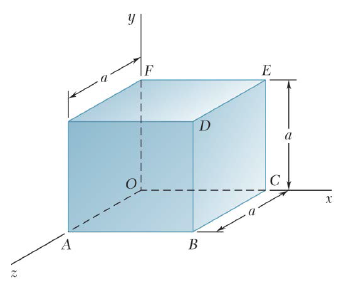
The potential function associated with a force P in space is known to beV(x,y,z) = -(x2 + y2 + z2)1/2.(a) Determine the x, y, and z components of P.(b) Calculate the work done by P from O to D by integrating along the path OABD, and show that it is equal to the negative of the change in potential
(a) Calculate the work done from D to O by the force P of Problem 13.82 by integrating along the diagonal of the cube.(b) Using the result obtained and the answer to part b of Problem 13.82, verify that the work done by a conservative force around the closed path OABDO is zero.In PROBLEM 13.82The
The force F = (xi + yj + zk)/(x2 + y2 + z2)3/2 acts on the particle P(x, y, z) which moves in space.(a) Using the relations derived in Problem 13.79, prove that F is a conservative force.(b) Determine the potential function V(x, y, z) associated with F.
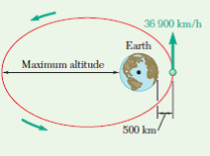
A satellite describes an elliptic orbit of minimum altitude 606 km above the surface of the earth. The semimajor and semiminor axes are 17,440 km and 13,950 km, respectively. Knowing that the speed of the satellite at Point C is 4.78 km/s,Determine(a) The speed at Point A, the perigee,(b) The speed
How much energy per pound should be imparted to a satellite in order to place it in a circular orbit at an altitude of (a) 400 mi, (b) 4000 mi?
A package is projected up a 15° incline at A with an initial velocity of 8 m/s. Knowing that the coefficient of kinetic friction between the package and the incline is 0.12, determine(a) The maximum distance d that the package will move up the incline,(b) The velocity of the package as it
Observations show that a celestial body traveling at 1.2 x 10⁶mi/h appears to be describing about Point B a circle of radius equal to 60 light years. Point B is suspected of being a very dense concentration of mass called a black hole. Determine the ratio MB/MS of the mass at B to the mass of the
Collar A has a mass of 3 kg and is attached to a spring of constant 1200 N/m and of un-deformed length equal to 0.5 m. The system is set in motion with r = 0.3m, vθ - 2m/s, and vr = 0. Neglecting the mass of the rod and the effect of friction, determine the radial and transverse components of
Collar A has a mass of 3 kg and is attached to a spring of constant 1200 N/m and of undeformed length equal to 0.5 m. The system is set in motion with r = 0.3m, vθ = 2m/s, and vr = 0. Neglecting the mass of the rod and the effect of friction,Determine(a) The maximum distance between the origin
A governor is designed so that the valve of negligible mass at D will open once a vertical force greater than 20 lbs is exerted on it. In initial testing of the device, the two 1 lb masses are at x = 1 in., and are prevented from sliding along the rod by stops. Each mass is connected to the valve
A 1.5-lb ball that can slide on a horizontal frictionless surface is attached to a fixed Point O by means of an elastic cord of constant k = 1 lb/in and un-deformed length 2 ft. The ball is placed at Point A, 3 ft from O, and given an initial velocity v0 perpendicular to OA.Determine(a) The
A 1.5-lb ball that can slide on a horizontal frictionless surface is attached to a fixed Point O by means of an elastic cord of constant k = 1 lb/in and un-deformed length 2 ft. The ball is placed at Point A, 3 ft from O, and given an initial velocity v0 perpendicular to OA, allowing the ball to
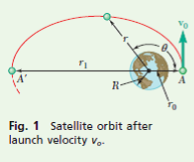
Using the principles of conservation of energy and conservation of angular momentum, solve part a of Sample Problem 12.14.Data from sample problem 12.14
Solve sample Problem 13.11, assuming that the elastic cord is replaced by a central force F of magnitude (80/r2) N directed toward O.In SAMPLE PROBLEM 13.11A sphere of mass m = 6kg is attached to an elastic cord of constant k = 100 N/m, which is un-deformed when the sphere is located at the origin
Block A is traveling with a speed v0 on a smooth surface when the surface suddenly becomes rough with a coefficient of friction of m causing the block to stop after a distance d. If block A were traveling twice as fast, that is, at a speed 2v0, how far will it travel on the rough surface before
Two small balls A and B with masses 2m and m respectively are released from rest at a height h above the ground. Neglecting air resistance, which of the following statements are true when the two balls hit the ground?(a) The kinetic energy of A is the same as the kinetic energy of B.(b) The kinetic
A 5 kg ball A strikes a 1 kg ball B that is initially at rest. Is it possible that after the impact A is not moving and B has a speed of 5v?(a) Yes(b) NoExplain your answer.
The initial velocity of the block in position A is 30 ft/s. The coefficient of kinetic friction between the block and the plane is μk = 0.30. Draw impulse-momentum diagrams that could be used to determine the time it takes for the block to reach B with zero velocity, if θ
Block A of mass mA strikes ball B of mass mB with a speed of vA as shown. Draw impulse-momentum diagrams that could be used to determine the speeds of A and B after the impact and the impulse during the impact.
A 4-lb collar which can slide on a frictionless vertical rod is acted upon by a force P which varies in magnitude as shown. Knowing that the collar is initially at rest, draw impulse-momentum diagrams that could be used to determine its velocity at t = 3 s.
The 15-kg suitcase A has been propped up against one end of a 40-kg luggage carrier B and is prevented from sliding down by other luggage. When the luggage is unloaded and the last heavy trunk is removed from the carrier, the suitcase is free to slide down, causing the 40-kg carrier to move to the
Two identical spheres A and B, each of mass m, are attached to an inextensible inelastic cord of length L and are resting at a distance a from each other on a frictionless horizontal surface. Sphere B is given a velocity v0 in a direction perpendicular to line AB and moves it without friction until
A sphere with a speed v0 rebounds after striking a frictionless inclined plane as shown. Draw impulse-momentum diagrams that could be used to find the velocity of the sphere after the impact.
Two frictionless balls strike each other as shown. The coefficient of restitution between the balls is e. Draw the impulse-momentum diagrams that could be used to find the velocities of A and B after the impact.
A 10-kg ball A moving horizontally at 12 m/s strikes a 10-kg block B. The coefficient of restitution of the impact is 0.4 and the coefficient of kinetic friction between the block and the inclined surface is 0.5. Draw impulse-momentum diagrams that could be used to determine the speeds of A and B
A 30-g bullet is fired with a horizontal velocity of 450 m/s and becomes embedded in block B which has a mass of 3 kg. After the impact, block B slides on 30-kg carrier C until it impacts the end of the carrier. Knowing the impact between B and C is perfectly plastic and the coefficient of kinetic
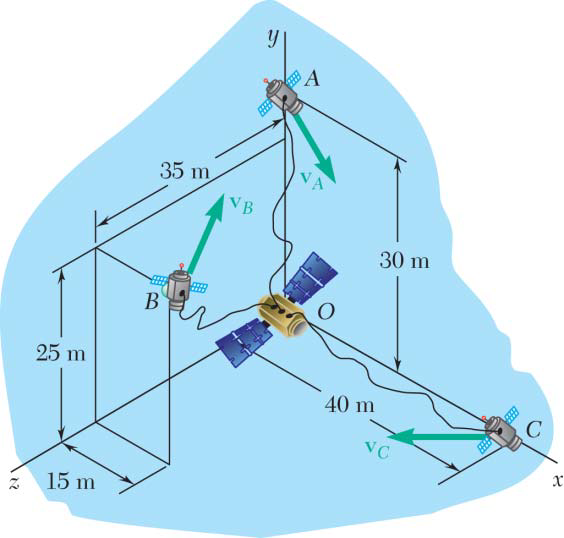
For the satellite system of Prob. 14.9, assuming that the velocity of the base satellite is zero, determine(a) The position vector r of the mass center G of the system,(b) The linear momentum mv̅ of the system,(c) The angular momentum HG of the system about G. Also, verify that the answers to this
A rocket weighs 2600 lb, including 2200 lb of fuel, which is consumed at the rate of 25 lb/s and ejected with a relative velocity of 13000 ft/s. Knowing that the rocket is fired vertically from the ground, determine (a) its acceleration as it is fired, (b) its acceleration as the last particle of
Determine the altitude reached by the spacecraft of Problem 14.95 when all the fuel of its launching rocket has been consumed.Problem 14.95A 540-kg spacecraft is mounted on top of a rocket with a mass of 19 Mg, including 17.8 Mg of fuel.Knowing that the fuel is consumed at a rate of 225 kg/s and
For the spacecraft and the two-stage launching rocket of Problem 14.96, determine the altitude at which (a) stage A of the rocket is released, (b) the fuel of both stages has been consumed.Problem 14.96The rocket used to launch the 540-kg spacecraft of Problem 14.95 is redesigned to include two
Three identical cars are being unloaded from an automobile carrier. Cars B and C have just been unloaded and are at rest with their brakes off when car A leaves the unloading ramp with a velocity of 5.76 ft/s and hits car B, which hits car C. Car A then again hits car B. Knowing that the velocity
A 30-g bullet is fired with a velocity of 480 m/s into block A, which has a mass of 5 kg. The coefficient of kinetic friction between block A and cart BC is 0.50. Knowing that the cart has a mass of 4 kg and can roll freely, determine (a) The final velocity of the cart and block, (b) The
Mass C, which has a mass of 4 kg, is suspended from a cord attached to cart A, which has a mass of 5 kg and can roll freely on a frictionless horizontal track. A 60-g bullet is fired with a speed v0 = 500 m/s and gets lodged in block C. Determine (a) The velocity of C as it reaches its maximum
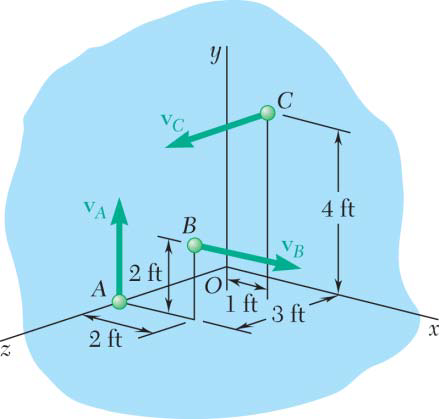
A system consists of three identical 19.32-lb particles A, B, and C. The velocities of the particles are, respectively, vA = vA j, vB = vB i, and vC = vC k. Knowing that the angular momentum of the system about O, expressed in ft ∙ lb ∙ s is HO = -1.2k, determine(a) The velocities of the
A 15-lb block B is at rest and a spring of constant k = 72 lb/in. is held compressed 3 in. by a cord. After 5-lb block A is placed against the end of the spring, the cord is cut causing A and B to move. Neglecting friction, determine the velocities of blocks A and B immediately after A leaves B.
Car A of mass 1800 kg and car B of mass 1700 kg are at rest on a 20-Mg flatcar which is also at rest. Cars A and B then accelerate and quickly reach constant speeds relative to the flatcar of 2.35 m/s and 1.175 m/s, respectively, before decelerating to a stop at the opposite end of the flatcar.
The nozzle shown discharges water at the rate of 200 gal/min. Knowing that at both B and C the stream of water moves with a velocity of magnitude 100 ft/s, and neglecting the weight of the vane, determine the force-couple system that must be applied at A to hold the vane in place (1 ft3 = 7.48 gal).
An airplane with weight W and total wing span b flies horizontally at a constant speed v. Use the airplane as a reference frame; that is, consider the airplane to be motionless and the air to flow past it with speed v. Suppose that a cylinder of air with diameter b is deflected downward by the wing
A garden sprinkler has four rotating arms, each of which consists of two horizontal straight sections of pipe forming an angle of 120° with each other. Each arm discharges water at a rate of 20 L/min with a velocity of 18 m/s relative to the arm. Knowing that the friction between the moving and
A system consists of three identical 19.32-lb particles A, B, and C. The velocities of the particles are, respectively, vA = vA j, vB = vB i, and vC = vCk, and the magnitude of the linear momentum L of the system is 9 lb∙s. Knowing that HG = HO, where HG is the angular momentum of the system
A 13-kg projectile is passing through the origin O with a velocity v0 = (35 m/s)i when it explodes into two fragments A and B, of mass 5 kg and 8 kg, respectively. Knowing that 3 s later the position of fragment A is (90 m, 7 m, -14 m), determine the position of fragment B at the same instant.
A 300-kg space vehicle traveling with a velocity v0 = (360 m/s)i passes through the origin O at t = 0. Explosive charges then separate the vehicle into three parts A, B, and C, with mass, respectively, 150 kg, 100 kg, and 50 kg. Knowing that at t = 4 s, the positions of parts A and B are observed
A 2-kg model rocket is launched vertically and reaches an altitude of 70 m with a speed of 30 m/s at the end of powered flight, time t = 0. As the rocket approaches its maximum altitude it explodes into two parts of masses mA = 0.7 kg and mB = 1.3 kg. Part A is observed to strike the ground 80 m
An 18-kg cannonball and a 12-kg cannonball are chained together and fired horizontally with a velocity of 165 m/s from the top of a 15-m wall. The chain breaks during the flight of the cannonballs and the 12-kg cannonball strikes the ground at t = 1.5 s, at a distance of 240 m from the foot of the
Car A was traveling east at high speed when it collided at Point O with car B, which was traveling north at 45 mi/h. Car C, which was traveling west at 60 mi/h, was 32 ft east and 10 ft north of Point O at the time of the collision. Because the pavement was wet, the driver of car C could not
Car A was traveling east at high speed when it collided at Point O with car B, which was traveling north at 45 mi/h. Car C, which was traveling west at 60 mi/h, was 32 ft east and 10 ft north of Point O at the time of the collision. Because the pavement was wet, the driver of car C could not
An expert archer demonstrates his ability by hitting tennis balls thrown by an assistant. A 2-oz tennis ball has a velocity of (32 ft/s)i - (7 ft/s)j and is 33 ft above the ground when it is hit by a 1.2-oz arrow traveling with a velocity of (165 ft/s)j + (230 ft/s)k where j is directed upwards.
Two spheres, each of mass m, can slide freely on a frictionless, horizontal surface. Sphere A is moving at a speed v0 = 16 ft/s when it strikes sphere B which is at rest and the impact causes sphere B to break into two pieces, each of mass m/2. Knowing that 0.7 s after the collision one piece
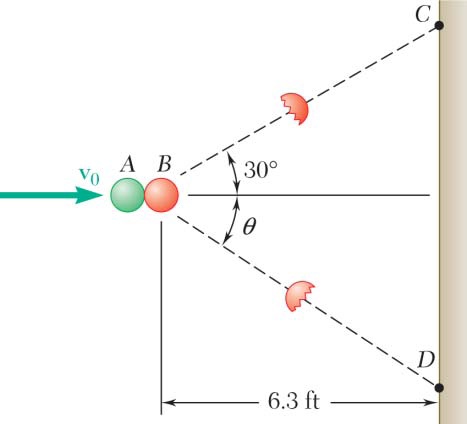
In a game of pool, ball A is moving with a velocity v0 when it strikes balls B and C which are at rest and aligned as shown. Knowing that after the collision the three balls move in the directions indicated, and that v0 = 12 ft/s and vC = 6.29 ft/s, determine the magnitude of the velocity
A 6-kg shell moving with a velocity v0 = (12 m/s) i - (9 m/s)j - (360 m/s)k explodes at Point D into three fragments A, B, and C of mass, respectively, 3 kg, 2 kg, and 1 kg. Knowing that the fragments hit the vertical wall at the points indicated, determine thespeed of each fragment immediately
A 6-kg shell moving with a velocity v0 = (12 m/s)i - (9 m/s)j - (360 m/s)k explodes at Point D into three fragments A, B, and C of mass, respectively, 2 kg, 1 kg, and 3 kg. Knowing that the fragments hit the vertical wall at the points indicated, determine the speed of each fragment immediately
Show that Eq. (14.23) may be derived directly from Eq. (14.11) by substituting for HO the expression given in Problem 14.27.
Two automobiles A and B, of mass mA and mB, respectively, are traveling in opposite directions when they collide head on. The impact is assumed perfectly plastic, and it is further assumed that the energy absorbed by each automobile is equal to its loss of kinetic energy with respect to a moving
Two automobiles A and B, of mass mA and mB, respectively, are traveling in opposite directions when they collide head on. The impact is assumed perfectly plastic, and it is further assumed that the energy absorbed by each automobile is equal to its loss of kinetic energy with respect to a moving
Two hemispheres are held together by a cord which maintains a spring under compression (the spring is not attached to the hemispheres). The potential energy of the compressed spring is 120 J and the assembly has an initial velocity v0 of magnitude v0 = 8 m/s. Knowing that the cord is severed when
A 15-lb block B starts from rest and slides on the 25-lb wedge A, which is supported by a horizontal surface. Neglecting friction, determine (a) The velocity of B relative to A after it has slid 3 ft down the inclined surface of the wedge, (b) The corresponding velocity of A.
Showing 16800 - 16900
of 21795
First
162
163
164
165
166
167
168
169
170
171
172
173
174
175
176
Last
Step by Step Answers

 Get 50% OFF
Claim Now
Get 50% OFF
Claim Now


.png)
.png)
.png)
.png)
.png)
.png)
.png)
.png)
.png)
.png)
.png)
.png)
.png)
.png)
.png)
.png)
.png)
.png)
.png)
.png)
.png)
.png)
.png)
.png)
.png)
.png)
.png)
.png)
.png)
.png)
.png)
.png)
.png)
.png)
.png)
.png)
.png)
.png)
.png)
.png)
.png)
.png)
.png)
.png)
.png)
.png)
.png)
.png)
.png)
.png)
.png)
.png)
.png)
.png)
.png)
.png)
.png)
.png)
.png)
.png)
.png)
.png)
.png)
.png)
.png)
.png)
.png)
.png)
.png)
.png)
.png)
.png)
.png)
.png)
.png)
.png)
.png)
.png)
.png)
.png)
.png)
.png)
.png)
.png)


