New Semester
Started
Get
50% OFF
Study Help!
--h --m --s
Claim Now
Question Answers
Textbooks
Find textbooks, questions and answers
Oops, something went wrong!
Change your search query and then try again
S
Books
FREE
Study Help
Expert Questions
Accounting
General Management
Mathematics
Finance
Organizational Behaviour
Law
Physics
Operating System
Management Leadership
Sociology
Programming
Marketing
Database
Computer Network
Economics
Textbooks Solutions
Accounting
Managerial Accounting
Management Leadership
Cost Accounting
Statistics
Business Law
Corporate Finance
Finance
Economics
Auditing
Tutors
Online Tutors
Find a Tutor
Hire a Tutor
Become a Tutor
AI Tutor
AI Study Planner
NEW
Sell Books
Search
Search
Sign In
Register
study help
physics
mechanics
Vector Mechanics for Engineers Statics and Dynamics 11th edition Ferdinand Beer, E. Russell Johnston Jr., David Mazurek, Phillip Cornwell, Brian Self - Solutions
A bullet is fired with a horizontal velocity of 1500 ft/s through a 6-lb block A and becomes embedded in a 4.95-lb block B. Knowing that blocks A and B start moving with velocities of5 ft/s and 9 ft/s, respectively, determine(a) The weight of the bullet,(b) Its velocity as it travels from block A
A 40-lb block B is suspended from a 6-ft cord attached to a 60-lb cart A, which may roll freely on a frictionless, horizontal track. If the system is released from rest in the position shown, determine the velocities of A and B as B passes directly under A.
The 2-kg sub-satellite B has an initial velocity vB = 3 m/s j. It is connected to the 20-kg base-satellite A by a 500-m space tether. Determine the velocity of the base satellite and sub-satellite immediately after the tether becomes taut (assuming no rebound).
A 900-lb space vehicle traveling with a velocity v0 = (1500 ft/s)k passes through the origin O. Explosive charges then separate the vehicle into three parts A, B, and C, with masses of 150 lb, 300 lb, and 450 lb, respectively. Knowing that shortly thereafter the positions of the three parts are,
Four small disks A, B, C, and D can slide freely on a frictionless horizontal surface. Disks B, C, and D are connected by light rods and are at rest in the position shown when disk B is struck squarely by disk A, which is moving to the right with a velocity v0 = (38.5 ft/s)i. The weights of the
Two swimmers A and B, of weight 190 lb and 125 lb, respectively, are at diagonally opposite corners of a floating raft when they realize that the raft has broken away from its anchor.Swimmer A immediately starts walking toward B at a speed of 2 ft/s relative to the raft. Knowing that the raft
Two small disks A and B, of mass 3 kg and 1.5 kg, respectively, may slide on a horizontal, frictionless surface. They are connected by a cord, 600 mm, long, and spin counterclockwise about their mass center G at the rate of 10 rad/s. At t = 0, the coordinates of G are xÌ…0 = 0, yÌ…0 = 2 m,
Two small disks A and B, of mass 2 kg and 1 kg, respectively, may slide on a horizontal and frictionless surface. They are connected by a cord of negligible mass and spin about their mass center G. At t = 0, G is moving with the velocity vÌ…0 and its coordinates are xÌ…0 = 0, yÌ…0 =1.89 m.
Three small identical spheres A, B, and C, which can slide on a horizontal, frictionless surface, are attached to three 9-in-long strings, which are tied to a ring G. Initially, the spheres rotate clockwise about the ring with a relative velocity of 2.6 ft/s and the ring moves along the x-axis with
Three small identical spheres A, B, and C, which can slide on a horizontal, frictionless surface, are attached to three strings of length l which are tied to a ring G. Initially, the spheres rotate clockwise about the ring which moves along the x axis with a velocity v0. Suddenly the ring breaks
A stream of water with density Ï = 1000 kg/m3 is discharged from a nozzle at the rate of 0.06 m3/s. Using Bernoulli's equation the gage pressure P in the pipe just upstream from the nozzle isKnowing the nozzle is held to the pipe by six flange bolts, determine the tension in each bolt,
A jet ski is placed in a channel and is tethered so that it is stationary. Water enters the jet ski with velocity v1 and exits with velocity v2. Knowing the inlet area is A1 and the exit area is A2, determine the tension in the tether.
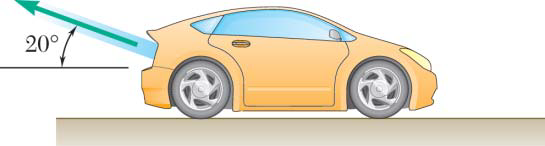
A rotary power plow is used to remove snow from a level section of railroad track. The plow car is placed ahead of an engine that propels it at a constant speed of 20 km/h. The plow car clears 160 Mg of snow per minute, projecting it in the direction shown with a velocity of 12 m/s relative to the
Tree limbs and branches are being fed at A at the rate of 5 kg/s into a shredder which spews the resulting wood chips at C with a velocity of 20 m/s. Determine the horizontal component of the force exerted by the shredder on the truck hitch at D.
Sand falls from three hoppers onto a conveyor belt at a rate of 90 lb/s for each hopper. The sand hits the belt with a vertical velocity v1 = 10 ft/s and is discharged at A with a horizontal velocity v2 = 13 ft/s. Knowing that the combined mass of the beam, belt system, and the sand it supports is
The stream of water shown flows at a rate of 550 liters/min and moves with a velocity of magnitude 18 m/s at both A and B. The vane is supported by a pin and bracket at C and by a load cell at D that can exert only a horizontal force. Neglecting the weight of the vane, determine the components of
A stream of water flowing at a rate of 1.2 m3/min and moving with a velocity of magnitude 30 m/s at both A and B is deflected by a vane welded to a hinged plate. Knowing that the combined mass of the vane and plate is 20 kg with the mass center at point G, determine (a) the angle θ, (b) the
A stream of water flowing at a rate of 1.2 m3/min and moving with a velocity of magnitude v at both A and B is deflected by a vane welded to a hinged plate. The combined mass of the vane and plate is 20 kg with the mass center at point G. Knowing that θ = 45°, determine (a) the speed v of the
Coal is being discharged from a first conveyor belt at the rate of 120 kg/s. It is received at A by a second belt that discharges it again at B. Knowing that v1 = 3 m/s and v2 = 4.25 m/s and that the second belt assembly and the coal it supports have a total mass of 472 kg, determine the components
A 40-Mg boxcar A is moving in a railroad switchyard with a velocity of 9 km/h toward cars B and C, which are both at rest with their brakes off at a short distance from each other. Car B is a 25-Mg flatcar supporting a 30-Mg container, and car C is a 35-Mg boxcar. As the cars hit each other they
While cruising in level flight at a speed of 600 mi/h, a jet plane scoops in air at the rate of 200 lb/s and discharges it with a velocity of 2100 ft/s relative to the airplane. Determine the total drag due to air friction on the airplane
The helicopter shown can produce a maximum downward air speed of 80 ft/s in a 30-ft-diameter slipstream. Knowing that the weight of the helicopter and its crew is 3500 lb and assuming γ = 0.076 lb/ft3 for air, determine the maximum load that the helicopter can lift while hovering in midair.
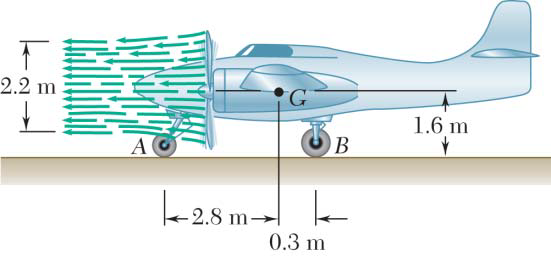
Prior to take-off the pilot of a 3000-kg twin-engine airplane tests the reversible-pitch propellers by increasing the reverse thrust with the brakes at point B locked. Knowing that point G is the center of gravity of the airplane, determine the velocity of the air in the two 2.2-meter-diameter
The jet engine shown scoops in air at A at a rate of 200 lb/s and discharges it at B with a velocity of 2000 ft/s relative to the airplane. Determine the magnitude and line of action of the propulsive thrust developed by the engine when the speed of the airplane is (a) 300 mi/h, (b) 600 mi/h.
A 16-Mg jet airplane maintains a constant speed of 774 km/h while climbing at an angle α =18°. The airplane scoops in air at a rate of 300 kg/s and discharges it with a velocity of 665 m/s relative to the airplane. If the pilot changes to a horizontal flight while maintaining the same engine
The propeller of a small airplane has a 2-m-diameter slipstream and produces a thrust of 3600 N when the airplane is at rest on the ground. Assuming ρ =1.225 kg/m3 for air, determine (a) the speed of the air in the slipstream, (b) the volume of air passing through the propeller per second, (c) the
The wind turbine-generator shown has an output-power rating of 1.5 MW for a wind speed of 36 km/h. For the given wind speed, determine (a) the kinetic energy of the air particles entering the 82.5-m-diameter circle per second, (b) the efficiency of this energy conversion system. Assume Ï = 1.21
A wind turbine-generator system having a diameter of 82.5 m produces 1.5 MW at a wind speed of 12 m/s. Determine the diameter of blade necessary to produce 10 MW of power assuming the efficiency is the same for both designs and p = 1.21 kg/m3 for air
Two identical cars A and B are at rest on a loading dock with brakes released. Car C, of a slightly different style but of the same weight, has been pushed by dockworkers and hits car B with a velocity of 1.5 m/s. Knowing that the coefficient of restitution is 0.8 between B and C and 0.5 between A
A toy car is propelled by water that squirts from an internal tank at a constant 6 ft/s relative to the car. The weight of the empty car is 0.4 lb and it holds 2 lb of water. Neglecting other tangential forces, determine the top speed of the car.
A 20-kg base satellite deploys three sub-satellites, each which has its own thrust capabilities, to perform research on tether propulsion. The weights of sub-satellite A, B, and C are 4 kg, 6 kg, and 8 kg, respectively, and their velocities expressed in m/s are given by vA = 4i - 2j + 2k, vB = i +
A toy car is propelled by water that squirts from an internal tank. The weight of the empty car is 0.4 lb and it holds 2 lb of water. Knowing the top speed of the car is 8 ft/s, determine the relative velocity of the water that is being ejected.
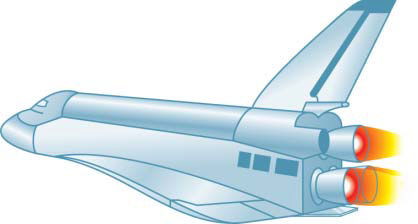
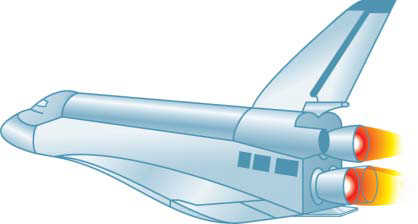
The main propulsion system of a space shuttle consists of three identical rocket engines which provide a total thrust of 6 MN. Determine the rate at that the hydrogen-oxygen propellant is burned by each of the three engines, knowing that it is ejected with a relative velocity of 3750 m/s.
The main propulsion system of a space shuttle consists of three identical rocket engines, each of which burns the hydrogen-oxygen propellant at the rate of 750 lb/s and ejects it with a relative velocity of 12000 ft/s. Determine the total thrust provided by the three engines.
A rocket sled burns fuel at the constant rate of 120 lb/s. The initial weight of the sled is 1800 lb, including 360 lb of fuel. Assume that the track is lubricated and the sled is aerodynamically designed so that air resistance and friction are negligible. (a) Derive a formula for the acceleration
A space vehicle describing a circular orbit at a speed of 24×103 km/h releases its front end, a capsule that has a gross mass of 600 kg, including 400 kg of fuel. If the fuel is consumed at the rate of 18 kg/s and ejected with a relative velocity of 3000 m/s, determine (a) the
A 540-kg spacecraft is mounted on top of a rocket with a mass of 19 Mg, including 17.8 Mg of fuel. Knowing that the fuel is consumed at a rate of 225 kg/s and ejected with a relative velocity of 3600 m/s, determine the maximum speed imparted to the spacecraft if the rocket is fired vertically from
The rocket used to launch the 540-kg spacecraft of Problem 14.95 is redesigned to include two stages A and B, each of mass 9.5 Mg, including 8.9 Mg of fuel. The fuel is again consumed at a rate of 225 kg/s and ejected with a relative velocity of 3600 m/s. Knowing that when stage A expels its last
The brake drum is attached to a larger flywheel that is not shown. The motion of the brake drum is defined by the relation θ = 36t - 1.6t2, where θ is expressed in radians and t in seconds. Determine (a) the angular velocity at t = 2 s, (b) the number of revolutions
A 5-m steel beam is lowered by means of two cables unwinding at the same speed from overhead cranes. As the beam approaches the ground, the crane operators apply brakes to slow the unwinding motion. At the instant considered the deceleration of the cable attached at B is 2.5m/s2, while that of the
For a 5-m steel beam AE the acceleration of point A is 2 m/s2 downward and the angular acceleration of the beam is 1.2rad/s2 counterclockwise. Knowing that at the instant considered the angular velocity of the beam is zero, determine the acceleration (a) of cable B, (b) of cable D.
A 900-mm rod rests on a horizontal table. A force P applied as shown produces the following accelerations: aA = 3.6 m/s2 to the right, a = 6rad/s2 counterclockwise as viewed from above. Determine the acceleration (a) of Point G, (b) of Point B.
In Problem 15.107, determine the point of the rod that (a) has no acceleration, (b) has an acceleration of 2.4 m/s to the right.Data from problem 107A 900-mm rod rests on a horizontal table. A force P applied as shown produces the following accelerations: aA = 3.6 m/s2 to the right, α = 6 rad/s2
End A of rod AB moves to the right with a constant velocity of 6 ft/s. For the position shown, determine (a) the angular acceleration of rod AB, (b) the acceleration of the midpoint G of rod AB.
An automobile travels to the left at a constant speed of 72 km/h. Knowing that the diameter of the wheel is 560 mm, determine the acceleration (a) of Point B, (b) of Point C, (c) of Point D.
The 18-in.-radius flywheel is rigidly attached to a 1.5-in.-radius shaft that can roll along parallel rails. Knowing that at the instant shown the center of the shaft has a velocity of 1.2 in./s and an acceleration of 0.5in./s2, both directed down to the left, determine the acceleration (a) of
A 3-in.-radius drum is rigidly attached to a 5-in.-radius drum as shown. One of the drums rolls without sliding on the surface shown, and a cord is wound around the other drum. Knowing that at the instant shown end D of the cord has a velocity of 8 in./s and an acceleration of 30 in./s2, both
A 3-in.-radius drum is rigidly attached to a 5-in.-radius drum as shown. One of the drums rolls without sliding on the surface shown, and a cord is wound around the other drum. Knowing that at the instant shown end D of the cord has a velocity of 8 in./s and an acceleration of 30 in./s2, both
The 100 mm radius drum rolls without slipping on a portion of a belt that moves downward to the left with a constant velocity of 120 mm/s. Knowing that at a given instant the velocity and acceleration of the center A of the drum are as shown, determine the acceleration of Point D.
The 200-mm-radius disk rolls without sliding on the surface shown. Knowing that the distance BG is 160 mm and that at the instant shown the disk has an angular velocity of 8 rad/s counterclockwise and an angular acceleration of 2 rad/s2 clockwise, determine the acceleration of A.
A straight rack rests on a gear of radius r = 3 in. and is attached to a block B as shown. Knowing that at the instant shown θ = 20°, the angular velocity of gear D is 3 rad/s clockwise, and it is speeding up at a rate of 2 rad/s2, determine (a) the angular acceleration of AB, (b) the
The elliptical exercise machine has fixed axes of rotation at points A and E. Knowing that at the instant shown the flywheel AB has a constant angular velocity of 6 rad/s clockwise, determine the acceleration of point D.
The elliptical exercise machine has fixed axes of rotation at points A and E. Knowing that at the instant shown the flywheel AB has a constant angular velocity of 6 rad/s clockwise, determine (a) the angular acceleration of bar DEF, (b) the acceleration of point F.
Robert's linkage is named after Richard Robert (1789-1864) and can be used to draw a close approximation to a straight line by locating a pen at Point F. The distance AB is the same as BF, DF and DE. Knowing that at the instant shown bar AB has a constant angular velocity of 4 rad/s clockwise,
For the oil pump rig shown, link AB causes the beam BCE to oscillate as the crank OA revolves. Knowing that OA has a radius of 0.6 m and a constant clockwise angular velocity of 20 rpm, determine the velocity and acceleration of Point D at the instant shown.
The drive disk of the scotch crosshead mechanism shown has an angular velocity ω and an angular acceleration α, both directed counterclockwise. Using the method of Section 15.4 B, derive expressions for the velocity and acceleration of Point B.
The wheels attached to the ends of rod AB roll along the surfaces shown. Using the method of Section 15.4 B, derive an expression for the angular velocity of the rod in terms of vB , θ, l , and β.
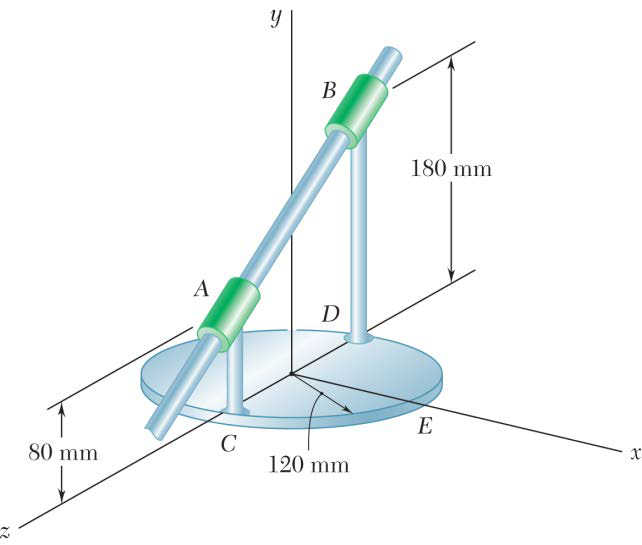
A circular plate of 120 mm radius is supported by two bearings A and B as shown. The plate rotates about the rod joining A and B with a constant angular velocity of 26 rad/s. Knowing that, at the instant considered, the velocity of Point C is directed to the right, determine the velocity and
The wheels attached to the ends of rod AB roll along the surfaces shown. Using the method of Section 15.4 B and knowing that the acceleration of wheel B is zero, derive an expression for the angular acceleration of the rod in terms of vB, θ, l , and β.
In Problem 15.14, determine the velocity and acceleration of Point E, assuming that the angular velocity is 26 rad/s and increases at the rate of 65 rad/s2.Data from 15.14A circular plate of 120 mm radius is supported by two bearings A and B as shown. The plate rotates about the rod joining A and B
At the instant shown the length of the boom AB is being decreased at the constant rate of 0.2 m/sand the boom is being lowered at the constant rate of 0.08 rad/s. Determine(a) The velocity of Point B, (b) The acceleration of Point B.
At the instant shown the length of the boom AB is being increased at the constant rate of 0.2 m/s and the boom is being lowered at the constant rate of 0.08 rad/s. Determine (a) The velocity of Point B, (b) The acceleration of Point B.
A chain is looped around two gears of radius 40 mm that can rotate freely with respect to the 320-mm arm AB. The chain moves about arm AB in a clockwise direction at the constant rate of 80 mm/s relative to the arm. Knowing that in the position shown arm AB rotates clockwise about A at the constant
A chain is looped around two gears of radius 40 mm that can rotate freely with respect to the 320-mm arm AB. The chain moves about arm AB in a clockwise direction at the constant rate 80 mm/s relative to the arm. Knowing that in the position shown arm AB rotates clockwise about A at the constant
A basketball player shoots a free throw in such a way that his shoulder can be considered a pin joint at the moment of release as shown. Knowing that at the instant shown the upper arm SE has a constant angular velocity of 2 rad/s counterclockwise and the forearm EW has a constant clockwise angular
The human leg can be crudely approximated as two rigid bars (the femur and the tibia) connected with a pin joint. At the instant shown the veolcity and acceleration of the ankle is zero. During a jump, the velocity of the ankle A is zero, the tibia AK has an angular velocity of 1.5 rad/s
At the instant shown, bar BC has an angular velocity of 3 rad/s and an angular acceleration of 2 rad/s2, both counterclockwise. Determine the angular acceleration of the plate.
At the instant shown bar BC has an angular velocity of 3 rad/s and an angular acceleration of 2 rad/s, both clockwise. Determine the angular acceleration of the plate.
Rod AB passes through a collar that is welded to link DE. Knowing that at the instant shown block A moves to the right at a constant speed of 75 in./s, determine (a) the angular velocity of rod AB, (b) the velocity relative to the collar of the point of the rod in contact with the collar, (c) the
Plate ABD and rod OB are rigidly connected and rotate about the ball-and-socket joint O with an angular velocity ω = ωxi + ωxj + ωzk. Knowing that vA = (80 mm/s)i + (360 mm/s)j + (vA)z k and ωx = 1.5 rad/s, determine (a) the angular velocity of the assembly, (b) the velocity of
At the instant considered the radar antenna shown rotates about the origin of coordinates with an angular velocity ω = ωxi + ωyj + ω2k . Knowing that (vA)y = 15 in./s, (vB)y = 9 in./s, and (vB)z = 18 in./s, determine (a) the angular velocity of the antenna, (b) the velocity of point
The rotor of an electric motor rotates at the constant rate ω1 = 1800 rpm Determine the angular acceleration of the rotor as the motor is rotated about the y axis with a constant angular velocity ω2 of 6 rpm counterclockwise when viewed from the positive y axis.
The disk of a portable sander rotates at the constant rate ω1 = 4400 rpm as shown. Determine the angular acceleration of the disk as a worker rotates the sander about the z axis with an angular velocity of 0.5 rad/s and an angular acceleration of 2.5 rad/s2, both clockwise when viewed from the
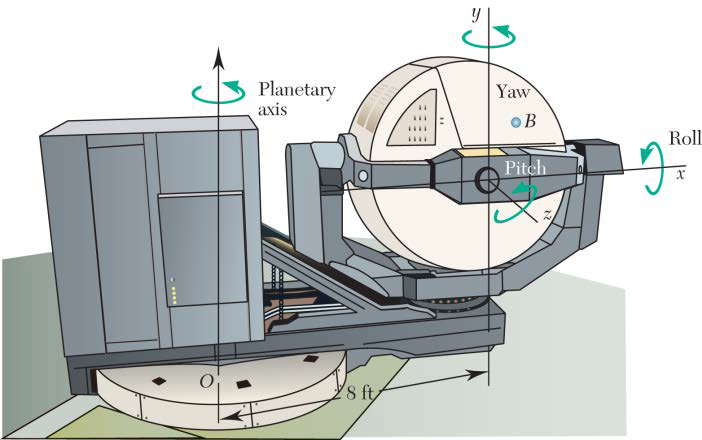
A flight simulator is used to train pilots on how to recognize spatial disorientation. It has four degrees of freedom, and can rotate around a planetary axis as well as in yaw, pitch, and roll. Knowing that the simulator is rotating around the planetary axis with a constant angular velocity of 20
In the system shown, disk A is free to rotate about the horizontal rod OA. Assuming that disk B is stationary (ω2 = 0), and that shaft OC rotates with a constant angular velocity ω1, determine (a) The angular velocity of disk A, (b) The angular acceleration of disk A.
In the system shown, disk A is free to rotate about the horizontal rod OA. Assuming that shaft OC and disk B rotate with constant angular velocities ω1 and ω2, respectively, both counter clock wise, determine (a) The angular velocity of disk A, (b) The angular acceleration of disk
A gun barrel of length OP = 4m is mounted on a turret as shown. To keep the gun aimed at a moving target, the azimuth angle β is being increased at the rate dβ/dt = 30°/s and the elevation angle γ is being increased at the rate dγ/dt = 10°/s. For the position β = 90° and
At the instant shown, the robotic arm ABC is being rotated simultaneously at the constant rate ω1 = 0.15rad/s about the y axis, and at the constant rate ω2 = 0.25 rad/s about the z axis. Knowing that the length of arm ABC is 1 m, determine (a) The angular acceleration of the
The belt sander shown is initially at rest. If the driving drum B has a constant angular acceleration of 120 rad/s2 counter-clockwise, determine the magnitude of the acceleration of the belt at Point C when (a) t = 0.5 s, (b) t = 2 s.
Several rods are brazed together to form the robotic guide arm shown which is attached to a ball-and-socket joint at O. Rod OA slides in a straight inclined slot while rod OB slides in a slot parallel to the z axis. Knowing that at the instant shown vB = (9 in./s),B=vk determine (a) The
Rod AB of length 25 in. is connected by ball-and-socket joints to collars A and B, which slide along the two rods shown. Knowing that collar B moves toward Point E at a constant speed of 20 in./s, determine the velocity of collar A as collar B passes through Point D.
Rod AB of length 13 in. is connected by ball-and-socket joints to collars A and B, which slide along the two rods shown. Knowing that collar B moves toward point D at a constant speed of 36 in./s, determine the velocity of collar A when b = 4 in.
Rods BC and BD are each 840 mm long and are connected by ball-and-socket joints to collars that may slide on the fixed rods shown. Knowing that collar B moves toward A at a constant speed of 390 mm/s, determine the velocity of collar C for the position shown.
Rod AB of length 29 in. is connected by ball-and-socket joints to the rotating crank BC and to the collar A. Crank BC is of length 8 in. and rotates in the horizontal xz plane at the constant rate ω0 = 10 rad/s. At the instant shown, when crank BC is parallel to the z axis, determine the
Rod AB of length 300 mm is connected by ball-and-socket joints to collars A and B, which slide along the two rods shown. Knowing that collar B moves toward Point D at a constant speed of 50 mm/s, determine the velocity of collar A when c = 80mm.
Rod AB of length 300 mm is connected by ball-and-socket joints to collars A and B, which slide along the two rods shown. Knowing that collar B moves toward Point D at a constant speed of 50 mm/s, determine the velocity of collar A when c = 120mm.
Rod AB has a length of 275 mm and is connected by a ball-and-socket joint to collar A and by a clevis connection to collar B. Knowing that collar B moves down at a constant speed of 1.35 m/s, determine at the instant shown (a) the angular velocity of the rod, (b) the velocity of collar A.
The two pulleys shown may be operated with the V belt in any of three positions. If the angular acceleration of shaft A is 6 rad/s2 and if the system is initially at rest, determine the time required for shaft B to reach a speed of 400 rpm with the belt in each of the three positions.
A flight simulator is used to train pilots on how to recognize spatial disorientation. It has four degrees of freedom, and can rotate around a planetary axis as well as in yaw, pitch, and roll. The pilot is seated so that her head B is located at r = 2i + 1j ft with respect to the center of the cab
A flight simulator is used to train pilots on how to recognize spatial disorientation. It has four degrees of freedom, and can rotate around a planetary axis as well as in yaw, pitch, and roll. The pilot is seated so that her head B is located at r = 2i + 1j ft with respect to the center of the cab
Rod AB is welded to the 0.3-m-radius plate, which rotates at the constant rate ω1 = 6 rad/s. Knowing that collar D moves toward end B of the rod at a constant speed u = 1.3 m, determine, for the position shown, (a) the velocity of D, (b) the acceleration of D.
Manufactured items are spray-painted as they pass through the automated work station shown. Knowing that the bent pipe ACE rotates at the constant rate ω1 = 0.4 rad/s and that at Point D the paint moves through the pipe at a constant relative speed u = 150mm/s, determine, for the position
Solve Prob. 15.225, assuming that at the instant shown the angular velocity ω1 of the rod is 5 rad/s and is increasing at the rate of 10 2rad/s, while the relative speed u of the collar C is 39 in./s and is decreasing at the rate of 260 in./s2.
The 400-mm bar AB is made to rotate at the constant rate ω2 = dθ / dt = 8 rad/s with respect to the frame CD which itself rotates at the constant rate ω1 = 12 rad/s about the Y axis. Knowing that θ = 60° at the instant shown, determine the velocity and acceleration of point A.
The 400-mm bar AB is made to rotate at the rate ω2 = dθ / dt with respect to the frame CD which itself rotates at the rate ω1 about the Y axis. At the instant shown ω1 = 12 rad/s, dω1 / dt = -16 rad/s2, ω2 = 8 rad/s, dω2/dt = 10 rad/s2, and θ = 60°. Determine the
The remote manipulator system (RMS) shown is used to deploy payloads from the cargo bay of space shuttles. At the instant shown, the whole RMS is rotating at the constant rate ω1 = 0.03 rad/s about the axis AB. At the same time, portion BCD rotates as a rigid body at the constant rate ω2 =
A disk of radius 120 mm rotates at the constant rate ω2 = 5rad/s with respect to the arm AB, which itself rotates at the constant rate ω1 = 3rad/s. For the position shown, determine the velocity and acceleration of Point C.
The crane shown rotates at the constant rate ω1 = 0.25 rad/s; simultaneously, the telescoping boom is being lowered at the constant rate ω2 = 0.40 rad/s. Knowing that at the instant shown the length of the boom is 20 ft and is increasing at the constant rate u = 1.5ft/s, determine the
A disk of 180-mm radius rotates at the constant rate ω2 = 12= rad/s with respect to arm CD, which itself rotates at the constant rate ω1= 8 rad/s about the Y axis. Determine at the instant shown the velocity and acceleration of Point A on the rim of the disk.
A disk of 180-mm radius rotates at the constant rate ω2 = 12 rad/s with respect to arm CD, which itself rotates at the constant rate ω1 = 8 rad/s about the Y axis. Determine at the instant shown the velocity and acceleration of Point B on the rim of the disk.
Showing 16900 - 17000
of 21795
First
163
164
165
166
167
168
169
170
171
172
173
174
175
176
177
Last
Step by Step Answers

 Get 50% OFF
Claim Now
Get 50% OFF
Claim Now


.png)
.png)
.png)
.png)
.png)
.png)
.png)
.png)
.png)
-1.png)
-2.png)
.png)
.png)
.png)
.png)
.png)
.png)
.png)
.png)
.png)
.png)
.png)
.png)
.png)
.png)
.png)
.png)
.png)
.png)
.png)
.png)
.png)
.png)
.png)
.png)
.png)
.png)
.png)
.png)
.png)
.png)
.png)
.png)
.png)
.png)
.png)
.png)
.png)
.png)
.png)
.png)
.png)
.png)
.png)
.png)
.png)
.png)
.png)
.png)
.png)
.png)
.png)
.png)
.png)
.png)
.png)
.png)
.png)
.png)
.png)
.png)
.png)
.png)
.png)
.png)
.png)
.png)
.png)
.png)
.png)
.png)
.png)
.png)
.png)
.png)
.png)
.png)
.png)
.png)
.png)
.png)


